Virginia Easement Agreement for Storm Water Drainage and Retention Pond
What this document covers
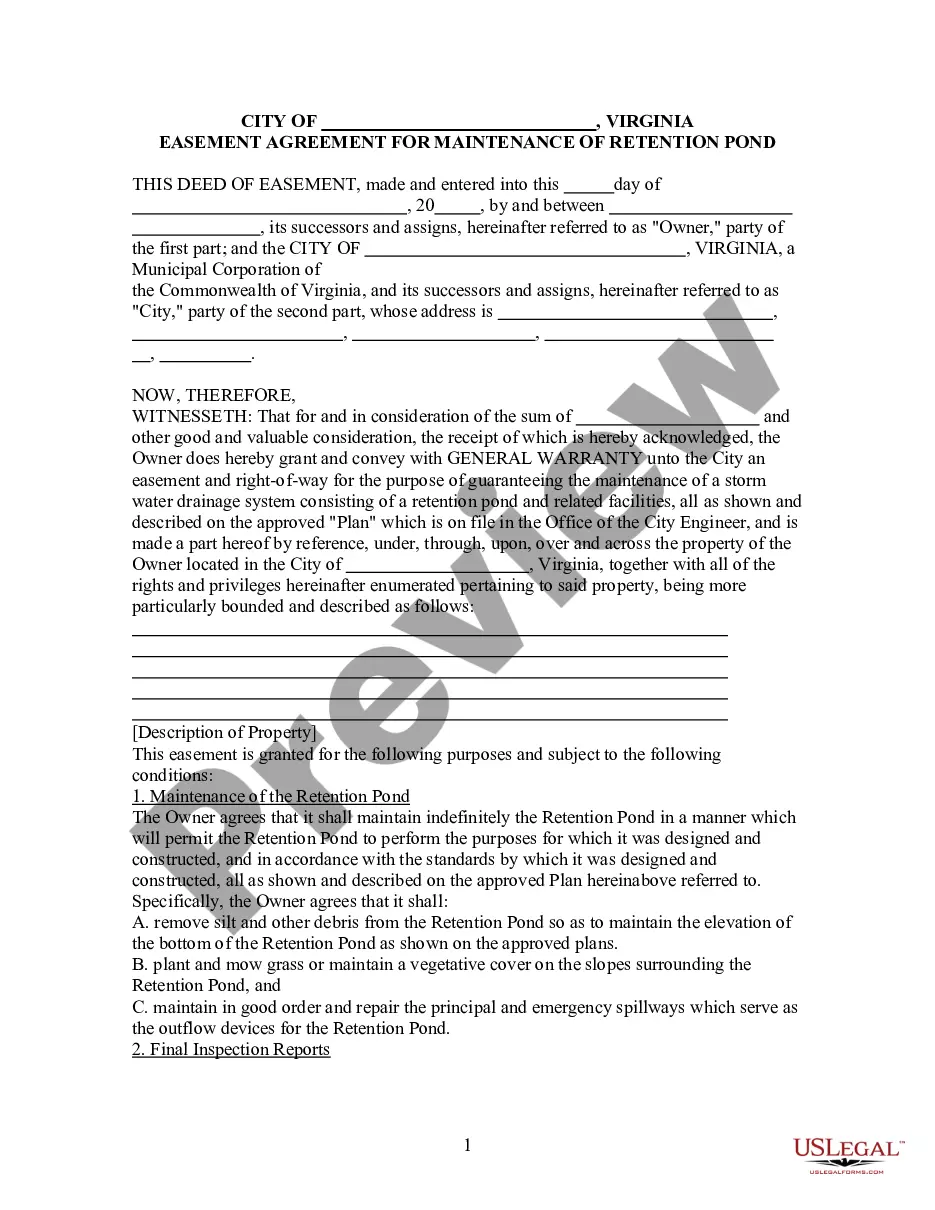
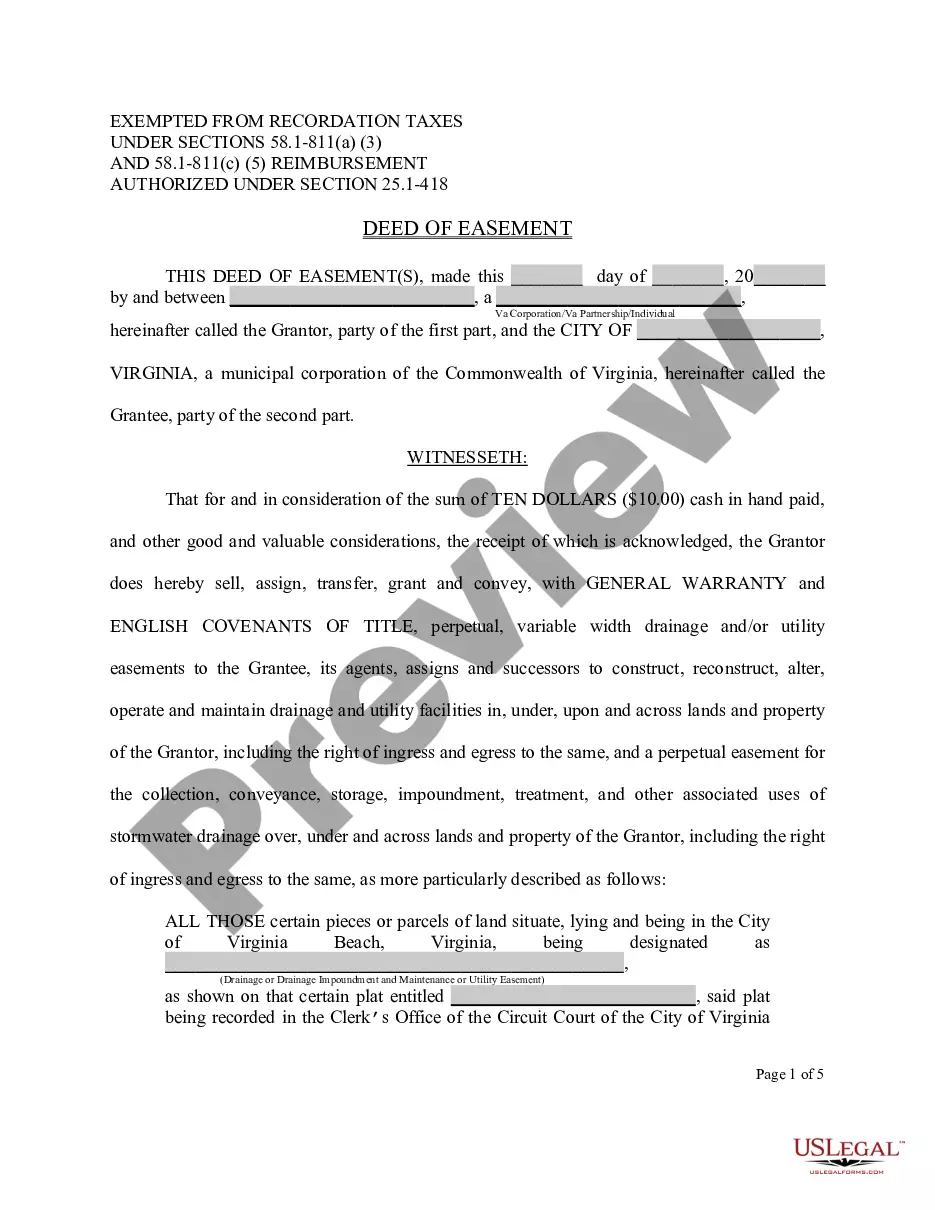
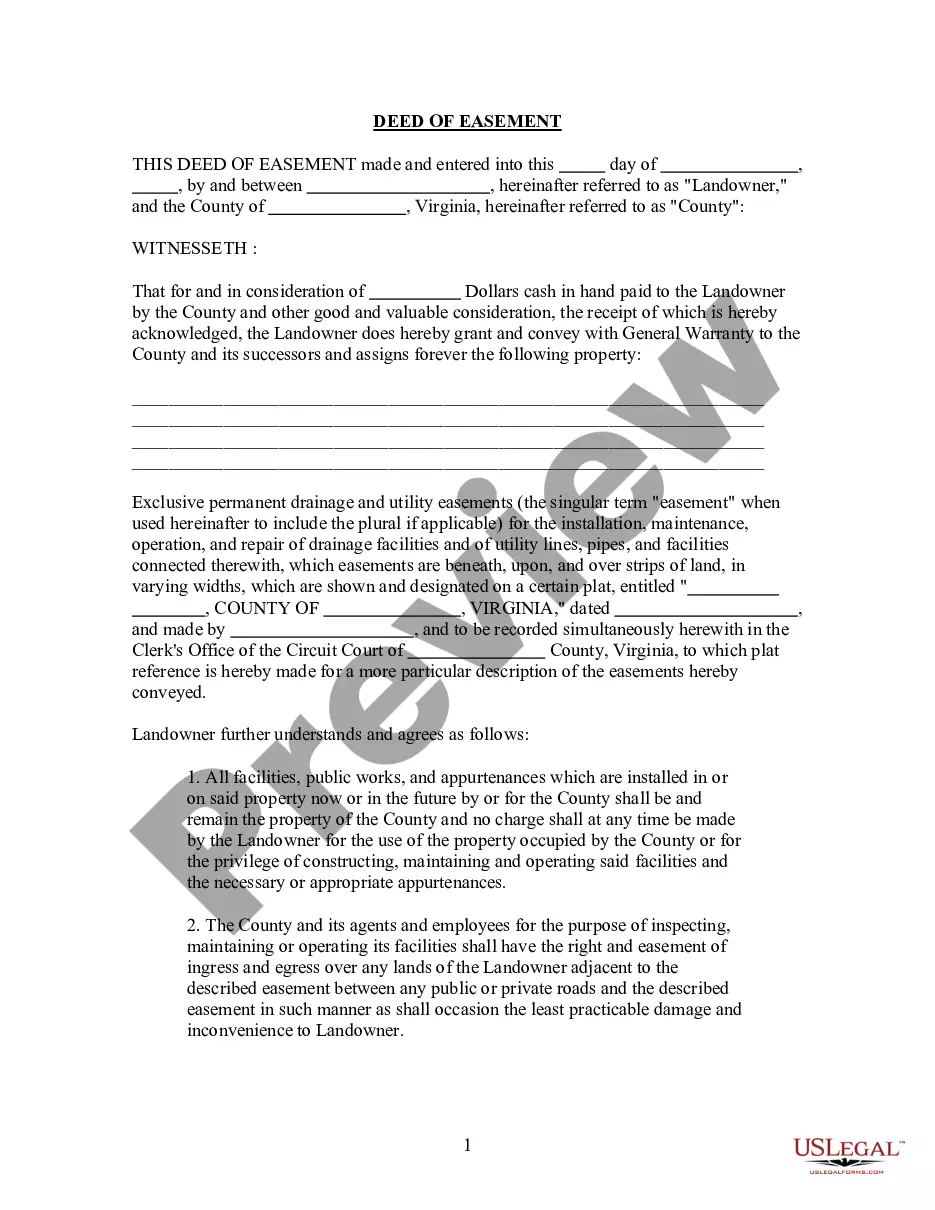
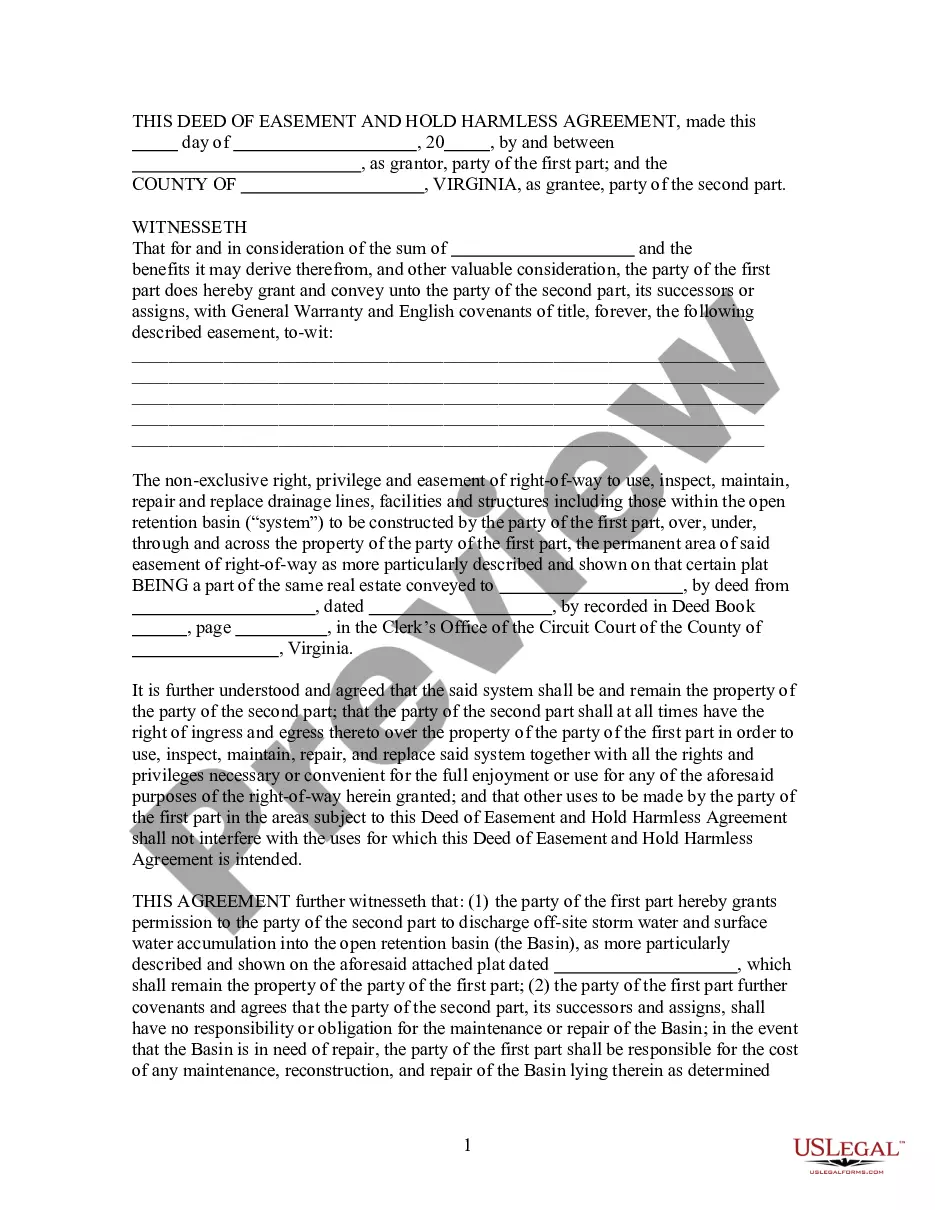
The Easement Agreement for Storm Water Drainage and Retention Pond is a legal document that creates a right for one party to maintain storm water drainage systems, including retention ponds, on another's property. The form outlines the responsibilities for maintenance and inspections, ensuring the effective operation of the drainage system. This agreement differs from other easement forms by specifically addressing the maintenance of storm water facilities, making it crucial for property owners involved in storm water management.
Key components of this form
- Maintenance requirements for the retention pond, including debris removal and vegetation management.
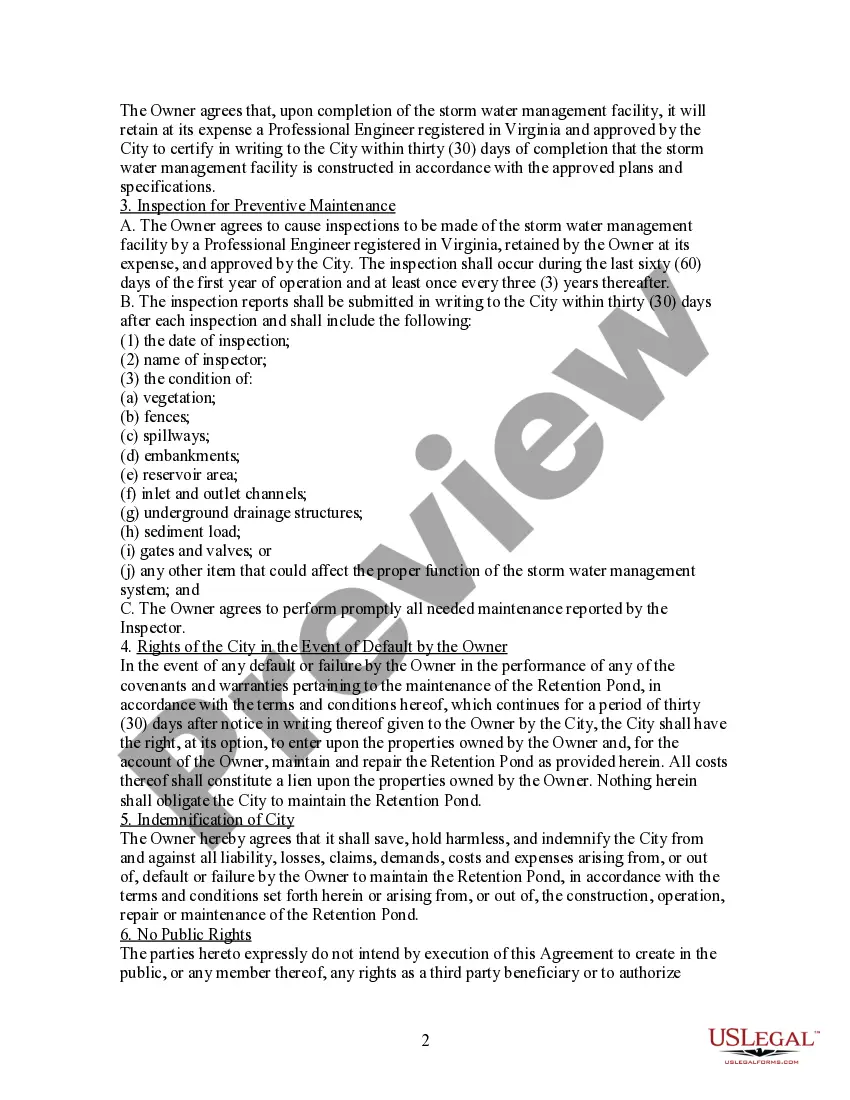
- Protocols for final inspection reports conducted by a licensed Professional Engineer.
- Inspection schedule for preventive maintenance, requiring regular evaluations by an approved engineer.
- Rights of the city to intervene in maintenance if the owner fails to comply.
- Indemnification clause protecting the city from liabilities related to the retention pond.
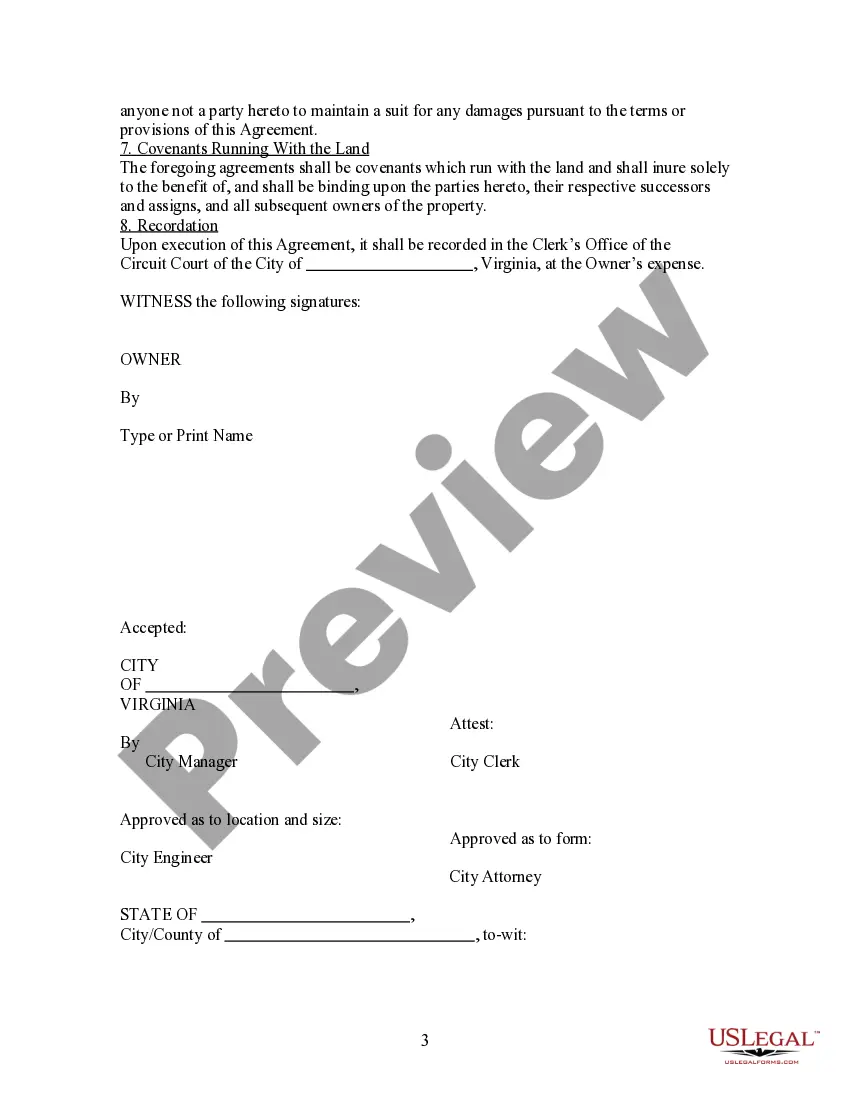
- Provisions on the applicability of agreements to successors and assigns.
When this form is needed
You should use the Easement Agreement for Storm Water Drainage and Retention Pond when establishing the responsibilities for maintaining a storm water management system on your property. This form is essential if you have constructed or plan to construct a retention pond as part of your propertyâs drainage system, ensuring compliance with local regulations and protecting against potential drainage issues.
Who needs this form
- Property owners who have a retention pond on their land.
- Developers of properties involving storm water management systems.
- Municipalities overseeing land use and drainage management in their jurisdiction.
- Homeowners' associations managing common areas with drainage facilities.
Steps to complete this form
- Identify the parties involved: the property owner and the relevant municipal authority.
- Specify the property location where the retention pond is situated.
- Detail the maintenance responsibilities, including cleaning and vegetation management.
- Include inspection protocols and timelines for regular evaluations by a qualified engineer.
- Ensure that all parties sign and date the form, acknowledging their rights and responsibilities.
Notarization requirements for this form
This form does not typically require notarization unless specified by local law. However, it is advisable to check with local authorities to confirm any specific requirements that may apply in your region.
Get your form ready online
Our built-in tools help you complete, sign, share, and store your documents in one place.
Make edits, fill in missing information, and update formatting in US Legal Forms—just like you would in MS Word.
Download a copy, print it, send it by email, or mail it via USPS—whatever works best for your next step.
Sign and collect signatures with our SignNow integration. Send to multiple recipients, set reminders, and more. Go Premium to unlock E-Sign.
If this form requires notarization, complete it online through a secure video call—no need to meet a notary in person or wait for an appointment.
We protect your documents and personal data by following strict security and privacy standards.

Make edits, fill in missing information, and update formatting in US Legal Forms—just like you would in MS Word.

Download a copy, print it, send it by email, or mail it via USPS—whatever works best for your next step.

Sign and collect signatures with our SignNow integration. Send to multiple recipients, set reminders, and more. Go Premium to unlock E-Sign.

If this form requires notarization, complete it online through a secure video call—no need to meet a notary in person or wait for an appointment.

We protect your documents and personal data by following strict security and privacy standards.
Common mistakes
- Failing to clearly define the property boundaries where the easement applies.
- Neglecting to specify maintenance duties and inspection schedules.
- Not including signatures from all required parties.
- Overlooking local regulations that may affect the easement terms.
Benefits of completing this form online
- Quick access to professionally drafted legal templates from licensed attorneys.
- Convenient download options, allowing you to fill out the form at your own pace.
- Enhanced reliability due to compliance with current legal standards in Virginia.
- Editable formats to tailor the agreement to your specific needs easily.
Key takeaways
- The easement agreement is essential for regulating the maintenance of storm water drainage systems.
- This form is tailored for use in Virginia and must adhere to local regulations.
- Property owners and developers should clearly outline their maintenance responsibilities to avoid potential legal issues.
- Regular inspections and compliance with the agreement are crucial for effective storm water management.
Looking for another form?

Form popularity
FAQ
Stormwater management is the control and use of storm- water runoff. It includes planning for runoff, maintaining stormwater systems, and regulating the collection, storage, and movement of stormwater. Stormwater management also considers drainage in the design of cities and housing developments.
To do this, we simply multiply across each row. The runoff, Q, for the roof area in drainage Zone A is: (1.00 x 1.5 x 500) / 96.23 = 7.79 gallons per minute. The runoff for the grass portion of drainage Zone A is: (0.35 x 1.5 x 900) / 96.23 = 4.91 gpm.
The storm system, completely separate from the sanitary sewer, is there to prevent flooding and is meant for rainwater and groundwater only. The drains you see on streets and parking lots are connected to the storm sewer system, which drains directly to the nearest stream or body of water.
(17). A completely filled, rectangular, smooth concrete drain of 1.5 m by 0.7 m, with a gradient of 0.005, can in ideal circumstances discharge around (1000 x ((1.5 x 0.7) x ((1.5 x 0.7/(1.5 + 0.7 + 0.7))0.67 x (0.005)0.5 ) / 0.015) = 2500 litres per second.
In New South Wales, local councils have the responsibility to manage stormwater drains and systems from public land (for example, roads and parks), private land that pays council rates or other land like Department of Housing properties.
Stormwater Program - What is Stormwater. Do you know what responsibilities the State Water Resources Control Board (SWRCB) and the Regional Water Quality Control Boards (RWQCB) have regarding storm drain water? The SWRCB is responsible for protecting the quality of water in California and allocating water rights.
Easement to drain water an easement granting the legal right for a body (usually a public authority such as a local council) to drain stormwater, rainwater, spring water, soakage water or seepage water through the land burdened.
Stormwater flows into small drains which lead to larger stormwater drains and eventually join large (trunk) drains or pipes that carry the water to creeks, rivers and the ocean.
If ground is saturated, frozen, or has paved surfaces, water flows & is called stormwater runoff. Stormwater Flows over surfaces such as roads, driveways and parking lots.Stormwater goes into storm drains and pollutants flow untreated into local streams, rivers & lakes.