Virginia Declaration of Trust - Uniform Custodial Trust Act
What this document covers
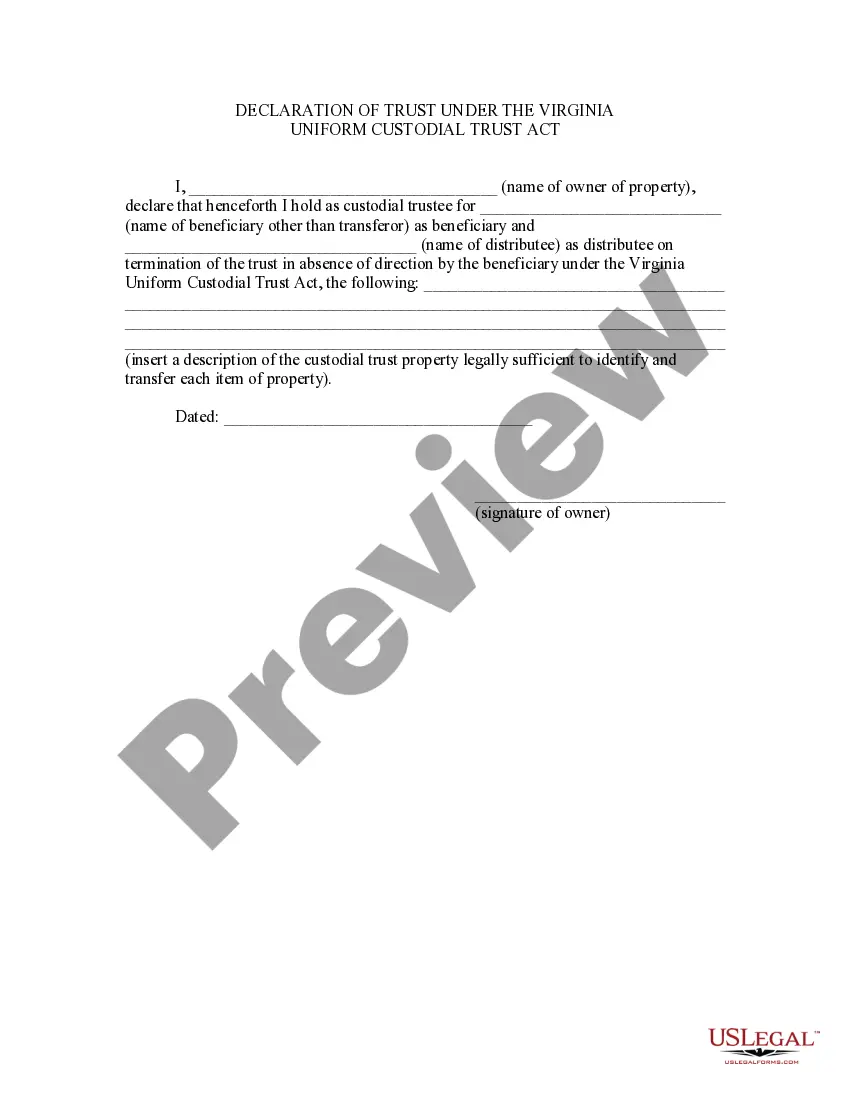
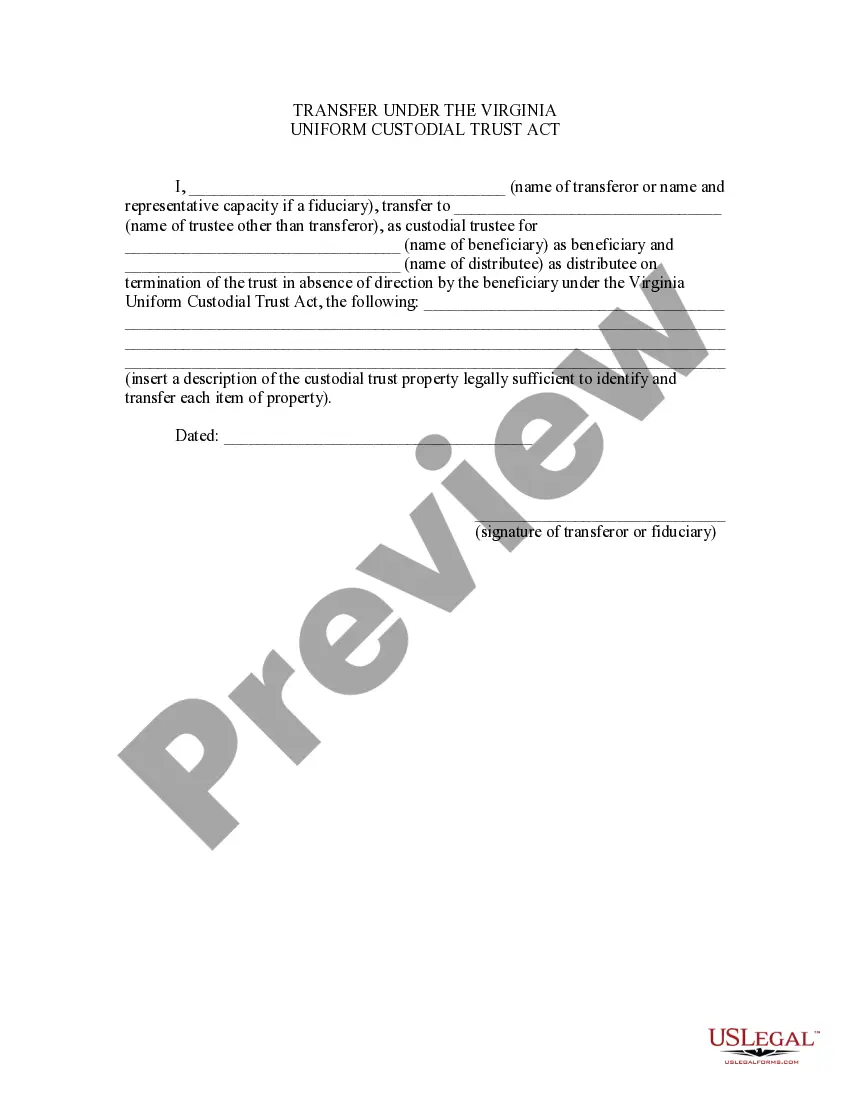
The Declaration of Trust - Uniform Custodial Trust Act is a legal document used to create a custodial trust under Virginia law. This form allows an individual to hold property for the benefit of another person, designating a custodial trustee to manage the assets. It clearly establishes how the trust operates, distinguishing it from other types of trusts, such as revocable or irrevocable trusts.
Form components explained
- Name and signature of the property owner.
- Name of the beneficiary who is not the transferor.
- Name of the distributee for trust termination.
- Detailed description of the custodial trust property.
- Date of the declaration.
Common use cases
This form should be used when you want to establish a custodial trust for assets to be managed by a designated trustee for the benefit of a specific beneficiary in Virginia. It's particularly relevant in situations involving minor beneficiaries, estate planning, or when managing property on behalf of another person who cannot manage it themselves.
Who needs this form
- Property owners who wish to create a custodial trust.
- Individuals intending to manage assets for someone else, such as a minor or incapacitated adult.
- Estate planners and attorneys assisting clients with trust creation.
- Beneficiaries and distributees involved in trust administration.
Instructions for completing this form
- Identify the owner of the property and enter their name.
- Specify the name of the beneficiary who will benefit from the trust.
- List the distributee to receive the property upon trust termination.
- Provide a detailed description of the custodial trust property.
- Sign and date the declaration to finalize the trust.
Notarization requirements for this form
In most cases, this form does not require notarization. However, some jurisdictions or signing circumstances might. US Legal Forms offers online notarization powered by Notarize, accessible 24/7 for a quick, remote process.
Get your form ready online
Our built-in tools help you complete, sign, share, and store your documents in one place.
Make edits, fill in missing information, and update formatting in US Legal Forms—just like you would in MS Word.
Download a copy, print it, send it by email, or mail it via USPS—whatever works best for your next step.
Sign and collect signatures with our SignNow integration. Send to multiple recipients, set reminders, and more. Go Premium to unlock E-Sign.
If this form requires notarization, complete it online through a secure video call—no need to meet a notary in person or wait for an appointment.
We protect your documents and personal data by following strict security and privacy standards.

Make edits, fill in missing information, and update formatting in US Legal Forms—just like you would in MS Word.

Download a copy, print it, send it by email, or mail it via USPS—whatever works best for your next step.

Sign and collect signatures with our SignNow integration. Send to multiple recipients, set reminders, and more. Go Premium to unlock E-Sign.

If this form requires notarization, complete it online through a secure video call—no need to meet a notary in person or wait for an appointment.

We protect your documents and personal data by following strict security and privacy standards.
Avoid these common issues
- Failing to clearly describe the trust property.
- Not including a valid beneficiary who is not the transferor.
- Omitting the date of the declaration.
- Incorrectly identifying the distributee for trust termination.
Benefits of using this form online
- Convenient access to legal documents anytime and anywhere.
- Easy to customize and fill out to meet specific needs.
- Reliable templates drafted by licensed attorneys.
- Time-efficient with downloadable options.
Looking for another form?

Form popularity
FAQ
A custodial account is a means by which an adult can open a savings account for a child. The adult who opens the account is responsible for managing it, including making investment decisions, and deciding how the money is to be used, so long as it benefits the child in some way.
Custodial trust is a revocable trust wherein a custodial trustee is named to manage the assets for a beneficiary who is incapacitated or disabled.
Generally speaking, beneficiaries have a right to see trust documents which set out the terms of the trusts, the identity of the trustees and the assets within the trust as well as the trust deed, any deeds of appointment/retirement and trust accounts.
A trustee has a duty to report and account to the trust beneficiaries. If you are a trust beneficiary, you have a right to information about the trust, your interest in the trust, and the various assets of the trust and how they are being administered, invested and distributed.
Custodial accounts can be thought of as a type of trust account, and are used to save money for children, their beneficiaries. These accounts are set up under the Uniform Gifts to Minors Act (UGMA) or the Uniform Transfers to Minors Act (UTMA).The responsibility of managing the account falls to the custodian.
In most cases, a trustee cannot remove a beneficiary from a trust. This power of appointment generally is intended to allow the surviving spouse to make changes to the trust for their own benefit, or the benefit of their children and heirs.
Trusts and trustees in California are governed by the California Probate Code and court cases decided which interpret the probate code.If a trustee is holding back money and not paying the beneficiaries then the trustee needs to have documented and businesslike reasons for withholding payment.
In a custodial arrangement, the account is owned by the beneficiary, and he or she is entitled to the money upon reaching the proper age.A trust fund, on the other hand, provides the person giving the money with a great deal more control, since the assets are owned by the trust.
While you can technically withdraw money from a custodial account before your child reaches the age of majority, you can only do so for the direct benefit of the child.Keep in mind that any funds you take out may also create taxable gains for your child, and that withdrawn money won't have as much time to grow.