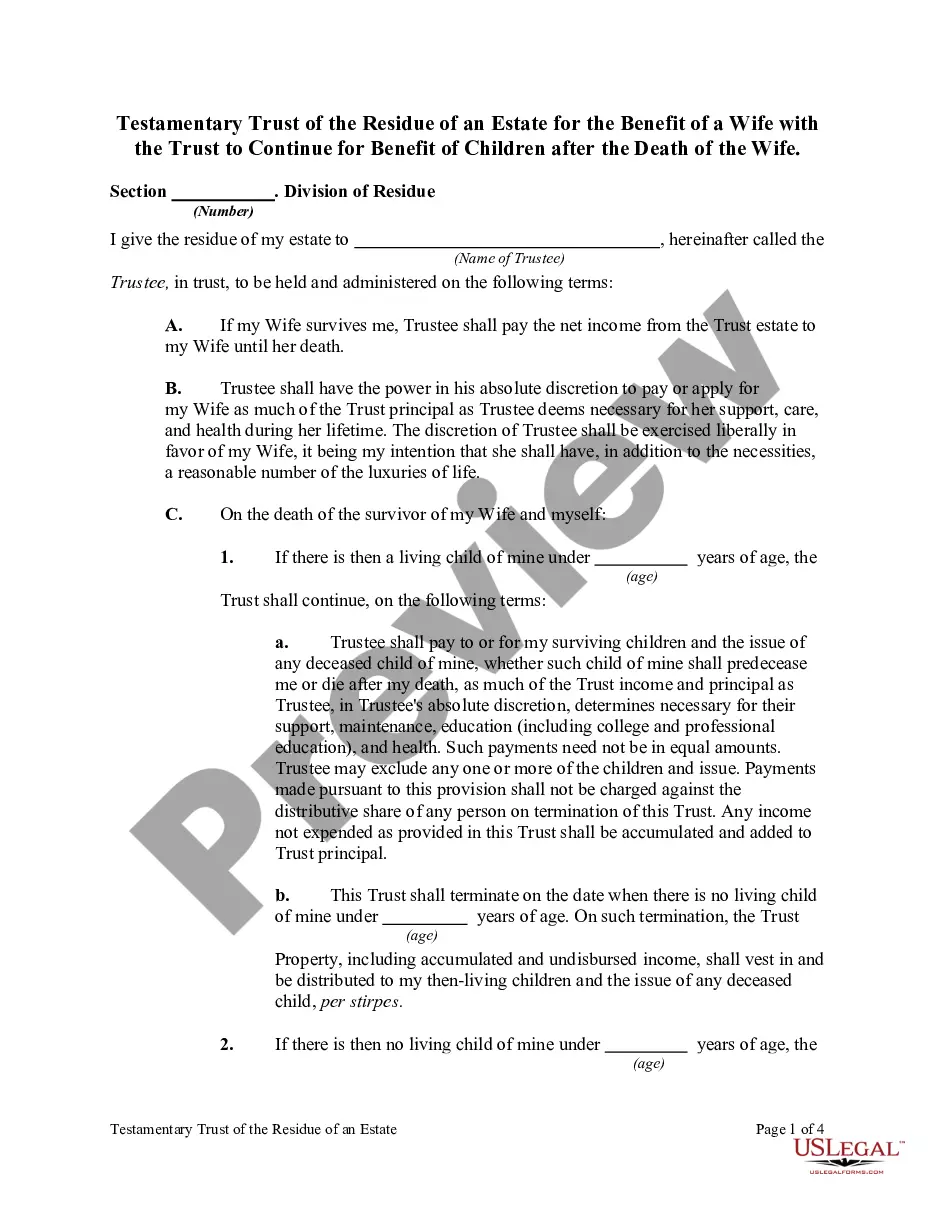
Utah Pot Testamentary Trust
Description



Get your form ready online
Our built-in tools help you complete, sign, share, and store your documents in one place.
Make edits, fill in missing information, and update formatting in US Legal Forms—just like you would in MS Word.
Download a copy, print it, send it by email, or mail it via USPS—whatever works best for your next step.
Sign and collect signatures with our SignNow integration. Send to multiple recipients, set reminders, and more. Go Premium to unlock E-Sign.
If this form requires notarization, complete it online through a secure video call—no need to meet a notary in person or wait for an appointment.
We protect your documents and personal data by following strict security and privacy standards.

Make edits, fill in missing information, and update formatting in US Legal Forms—just like you would in MS Word.

Download a copy, print it, send it by email, or mail it via USPS—whatever works best for your next step.

Sign and collect signatures with our SignNow integration. Send to multiple recipients, set reminders, and more. Go Premium to unlock E-Sign.

If this form requires notarization, complete it online through a secure video call—no need to meet a notary in person or wait for an appointment.

We protect your documents and personal data by following strict security and privacy standards.
Looking for another form?




How to fill out Pot Testamentary Trust?
Locating the correct authentic document template can be somewhat challenging.
Naturally, there is an abundance of templates accessible online, but how can you find the authentic type you need.
Utilize the US Legal Forms platform. The service offers thousands of templates, including the Utah Marijuana Testamentary Trust, which can be utilized for both business and personal purposes.
You can browse the form using the Preview button and review the form description to confirm it is suitable for you. If the form does not satisfy your needs, use the Search section to find the appropriate form. Once you are confident that the form is appropriate, click the Purchase now button to acquire the form. Choose the payment plan you prefer and enter the required information. Create your account and settle the order using your PayPal account or credit card. Select the file format and download the legal document template to your device. Fill out, modify, print, and sign the obtained Utah Marijuana Testamentary Trust. US Legal Forms is the premier repository of legal forms where you can discover various document templates. Leverage the service to download professionally crafted documents that comply with state requirements.
- All forms are reviewed by professionals and comply with federal and state regulations.
- If you are already registered, sign in to your account and click the Download button to obtain the Utah Marijuana Testamentary Trust.
- Use your account to search for the legal forms you have previously acquired.
- Navigate to the My documents section of your account and download another copy of the document you need.
- If you are a new user of US Legal Forms, here are simple steps to follow.
- First, ensure that you have selected the correct form for your city/region.
Form popularity
FAQ
How does it save tax? A testamentary trust allows the person who controls it to split the income generated by the trust between family members. Importantly, children who receive income from a testamentary trust are taxed at adult tax rates, instead of penalty rates (up to 66%) which apply to other types of trusts.
The main benefits of testamentary trusts are their ability to protect assets and to reduce tax paid by beneficiaries from income earned from the inheritance.
Testamentary trusts are discretionary trusts established in Wills, that allow the trustees of each trust to decide, from time to time, which of the nominated beneficiaries (if any) may receive the benefit of the distributions from that trust for any given period.
Living trusts and testamentary trustsA living trust (sometimes called an inter vivos trust) is one created by the grantor during his or her lifetime, while a testamentary trust is a trust created by the grantor's will.
How does it save tax? A testamentary trust allows the person who controls it to split the income generated by the trust between family members. Importantly, children who receive income from a testamentary trust are taxed at adult tax rates, instead of penalty rates (up to 66%) which apply to other types of trusts.
A testamentary trust is set up in a person's will and starts upon their death. It holds and protects all, or some, of the person's assets such as property and investments. The trust looks after the assets for the beneficiaries. Beneficiaries are the people or organisations that will benefit from the trust.
Well, because a testamentary trust allows the grantor some control over the assets during his or her lifetime. After the grantor passes away, the testamentary trust, which is considered an irrevocable trust, is created. Irrevocable trusts can sometimes protect assets against judgments and creditors.
Lawyers often use hourly fee schedules, and the price associated with creating a living trust is generally at least $1,000. Again, more complex estates may pay even more than that. In particular, make sure you're using an estate planning lawyer that has a specialty in trusts.
Trusts are a crucial element to Estate Planning as they help provide more control over asset distribution after death. Among the various types available, a Testamentary Trust can be one of the best options for those thinking of their young children or grandchildren.
Currently, taxable income earned in a testamentary trust is subject to the same graduated tax rates as an individual taxpayer (this is subject to change after December 31, 2015).