Utah Juvenile Court Petition Cover Sheet
What this document covers
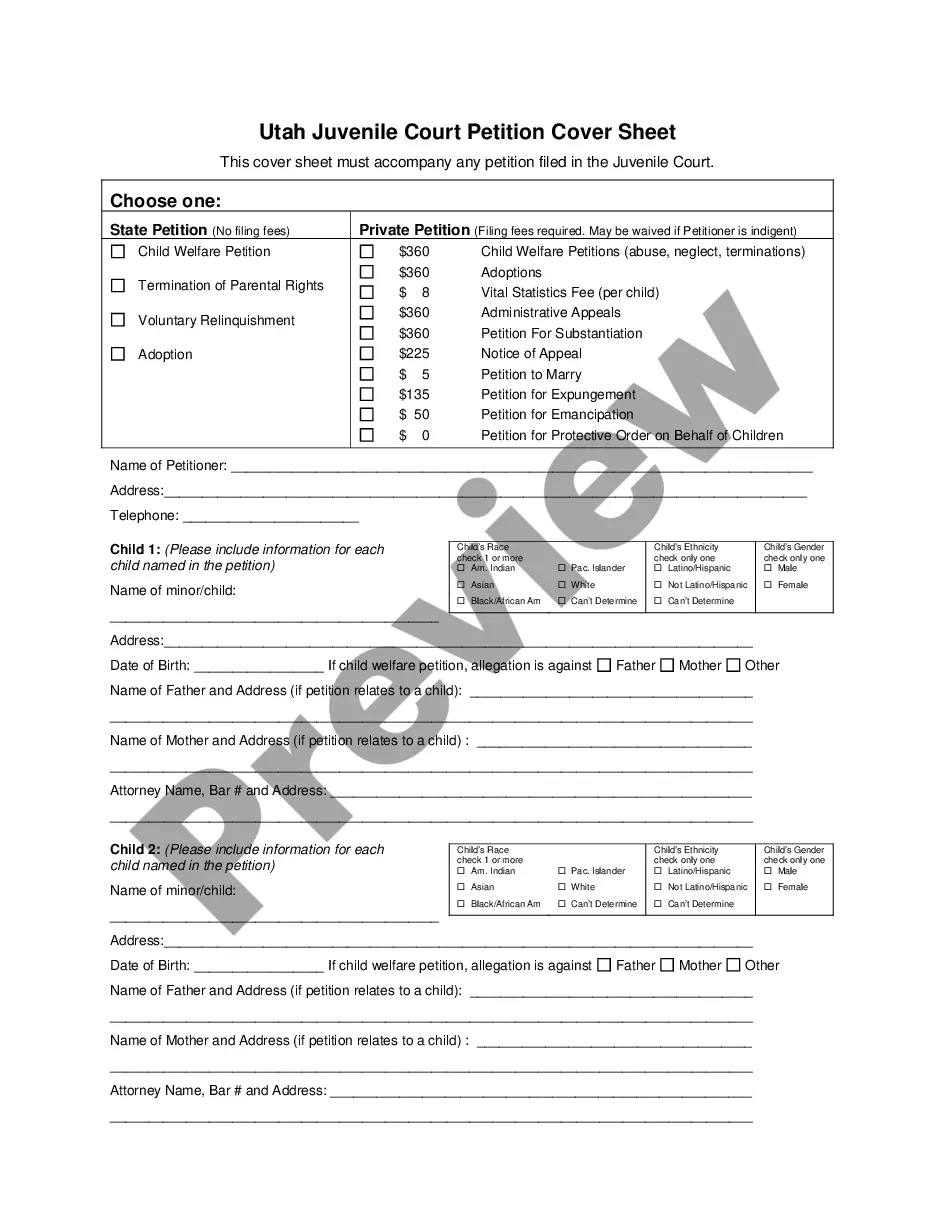
The Utah Juvenile Court Petition Cover Sheet is a required document that must accompany any petition filed in the Juvenile Court of Utah. This cover sheet ensures that all necessary information is presented in a standardized format, streamlining the court process. Unlike other court documents, the cover sheet is specifically tailored for juvenile cases, helping to categorize and process petitions effectively.
Key parts of this document
- Selection of the type of petition (State Petition or Private Petition).
- Details of the petitioner, including name, address, and telephone number.
- Information about each child involved, such as name, address, and date of birth.
- Identification of parties involved, including parental information.
- Specific options to indicate allegations if it's a child welfare petition.
- Signature from an attorney, if applicable.

When to use this form
This form should be used whenever you are filing a petition in the Juvenile Court in Utah. It is particularly important when dealing with cases involving child welfare, custody, adoption, or parental rights. Situations include cases of abuse or neglect, seeking termination of parental rights, or when a parent voluntarily relinquishes their rights. Using this cover sheet is crucial for proper court processing and to avoid delays.
Who can use this document
- Individuals or attorneys filing petitions in Utah Juvenile Court.
- Parents or guardians seeking to initiate a child welfare case.
- Individuals involved in adoption or termination of parental rights proceedings.
- Persons petitioning for child emancipation or protective orders.
Instructions for completing this form
- Choose the appropriate type of petition you are filing (State or Private).
- Fill in your personal information as the petitioner, including your name and contact details.
- Provide the necessary details for each child named in the petition, including their full name, address, and date of birth.
- Indicate which parent or guardian the allegations (if applicable) pertain to.
- If represented by an attorney, include their name, bar number, and contact information.
- Review the completed form for accuracy before submission to the court.
Is notarization required?
This form does not typically require notarization unless specified by local law. However, certain elements of court submissions may warrant additional verification depending on the specifics of your case.
Get your form ready online
Our built-in tools help you complete, sign, share, and store your documents in one place.
Make edits, fill in missing information, and update formatting in US Legal Forms—just like you would in MS Word.
Download a copy, print it, send it by email, or mail it via USPS—whatever works best for your next step.
Sign and collect signatures with our SignNow integration. Send to multiple recipients, set reminders, and more. Go Premium to unlock E-Sign.
If this form requires notarization, complete it online through a secure video call—no need to meet a notary in person or wait for an appointment.
We protect your documents and personal data by following strict security and privacy standards.

Make edits, fill in missing information, and update formatting in US Legal Forms—just like you would in MS Word.

Download a copy, print it, send it by email, or mail it via USPS—whatever works best for your next step.

Sign and collect signatures with our SignNow integration. Send to multiple recipients, set reminders, and more. Go Premium to unlock E-Sign.

If this form requires notarization, complete it online through a secure video call—no need to meet a notary in person or wait for an appointment.

We protect your documents and personal data by following strict security and privacy standards.
Common mistakes
- Failing to select the correct petition type, which can lead to processing delays.
- Omitting necessary details about each child being petitioned for, which can result in incomplete filings.
- Not including attorney information if represented, which may render the filing invalid.
- Ignoring fee requirements, leading to unexpected court rejections.
Why complete this form online
- Immediate access to the most up-to-date form templates.
- Easy editing and customization to fit your specific case.
- Faster completion, allowing timely submission to the court.
- Access to support and guidance throughout the form completion process.
Quick recap
- The Utah Juvenile Court Petition Cover Sheet is essential for filing in Juvenile Court.
- It includes specific sections for identifying children and parties involved in the petition.
- Correct completion helps ensure swift processing of your petition.
- Be aware of potential filing fees and exemptions based on your circumstances.
Looking for another form?
Form popularity
FAQ
The juvenile justice process involves nine major decision points: (1) arrest, (2) referral to court, (3) diversion, (4) secure detention, (5) judicial waiver to adult criminal court, (6) case petitioning, (7) delinquency finding/adjudication, (8) probation, and (9) residential placement, including confinement in a
The juvenile justice process involves nine major decision points: (1) arrest, (2) referral to court, (3) diversion, (4) secure detention, (5) judicial waiver to adult criminal court, (6) case petitioning, (7) delinquency finding/adjudication, (8) probation, and (9) residential placement, including confinement in a
2756 Petition: a formal document filed by a court counselor requesting that charges be brought against a juvenile.Juveniles are entitled to a probable cause hearing if they are charged with felonies. 2756 Probation: a court-2010ordered period of supervision for a juvenile who has been adjudicated as delinquent.
A delinquency petition is a petition that is filed by the prosecuting attorney in cases where a child under 18 years of age commits a delinquent act. The delinquency petition must state the acts which bring the juvenile within the court's jurisdiction.
How are juvenile cases handled? In North Carolina, juvenile cases are sent to the state district courts for hearings. These courts have authority over delinquent and undisciplined juveniles.
The juvenile justice system, as a process, involves four stages: intake, adjudication, disposition, and postadjudication review. Intake involves the filing of a juvenile petition by some party, such as the police, alleging illegal behavior by the juvenile. Adjudication is the trial process for juveniles.
Although courts with juvenile jurisdiction handle a variety of cases, including abuse, neglect, adoption, and traffic violations, the Juvenile Court Statistics series focuses on the disposition of delinquency cases and formally pro- cessed status offense cases.
Petition: A document filed in juvenile court alleging that a juvenile is a delinquent or a status offender and asking that the court assume jurisdiction over the juvenile or that an alleged delinquent be transferred to criminal court for prosecution as an adult.