Application and Affidavit For Placement on List of Approved Private Process Servers
About this form
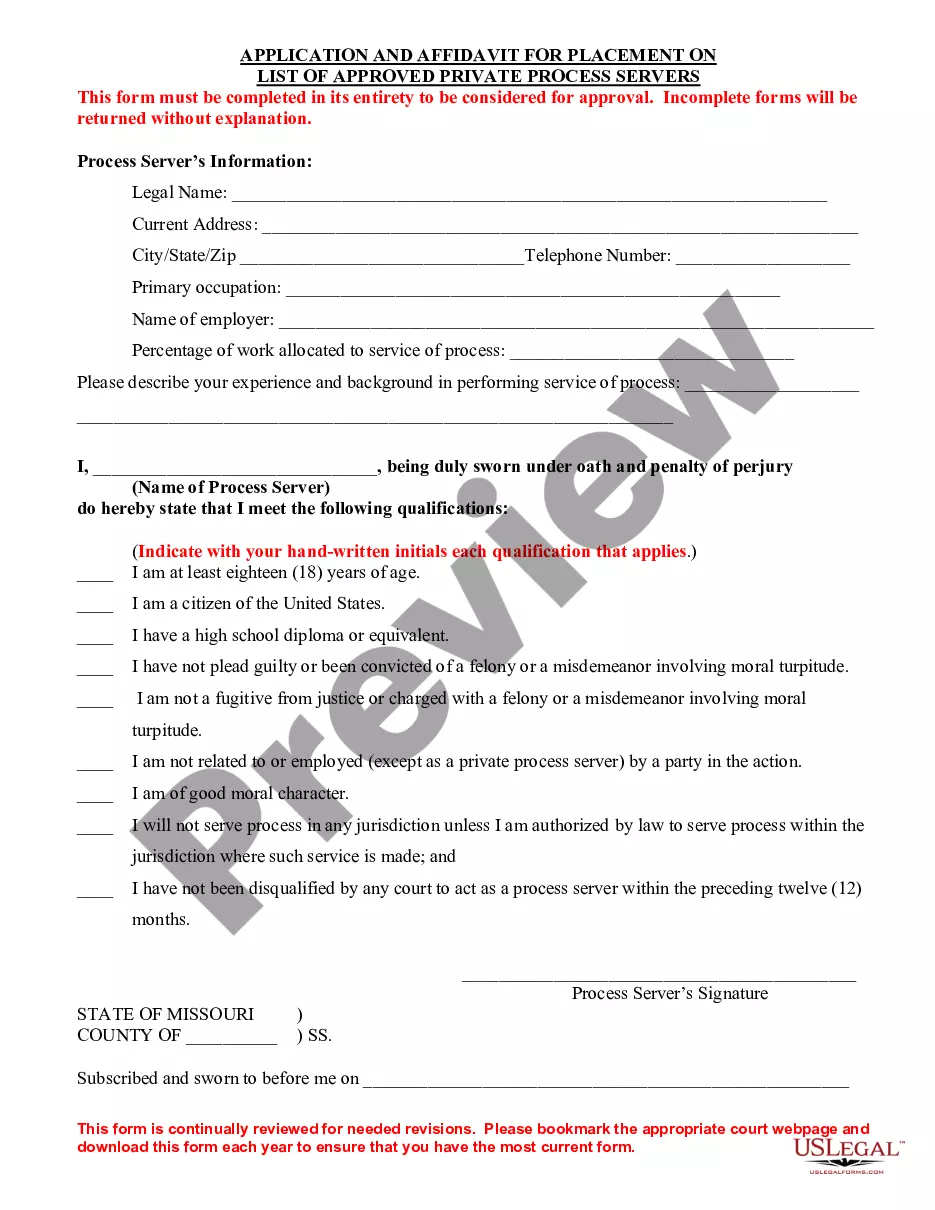
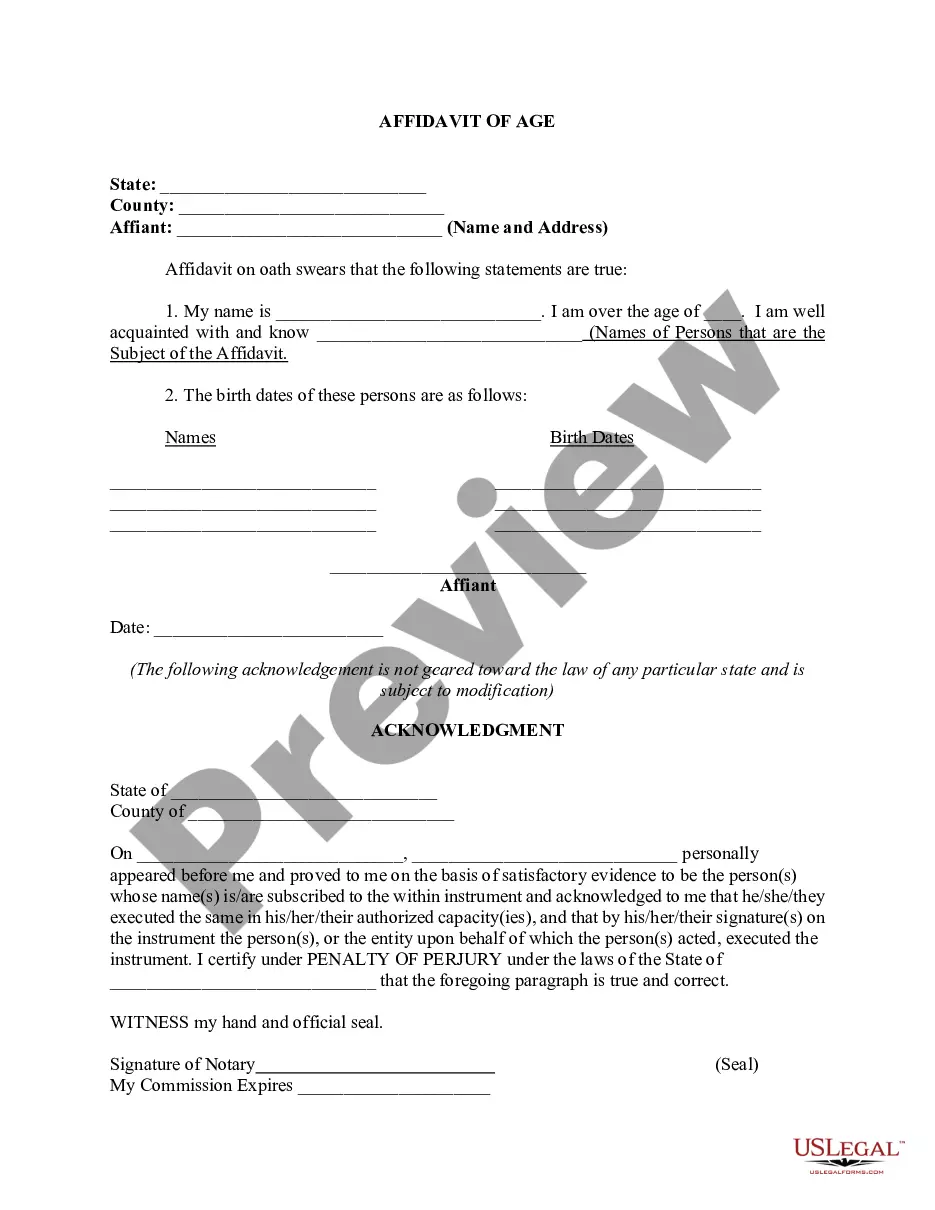
The Application and Affidavit for Placement on List of Approved Private Process Servers is a legal document used to apply for approval as a private process server. This form helps ensure that individuals serving legal documents meet specific qualifications and standards. Unlike other affidavits that may be used for various purposes, this form is tailored specifically for those seeking to be recognized as legal process servers within a given jurisdiction.
What’s included in this form
- Personal information of the process server, including legal name and address.
- Details of the current employer and job position.
- A declaration of qualifications that the applicant must initial to confirm compliance.
- A section to describe relevant experience in serving legal processes.
- Signature of the process server, along with notarization details to validate the affidavit.

When to use this document
This form should be used when an individual wishes to be added to the list of approved private process servers. It is essential for those intending to perform service of process for legal documents in a jurisdiction that requires formal approval. Completing this form demonstrates the applicant's qualifications and willingness to adhere to legal standards.
Who can use this document
- Individuals seeking to become recognized private process servers.
- Those with prior experience in serving legal documents.
- People who meet the minimum qualifications outlined in the affidavit.
Steps to complete this form
- Enter your legal name and current address in the designated fields.
- Provide your primary occupation and employer information.
- Clearly describe your relevant experience in serving legal documents.
- Initial next to each qualification to confirm you meet the necessary criteria.
- Sign the affidavit in the presence of a notary public to validate your statements.
Is notarization required?
Yes, this form must be notarized to be legally valid. US Legal Forms offers integrated online notarization services that are available 24/7 via secure video calls, ensuring that your affidavit is legally valid without the need for in-person visits.
Get your form ready online
Our built-in tools help you complete, sign, share, and store your documents in one place.
Make edits, fill in missing information, and update formatting in US Legal Forms—just like you would in MS Word.
Download a copy, print it, send it by email, or mail it via USPS—whatever works best for your next step.
Sign and collect signatures with our SignNow integration. Send to multiple recipients, set reminders, and more. Go Premium to unlock E-Sign.
If this form requires notarization, complete it online through a secure video call—no need to meet a notary in person or wait for an appointment.
We protect your documents and personal data by following strict security and privacy standards.

Make edits, fill in missing information, and update formatting in US Legal Forms—just like you would in MS Word.

Download a copy, print it, send it by email, or mail it via USPS—whatever works best for your next step.

Sign and collect signatures with our SignNow integration. Send to multiple recipients, set reminders, and more. Go Premium to unlock E-Sign.

If this form requires notarization, complete it online through a secure video call—no need to meet a notary in person or wait for an appointment.

We protect your documents and personal data by following strict security and privacy standards.
Common mistakes
- Leaving fields incomplete or unfilled.
- Failing to initial all applicable qualifications.
- Not providing sufficient details about previous experience.
- Neglecting to have the affidavit notarized.
Benefits of completing this form online
- Convenient access to the latest version of the form at any time.
- Easy to fill out and edit as needed before submission.
- Access to legal guidance regarding completion and requirements.
Looking for another form?
Form popularity
FAQ
Process servers in California are required to apply and be registered in the county they serve in. Registration is statewide, and the individual must have lived in California for at least one year. No classes or training is required. Every applicant is required to post a $2,000 bond or cash deposit.
In some situations where the process server truly failed to serve you the court papers properly, the court cannot pass a judgment against you because it has no personal jurisdiction over you. Thus, they will postpone the case to another court date where the process server will attempt to serve you again.
To become a certified process server in the First Judicial Circuit you must: Pay a $300 non-refundable application fee.Pass a written exam covering the Chapter 48 of the Florida Statutes.Complete an application.Obtain a Certificate of Good Conduct.Obtain a bond in the amount of $5,000.
How late can process servers serve in Texas? Technically, it is 24 hours a day. However, a process service company that cares about the quality of its work will do everything possible to act professionally. This usually means they will attempt delivery between 6 am to 10 pm on Monday through Saturday.
How late can process servers serve in Texas? Technically, it is 24 hours a day. However, a process service company that cares about the quality of its work will do everything possible to act professionally. This usually means they will attempt delivery between 6 am to 10 pm on Monday through Saturday.
After employing a professional process server, the average time it takes to attempt to serve papers is five to seven days.
A person serving papers must be 18 years of age or older and must not be a party to the case (CPLR 2103a). Papers may be served by a process server, friend or relative of a party so long as he or she is not a party to the case.
In most cases, three attempts will be made, and at different times of the day and on different days. If the process server fails to serve the documents after all attempts are made, the applicant can go to the court and ask permission to deliver the documents by a substitute or alternative service method.