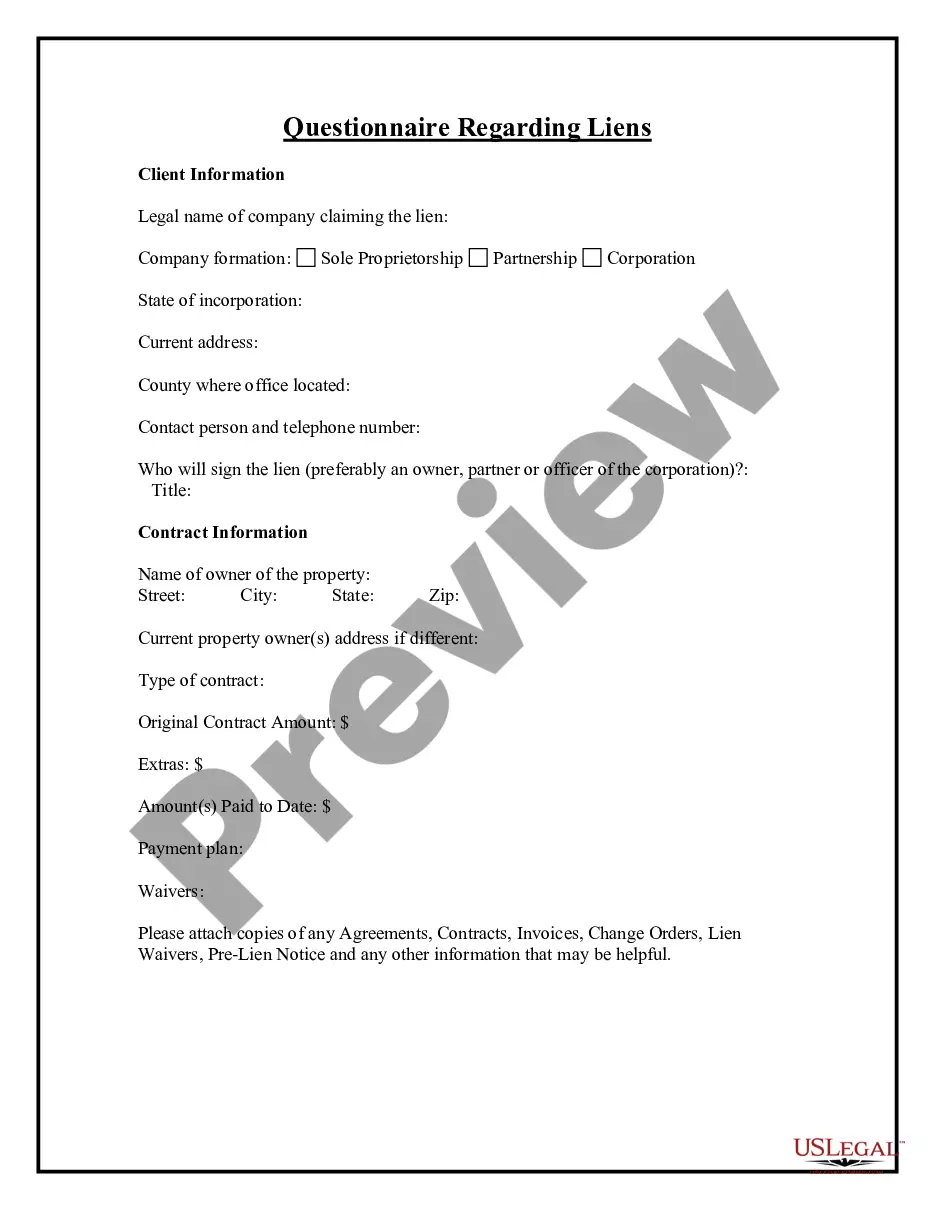
General Liens Questionnaire
What is this form?
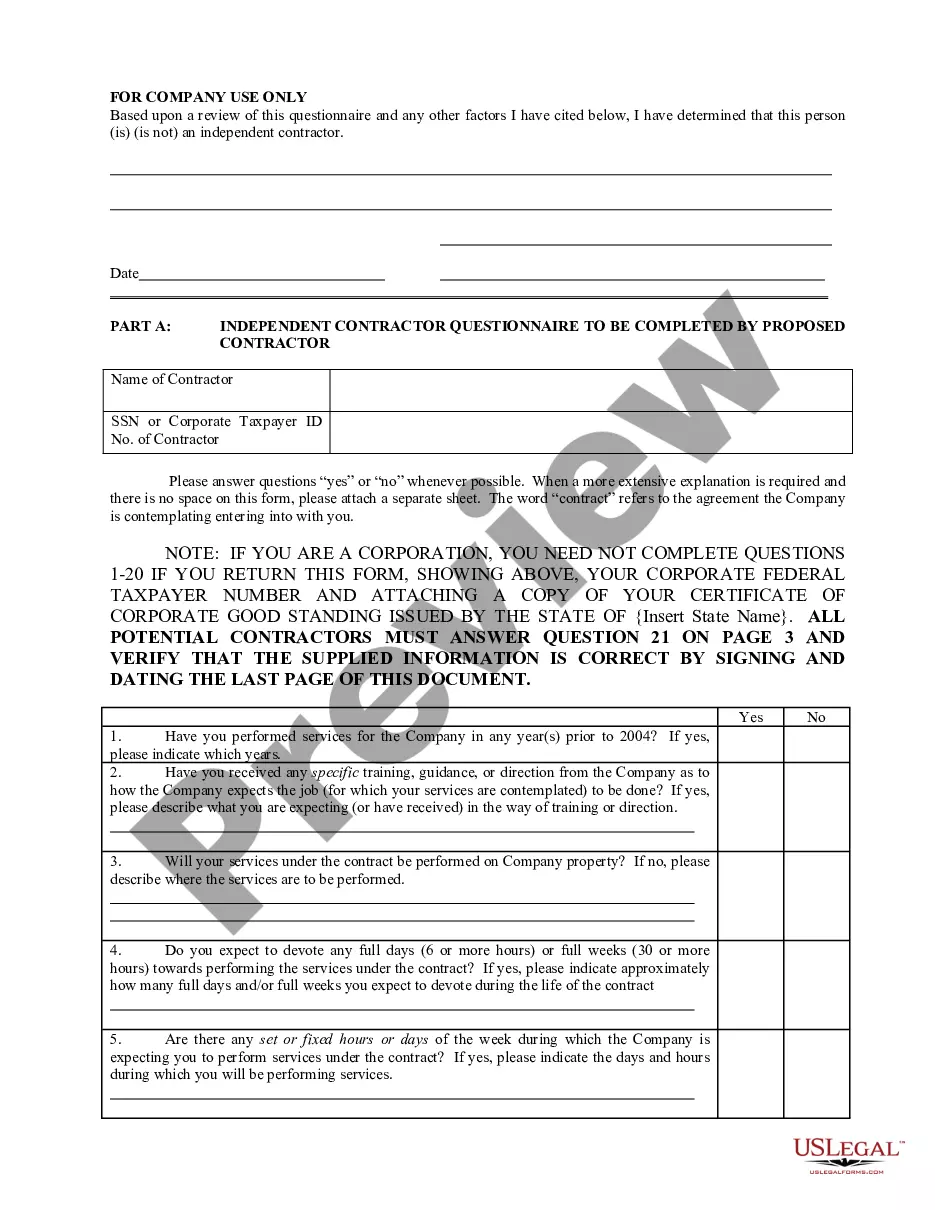
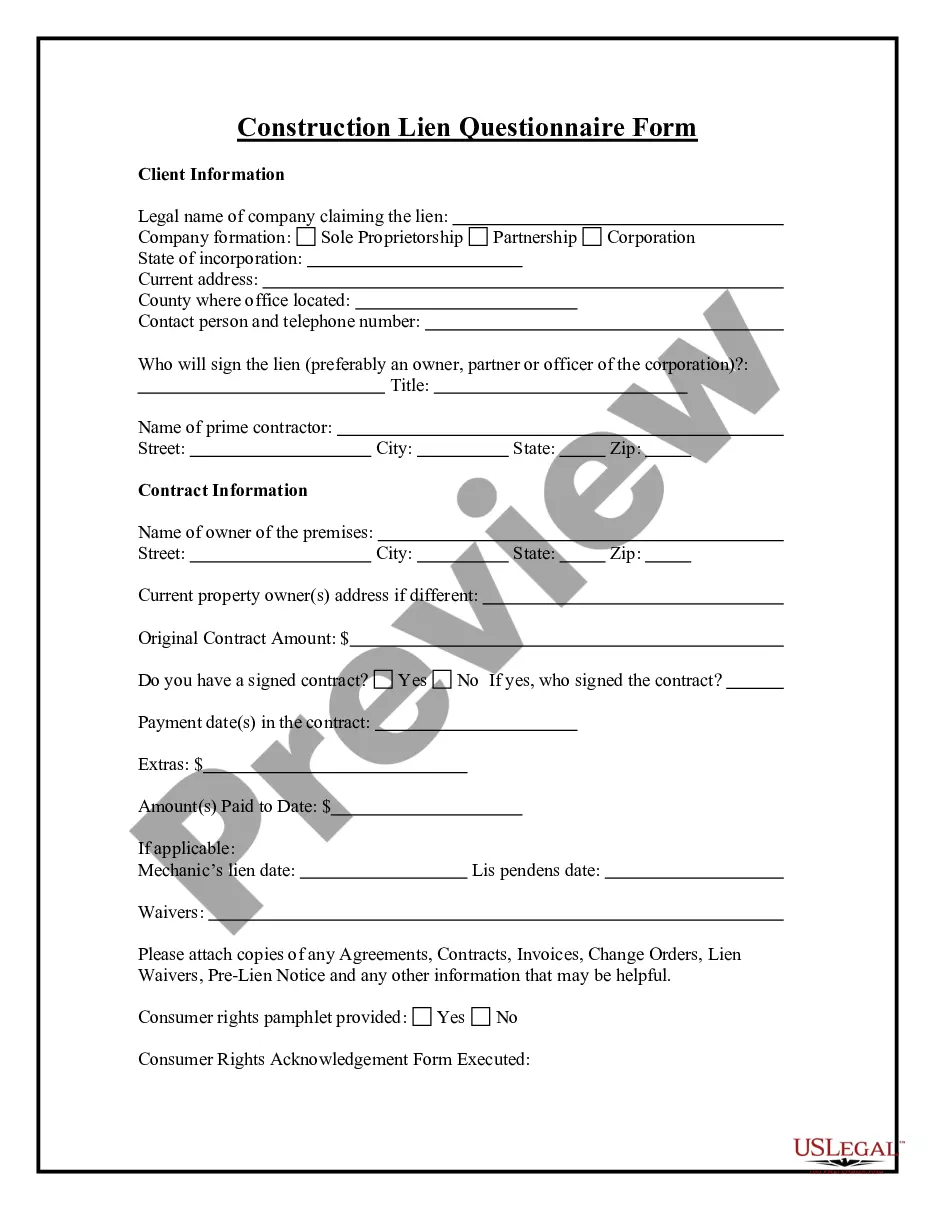
The General Liens Questionnaire is a tool designed to help parties involved in a lien matter. This form assists individuals in identifying key issues and questions to discuss with their attorney, ensuring thorough case preparation. It is distinct from other forms in that it focuses specifically on liens, which are claims against property for the payment of a debt or obligation.
Main sections of this form
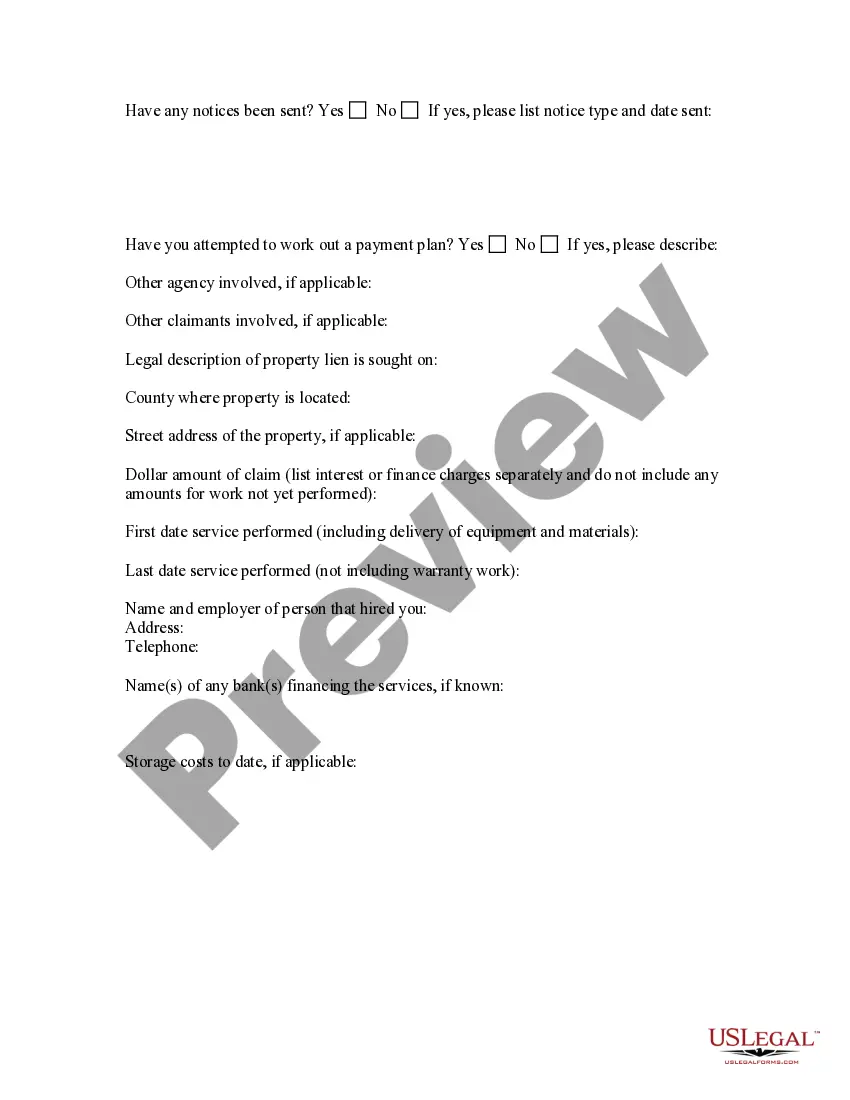
- A section for detailing any notices that have been sent, including type and date.
- Questions to help identify potential issues related to lien rights and obligations.
- Prompts that guide both clients and attorneys in evaluating the case effectively.
- Designed for use in forming an attorney-client relationship by gathering essential information.
- Aids in enhancing communication and understanding between the client and their attorney.
When to use this form
This questionnaire is useful in scenarios where a person or entity may face lien issues, such as disputes over property claims, unpaid debts leading to potential liens, or the need to avoid lien pitfalls before proceeding with a transaction. It provides a structured way to organize thoughts and concerns before engaging in legal counsel.
Who can use this document
- Individuals considering legal action regarding a lien.
- Property owners looking to understand their rights and obligations related to liens.
- Attorneys gathering information from new clients about potential lien matters.
- Anyone involved in a dispute over debt or property ownership.
- Clients wanting to streamline their consultations and reduce initial interview costs.
How to complete this form
- Identify the parties involved in the lien matter.
- Record any notices that have been sent regarding the lien, listing their type and dates.
- Reflect on the issues that may arise from the lien and note them for discussion with your attorney.
- Provide additional relevant details that will help your attorney understand your case better.
- Review the completed questionnaire to ensure all necessary information is included.
Notarization guidance
Notarization is not commonly needed for this form. However, certain documents or local rules may make it necessary. Our notarization service, powered by Notarize, allows you to finalize it securely online anytime, day or night.
Get your form ready online
Our built-in tools help you complete, sign, share, and store your documents in one place.
Make edits, fill in missing information, and update formatting in US Legal Forms—just like you would in MS Word.
Download a copy, print it, send it by email, or mail it via USPS—whatever works best for your next step.
Sign and collect signatures with our SignNow integration. Send to multiple recipients, set reminders, and more. Go Premium to unlock E-Sign.
If this form requires notarization, complete it online through a secure video call—no need to meet a notary in person or wait for an appointment.
We protect your documents and personal data by following strict security and privacy standards.

Make edits, fill in missing information, and update formatting in US Legal Forms—just like you would in MS Word.

Download a copy, print it, send it by email, or mail it via USPS—whatever works best for your next step.

Sign and collect signatures with our SignNow integration. Send to multiple recipients, set reminders, and more. Go Premium to unlock E-Sign.

If this form requires notarization, complete it online through a secure video call—no need to meet a notary in person or wait for an appointment.

We protect your documents and personal data by following strict security and privacy standards.
Common mistakes to avoid
- Failing to fully document all notices related to the lien.
- Not providing enough detail about the issues or circumstances surrounding the lien.
- Overlooking the importance of discussing all relevant information with your attorney.
- Using incomplete or outdated forms that do not address current laws.
Why use this form online
- Convenient access that allows for easy downloads and completions from any location.
- Editability ensures you can adjust your details as needed before finalizing.
- Reliability from using lawfully drafted templates created by licensed attorneys.
Summary of main points
- The General Liens Questionnaire is a necessary tool for individuals dealing with liens.
- It aids in identifying key issues and preparing for consultations with attorneys.
- This form can help reduce legal costs by improving initial evaluation processes.
Looking for another form?
Form popularity
FAQ
Examples of specific liens include: -Property tax lien when taxes are not paid. -Mortgage lien when a mortgage is used in financing.Both ad valorem tax liens and special assessment tax liens have priority over all other types of liens (but ad valorem tax liens have priority over special assessment tax liens.)
A mortgage lien is a type of voluntary specific lien, used when a bank lends money to purchase or refinance a home. Mortgages are secured loans, which creates a mortgage lien on the property. This means that the borrower promises some type of collateral to secure the loan in case they stop making payments.
What is the difference between the terms general and specific? If a lien is general, then it applies to all personal and real property. If it is specific to one property, such as a house upon which a mortgage is applied, then it is specific.
A specific lien is granted only with respect to a particular asset.A general lien is a lien on all property. This is both the real property and personal property an individual owns, not just one specific real property (like in the case of a foreclosure).
A general rule in property law says that whichever lien is recorded first in the land records has higher priority over later-recorded liens. This rule is known as the "first in time, first in right" rule.
A general lien is one that attaches to ALL property owned by the lienee. Examples of general liens include: -Federal income tax lien - a statutory lien which can occur when federal income taxes are not paid. -Judgement Lien - a statutory lien which results from court action brought against the lienee.
A general lien is a right of one person to retain any property or goods which are in his possession belonging to another person until the promise or liability is discharged.A general lien is available to bankers, factors, attorneys of High Court and policy brokers.
Tax liens are involuntary and specific. Mortgage lien: A mortgage lien is a voluntary, specific lien. In fact, it's the most common type of voluntary real estate lien. When you borrow money to buy or refinance a piece of real estate, you give the lender a lien against the property.
One example of involuntary liens at work involves the consequences to homeowners who don't pay their property taxes.The county can do this because state law gives it the right to lien real propertysell the property to pay off the owner's debteven though the owner never gave the county explicit permission to do so.