Motion for Additional Peremptory Challenges
About this form
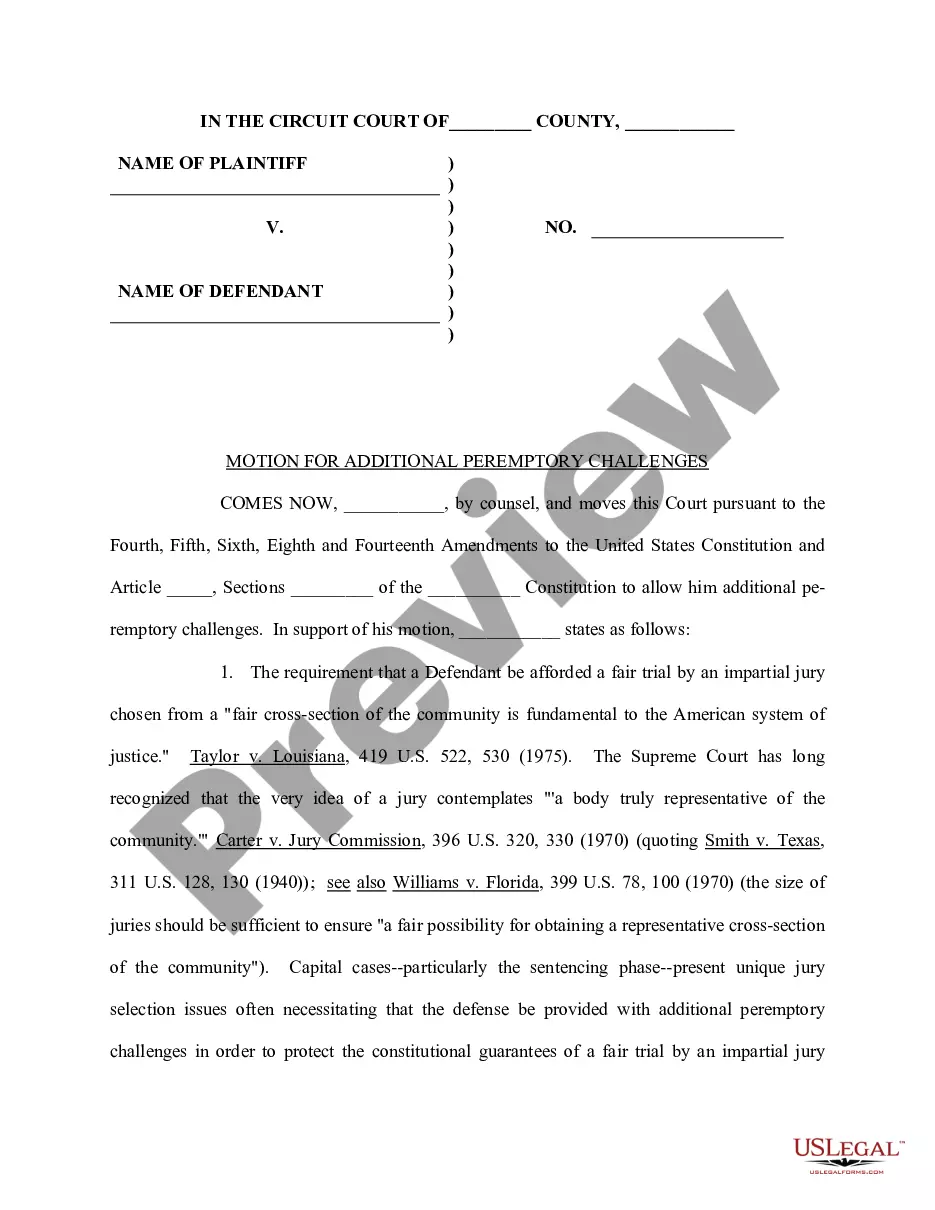
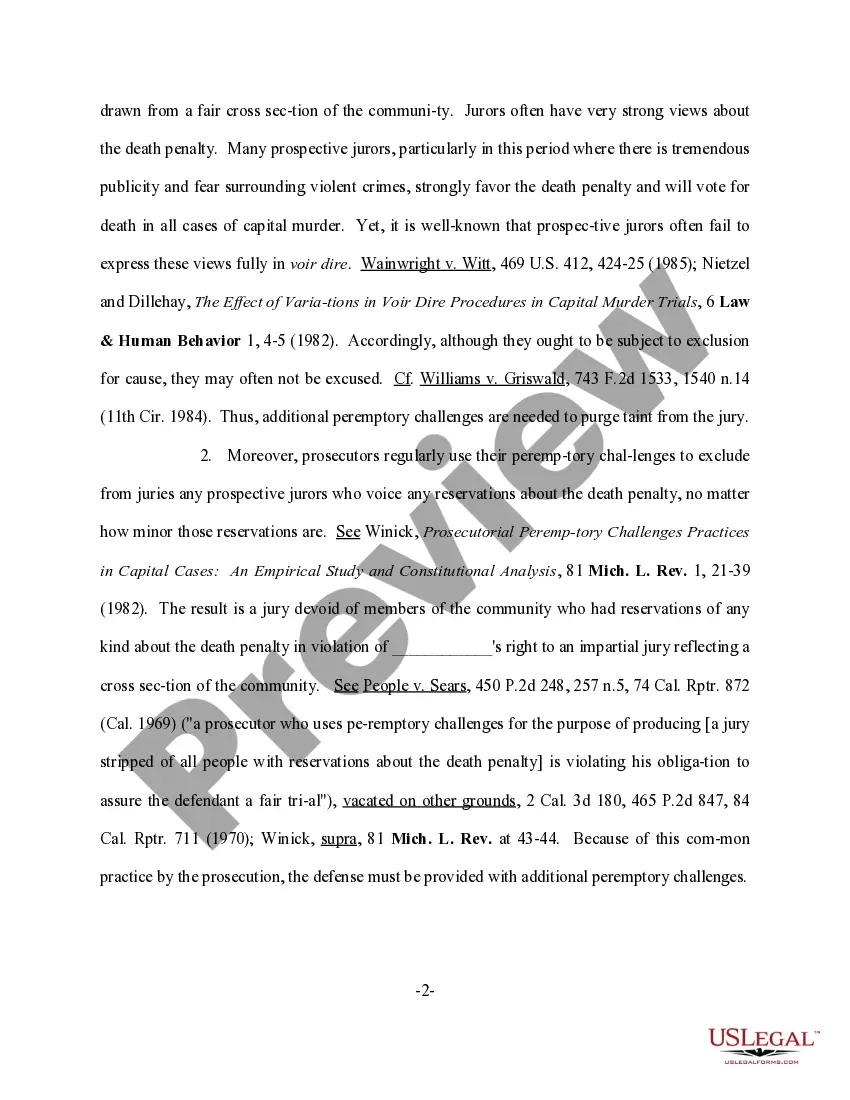
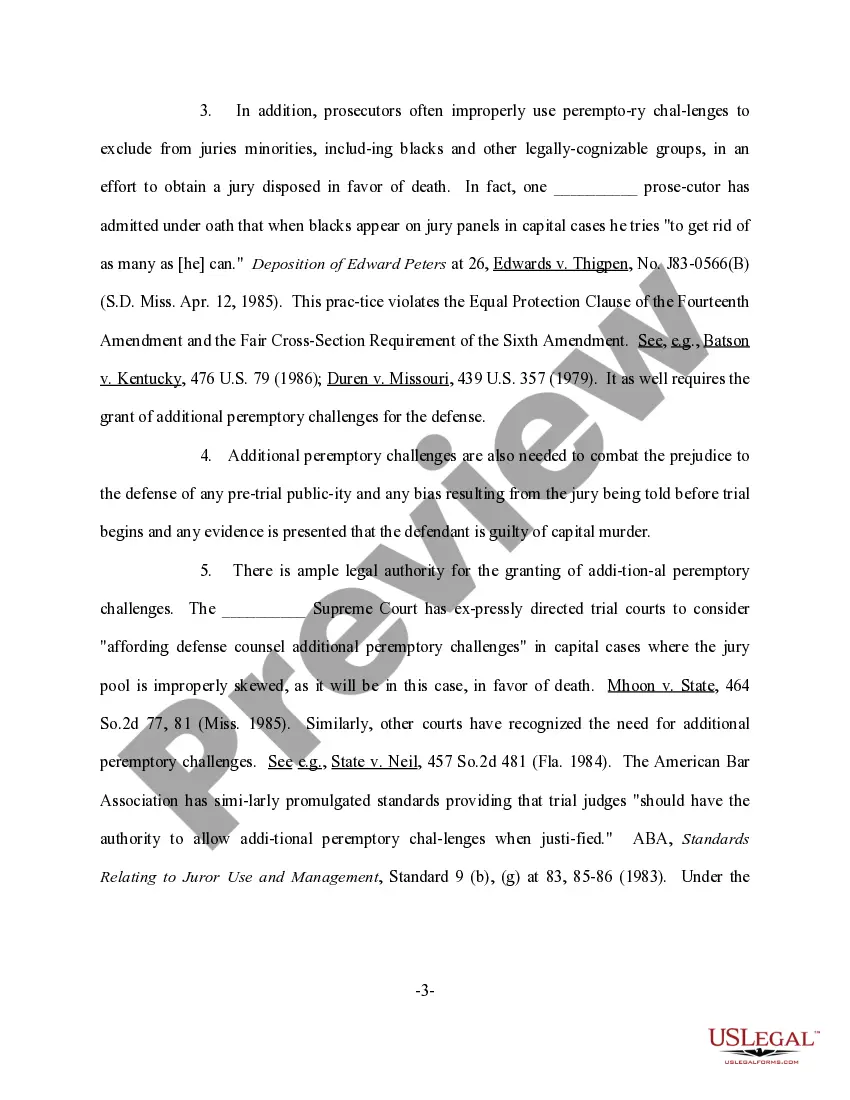
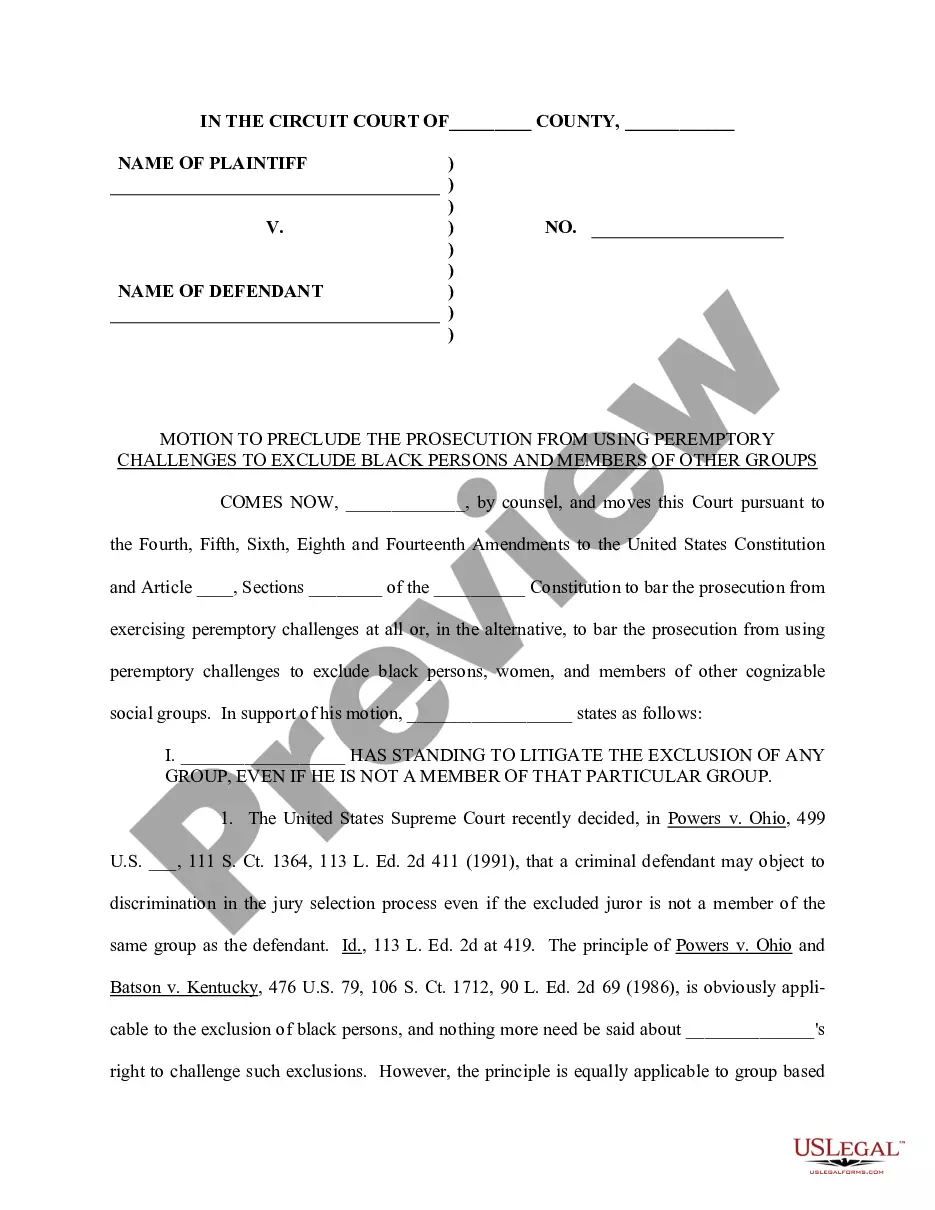
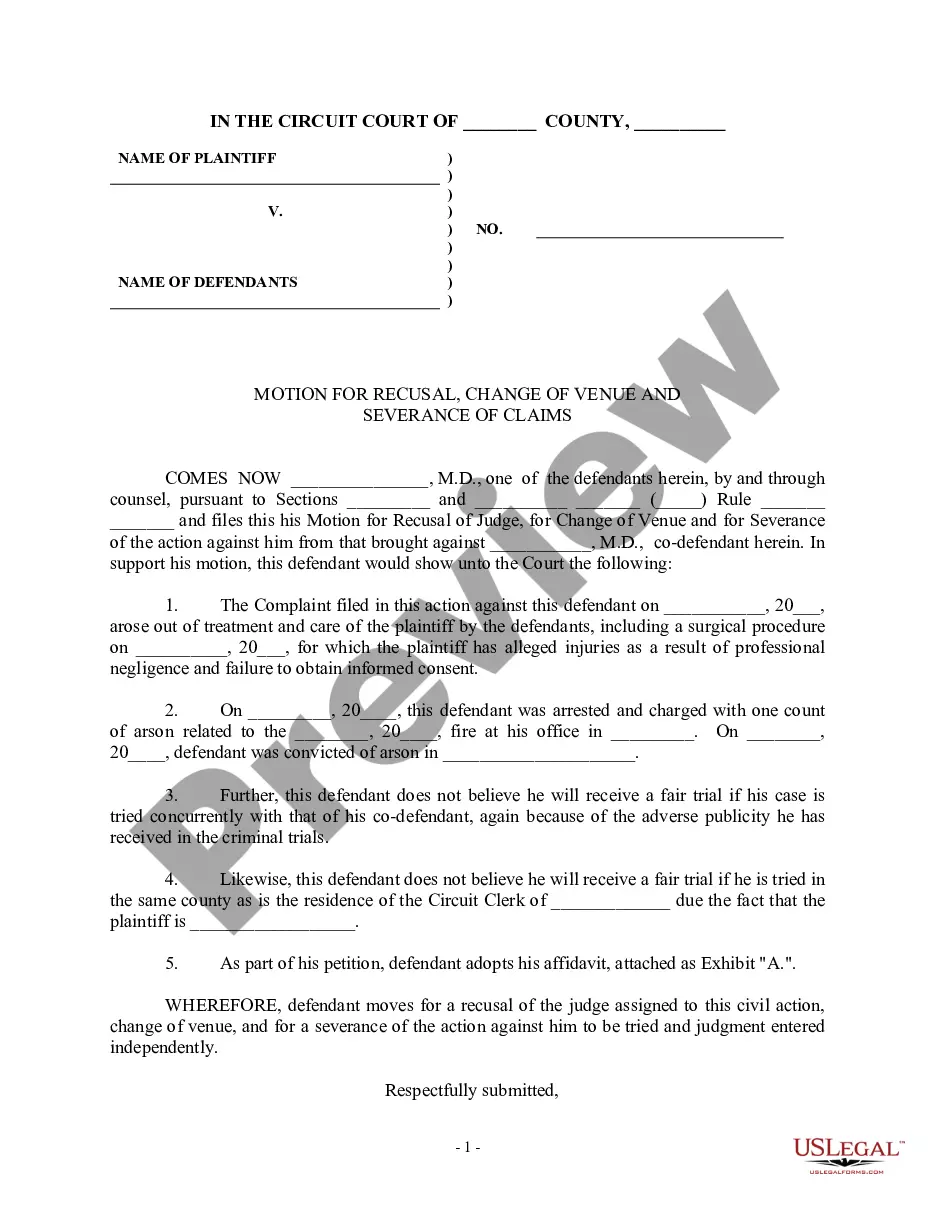
The Motion for Additional Peremptory Challenges is a legal document that requests the court to grant the defense additional peremptory challenges during jury selection, particularly in capital cases. This motion is grounded in the principle of ensuring a fair trial by a jury that reflects a representative cross-section of the community. The form includes references to case law and legal standards to support the necessity of these additional challenges, distinguishing it from standard motions in jury selection.
Form components explained
- Title of the motion requesting additional peremptory challenges.
- Legal standards and case law cited to justify the request.
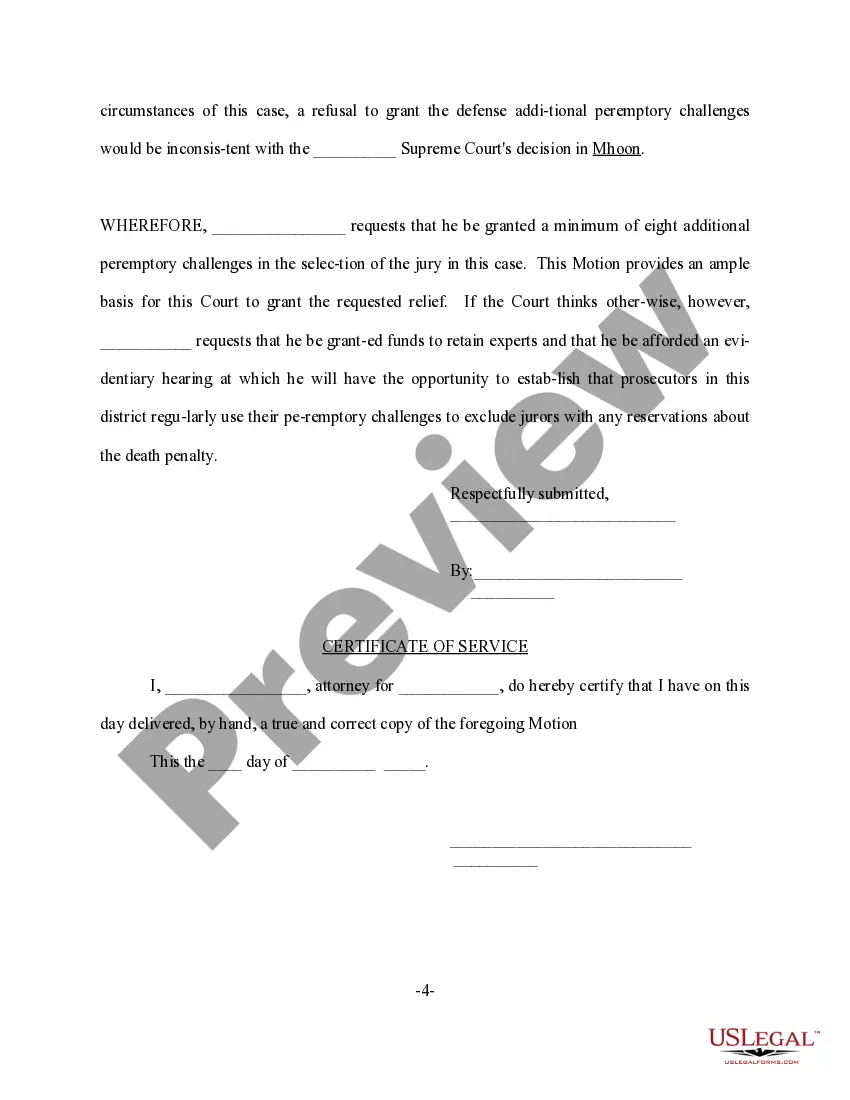
- Specific requests for the number of additional challenges needed.
- Arguments addressing potential bias in jury selection.
- Certification of service, detailing how the motion was delivered to other parties.
Situations where this form applies
This form should be used in capital cases where the defense believes that the jury pool is biased or not representative of the community, especially when issues like juror opinions on the death penalty may adversely affect the defendant's right to a fair trial. It is particularly relevant in jurisdictions where there is evidence of systematic exclusion of jurors based on race or death penalty views.
Who can use this document
- Defense attorneys representing clients in capital cases.
- Legal representatives who need to address juror bias during jury selection.
- Individuals involved in jury selection in states where additional challenges may be granted in capital cases.
Completing this form step by step
- Identify the parties involved, including the defendant and the court.
- Clearly state the number of additional peremptory challenges requested.
- Include relevant legal citations that support the motion.
- Detail specific reasons for the request, particularly addressing any potential juror bias.
- Complete the certification of service, noting how the motion was delivered to relevant parties.
Notarization requirements for this form
This form does not typically require notarization unless specified by local law. It is recommended to verify whether any specific jurisdictional requirements exist that may necessitate notarization before submission.
Get your form ready online
Our built-in tools help you complete, sign, share, and store your documents in one place.
Make edits, fill in missing information, and update formatting in US Legal Forms—just like you would in MS Word.
Download a copy, print it, send it by email, or mail it via USPS—whatever works best for your next step.
Sign and collect signatures with our SignNow integration. Send to multiple recipients, set reminders, and more. Go Premium to unlock E-Sign.
If this form requires notarization, complete it online through a secure video call—no need to meet a notary in person or wait for an appointment.
We protect your documents and personal data by following strict security and privacy standards.

Make edits, fill in missing information, and update formatting in US Legal Forms—just like you would in MS Word.

Download a copy, print it, send it by email, or mail it via USPS—whatever works best for your next step.

Sign and collect signatures with our SignNow integration. Send to multiple recipients, set reminders, and more. Go Premium to unlock E-Sign.

If this form requires notarization, complete it online through a secure video call—no need to meet a notary in person or wait for an appointment.

We protect your documents and personal data by following strict security and privacy standards.
Common mistakes to avoid
- Failing to cite relevant case law to support the motion adequately.
- Not specifying the number of additional challenges requested.
- Omitting the certification of service, which is critical for legal procedures.
Benefits of using this form online
- Immediate access to professionally drafted content tailored to legal needs.
- Easy customization to fit specific case circumstances.
- Secure downloading for convenience and legal validity.
Legal use & context
- Judges in certain jurisdictions are guided to consider the granting of extra peremptory challenges in capital cases.
- The form supports the defense's right to ensure a fair jury selection process aligned with constitutional principles.
- Additional peremptory challenges help mitigate the risk of jury bias stemming from pretrial publicity or strong juror opinions on sensitive issues like the death penalty.
Main things to remember
- The Motion for Additional Peremptory Challenges is essential for fair jury selection in capital cases.
- Providing adequate legal justification is crucial for the success of the motion.
- Awareness of state-specific requirements can enhance the effectiveness of the motion.
Looking for another form?




Form popularity
FAQ
A peremptory challenge results in the exclusion of a potential juror without the need for any reason or explanation - unless the opposing party presents a prima facie argument that this challenge was used to discriminate on the basis of race, ethnicity, or sex. See Batson challenge. criminal procedure. wex definitions.
Prior to Bill C-75's enactment, the accused and the Crown could each peremptorily challenge up to twenty prospective jurors pursuant to s. 634(1) of the Code. In other words, the accused and the Crown could reject potential jurors from serving without providing any reasons.
Peremptory challenges are limited to a certain number determined by the kind of lawsuit being tried. They can't be used to discriminate on the basis of race or sex. When both parties have agreed upon a jury, the jurors are sworn in to try the case by the court clerk. Those not selected are excused.
In federal criminal trials, the number of peremptory challenges allowed is ten for the defendant and six for the prosecution in a felony case, 20 for each side in a death penalty case, and three for each side in a misdemeanor case (Fed.
The government has 6 peremptory challenges and the defendant or defendants jointly have 10 peremptory challenges when the defendant is charged with a crime punishable by imprisonment of more than one year.
Peremptory challenges are limited to a certain number determined by the kind of lawsuit being tried. They can't be used to discriminate on the basis of race or sex. When both parties have agreed upon a jury, the jurors are sworn in to try the case by the court clerk. Those not selected are excused.
The number of challenges available There are up to five peremptory challenges for each accused where there are two accused,12 and up to four peremptory challenges each where there are three or more accused.
California currently permits a party in a civil case six (6) peremptory challenges, and 10 in non-capital criminal cases.
The government has 6 peremptory challenges and the defendant or defendants jointly have 10 peremptory challenges when the defendant is charged with a crime punishable by imprisonment of more than one year.