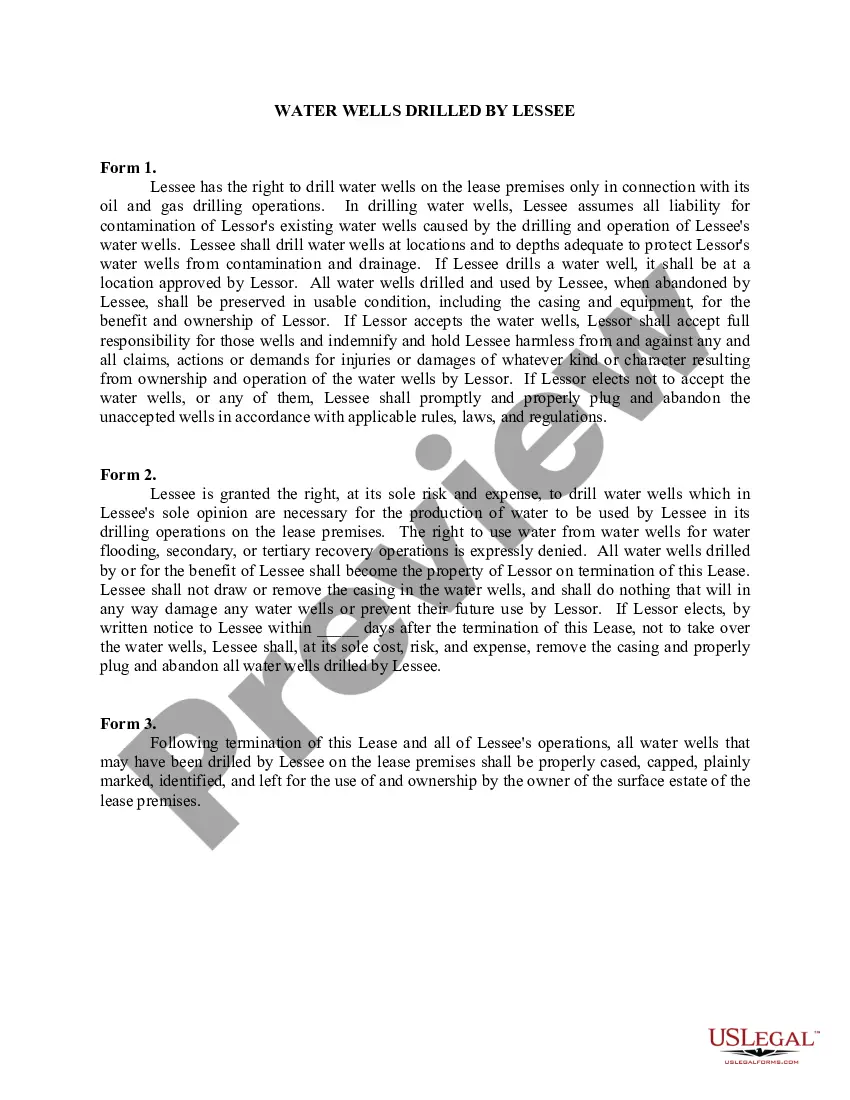
Water Wells Drilled by Lessee
About this form
The Water Wells Drilled by Lessee form is a lease rider that provides specific provisions regarding the drilling of water wells by the lessee in an oil and gas lease agreement. This form outlines the rights and responsibilities related to water wells, addressing potential contamination issues and ownership of the wells upon termination of the lease. It is tailored to address concerns that may not be covered in a standard lease agreement, making it an essential tool for those involved in such transactions.
Key components of this form
- Lessee's right to drill water wells only for oil and gas operations
- Lessee's assumption of liability for contamination of existing water wells
- Provisions for well capping, abandonment, and ownership transfer upon lease termination
- Conditions under which the lessor accepts responsibility for the water wells
- Stipulations on the drilling and location of water wells
When to use this form
This form is essential to use when entering into a lease agreement for oil and gas purposes, especially when the lessee intends to drill water wells on the leased property. It should be utilized when there are specific concerns regarding water usage, contamination risks, and ownership rights associated with the water wells that may arise during or after drilling operations.
Who needs this form
- Lessees involved in oil and gas drilling operations
- Property owners leasing land for oil and gas exploration
- Legal professionals advising clients on oil and gas lease agreements
- Landowners concerned about water well contamination and rights
How to prepare this document
- Identify the parties involved, specifically the lessor and lessee.
- Specify the terms related to drilling and use of water wells.
- Detail the liability agreements regarding contamination and damage.
- Include clauses on well abandonment and ownership transfer procedures.
- Collect signatures from all parties to validate the agreement.
Notarization requirements for this form
Notarization is not commonly needed for this form. However, certain documents or local rules may make it necessary. Our notarization service, powered by Notarize, allows you to finalize it securely online anytime, day or night.
Get your form ready online
Our built-in tools help you complete, sign, share, and store your documents in one place.
Make edits, fill in missing information, and update formatting in US Legal Forms—just like you would in MS Word.
Download a copy, print it, send it by email, or mail it via USPS—whatever works best for your next step.
Sign and collect signatures with our SignNow integration. Send to multiple recipients, set reminders, and more. Go Premium to unlock E-Sign.
If this form requires notarization, complete it online through a secure video call—no need to meet a notary in person or wait for an appointment.
We protect your documents and personal data by following strict security and privacy standards.

Make edits, fill in missing information, and update formatting in US Legal Forms—just like you would in MS Word.

Download a copy, print it, send it by email, or mail it via USPS—whatever works best for your next step.

Sign and collect signatures with our SignNow integration. Send to multiple recipients, set reminders, and more. Go Premium to unlock E-Sign.

If this form requires notarization, complete it online through a secure video call—no need to meet a notary in person or wait for an appointment.

We protect your documents and personal data by following strict security and privacy standards.
Typical mistakes to avoid
- Failing to specify the locations where water wells can be drilled.
- Ignoring liability clauses regarding contamination of existing wells.
- Not including terms for the abandonment of water wells after lease termination.
- Neglecting to obtain all necessary signatures before finalizing the agreement.
Why use this form online
- Convenience of downloading and completing the form at your pace.
- Editable templates allow customization to meet specific needs.
- Access to professionally drafted forms ensures legal compliance.
Looking for another form?




Form popularity
FAQ
Check Your Breaker BoxYour well pump may have stopped working due to lack of power. Sometimes resetting a breaker or replacing a fuse affected by a power surge or brownout can fix this. If the well pump circuit breaker has tripped, the well pump itself may be failing.
PVC and Poly pipe will hold up very well in harsh water conditions. When it comes to installation, Galvanized and PVC pipe are simple, predictable, easy to install, and easy to service. PVC pipe is also lightweight.
Wells get drilled as far down as 1,000 feet into the rock to access the water.Water travels through this casing via a well pump. The well system gets capped off above ground. The water then enters your home from a pipe connected between the casing and a pressure tank (generally located in your home's basement).
Whenever it is warm out, there is a chance of your private well running dry. Most wells flow without problem through warmer months, but in areas of drought and a low level of groundwater there is a chance for them to run dry. Read on to learn about the signs of a dry well and what can be done to fix one.
Wells get drilled as far down as 1,000 feet into the rock to access the water. Pipe casing gets installed into the hole, and a concrete or clay sealant surrounds it to protect against contaminants. Water travels through this casing via a well pump. The well system gets capped off above ground.
If you dig a hole into the ground that ends above the water table, most of the water at this depth is stuck to bits of soil and rock, so that little water empties out into your hole.A "well" is simply a hole dug deep enough that it penetrates below the water table and therefore fills up with water.
Possible solutions include lowering the water pump, deepening the well and drilling a new one. While most pumps are placed well below the surface of the water, there is a good possibility your pump can be lowered even further down to ensure it remains beneath the water level during the summers.
To tap groundwater, a well must be dug deeper than the groundwater level. The groundwater then seeps through the pores of the surrounding soil or porous rock into the well until the level of water in the well is the same as the level of the groundwater.
The average lifespan of a well is 30-50 years, although they can last longer or shorter depending on different circumstances. If the well you are buying is over 20 years old, you should at least factor in replacing the parts that commonly fail into your home buying budget.