Maintenance of Operational Areas, Control of Debris and Weeds
Overview of this form
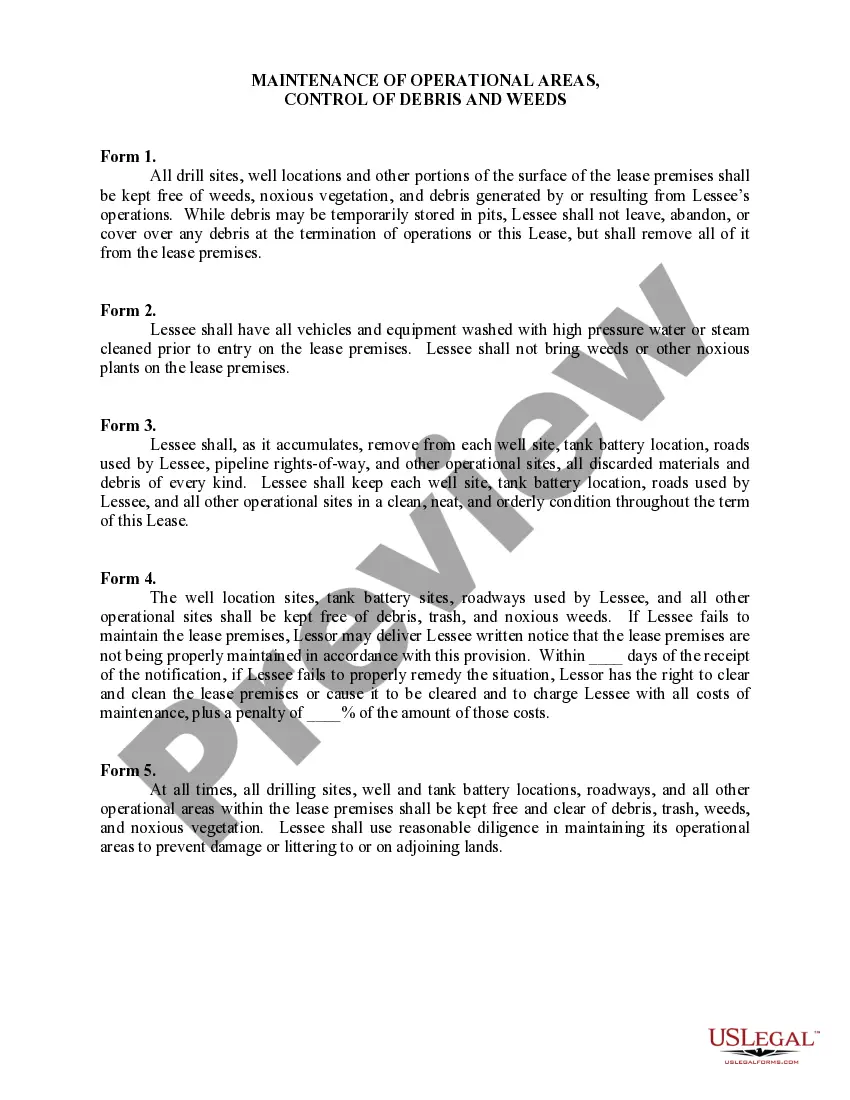
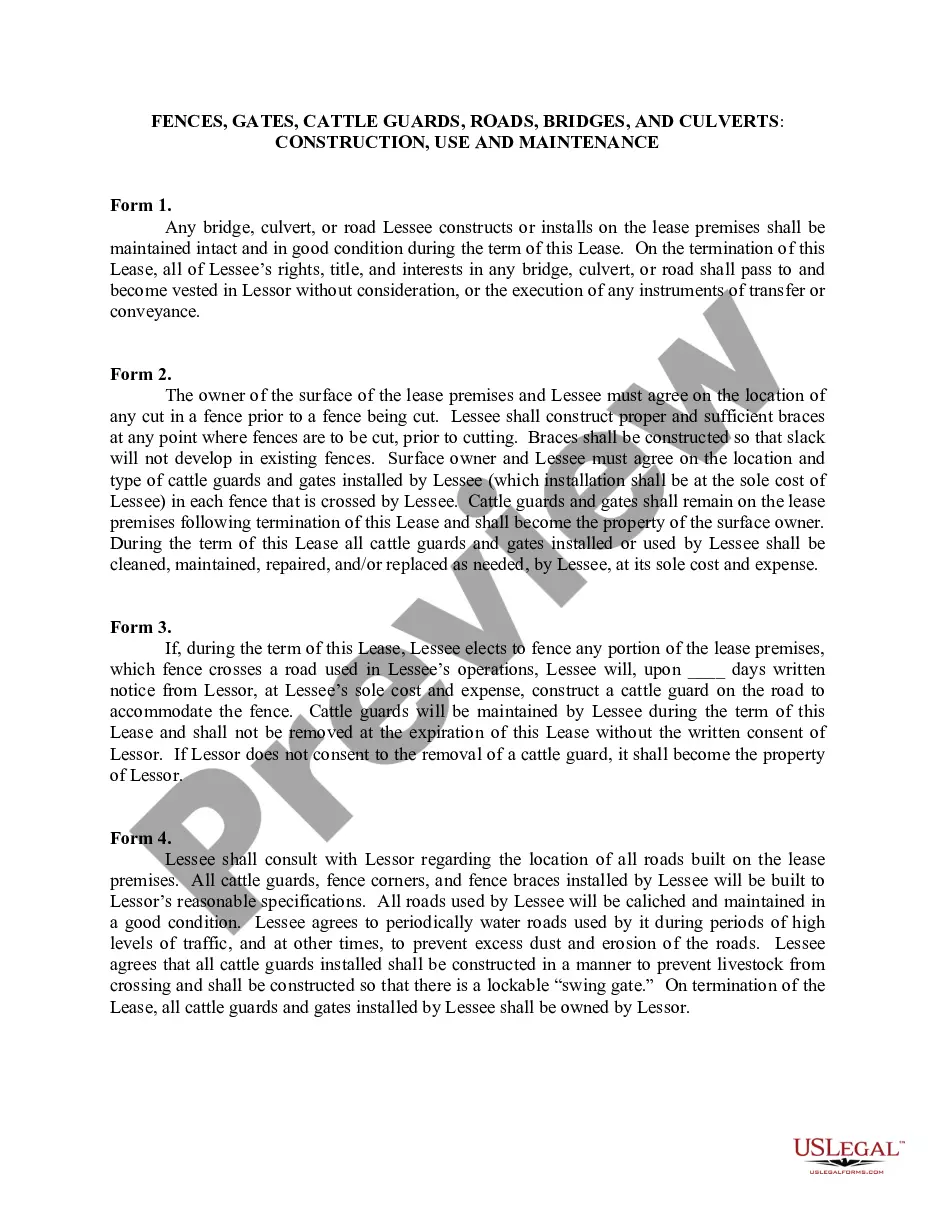
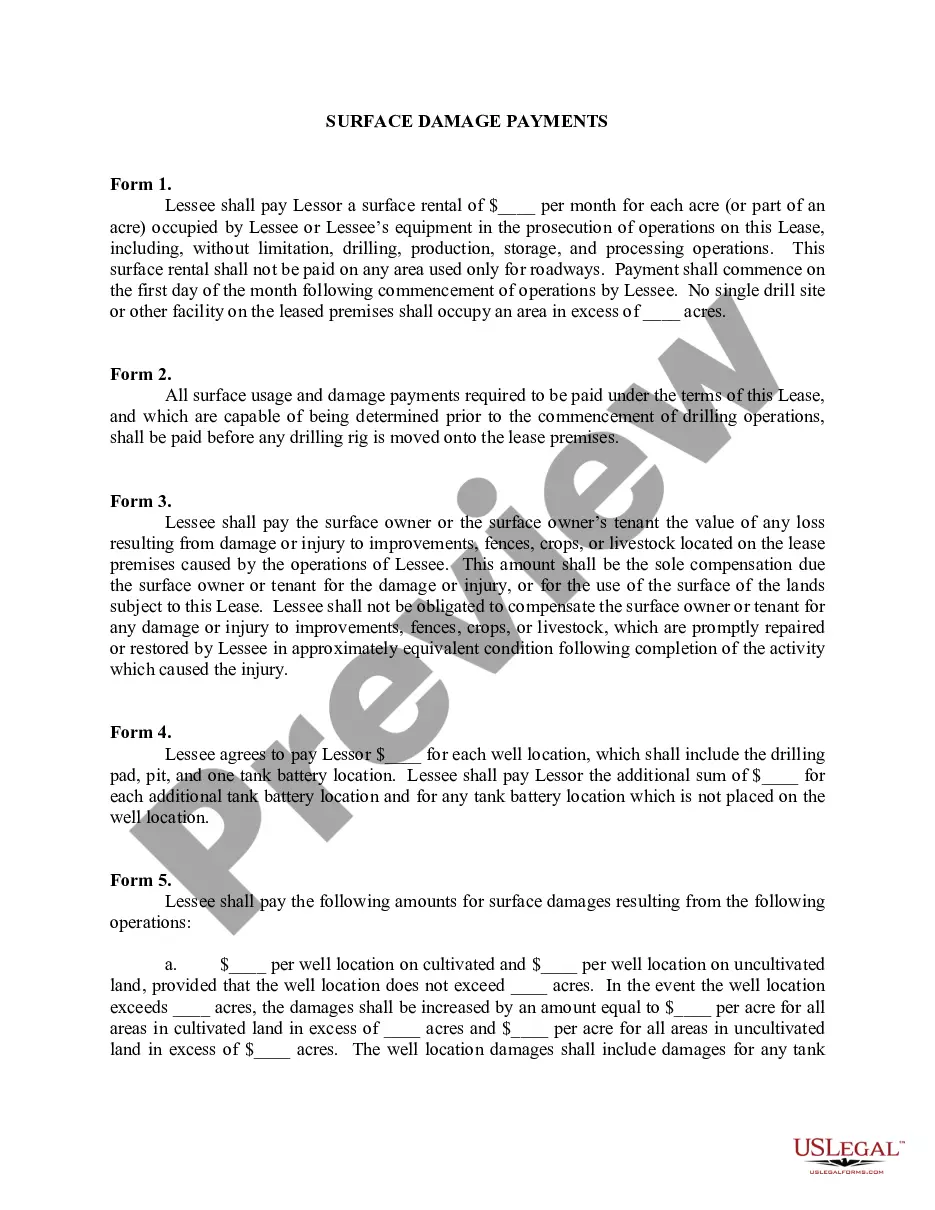
The Maintenance of Operational Areas, Control of Debris and Weeds form is designed to establish guidelines for maintaining clean and safe drilling sites throughout the duration of an oil and gas lease. This legal form helps property owners ensure that lessees take responsibility for keeping their operational areas free from debris, noxious weeds, and other unwanted materials, differentiating it from standard lease agreements that may not address environmental concerns specifically.
Form components explained
- Contractual obligation for lessees to keep drill sites, well locations, and lease premises free of weeds, debris, and noxious vegetation.
- Requirement for lessees to wash vehicles and equipment before entering the leased premises to prevent contamination.
- Clear guidelines for debris removal and site maintenance throughout the lease period.
- Notification procedure for lessors to address maintenance issues, including a timeline for rectification.
- Provision for penalties if maintenance requirements are not met by the lessee.
Situations where this form applies
This form should be utilized in lease transactions related to oil and gas operations when property owners wish to impose specific maintenance responsibilities on lessees. It is especially important if there are concerns about environmental impacts, littering, or the presence of noxious plants during the lease period. This form ensures that both parties have a clear understanding of their responsibilities regarding property upkeep.
Who can use this document
- Property owners who are leasing land for oil and gas exploration and want to include specific maintenance clauses.
- Lessees who wish to understand their obligations for site maintenance and environmental stewardship.
- Legal professionals involved in drafting or reviewing oil and gas leases for clients.
Completing this form step by step
- Clearly identify the lessee and lessor by entering their names and contact information.
- Specify the lease premises and its boundaries to ensure clarity on the property involved.
- Fill in any penalties or deadlines related to the maintenance and cleaning obligations.
- Ensure all vehicles and equipment are documented as having been cleaned before entering the site, if applicable.
- Review the completed form with legal counsel to ensure compliance with local laws.
Notarization requirements for this form
Notarization is generally not required for this form. However, certain states or situations might demand it. You can complete notarization online through US Legal Forms, powered by Notarize, using a verified video call available anytime.
Get your form ready online
Our built-in tools help you complete, sign, share, and store your documents in one place.
Make edits, fill in missing information, and update formatting in US Legal Forms—just like you would in MS Word.
Download a copy, print it, send it by email, or mail it via USPS—whatever works best for your next step.
Sign and collect signatures with our SignNow integration. Send to multiple recipients, set reminders, and more. Go Premium to unlock E-Sign.
If this form requires notarization, complete it online through a secure video call—no need to meet a notary in person or wait for an appointment.
We protect your documents and personal data by following strict security and privacy standards.

Make edits, fill in missing information, and update formatting in US Legal Forms—just like you would in MS Word.

Download a copy, print it, send it by email, or mail it via USPS—whatever works best for your next step.

Sign and collect signatures with our SignNow integration. Send to multiple recipients, set reminders, and more. Go Premium to unlock E-Sign.

If this form requires notarization, complete it online through a secure video call—no need to meet a notary in person or wait for an appointment.

We protect your documents and personal data by following strict security and privacy standards.
Common mistakes
- Failing to clearly define maintenance responsibilities, leading to confusion about obligations.
- Not specifying timelines for cleanup and maintenance efforts.
- Overlooking the requirement to communicate maintenance issues promptly, which may lead to penalties.
- Using outdated versions of the form that do not comply with current state or federal regulations.
Why use this form online
- Easy access to up-to-date legal form templates that are drafted by licensed attorneys.
- Ability to download and edit the form to suit specific lease needs before finalizing.
- A quick and convenient process, allowing users to complete the necessary paperwork from anywhere.
- Reliable formatting that ensures all required legal elements are included, reducing the risk of errors.
Legal use & context
- This form can bolster enforceability by clearly defining obligations and expectations.
- Failure to adhere to the maintenance requirements may result in penalties or lease termination.
- The form is designed to protect both the lessee's operational interests and the lessor's property rights.
What to keep in mind
- The form is crucial for maintaining property standards during oil and gas operations.
- It outlines essential responsibilities for site maintenance and debris control.
- Both lessors and lessees benefit from clear terms regarding property upkeep.
Looking for another form?

Form popularity
FAQ
Add pest-resistant plants to the sun/shade and soil conditions they like. Remove diseased plants, and compost dead plants in fall to reduce hiding places for insect pests. Pull weeds before they distribute their seeds and spread. Use a variety of plants, so if pests attack one plant, other plants can fill its place.
Bioagent like insects, pathogen etc., and other animals are used to control weeds. Insect and pathogens infest weeds and they either reduce growth or kill weeds. Biological control method can reduce weeds but it is not possible to eradicate weeds.
Weed control is important in agriculture. Methods include hand cultivation with hoes, powered cultivation with cultivators, smothering with mulch, lethal wilting with high heat, burning, and chemical control with herbicides (weed killers).
Weeds need to be controlled from planting until the crop canopy closes. With 2-3 cm of water in the field, start using a rotating hoe when emerged weeds are young (3- to 4-leaf stage). Repeat the hoeing one to two more times at 20-22 and 30-32 DAT or 30-32 and 40-42 DAS.
Let sleeping weeds lie. Kill weeds at their roots but leave the soiland dormant weed seedslargely undisturbed. Mulch, mulch, mulch. Don't give weeds the chance to see the light. Weed when the weeding's good. Lop off their heads. Mind the gaps between plants. Water the plants you want, not the weeds you've got.
Such methods include pulling, digging, disking, plowing and mowing. Success of various mechanical control methods is dependent on the life cycle of the target weed species.
Mechanical method- Involves pulling out weeds with hands or by ploughing. Weeds can also be removed using a big comb-like harrow or using a trowel.Biological method: involves the deliberate use of insects or some other organisms which consume and specifically destroy weed plants.
Blanket layers of cardboard paper and newspapers. Plants will grow when they have sunshine and water. Spray concentrated vinegar directly on weeds. Use your trusty assistant, liquid detergent soap. Spread some corn gluten meal around your plants. Scald the weeds with boiling water.
Preventative Weed Control. Cultural Weed Control. Mechanical Weed Control. Biological Weed Control. Chemical Weed Control.