Designation of Unit
What is this form?
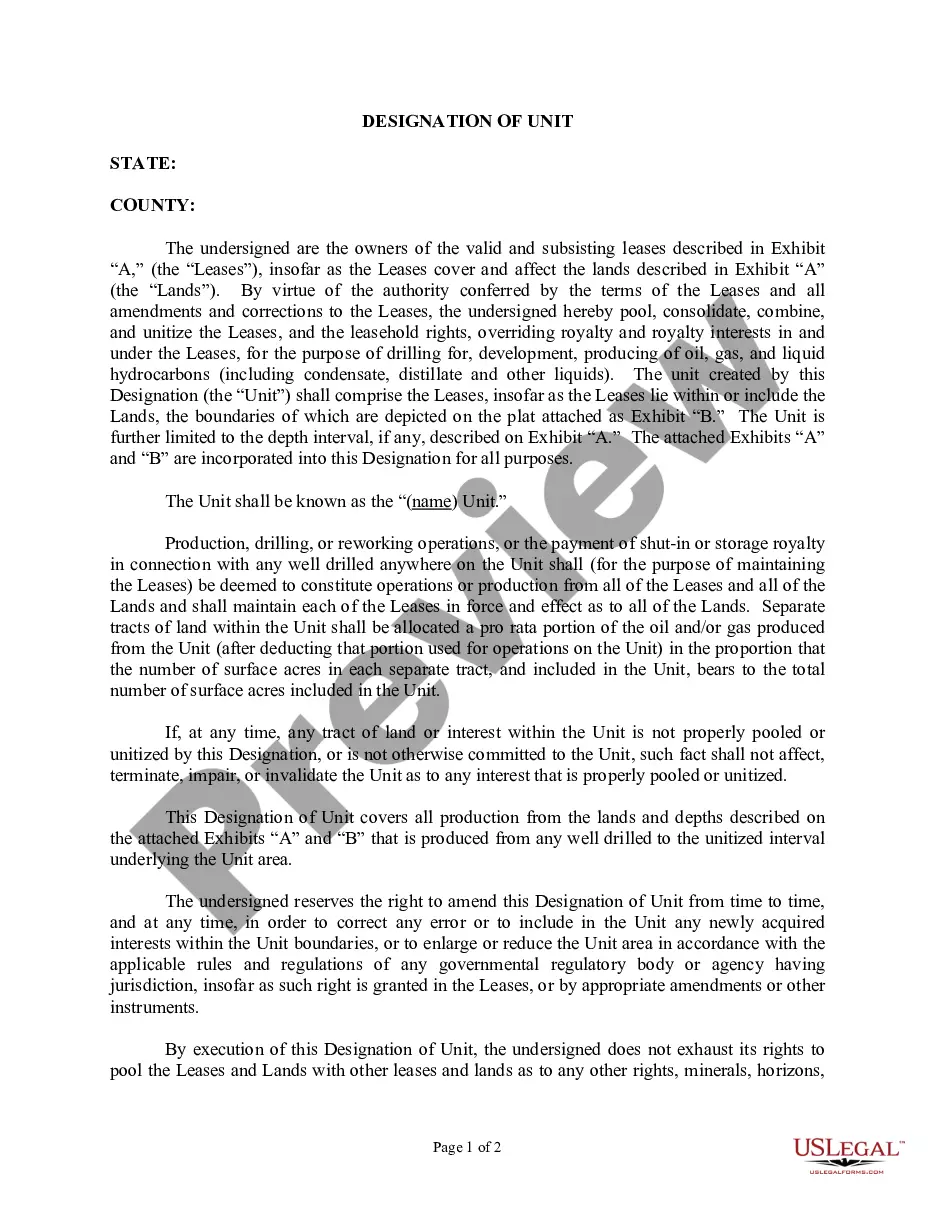
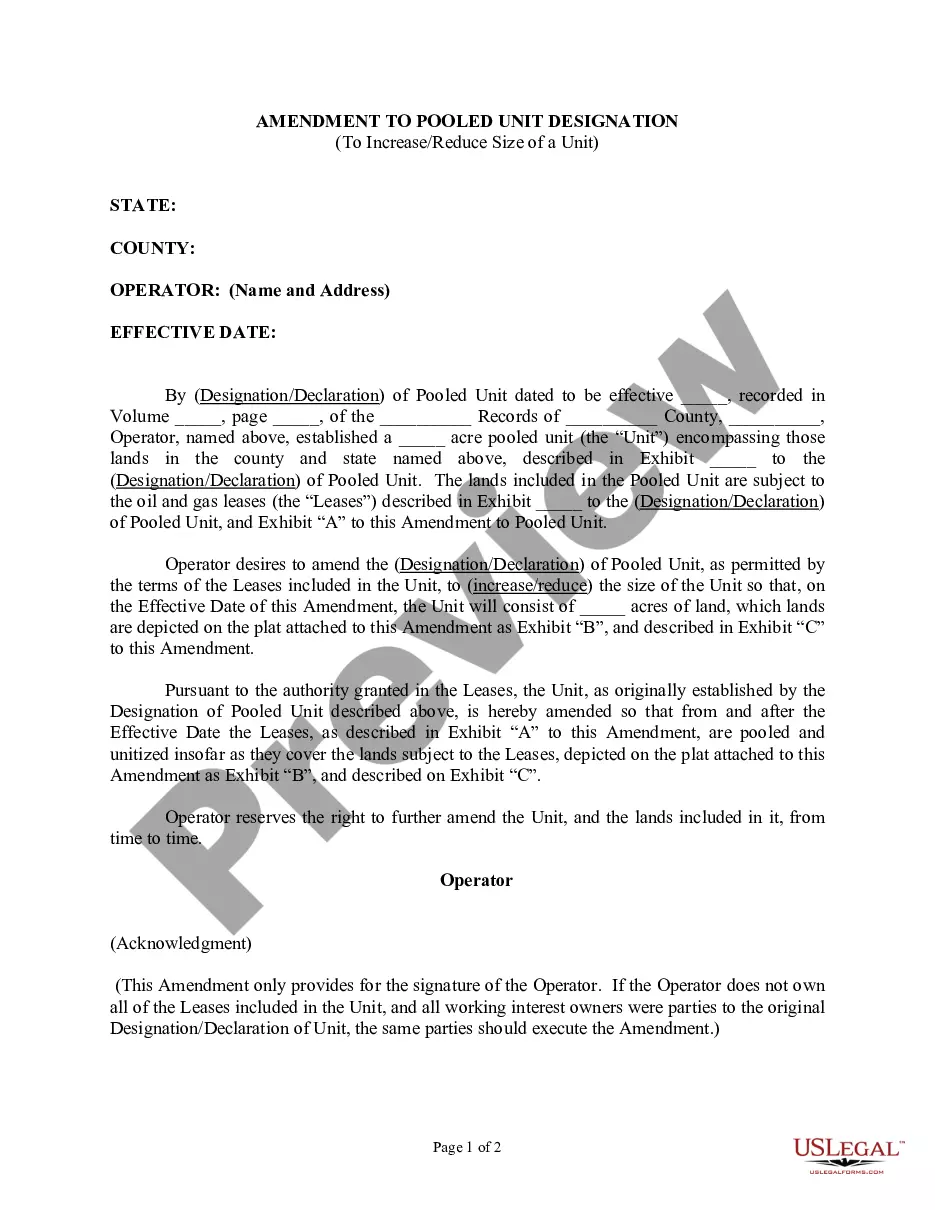
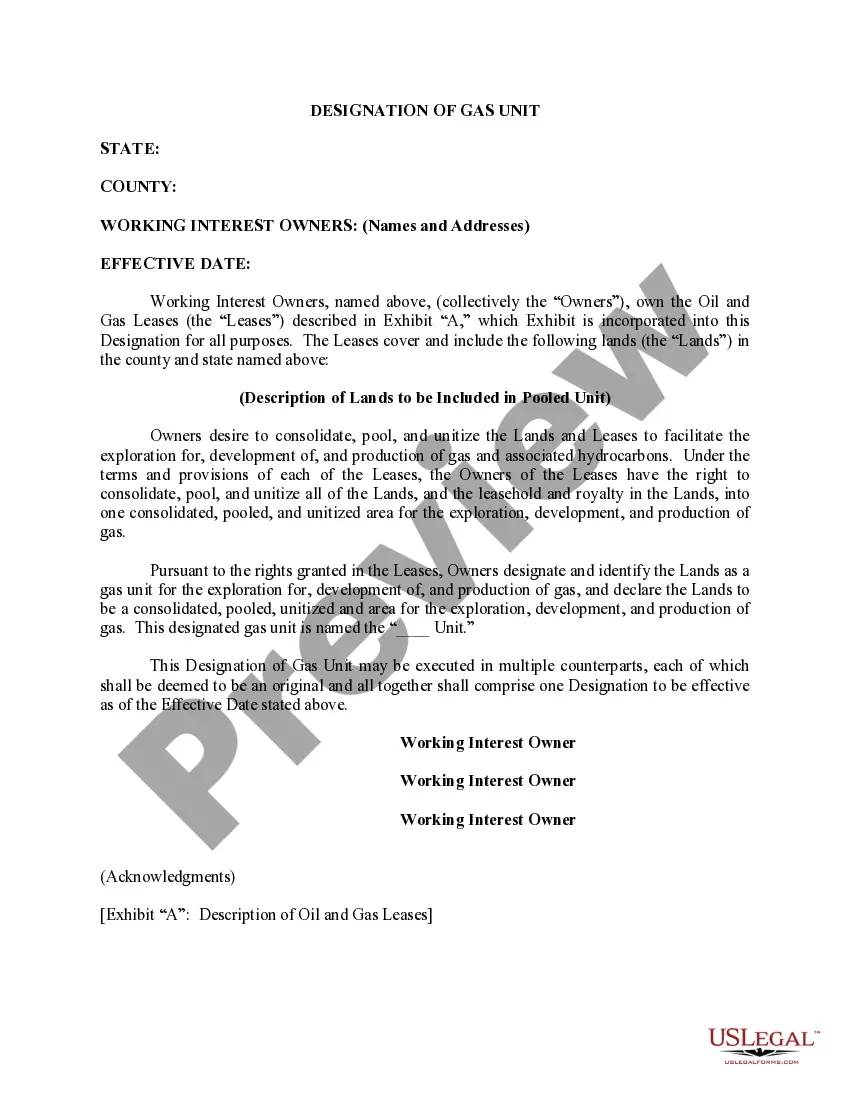
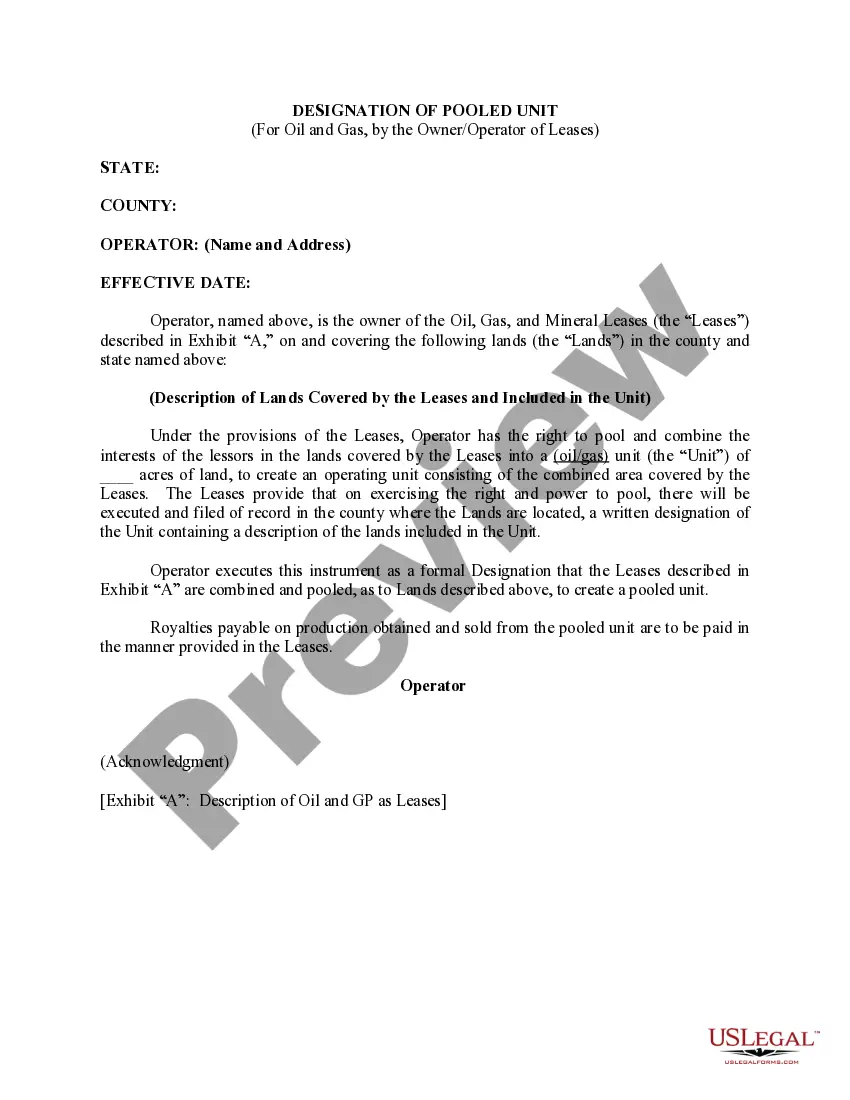
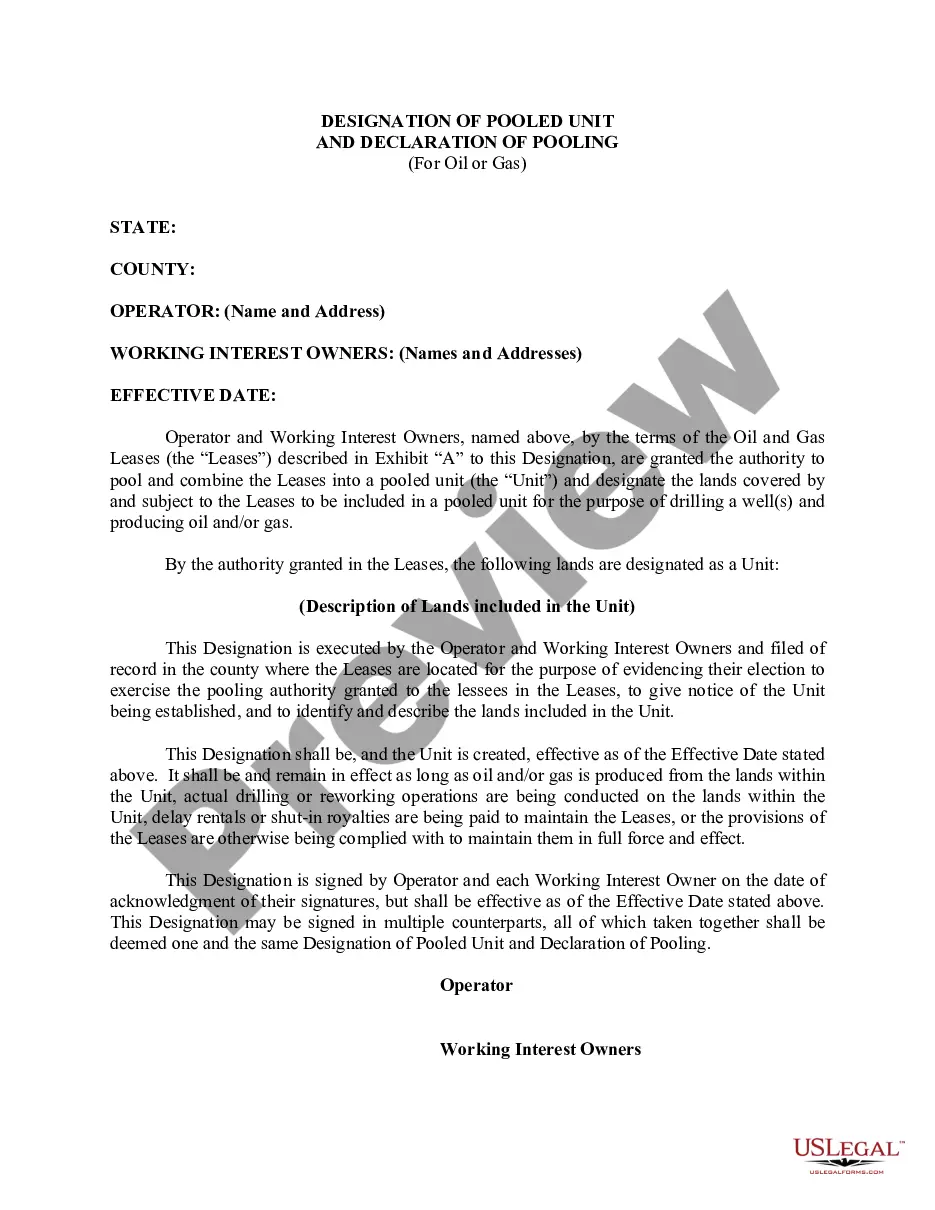
The Designation of Unit form is a legal document used by lease owners to pool, consolidate, and unitize their leases that cover specific lands for oil, gas, and liquid hydrocarbons production. This form facilitates coordinated drilling and production efforts by creating a defined unit from the pooled leases. Unlike individual lease agreements, this designation allows for shared operations and revenue distribution among the lease owners within the designated area.
Key parts of this document
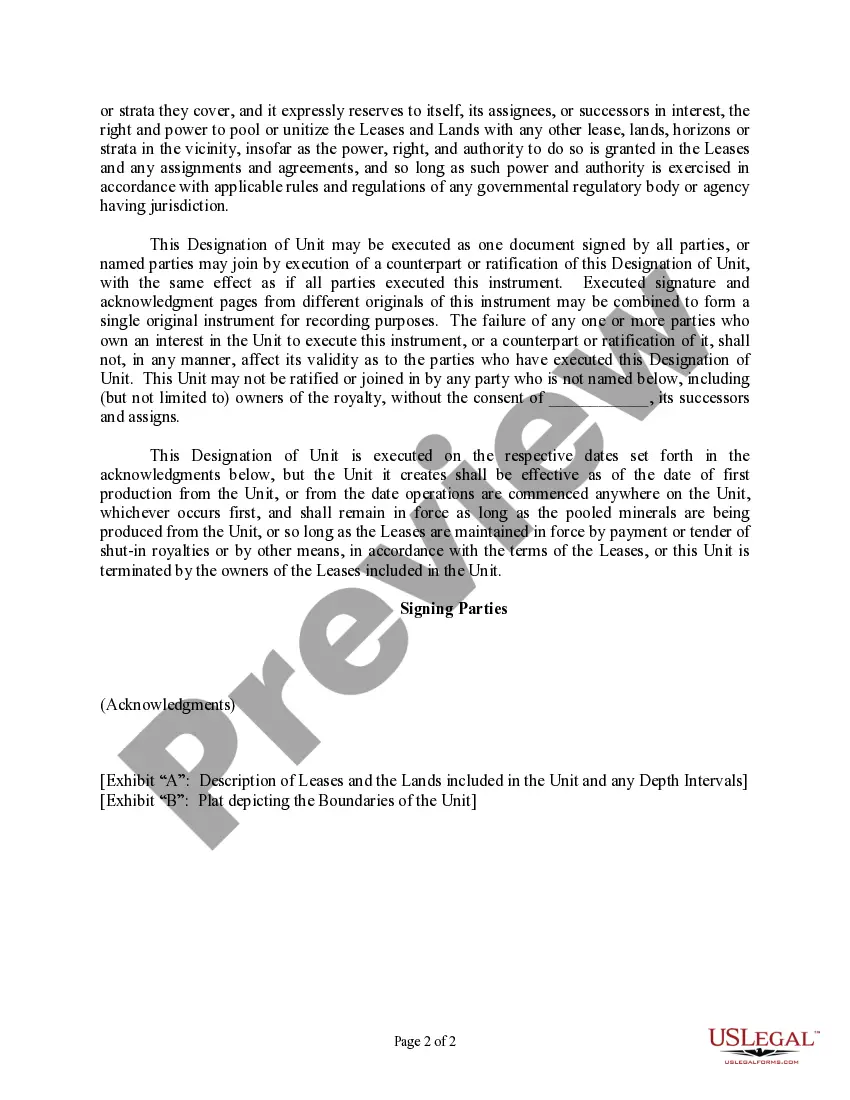
- Statement of lease ownership detailed in Exhibit A.
- Declaration of pooled unit boundaries illustrated in Exhibit B.
- Provisions for production and operations from the unit as a whole.
- Pro rata distribution of resources among separately owned lands.
- Rights for future amendments or adjustments to the unit.
Situations where this form applies
This form is typically used when multiple leaseholders want to consolidate their interests in certain lands to streamline the process of drilling, production, and revenue sharing. It is particularly useful when starting a new drilling operation or when existing leases need to be amended to reflect new ownership combinations or operational frameworks.
Who this form is for
- Leaseholders who own rights to lands with existing leases.
- Investors seeking to combine resources for oil and gas production.
- Companies involved in the exploration and production of hydrocarbons.
Instructions for completing this form
- Identify and describe the parties involved in the ownership of the leases.
- Specify the lands and rights covered under the designation in Exhibit A.
- Draw and attach a plat depicting the unit boundaries in Exhibit B.
- State the name of the unit for identification purposes.
- Gather signatures from all parties involved to execute the form.
Notarization requirements for this form
In most cases, this form does not require notarization. However, some jurisdictions or signing circumstances might. US Legal Forms offers online notarization powered by Notarize, accessible 24/7 for a quick, remote process.
Get your form ready online
Our built-in tools help you complete, sign, share, and store your documents in one place.
Make edits, fill in missing information, and update formatting in US Legal Forms—just like you would in MS Word.
Download a copy, print it, send it by email, or mail it via USPS—whatever works best for your next step.
Sign and collect signatures with our SignNow integration. Send to multiple recipients, set reminders, and more. Go Premium to unlock E-Sign.
If this form requires notarization, complete it online through a secure video call—no need to meet a notary in person or wait for an appointment.
We protect your documents and personal data by following strict security and privacy standards.

Make edits, fill in missing information, and update formatting in US Legal Forms—just like you would in MS Word.

Download a copy, print it, send it by email, or mail it via USPS—whatever works best for your next step.

Sign and collect signatures with our SignNow integration. Send to multiple recipients, set reminders, and more. Go Premium to unlock E-Sign.

If this form requires notarization, complete it online through a secure video call—no need to meet a notary in person or wait for an appointment.

We protect your documents and personal data by following strict security and privacy standards.
Common mistakes
- Failing to include complete and accurate descriptions of the leases and lands.
- Omitting signatures from all required parties, which may invalidate the form.
- Not attaching the required Exhibits A and B, which are essential for clarity.
Why use this form online
- Convenient access to legal templates prepared by licensed attorneys.
- Edit and customize your documents to suit specific needs easily.
- Secure downloads that save time and reduce the need for physical paperwork.
Legal use & context
- The Designation of Unit is recognized under legal frameworks governing land and mineral rights.
- Pooling agreements must comply with regional regulations to ensure enforceability.
Summary of main points
- The Designation of Unit form is essential for lease consolidation in oil and gas production.
- It streamlines operations and facilitates better resource management among leaseholders.
- Ensure all details are accurate and include the required exhibits for legal effectiveness.
Looking for another form?

Form popularity
FAQ
Military unit, a group having a prescribed size and a specific combat or support role within a larger military organization.
Divisions numbered 1-25 are Regular Army. 26-75 are National Guard. 76 and above, National Army. At the time, each infantry division contained four infantry regiments, held in two brigades, and three artillery regiments, in one field artillery brigade.
A special designation in the United States Army is a "nickname granted to a military organization" which has been authorized by the Center of Military History and recognized through a certificate signed by the Chief of Military History.
A Ground Attack ("A" is from Attack) B Bomber. C Transport ("C" from Cargo mover) E Special Electronic Installation ("E" stands for the addition of extensive Electronic equipment) F Fighter (air combat, think of the "F" for Fighting/dogFighting)
For example, before the new system, the Army Air Force used the "P" designation, which stood for pursuit, on a wide variety of its fighter aircraft, like the P-51 Mustang, P-47 Thunderbolt and P-38 Lightning. The Navy, though, used the "F" designation for its fighter aircraft.
Unit designation means the number, letter or combination thereof designating a unit in the declaration and on the plat.
There are five Army command relationships: organic, assigned, attached, operational control (OPCON), and tactical control (TACON).
Parent units All units that have held a command position over this unit.
The designation of a unit usually consists of a number, a branch or function, and a level of command.Parent regiments organized under the Combat Arms Regimental System (CARS) or U.S. Army Regimental System (USARS) consist of a variable number of active elements, depending upon Army force structure requirements.