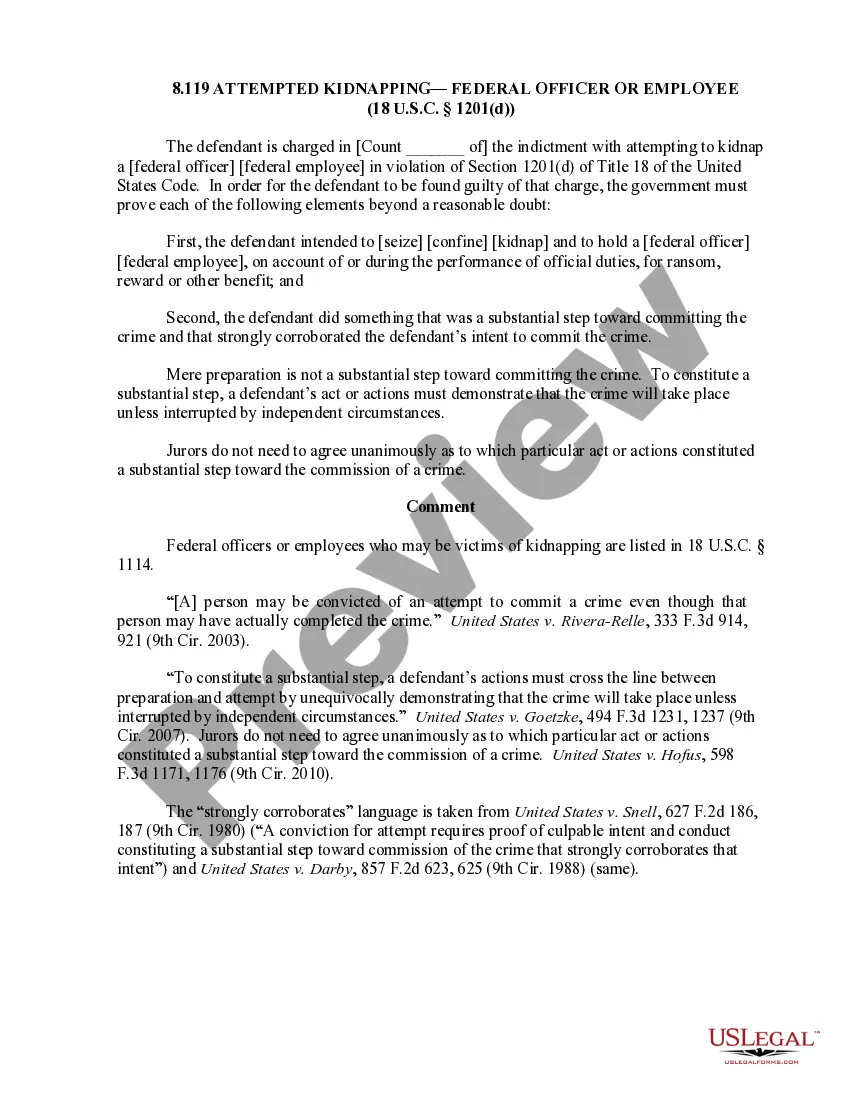
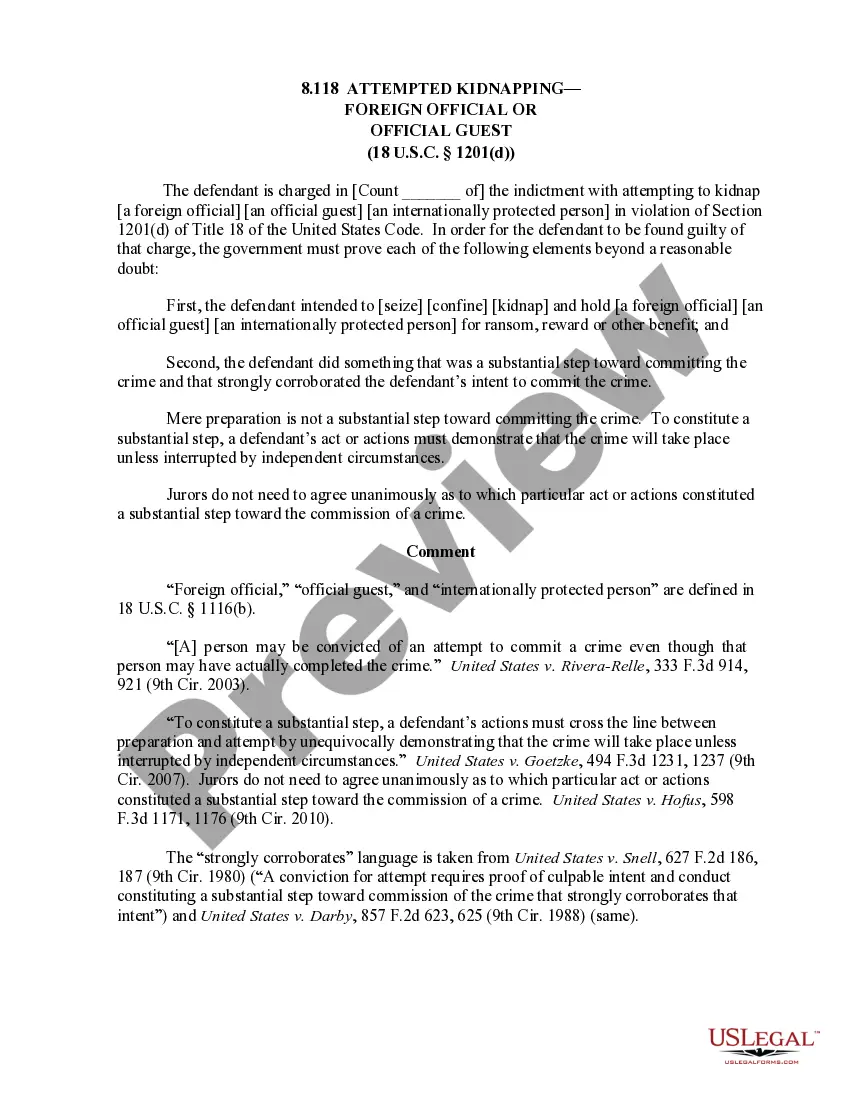
8.119 Attempted Kidnapping-Federal Officer or Employee (18 U.S.C. Sec. 1201(d)
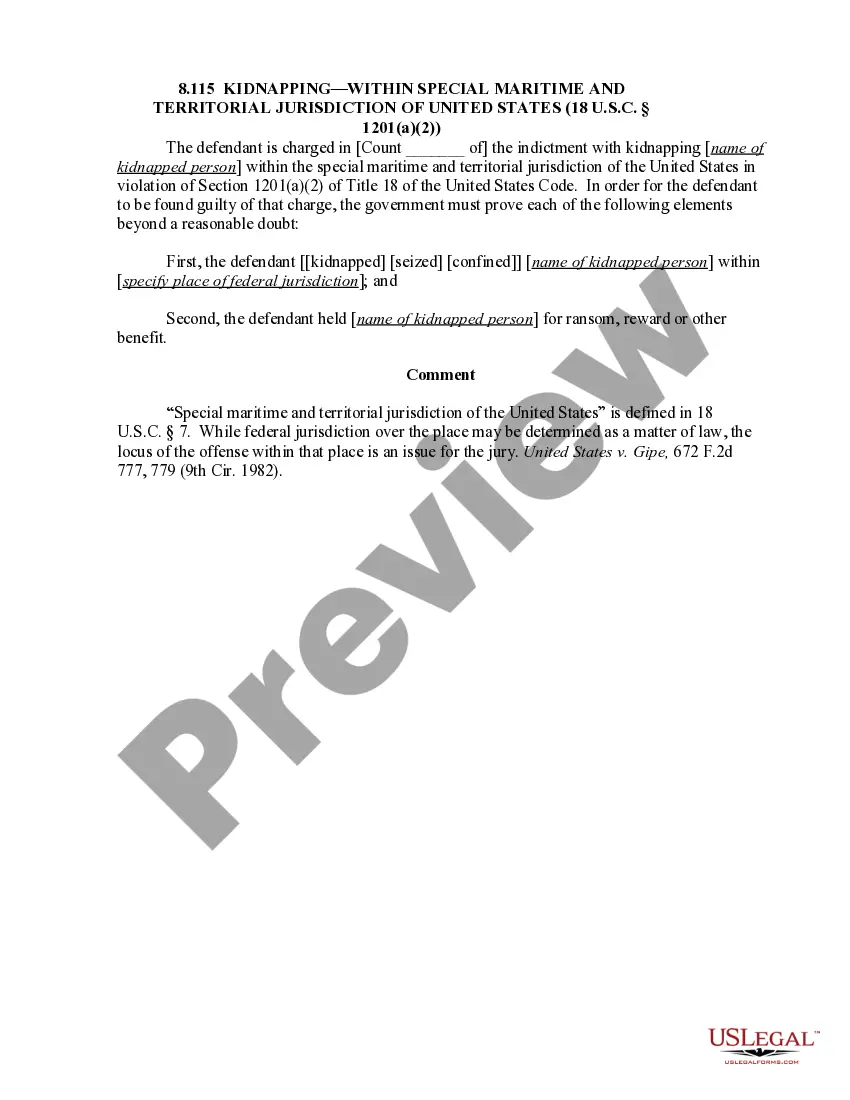
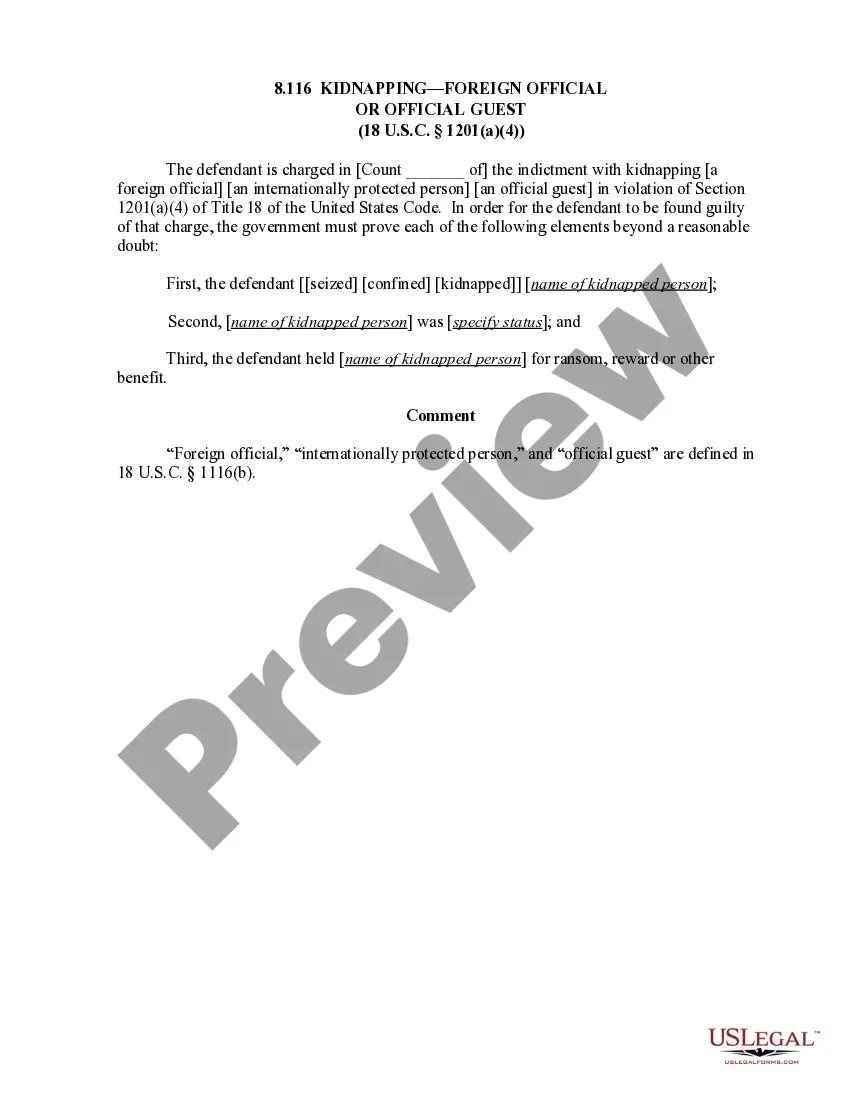
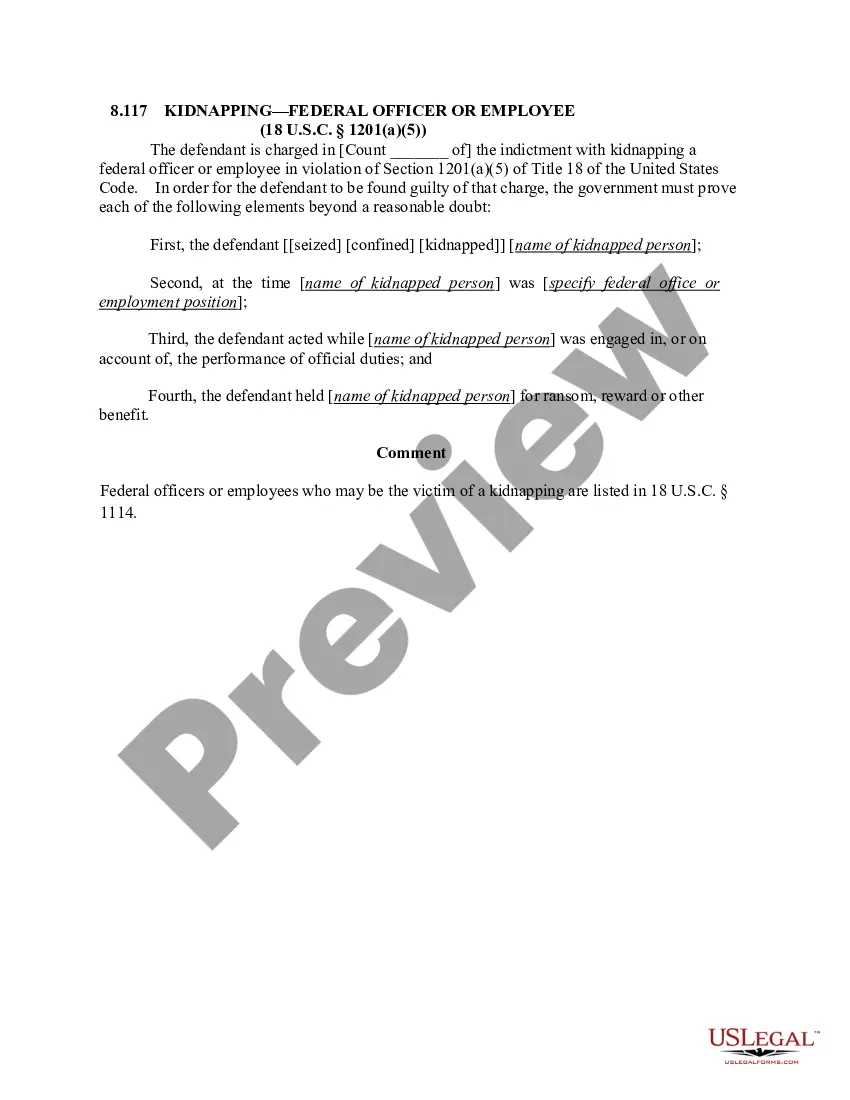
Notarization guidance
Notarization is not commonly needed for this form. However, certain documents or local rules may make it necessary. Our notarization service, powered by Notarize, allows you to finalize it securely online anytime, day or night.
Get your form ready online
Our built-in tools help you complete, sign, share, and store your documents in one place.
Make edits, fill in missing information, and update formatting in US Legal Forms—just like you would in MS Word.
Download a copy, print it, send it by email, or mail it via USPS—whatever works best for your next step.
Sign and collect signatures with our SignNow integration. Send to multiple recipients, set reminders, and more. Go Premium to unlock E-Sign.
If this form requires notarization, complete it online through a secure video call—no need to meet a notary in person or wait for an appointment.
We protect your documents and personal data by following strict security and privacy standards.

Make edits, fill in missing information, and update formatting in US Legal Forms—just like you would in MS Word.

Download a copy, print it, send it by email, or mail it via USPS—whatever works best for your next step.

Sign and collect signatures with our SignNow integration. Send to multiple recipients, set reminders, and more. Go Premium to unlock E-Sign.

If this form requires notarization, complete it online through a secure video call—no need to meet a notary in person or wait for an appointment.

We protect your documents and personal data by following strict security and privacy standards.
Looking for another form?
Form popularity
FAQ
Kidnapping Elements In most jurisdictions, kidnapping has the elements of criminal act, criminal intent, causation, harm, and an attendant circumstance.
Kidnapping someone for ransom money is defined under the federal statute 18 U.S.C. 1202. As noted, attempted kidnapping results in a prison sentence of up to 20 years; if the kidnapping is successful, it can result in life imprisonment.
In sum, to be guilty of Kidnapping under CPC §207(a), the prosecution must prove that: You took or held someone through force or fear; AND, You moved, or made the person move, a substantial distance; AND, The other person didn't consent; AND, You didn't actually believe the person consented.
In order to be convicted of kidnapping, it is not enough to simply move the victim, you must use physical force, threats of physical harm, or fraud in order to do so. This could include restraining or dragging the victim (force) or threatening the victim with a knife or a gun (fear).
In sum, to be guilty of Kidnapping under CPC §207(a), the prosecution must prove that: You took or held someone through force or fear; AND, You moved, or made the person move, a substantial distance; AND, The other person didn't consent; AND, You didn't actually believe the person consented.
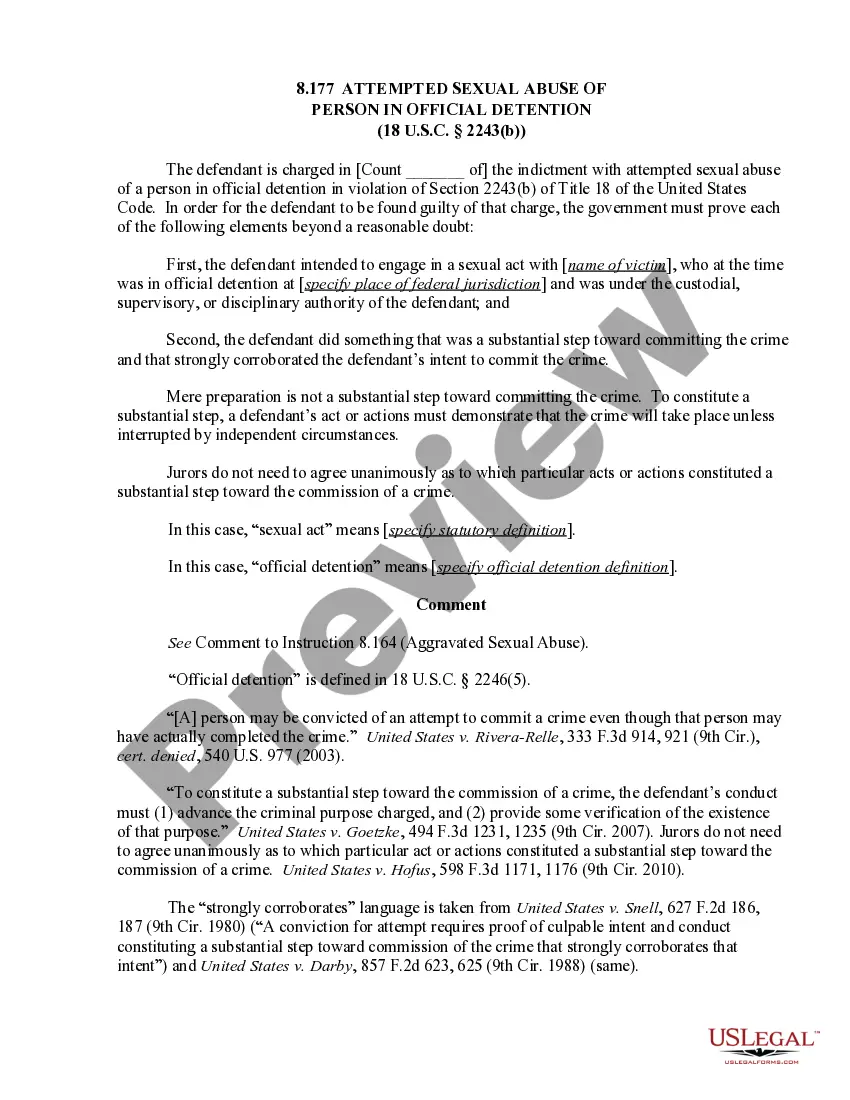
Under 18 USC 1201, a person is guilty of kidnapping who "unlawfully seizes, confines, inveigles, decoys, kidnaps, abducts, or carries away and holds for ransom or reward or otherwise any person."
In situations where the transportation of an individual remains in one state, kidnapping is a state crime. However, it can become a federal crime when certain elements are present ? more specifically, when the offense, in some way, crosses state lines or country borders.
Examples CodeDescription134Kidnapping135Escape136Hold of hostages137Riot29 more rows