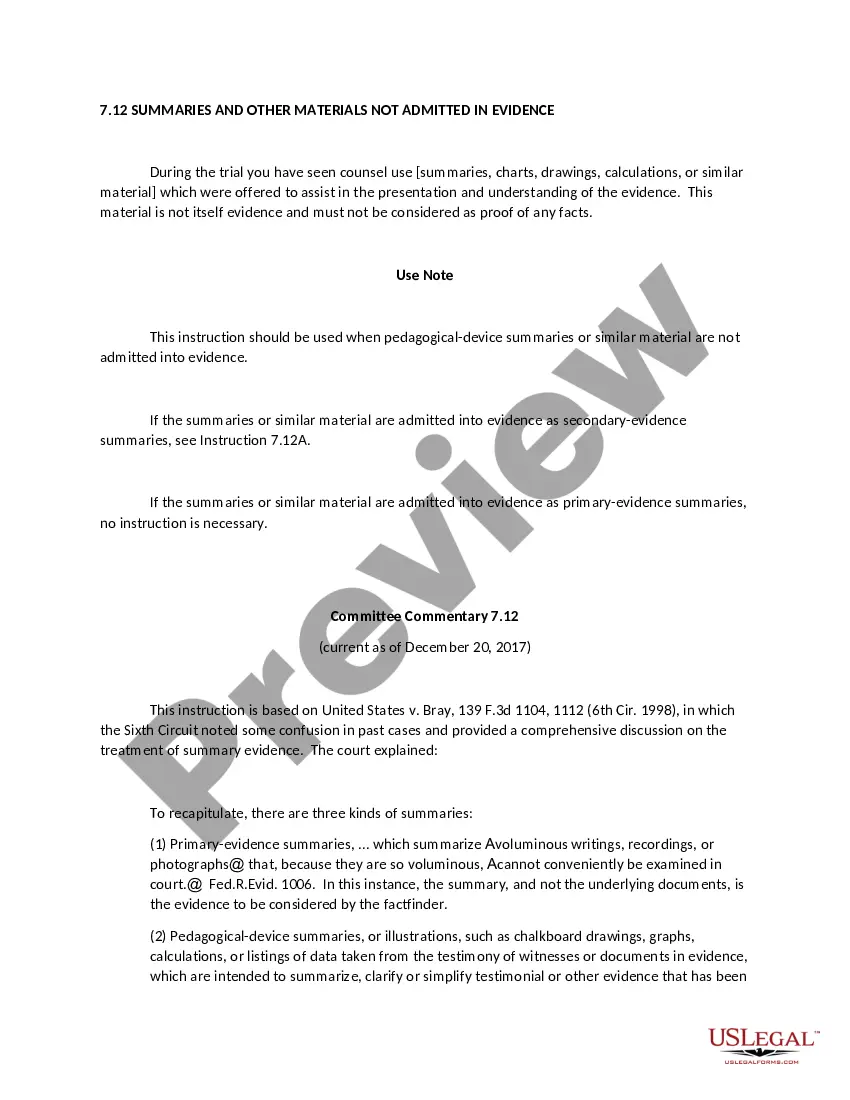
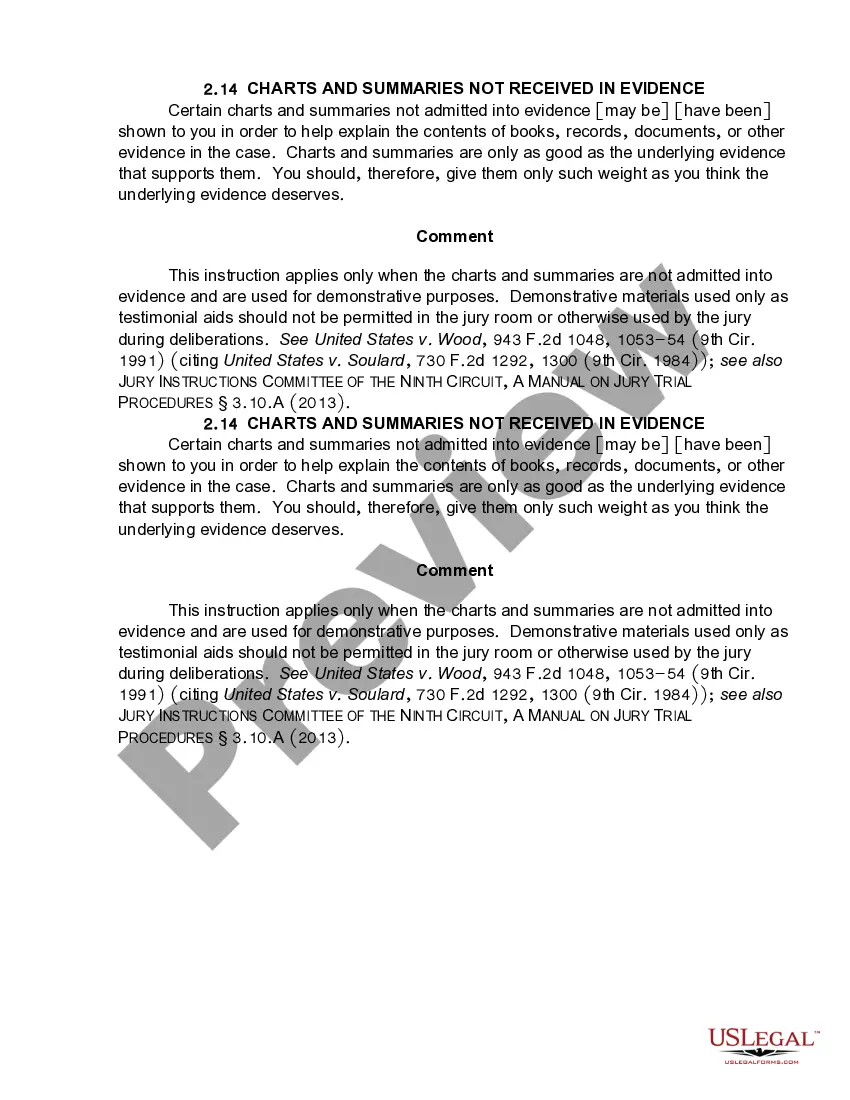
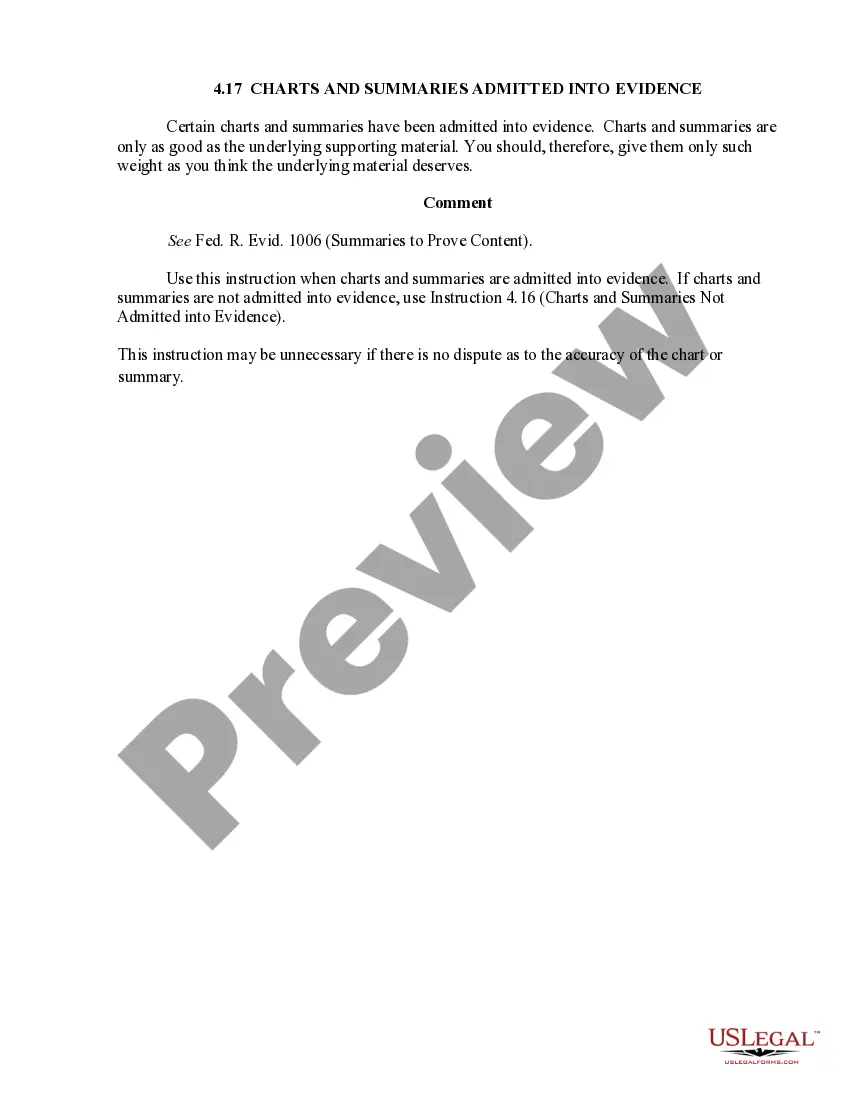
4.16 Charts and Summaries Not Admitted into Evidence

Does this form need to be notarized?
This form does not typically require notarization to be legally valid. However, some jurisdictions or document types may still require it. US Legal Forms provides secure online notarization powered by Notarize, available 24/7 for added convenience.
Get your form ready online
Our built-in tools help you complete, sign, share, and store your documents in one place.
Make edits, fill in missing information, and update formatting in US Legal Forms—just like you would in MS Word.
Download a copy, print it, send it by email, or mail it via USPS—whatever works best for your next step.
Sign and collect signatures with our SignNow integration. Send to multiple recipients, set reminders, and more. Go Premium to unlock E-Sign.
If this form requires notarization, complete it online through a secure video call—no need to meet a notary in person or wait for an appointment.
We protect your documents and personal data by following strict security and privacy standards.

Make edits, fill in missing information, and update formatting in US Legal Forms—just like you would in MS Word.

Download a copy, print it, send it by email, or mail it via USPS—whatever works best for your next step.

Sign and collect signatures with our SignNow integration. Send to multiple recipients, set reminders, and more. Go Premium to unlock E-Sign.

If this form requires notarization, complete it online through a secure video call—no need to meet a notary in person or wait for an appointment.

We protect your documents and personal data by following strict security and privacy standards.
Looking for another form?
Form popularity
FAQ
Circumstantial evidence is generally admissible in court unless the connection between the fact and the inference is too weak to be of help in deciding the case. Many convictions for various crimes have rested largely on circumstantial evidence.
Its disadvantage is that it is indirect: you must piece it all together and then determine whether or not it leads to a reasonable conclusion about the fact which is to be proved.
Circumstantial evidence is generally admissible in court unless the connection between the fact and the inference is too weak to be of help in deciding the case. Many convictions for various crimes have rested largely on circumstantial evidence.
The maxim is simply a translation of the Latin phrase ?falsus in uno, falsus in omnibus.? It currently means that a jury may disregard the testimony of a witness if the jury believes that witness deliberately, or willfully and corruptly, testified falsely about a material issue.
Both direct and circumstantial evidence is legitimate proof that someone committed a crime. In fact, they are common in all state and federal criminal courts. It is a fact that somebody could be convicted of a crime based only on circumstantial proof.
Generally, circumstantial evidence can be admitted in court. However, the courts are careful when the only evidence in a case is circumstantial evidence. Circumstantial evidence must be examined closely and it should be looked at together with other evidence.