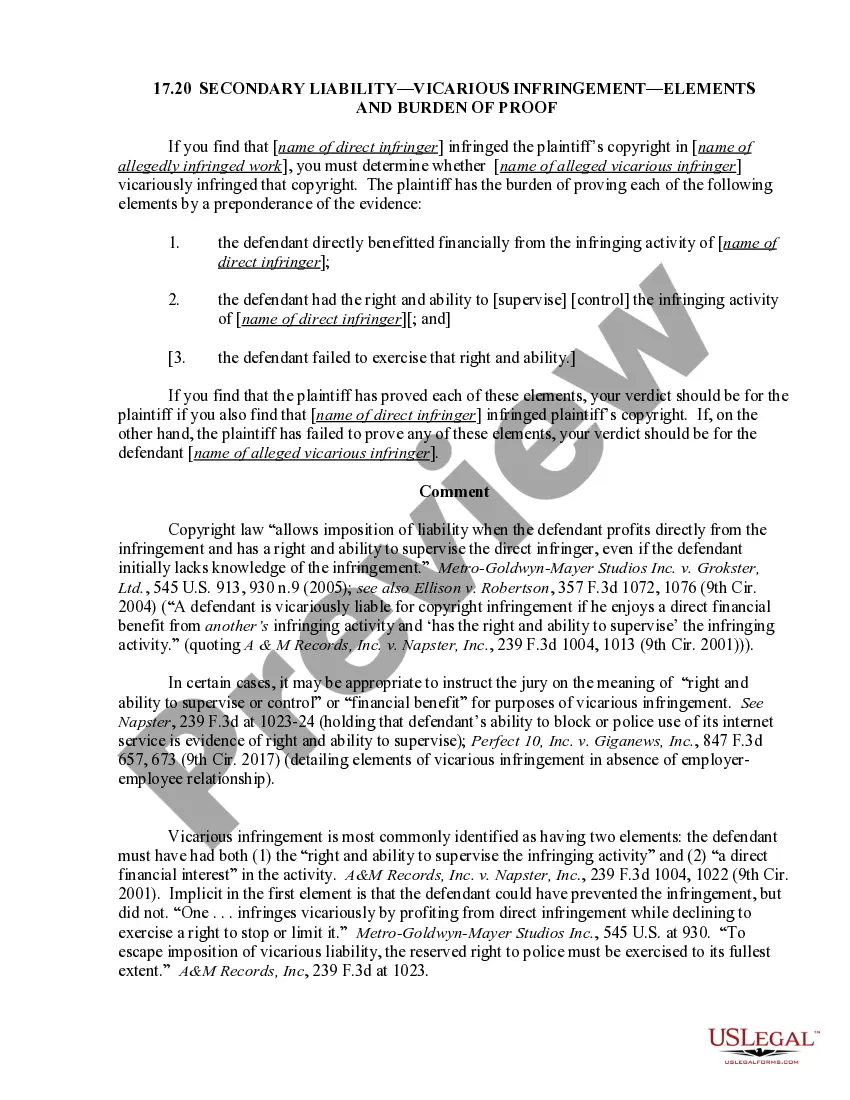
17.20 Secondary Liability-Vicarious Infringement-Elements and Burden of Proof
Notarization requirements for this form
Notarization is generally not required for this form. However, certain states or situations might demand it. You can complete notarization online through US Legal Forms, powered by Notarize, using a verified video call available anytime.
Get your form ready online
Our built-in tools help you complete, sign, share, and store your documents in one place.
Make edits, fill in missing information, and update formatting in US Legal Forms—just like you would in MS Word.
Download a copy, print it, send it by email, or mail it via USPS—whatever works best for your next step.
Sign and collect signatures with our SignNow integration. Send to multiple recipients, set reminders, and more. Go Premium to unlock E-Sign.
If this form requires notarization, complete it online through a secure video call—no need to meet a notary in person or wait for an appointment.
We protect your documents and personal data by following strict security and privacy standards.

Make edits, fill in missing information, and update formatting in US Legal Forms—just like you would in MS Word.

Download a copy, print it, send it by email, or mail it via USPS—whatever works best for your next step.

Sign and collect signatures with our SignNow integration. Send to multiple recipients, set reminders, and more. Go Premium to unlock E-Sign.

If this form requires notarization, complete it online through a secure video call—no need to meet a notary in person or wait for an appointment.

We protect your documents and personal data by following strict security and privacy standards.
Looking for another form?
Form popularity
FAQ
The plaintiff in a copyright infringement lawsuit has the burden of proving two elements: that they own a copyright, and that the defendant infringed it. To establish ownership of a valid copyright, a plaintiff must demonstrate that the work is original, and that it is subject to legal protection.
Access can be established by way of circumstantial evidence. A court will consider either: (1) a particular chain of events that establishes a link between the plaintiff's work and the defendant's access (e.g., dealings with a movie studio or record label), or (2) that the plaintiff's work has been widely disseminated.
Courts usually require a copyright owner to prove that she owned the copyrighted work, and the defendant violated one of the exclusive rights of the copyright owner.
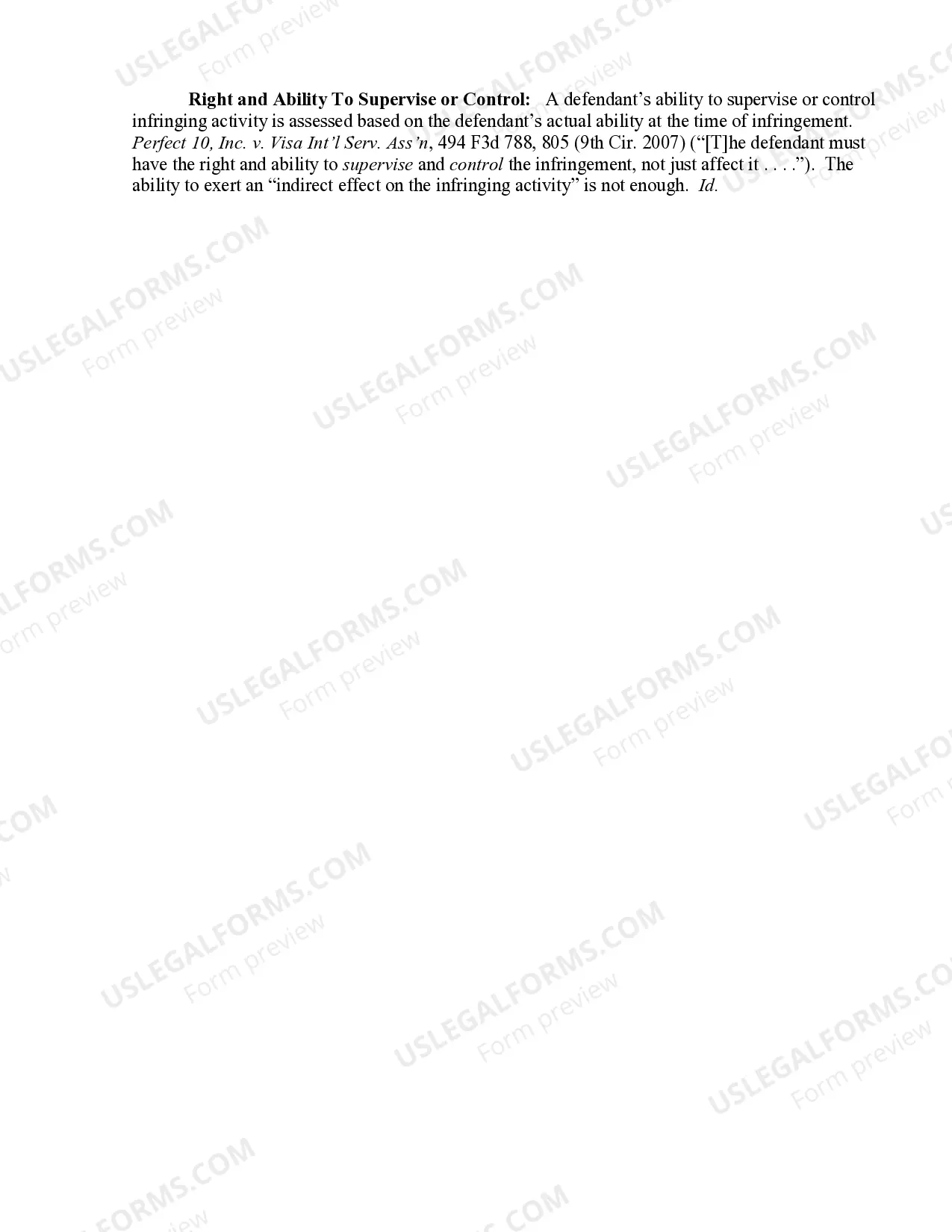
Vicarious infringement is most commonly identified as having two elements: the defendant must have had both (1) the ?right and ability to supervise the infringing activity? and (2) ?a direct financial interest? in the activity.
The three basic elements of copyright: originality, creativity, and fixation. There are three basic elements that a work must possess in order to be protected by copyright in the US: Originality: To get a copyright, a work must be the original work of the author.
There are two types of secondary infringement, contributory and vicarious infringement, neither of which is expressly prohibited under the Copyright Act, but which have arisen as prohibitions under case law.
Caselaw shows that a copyright owner's actual damages may be calculated by showing lost profits or imputing a hypothetical copyright license fee to assess the market value of the copyright. Also, plaintiff's may recover for various indirect damages as a result of the infringement.
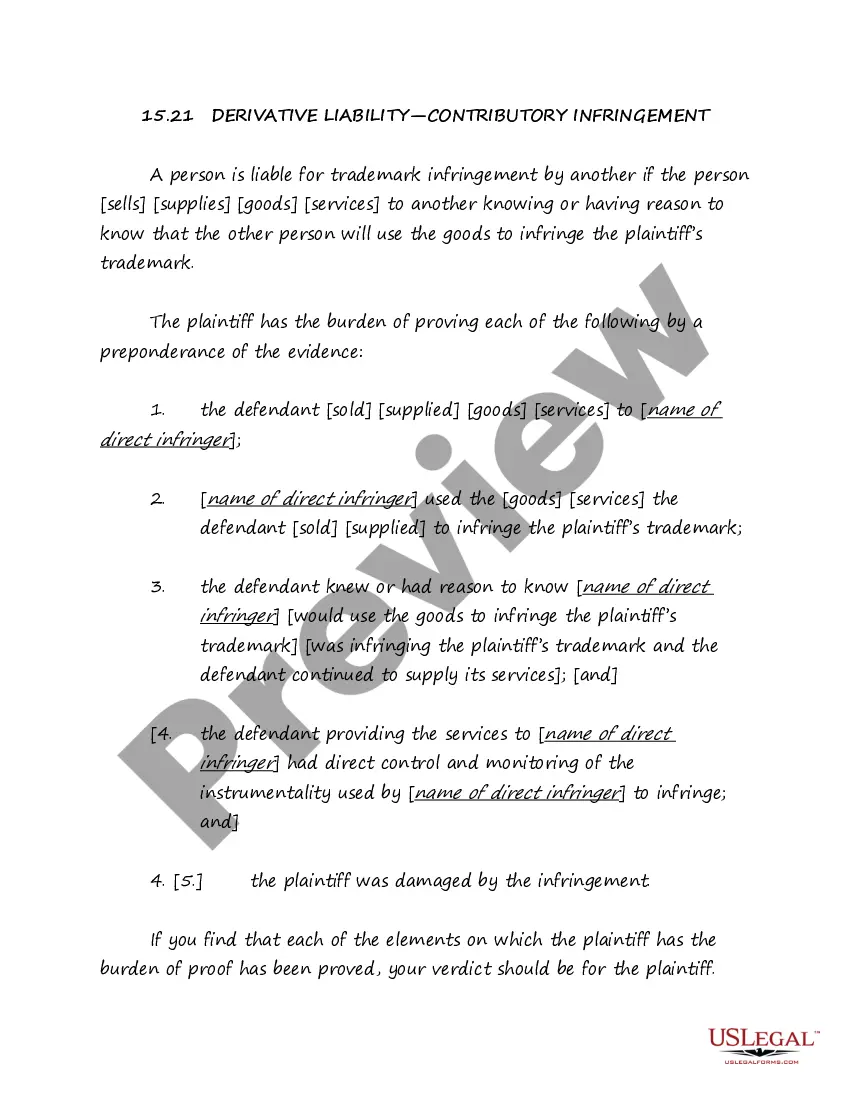
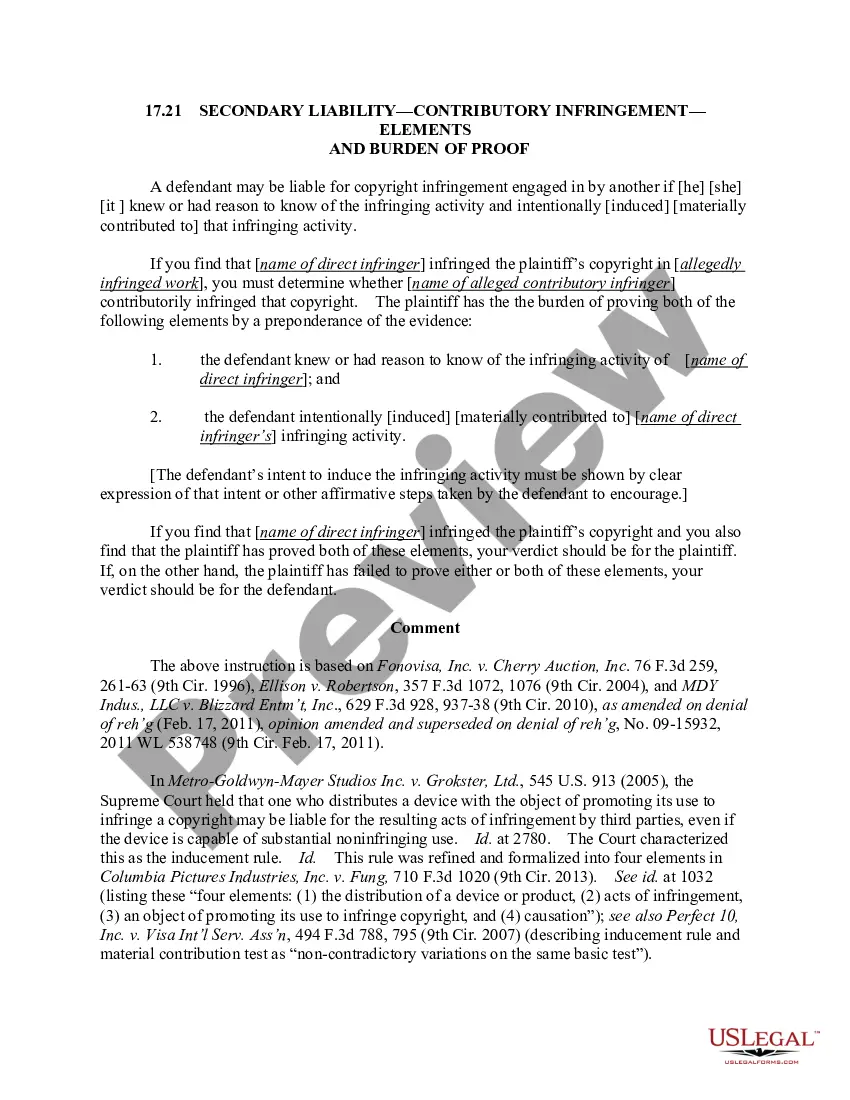
17.21 Derivative Liability?Contributory Infringement?Elements and Burden of Proof. A defendant may be liable for copyright infringement engaged in by another if he she it knew or had reason to know of the infringing activity and intentionally induced materially contributed to that infringing activity.