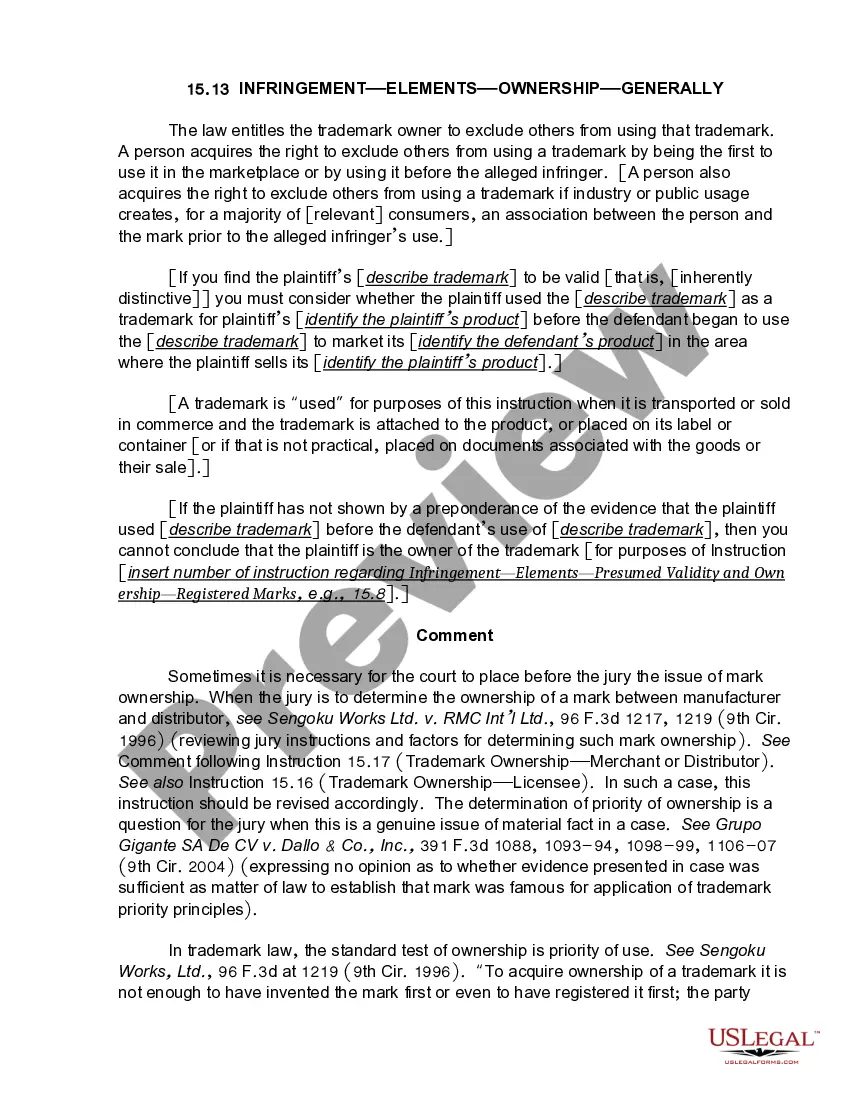
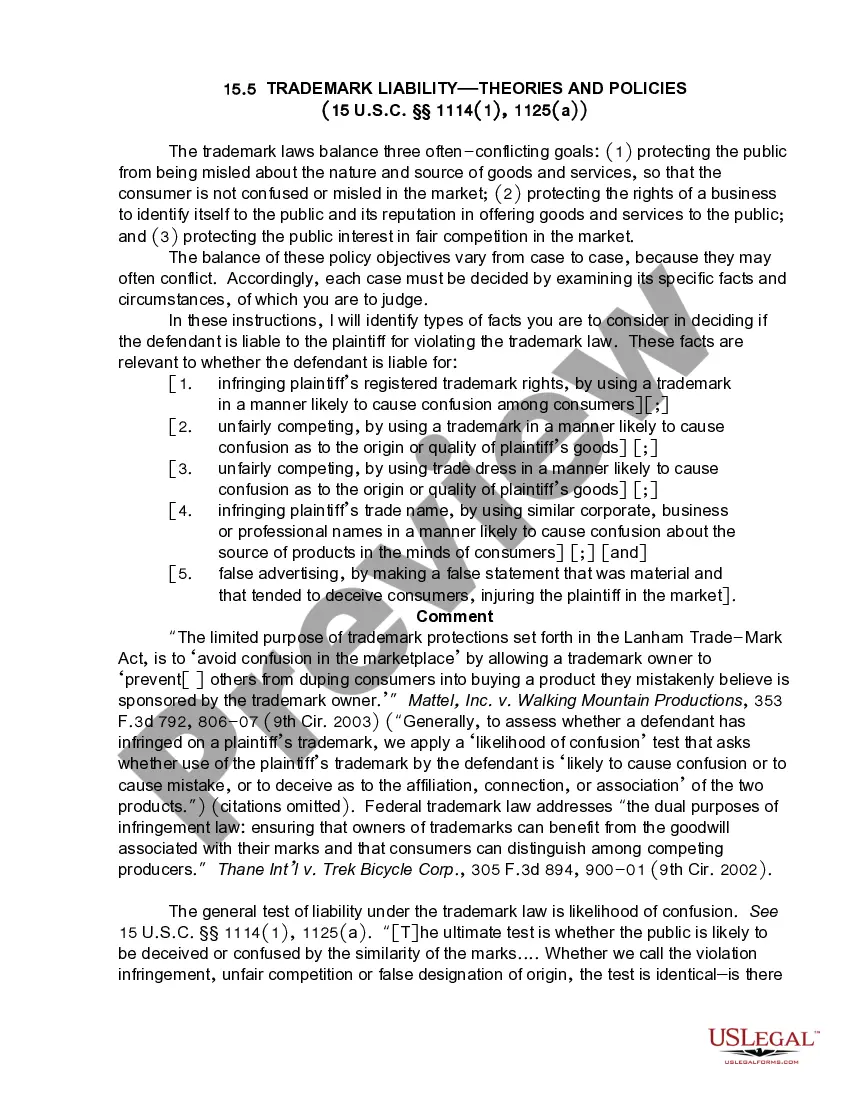
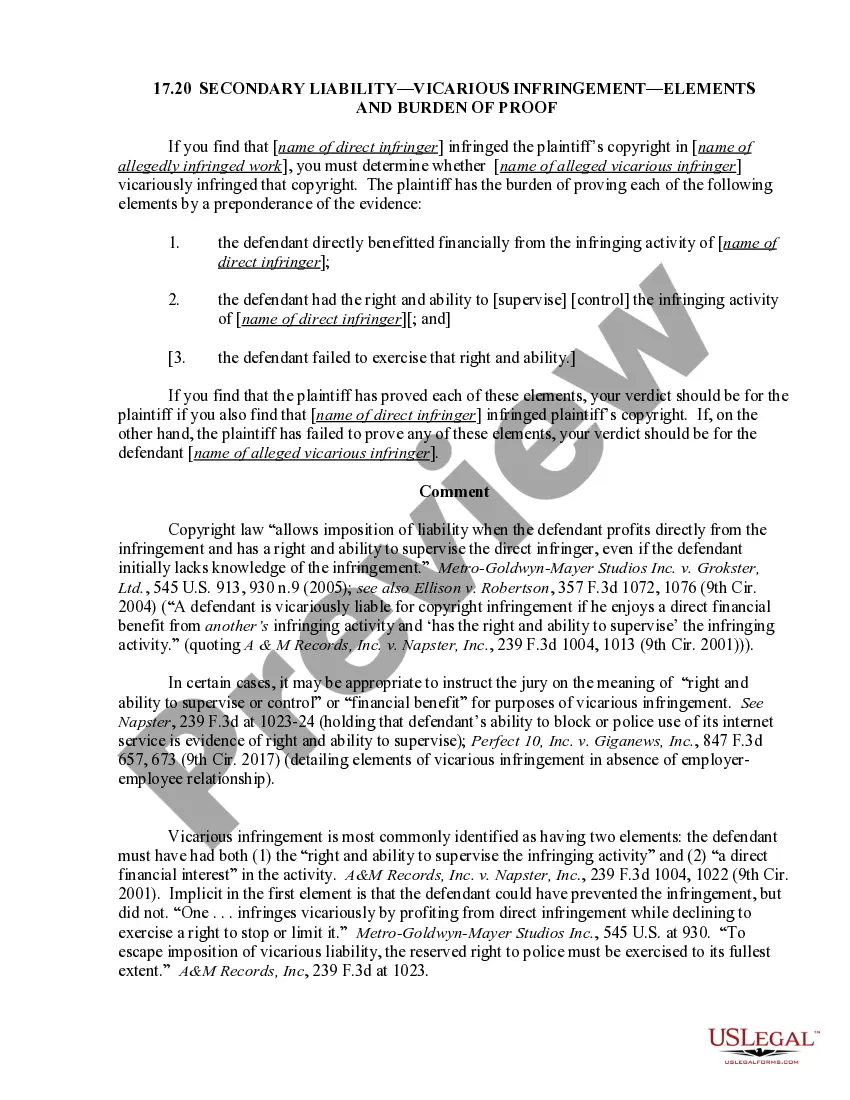
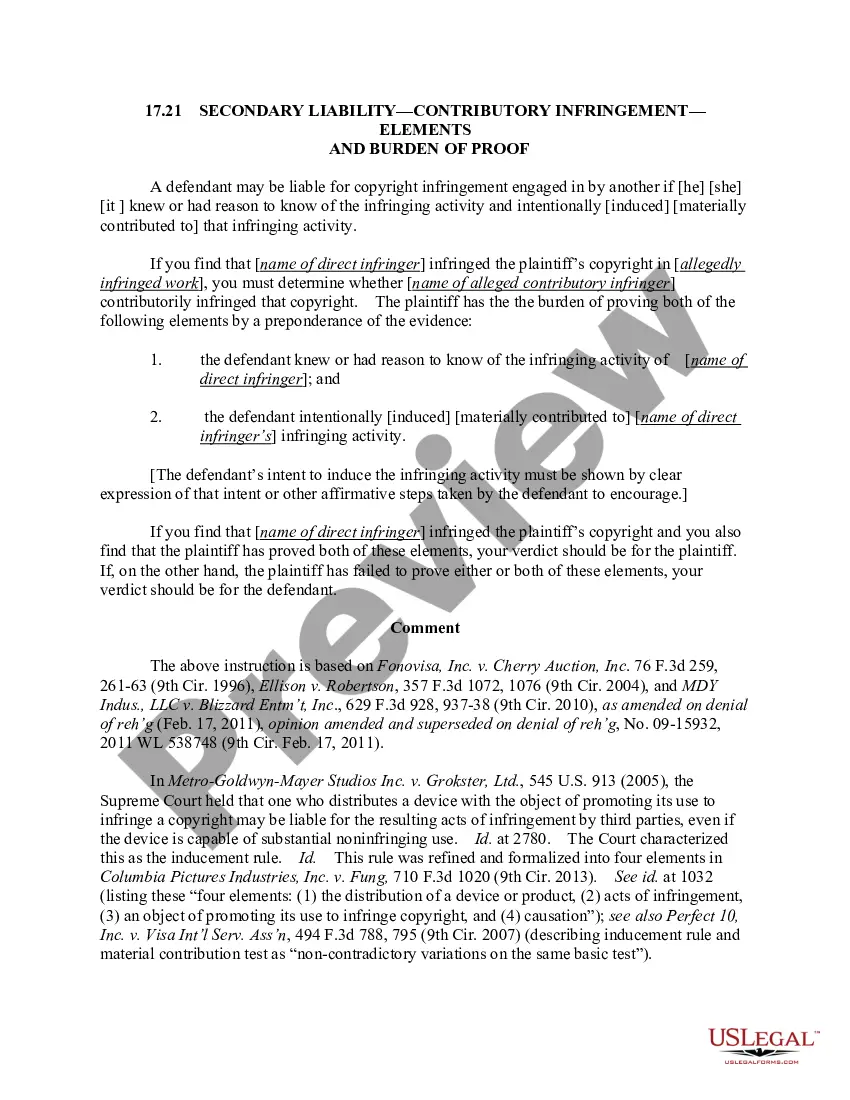
15.20 Derivative Liability-Inducing Infringement
Does this document require notarization?
Notarization is not commonly needed for this form. However, certain documents or local rules may make it necessary. Our notarization service, powered by Notarize, allows you to finalize it securely online anytime, day or night.
Get your form ready online
Our built-in tools help you complete, sign, share, and store your documents in one place.
Make edits, fill in missing information, and update formatting in US Legal Forms—just like you would in MS Word.
Download a copy, print it, send it by email, or mail it via USPS—whatever works best for your next step.
Sign and collect signatures with our SignNow integration. Send to multiple recipients, set reminders, and more. Go Premium to unlock E-Sign.
If this form requires notarization, complete it online through a secure video call—no need to meet a notary in person or wait for an appointment.
We protect your documents and personal data by following strict security and privacy standards.

Make edits, fill in missing information, and update formatting in US Legal Forms—just like you would in MS Word.

Download a copy, print it, send it by email, or mail it via USPS—whatever works best for your next step.

Sign and collect signatures with our SignNow integration. Send to multiple recipients, set reminders, and more. Go Premium to unlock E-Sign.

If this form requires notarization, complete it online through a secure video call—no need to meet a notary in person or wait for an appointment.

We protect your documents and personal data by following strict security and privacy standards.
Looking for another form?
Form popularity
FAQ
Secondary trademark infringement, also known as indirect or contributory infringement, is the liability a party assumes when it doesn't actually take part in trademark infringing activities but contributes to infringement by other parties.
Contributory infringement is a form of secondary liability for direct infringement of a patent, copyright, or trademark. It is a means by which a person may be held liable for infringement even though they did not actually engage in infringing activities.
The likelihood-of-confusion test requires the plaintiff to prove two elements: (1) that ?it has a valid, protectable trademark? and (2) that "the defendant's use of the mark is likely to cause confusion." Gordon v. Drape Creative, Inc. 909 F. 3d 257, 264 (9th Cir.
Inducement of infringement refers to a situation where a person encourages or facilitates another person to directly infringe on a patent. This form of secondary liability for patent infringement is prohibited under 35 U.S.C. § 271(b).
The Lapp test is the standard used to determine whether a likelihood of confusion exists between two trademarks. Under the Lanham Act, liability for trademark infringement is essentially based on a finding that the use of one trademark causes a likelihood of confusion with another previously established trademark.
The owner of an unregistered trademark may be able to assert a claim under the Lanham Act's ?likelihood of confusion? standard, which prohibits the use of the mark in a way that is likely to deceive or cause confusion about the nature or origin of a product or service. 15 U.S.C. § 1125(a)(1).
Under the Rogers test, an artistically expressive use of a trademark may by protected by the First Amendment, and therefore will not constitute trademark infringement ?unless the use of the mark has no artistic relevance to the underlying work whatsoever, or, if it has some artistic relevance, unless it explicitly
OF THE ROGERS TEST Grimaldi adopted a two-prong test. That test requires the court to determine (1) whether the defendant's use is artistically relevant to the underlying work and (2) whether the defendant's use is explicitly misleading as to the source or content of the work.