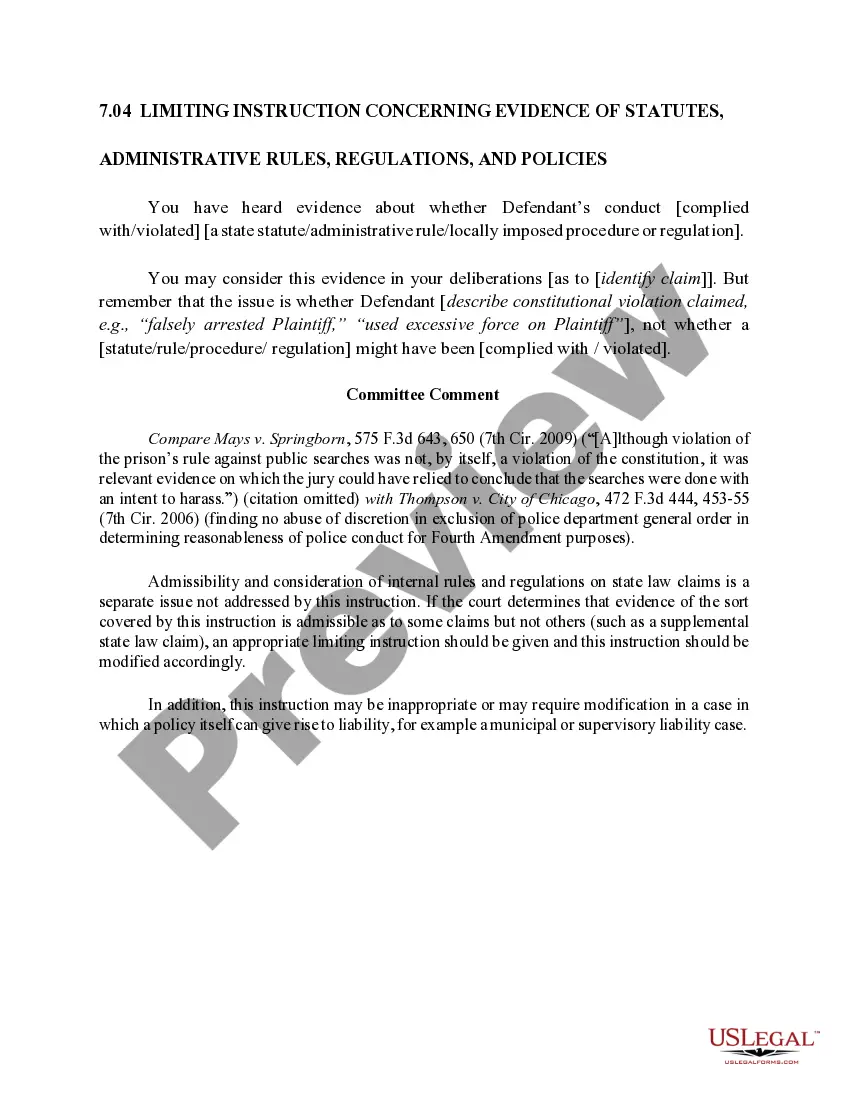
7.04 Limiting Instruction Concerning Evidence of Statutes, Administrative Rules, Regulations, and Policies
About this form
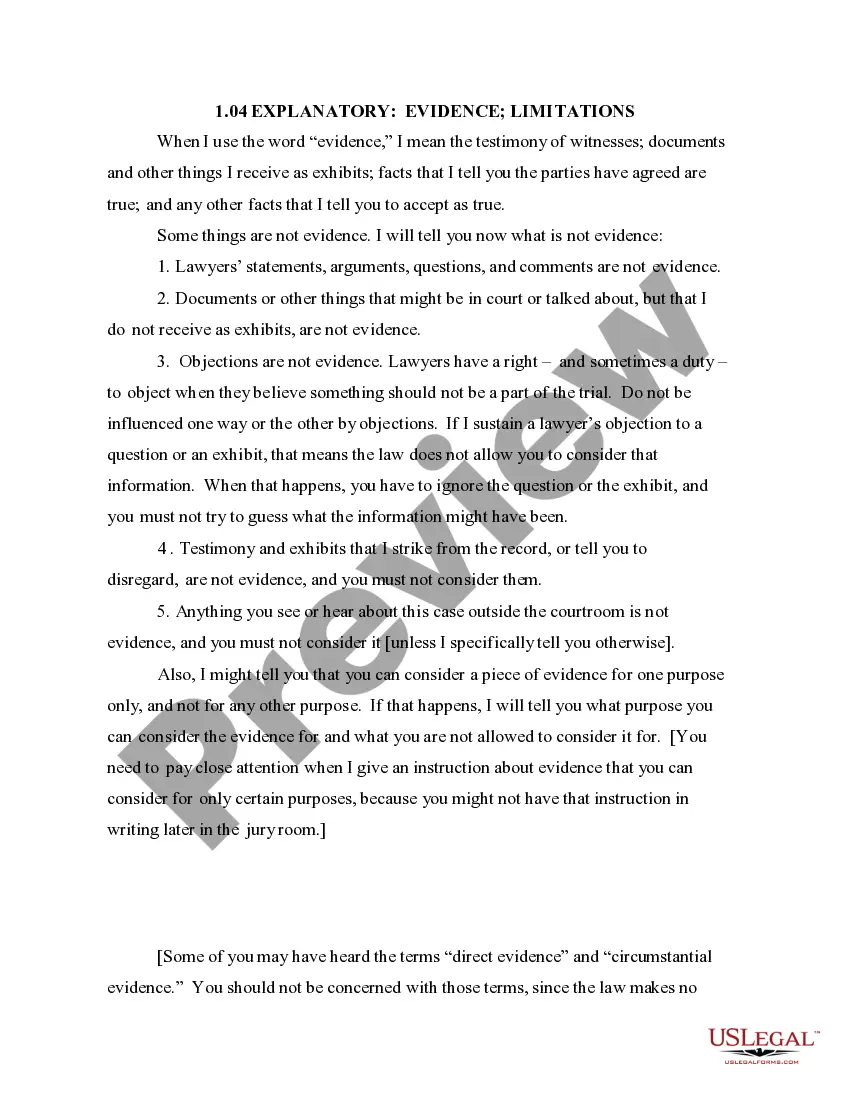
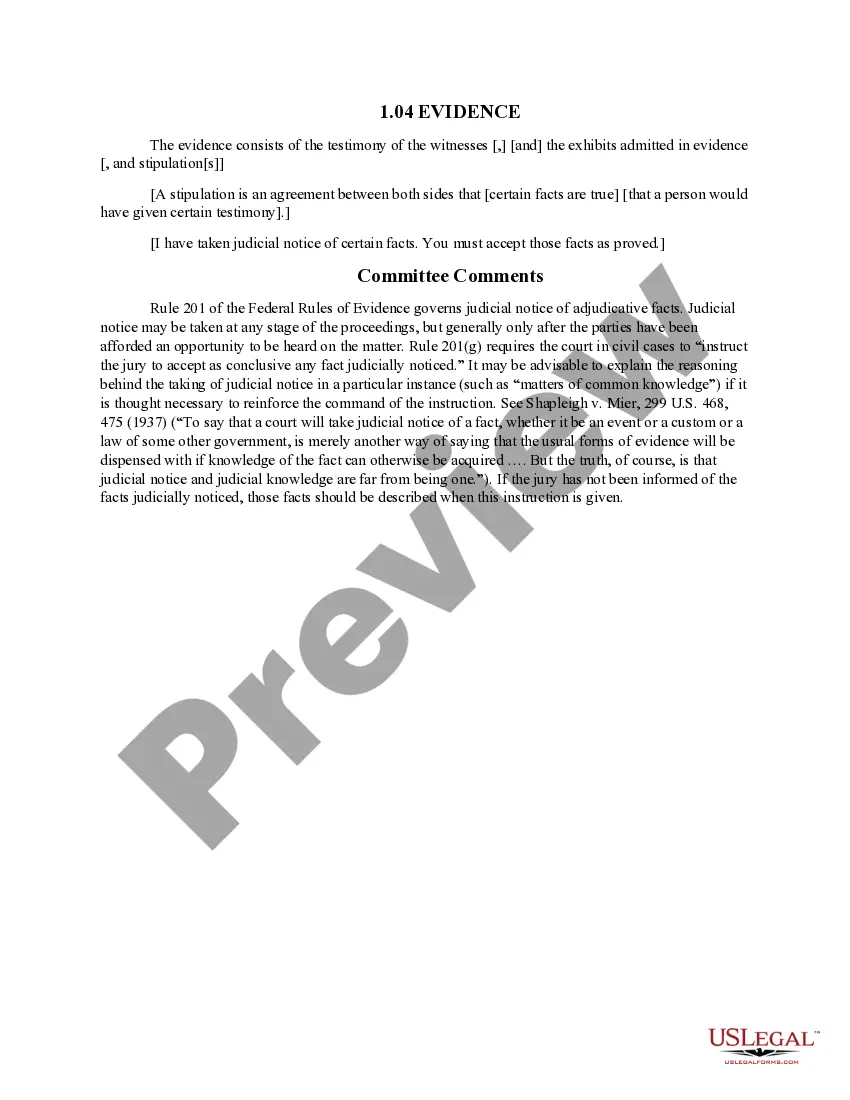
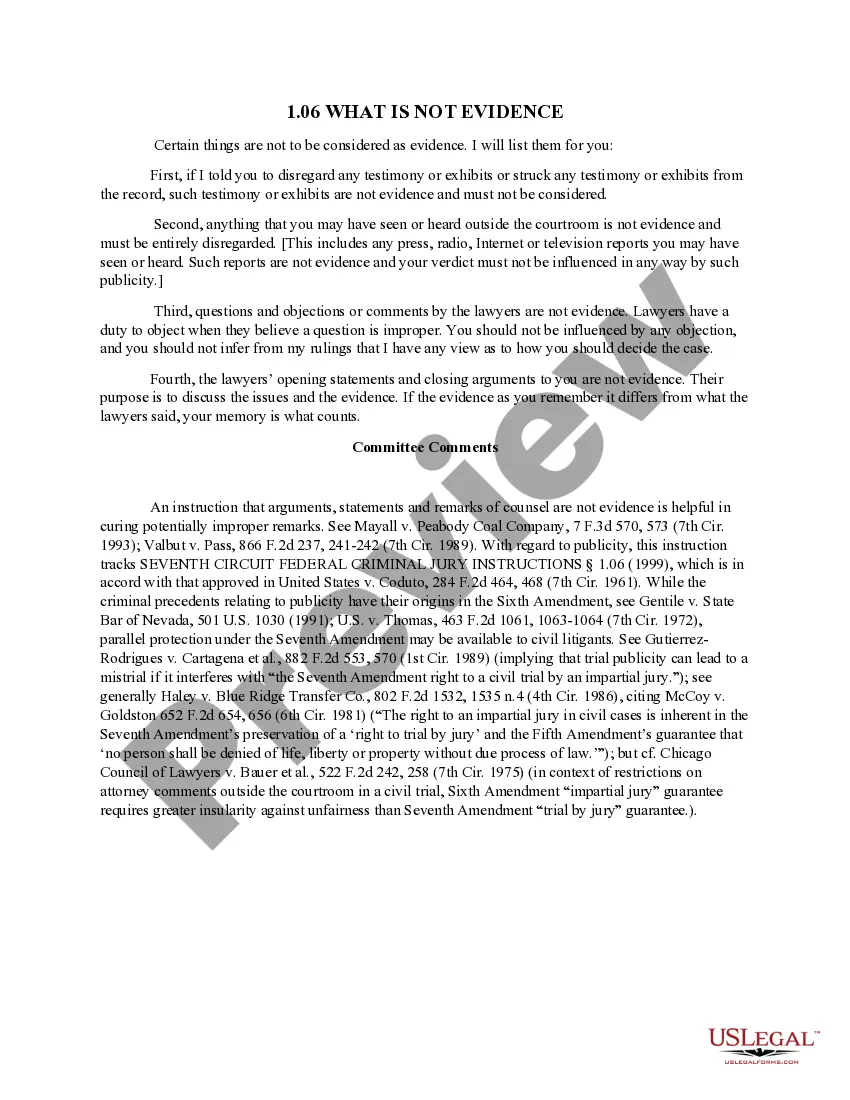
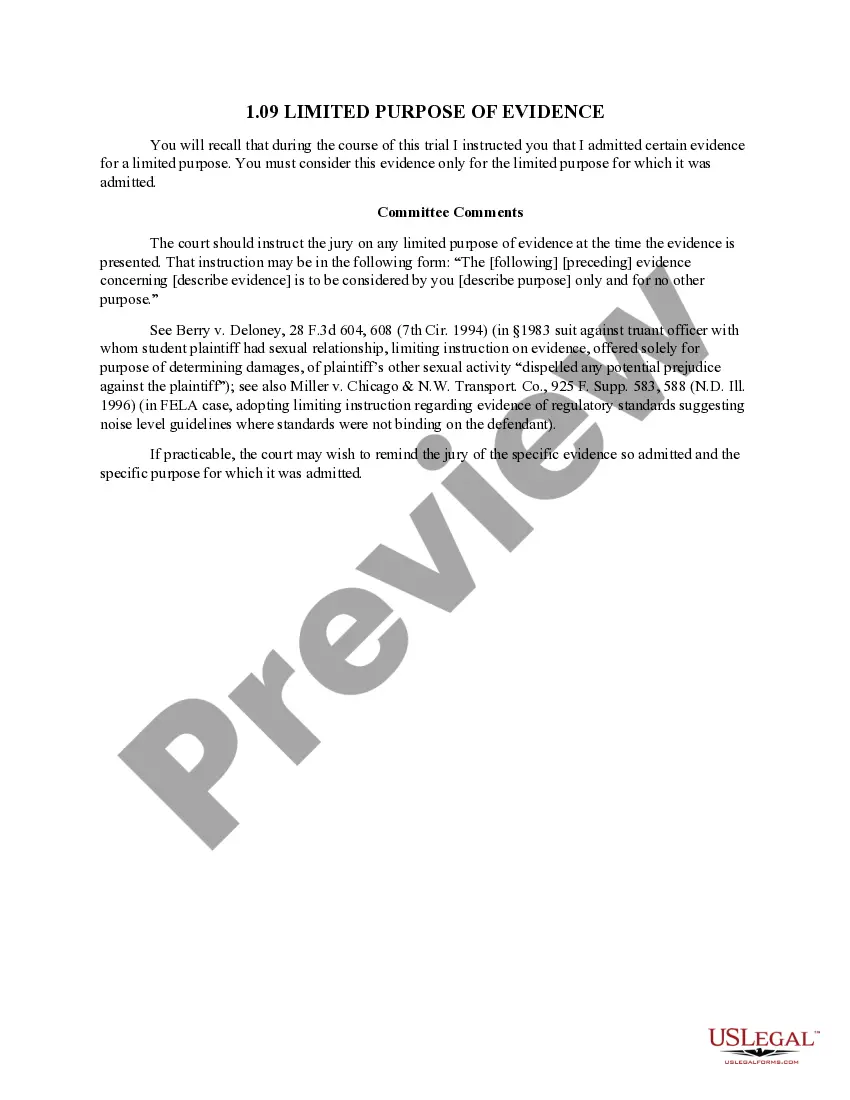
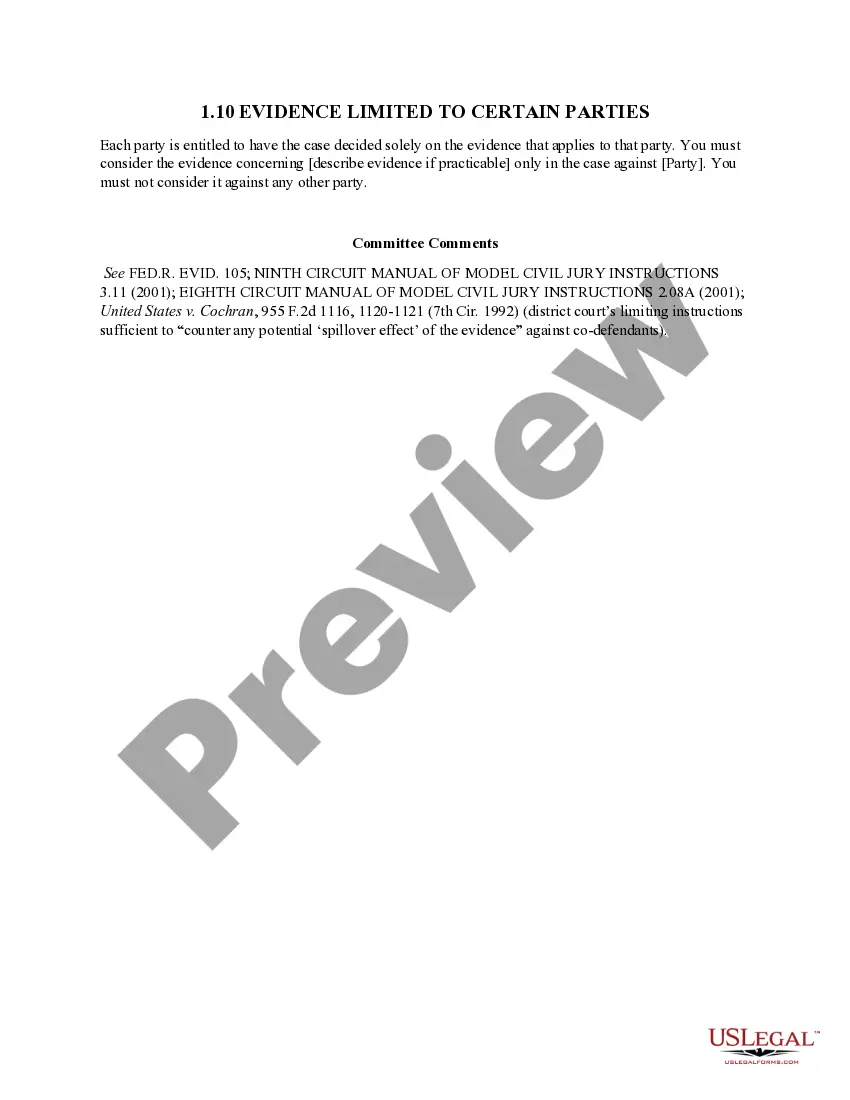
The 7.04 Limiting Instruction Concerning Evidence of Statutes, Administrative Rules, Regulations, and Policies is an official pattern jury instruction adopted by the Federal 7th Circuit Court. This form guides juries on the appropriate use of certain types of evidence, particularly regarding whether a defendant's actions complied with or violated specific statutes or regulations. It clarifies that the main issue is the constitutional violation alleged, not merely compliance with legal standards. This distinguishes it from other jury instructions that may focus more broadly on evidence admissibility.
Key components of this form
- Clarifies the role of evidence concerning statutes and rules in jury deliberations.
- Details the necessary wording adjustments for different claims.
- Includes references to relevant case law for context and application.
- Addresses limitations on using the evidence for determining liability in some circumstances.
- Indicates when a modified version of the instruction may be needed.
Common use cases
This form is used during jury trials where there is evidence to suggest either compliance with or violation of laws or regulations by a defendant. It is essential in cases involving constitutional claims, such as civil rights violations, where the jury must consider how the defendant's actions align with or diverge from legal requirements. This instruction helps ensure jurors focus on the core issues of the case rather than being distracted by statutory compliance alone.
Who this form is for
- Judges overseeing jury trials involving constitutional claims.
- Attorneys representing plaintiffs or defendants in civil rights litigation.
- Legal professionals ensuring jury instructions are accurately crafted and appropriate.
- Anyone involved in the preparation of jury instructions for cases in the Federal 7th Circuit.
Steps to complete this form
- Identify the specific claim being made against the defendant.
- Specify whether the evidence pertains to compliance or violation of statutes/rules.
- Outline the actual constitutional violation that is being claimed.
- Adjust the wording of the instruction for the specifics of the case as needed.
- Ensure compliance with any additional legal requirements specific to the case.
Does this form need to be notarized?
Notarization is not commonly needed for this form. However, certain documents or local rules may make it necessary. Our notarization service, powered by Notarize, allows you to finalize it securely online anytime, day or night.
Get your form ready online
Our built-in tools help you complete, sign, share, and store your documents in one place.
Make edits, fill in missing information, and update formatting in US Legal Forms—just like you would in MS Word.
Download a copy, print it, send it by email, or mail it via USPS—whatever works best for your next step.
Sign and collect signatures with our SignNow integration. Send to multiple recipients, set reminders, and more. Go Premium to unlock E-Sign.
If this form requires notarization, complete it online through a secure video call—no need to meet a notary in person or wait for an appointment.
We protect your documents and personal data by following strict security and privacy standards.

Make edits, fill in missing information, and update formatting in US Legal Forms—just like you would in MS Word.

Download a copy, print it, send it by email, or mail it via USPS—whatever works best for your next step.

Sign and collect signatures with our SignNow integration. Send to multiple recipients, set reminders, and more. Go Premium to unlock E-Sign.

If this form requires notarization, complete it online through a secure video call—no need to meet a notary in person or wait for an appointment.

We protect your documents and personal data by following strict security and privacy standards.
Mistakes to watch out for
- Failing to accurately specify the claim leading to confusion among jurors.
- Overemphasizing statutory compliance rather than the constitutional issues at hand.
- Neglecting potential modifications required based on case specifics.
- Using outdated or incorrect language from previous versions of jury instructions.
Why complete this form online
- Convenient access to up-to-date legal forms drafted by licensed attorneys.
- Ability to download and edit the form to meet case-specific requirements easily.
- Ensures compliance with current legal standards and court rulings.
- Quickly find and use standardized legal language that can save time and reduce errors.
Legal use & context
- Provides a clear framework for juries when determining issues of compliance with laws.
- Supports the fair trial process by focusing jurors on the substantive issues of a case.
- Reduces the risk of juror confusion regarding the relevance of statutory evidence.
- Ensures that jury deliberations remain focused on constitutional violations rather than procedural adherence alone.
Looking for another form?
Form popularity
FAQ
Rule 105 ? Limited Admissibility. When evidence which is admissible as to one party or for one purpose but not admissible as to another party or for another purpose is admitted, the court, upon request, shall restrict the evidence to its proper scope and instruct the jury ingly.
If the court admits evidence that is admissible against a party or for a purpose ? but not against another party or for another purpose ? the court, on timely request, must restrict the evidence to its proper scope and instruct the jury ingly.
Article IV of the Federal Rules of Evidence deals with relevancy, the fundamental concept underlying the admissi- bility of any evidence. Notwithstanding any other rules or considerations, an item of evidence is inadmissible unless it meets the test of relevancy.
A jury instruction in which the judge instructs the jury to consider a piece of evidence for a specific purpose and ignore it for any other purpose. At trial, a court may admit evidence that is admissible for one purpose or against one party but not another.
Article VI of the Federal Rules of Evidence focuses on the competency and credibility of witnesses. The rules in this article come up often in impeachment?when one side seeks to discredit the other side's witness.
Character evidence is not admissible to prove conduct in civil cases. For example, a defendant cannot offer the testimony of friends (or her own testimony) that she is usually a very careful driver as circumstantial evidence she was probably driving carefully and not negligently on the day of an accident.
This rule provides that evidence of other crimes, wrongs, or acts is not admissible to prove character but may be admissible for other specified purposes such as proof of motive.
The Federal Rules of Evidence are a set of rules that governs the introduction of evidence at civil and criminal trials in United States federal trial courts. The current rules were initially passed by Congress in 1975, after several years of drafting by the Supreme Court.