1.06 What is Not Evidence
Overview of this form
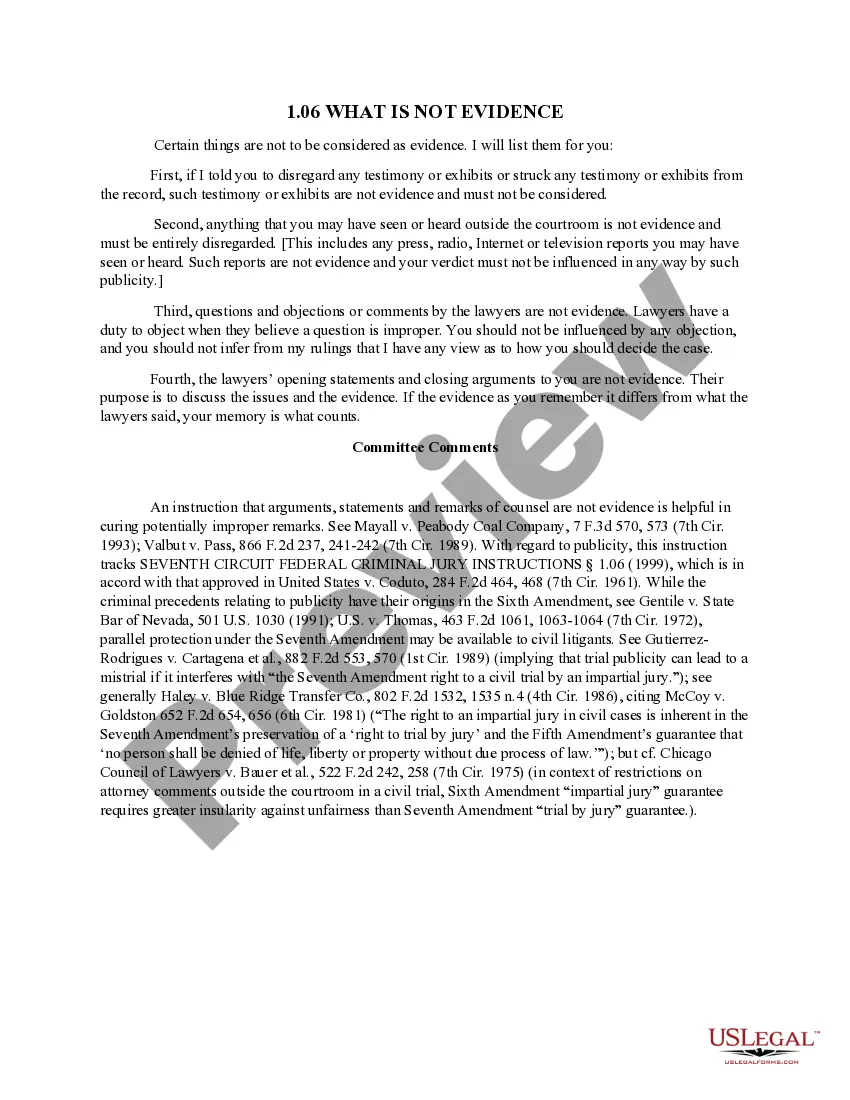
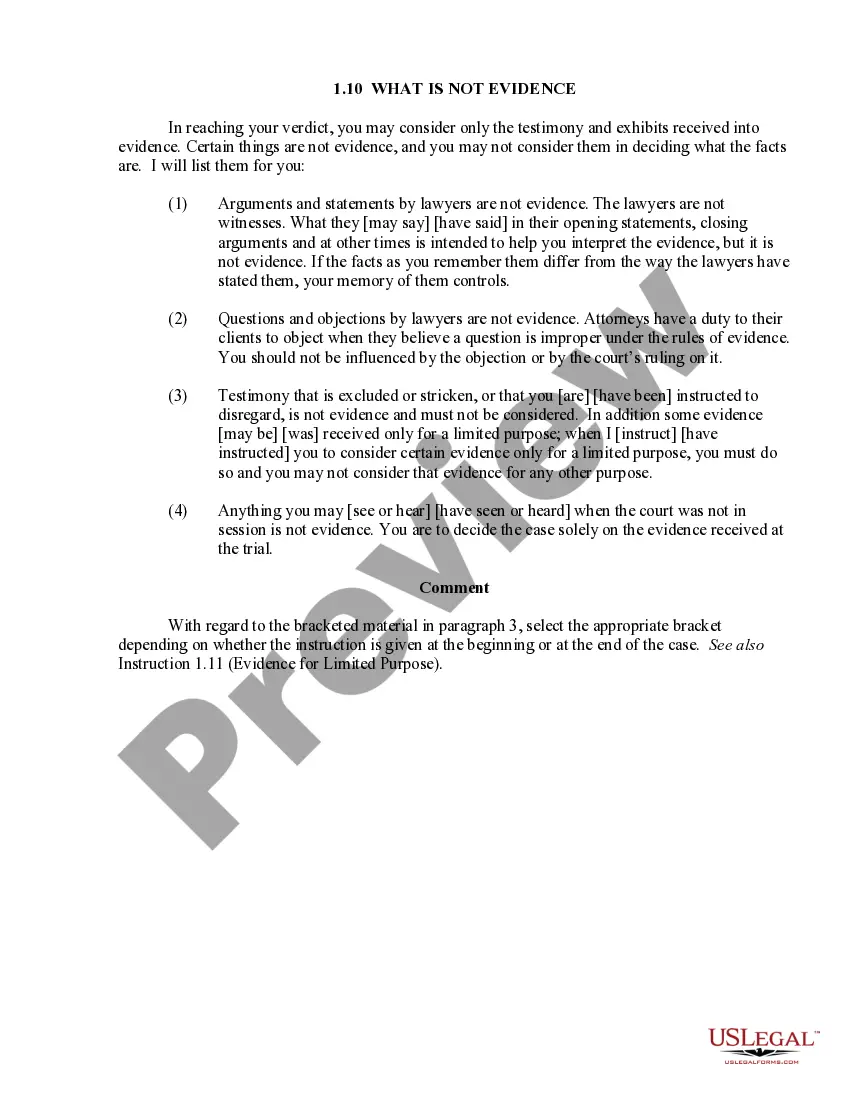
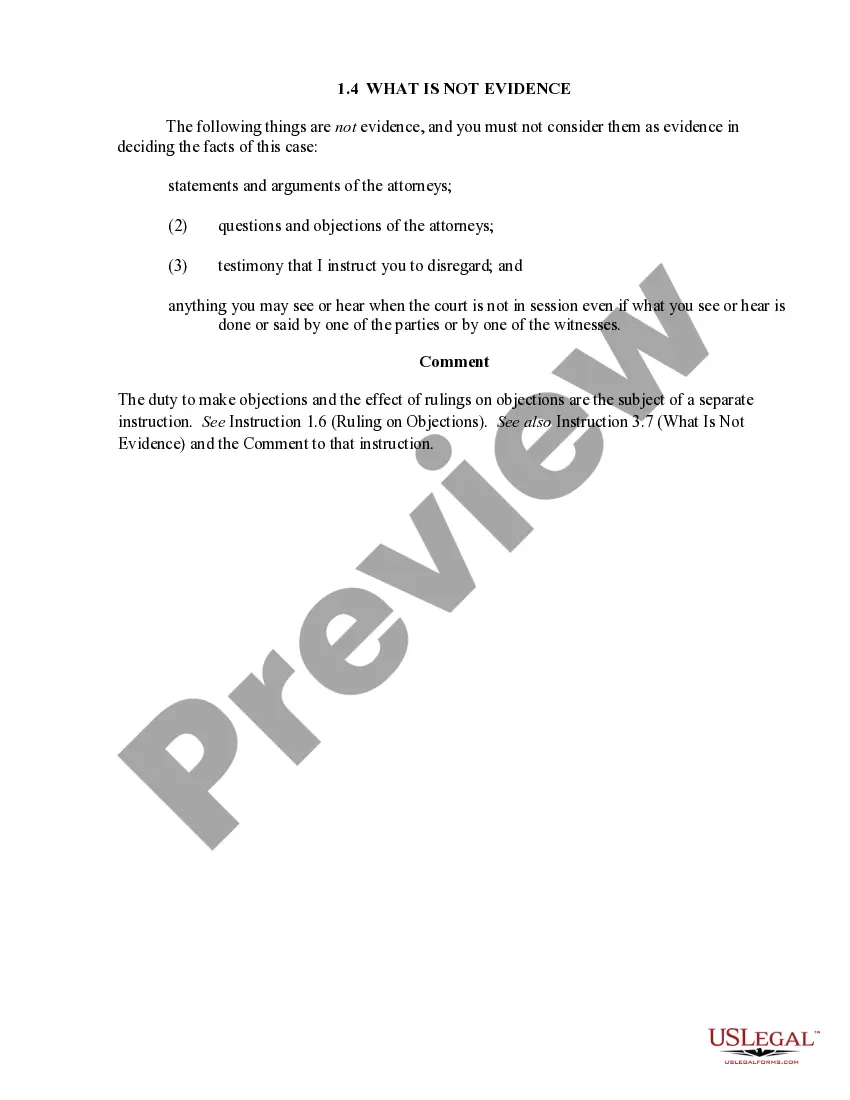
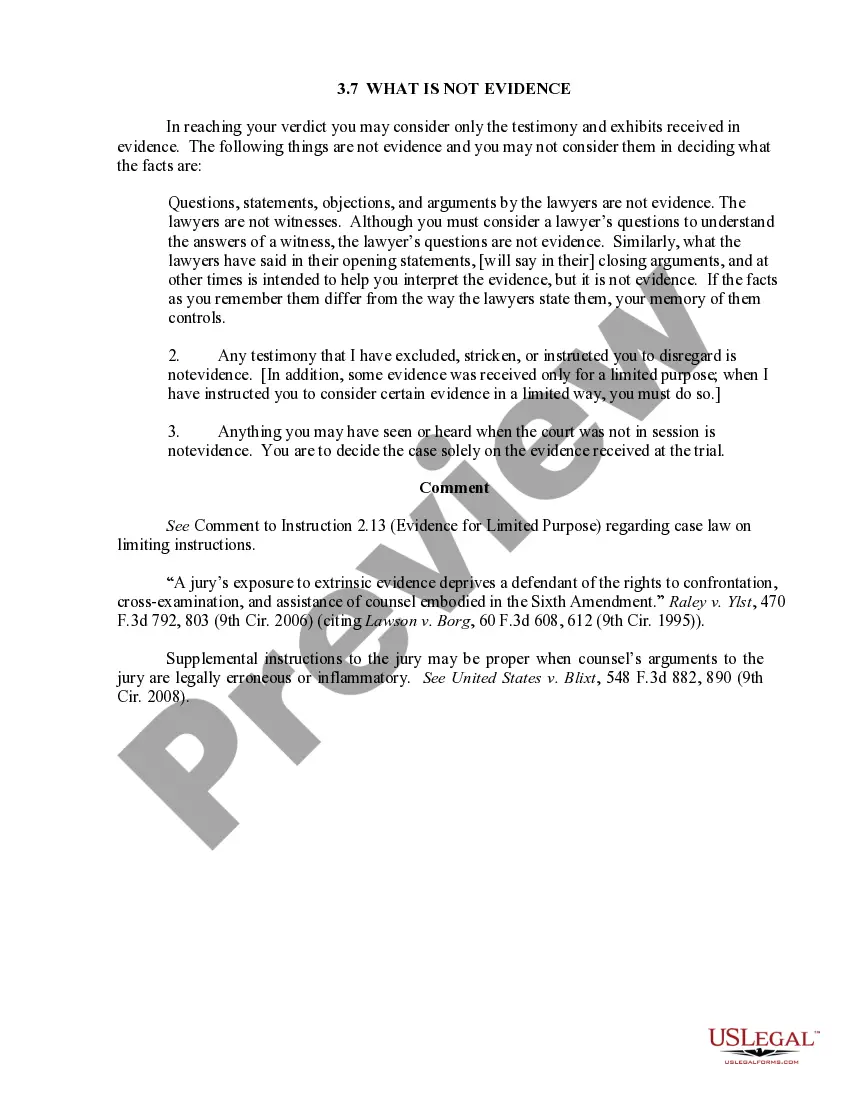
The form titled "1.06 What is Not Evidence" provides essential instructions regarding what the jury should disregard as evidence during a trial. This instruction is specifically tailored for use within the Federal 7th Circuit Court, guiding jurors to focus solely on valid evidence presented in court, while ignoring irrelevant information such as testimonies struck from the record, outside media coverage, and comments made by attorneys. Understanding this form helps ensure that jurors make decisions based strictly on evidence, free from external influences, which is crucial for fair trial outcomes.
Form components explained
- Instructions on disregarded testimony and exhibits.
- Clarification that outside information, including media reports, is not evidence.
- Clarification that lawyers' questions and objections are not considered evidence.
- Indication that opening and closing statements by lawyers are not evidence.
- Committee comments explaining the importance of these instructions for jurors.
When to use this document
This form is utilized during jury trials to inform jurors about what constitutes evidence, ensuring they understand which information they must disregard. It is applicable in any trial where jury members need clear guidance on focusing their verdict solely based on the evidence presented in court.
Who can use this document
- Judges presiding over trials in the Federal 7th Circuit Court.
- Jury members needing clear guidance on which evidence to consider.
- Legal professionals or attorneys who require a reference for jury instructions.
How to prepare this document
- Review the complete instructions before presenting to the jury.
- Clearly indicate which testimonies and exhibits should be disregarded.
- Reiterate the importance of disregarding outside media coverage.
- Define the role of lawyer comments and their lack of evidentiary value.
- Ensure jurors understand that their memory of evidence is paramount over lawyer statements.
Notarization guidance
This form usually doesn’t need to be notarized. However, local laws or specific transactions may require it. Our online notarization service, powered by Notarize, lets you complete it remotely through a secure video session, available 24/7.
Get your form ready online
Our built-in tools help you complete, sign, share, and store your documents in one place.
Make edits, fill in missing information, and update formatting in US Legal Forms—just like you would in MS Word.
Download a copy, print it, send it by email, or mail it via USPS—whatever works best for your next step.
Sign and collect signatures with our SignNow integration. Send to multiple recipients, set reminders, and more. Go Premium to unlock E-Sign.
If this form requires notarization, complete it online through a secure video call—no need to meet a notary in person or wait for an appointment.
We protect your documents and personal data by following strict security and privacy standards.

Make edits, fill in missing information, and update formatting in US Legal Forms—just like you would in MS Word.

Download a copy, print it, send it by email, or mail it via USPS—whatever works best for your next step.

Sign and collect signatures with our SignNow integration. Send to multiple recipients, set reminders, and more. Go Premium to unlock E-Sign.

If this form requires notarization, complete it online through a secure video call—no need to meet a notary in person or wait for an appointment.

We protect your documents and personal data by following strict security and privacy standards.
Common mistakes
- Failing to clearly instruct jurors on what should be disregarded.
- Overlooking the importance of reinforcing that outside information is not evidence.
- Neglecting to emphasize that lawyers' statements do not count as evidence.
Why use this form online
- Quick access to legal instructions for jurors without delays.
- Easy editing for specific case requirements while ensuring compliance.
- Reliability of the format developed by licensed attorneys.
Legal use & context
- This instruction is integral for maintaining the integrity of the jury's deliberation process.
- It helps prevent jurors from being influenced by erroneous or extraneous information.
- Ensures compliance with the fair trial rights outlined in both the Sixth and Seventh Amendments.
What to keep in mind
- This form clarifies what should be disregarded as evidence in a jury trial.
- It plays a significant role in maintaining the integrity of jury decisions.
- The document is relevant for judges, lawyers, and jurors within the 7th Circuit.
Looking for another form?
Form popularity
FAQ
Hearsay evidence generally is inadmissible unless it falls within an exception or exclusion set out in the Federal Rules, a federal statute, or a Supreme Court rule.
Evidence an item or information proffered to make the existence of a fact more or less probable. Evidence can take the form of testimony, documents, photographs, videos, voice recordings, DNA testing, or other tangible objects.
A lawyer is required to give an honest opinion about the actual consequences that appear likely to result from a client's conduct. The fact that a client uses advice in a course of action that is criminal or fraudulent does not, of itself, make a lawyer a party to the course of action.
Questions, statements, objections, and arguments by the lawyers are not evidence. The lawyers are not witnesses. Although you must consider a lawyer's questions to understand the answers of a witness, the lawyer's questions are not evidence.
Sufficient evidence is admitted evidence that has enough overall weight, in terms of relevance and credibility, to legally justify a particular conclusion. Sufficient evidence to support the legitimacy, effectiveness and necessity of the measure to achieve a specific health outcome.
There are four types evidence by which facts can be proven or disproven at trial which include: Real evidence; Demonstrative evidence; Documentary evidence; and. Testimonial evidence.
Primary tabs. In contrast to admissible evidence, inadmissible evidence is evidence that may not be introduced to a factfinder (usually the judge or jury) to prove the party's claim.
Evidence is irrelevant when it does not relate to or affect the matter in controversy.