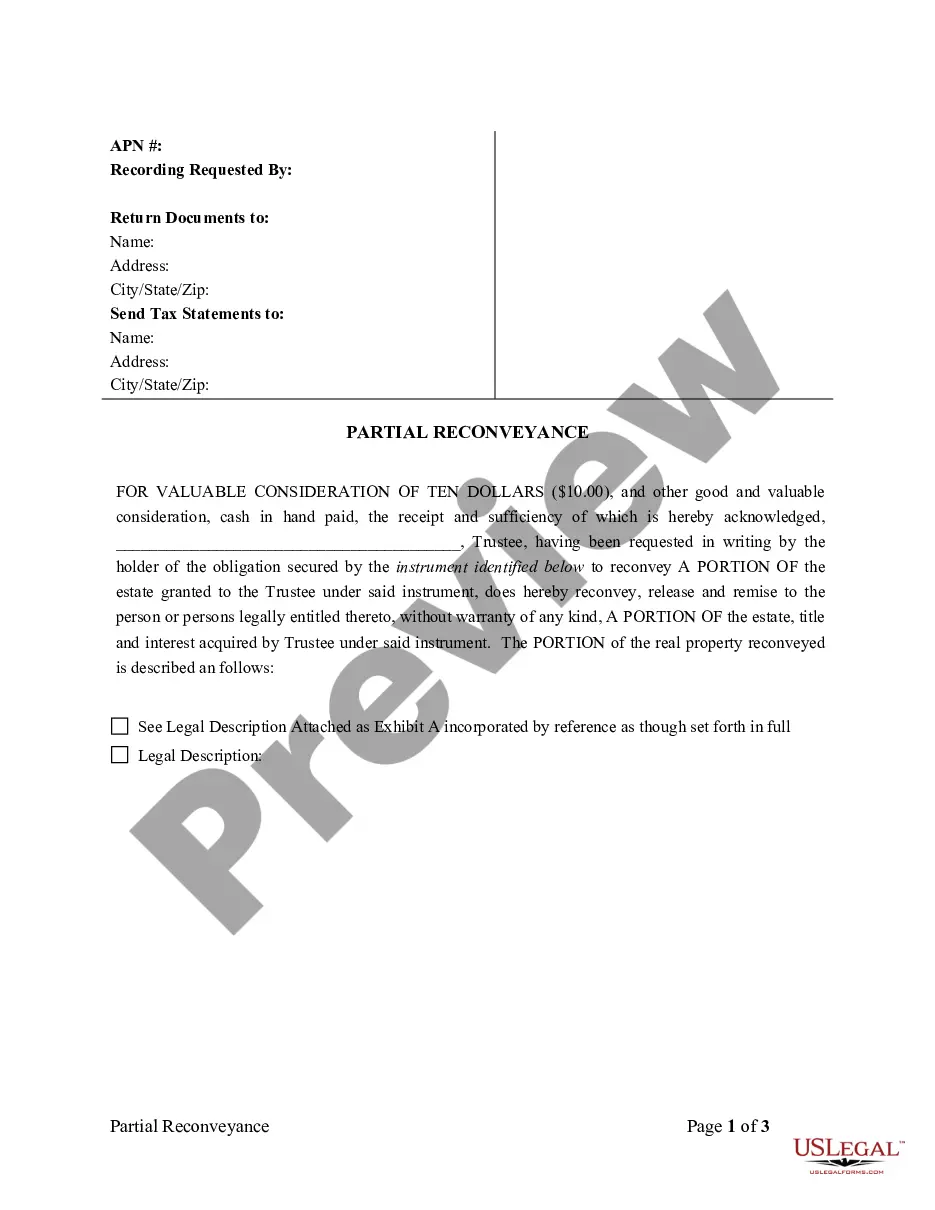
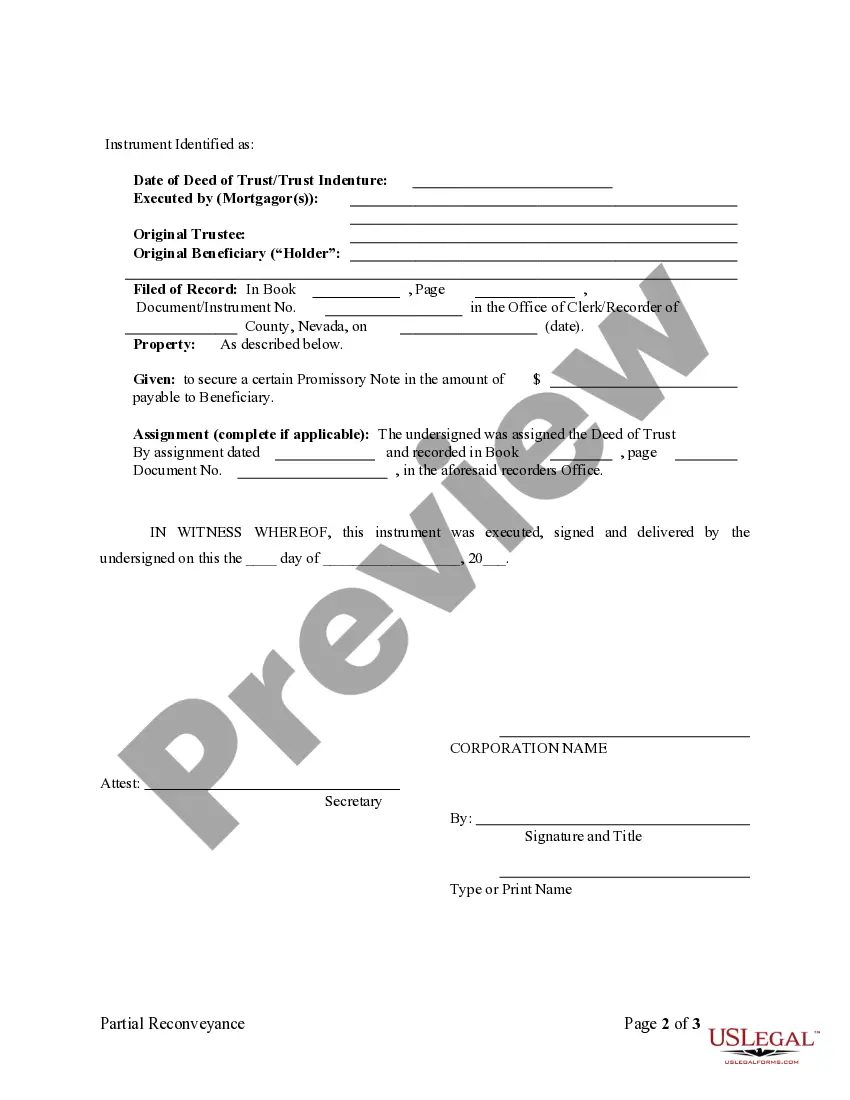
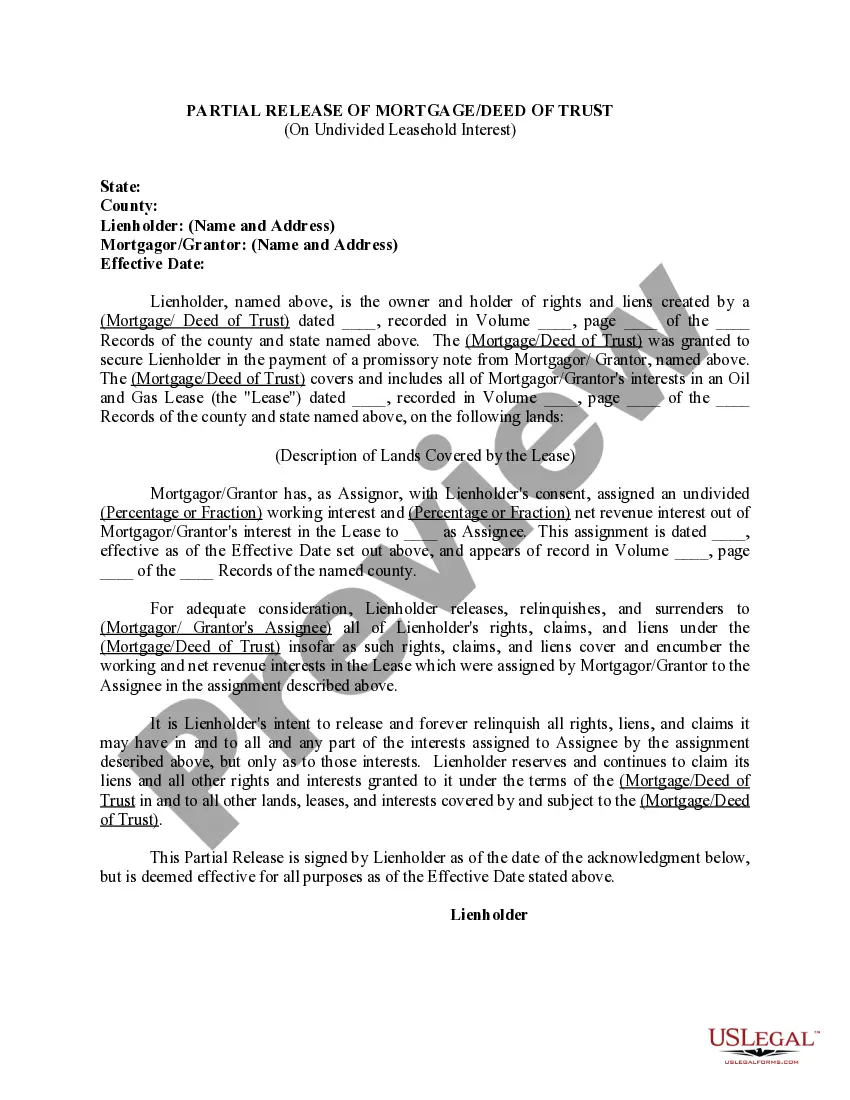
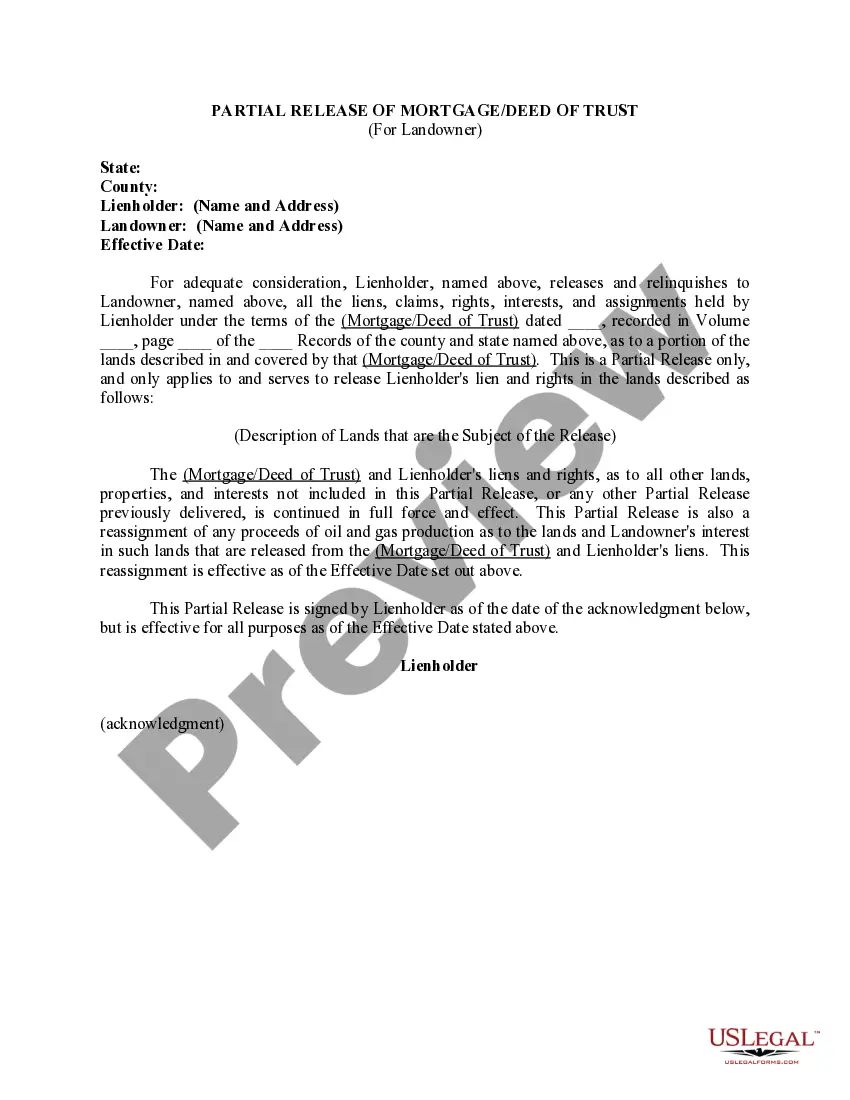
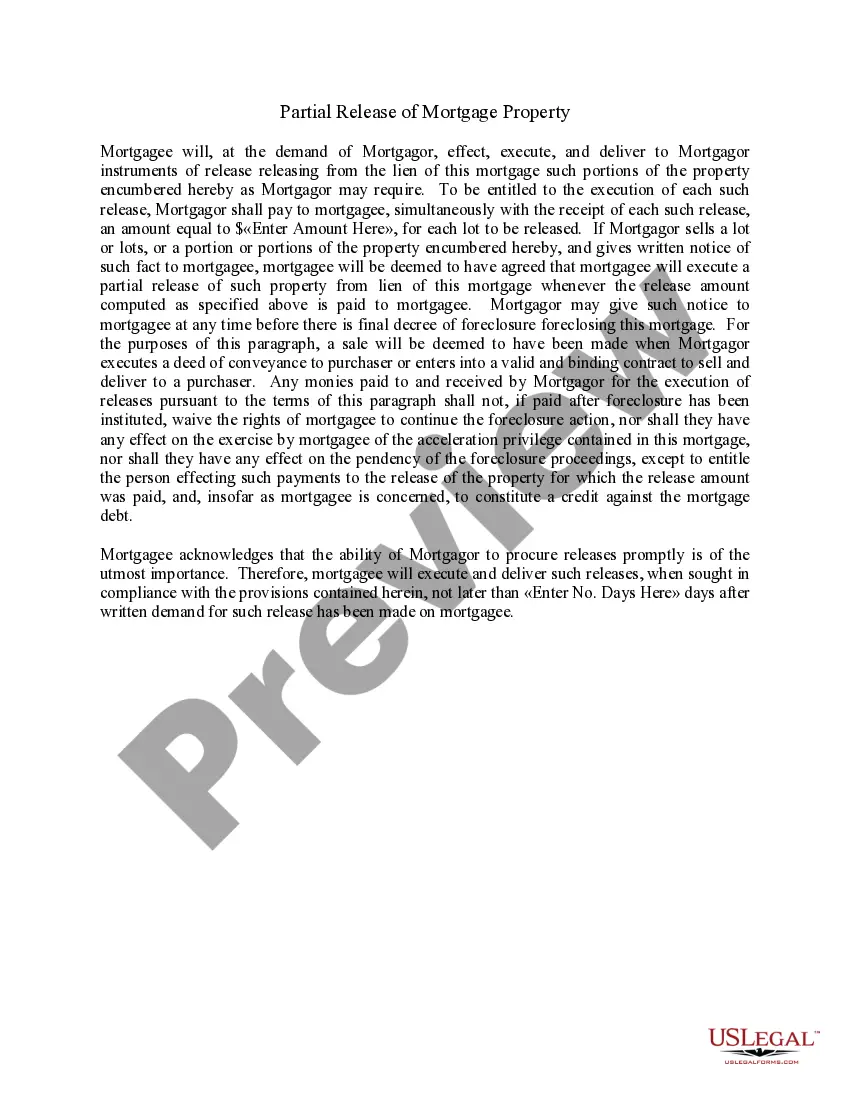
Partial Release of Property From Deed of Trust for Individual
Assignments Generally:
Lenders, or holders of mortgages or deeds of trust, often assign mortgages or deeds of trust
to other lenders, or third parties. When this is done the assignee
(person who received the assignment) steps into the place of the original
lender or assignor. To effectuate an assignment, the general rule
is that the assignment must be in proper written format and recorded to
provide notice of the assignment.
Satisfactions Generally:
Once a mortgage or deed of trust is paid, the holder of the mortgage is required to satisfy
the mortgage or deed of trust of record to show that the mortgage or deed
of trust is no longer a lien on the property. The general rule is that
the satisfaction must be in proper written format and recorded to provide
notice of the satisfaction. If the lender fails to record a satisfaction
within set time limits, the lender may be responsible for damages set by
statute for failure to timely cancel the lien. Depending on your state,
a satisfaction may be called a Satisfaction, Cancellation, or Reconveyance.
Some states still recognize marginal satisfaction but this is slowly being
phased out. A marginal satisfaction is where the holder of the mortgage
physically goes to the recording office and enters a satisfaction on the
face of the the recorded mortgage, which is attested by the clerk.
Nevada Law
Execution of Assignment or Satisfaction:
Assignment must be signed by Trust Beneficiary. Trust Beneficiary must sign certificate
of release and provide to Trustee, who then signs satisfaction.
Assignment:
Recommended that assignment be recorded in order to avoid complications.
Demand to Satisfy:
Within 21 calendar days after receiving written notice that a debt secured by a deed of trust made
on or after October 1, 1991, has been paid or otherwise satisfied or discharged,
the beneficiary shall deliver to the trustee or the trustor the original
note and deed of trust, if he is in possession of those documents, and
a properly executed request to reconvey the estate in real property conveyed
to the trustee by the grantor.
Recording Satisfaction:
A recorded deed of trust may be discharged by an entry on the margin of the record thereof,
signed by the trustee or his personal representative or assignee in the
presence of the recorder or his deputy, acknowledging the satisfaction
of or value received for the deed of trust and the debt secured thereby.
(But see, NRS 107.073, below.)
Marginal Satisfaction:
Allowed, UNLESS deed of trust has been recorded by a microfilm or other photographic process-
if so, an acknowledged reconveyance of the deed of trust must be recorded.
Penalty:
If the beneficiary fails to deliver to the trustee a properly executed request to reconvey, or if the trustee
fails to cause to be recorded a reconveyance of the deed of trust, the
beneficiary or the trustee, as the case may be, is liable in a civil action
to the grantor, his heirs or assigns in the sum of $500, plus a reasonable
attorney's fee. (And see, NRS 107.077(3), below.)
Acknowledgment:
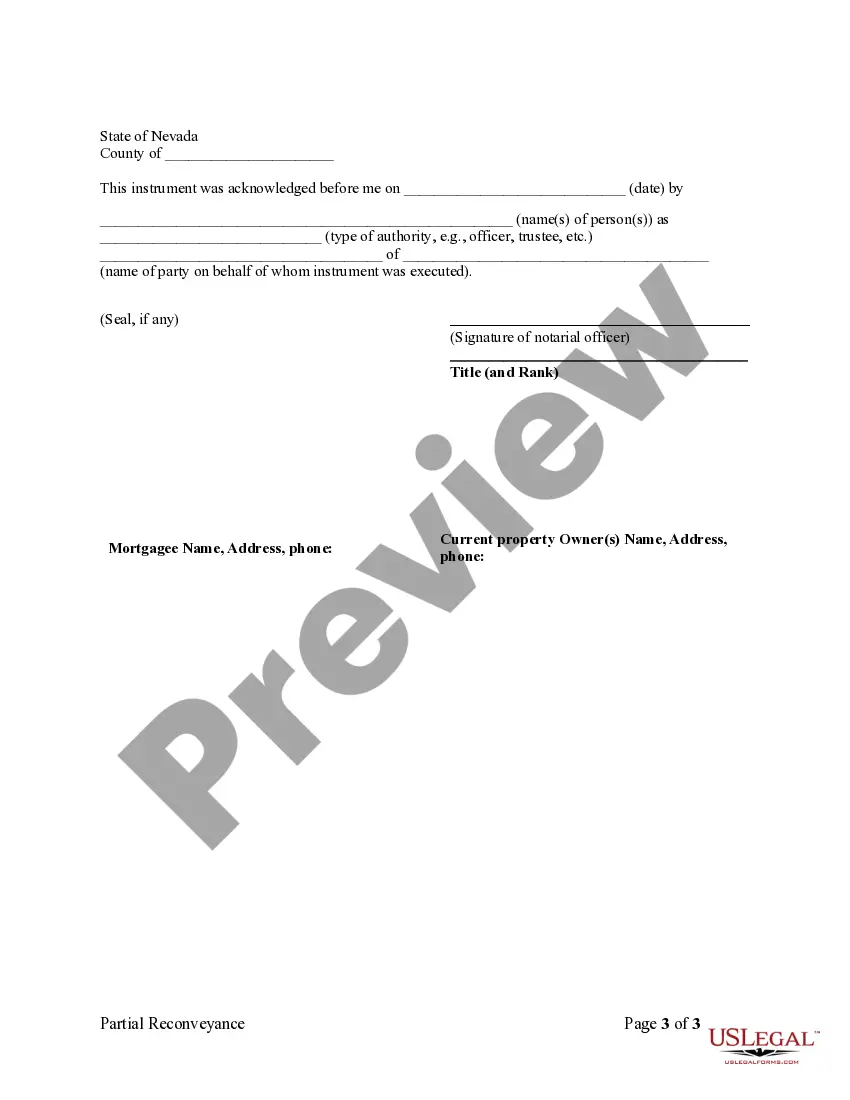
An assignment or satisfaction must contain a proper Nevada acknowledgment, or other acknowledgment approved
by Statute.
Nevada Statutes
NRS 107.073 Marginal entries; reconveyance must be recorded if
deed of trust recorded by photographic process; presentation of certificate
executed by trustee or his personal representative or assignee.
1. Except as otherwise provided in subsection 2, a recorded
deed of trust may be discharged by an entry on the margin of the record
thereof, signed by the trustee or his personal representative or
assignee in the presence of the recorder or his deputy, acknowledging
the satisfaction of or value received for the deed of trust and the debt
secured thereby. The recorder or his deputy shall subscribe the entry as
witness. The entry has the same effect as a reconveyance of the deed of
trust acknowledged and recorded as provided by law. The recorder shall
properly index each marginal discharge.
2. If the deed of trust has been recorded by a microfilm
or other photographic process, a marginal release may not be used and an
acknowledged reconveyance of the deed of trust must be recorded.
3. If the recorder or his deputy is presented with a certificate
executed by the trustee or his personal representative or assignee, specifying
that the deed of trust has been paid or otherwise satisfied or discharged,
the recorder or his deputy shall discharge the deed of trust upon the record.
NRS 107.077 Delivery of documents by beneficiary to trustee;
recording by trustee; liability for failure to deliver or record documents;
requirements for release of deed of trust when reconveyance not recorded;
liability for improperly recording deed of trust; criminal penalty.
1. Within 21 calendar days after receiving written notice
that a debt secured by a deed of trust made on or after October 1, 1991,
has been paid or otherwise satisfied or discharged, the beneficiary shall
deliver to the trustee or the trustor the original note and deed of trust,
if he is in possession of those documents, and a properly executed request
to reconvey the estate in real property conveyed to the trustee by the
grantor. If the beneficiary delivers the original note and deed of trust
to the trustee or the trustee has those documents in his possession, the
trustee shall deliver those documents to the grantor.
2. Within 45 calendar days after a debt secured by a deed
of trust made on or after October 1, 1991, is paid or otherwise satisfied
or discharged, and a properly executed request to reconvey is received
by the trustee, the trustee shall cause to be recorded a reconveyance of
the deed of trust.
3. If the beneficiary fails to deliver to the trustee a
properly executed request to reconvey pursuant to subsection 1, or if the
trustee fails to cause to be recorded a reconveyance of the deed of trust
pursuant to subsection 2, the beneficiary or the trustee, as the case may
be, is liable in a civil action to the grantor, his heirs or assigns in
the sum of $500, plus a reasonable attorney's fee and the costs of bringing
the action, and he is liable in a civil action to any party to the deed
of trust for any actual damages caused by his failure to comply with the
provisions of this section and for a reasonable attorney's fee and the
costs of bringing the action.
4. Except as otherwise provided in this subsection, if a reconveyance
is not recorded pursuant to subsection 2 within:
(a) Seventy-five calendar days after the payment, satisfaction or
discharge of the debt, if the payment, satisfaction or discharge was made
on or after October 1, 1993; or
(b) Ninety calendar days after the payment, satisfaction or discharge
of the debt, if the payment, satisfaction or discharge was made before October
1, 1993, a title insurer may prepare and cause to be recorded a release
of the deed of trust. At least 30 calendar days before the recording of
a release pursuant to this subsection, the title insurer shall mail, by
first-class mail, postage prepaid, notice of the intention to record the
release of the deed of trust to the trustee, trustor and beneficiary of
record, or their successors in interest, at the last known address of each
such person. A release prepared and recorded pursuant to this subsection
shall be deemed a reconveyance of a deed of trust. The title insurer shall
not cause a release to be recorded pursuant to this subsection if the title
insurer receives written instructions to the contrary from the trustee,
the trustor, the owner of the land, the holder of the escrow or the owner
of the debt secured by the deed of trust or his agent.
5. The release prepared pursuant to subsection 4 must set
forth:
(d) A statement that the debt secured
by the deed of trust has been paid in full or otherwise satisfied or discharged;
6. A release prepared and recorded pursuant to subsection
4 does not relieve a beneficiary or trustee of the requirements imposed
by subsections 1 and 2.
7. A trustee may charge a reasonable fee to the trustor or
the owner of the land for services relating to the preparation, execution
or recordation of a reconveyance or release pursuant to this section. A
trustee shall not require the fees to be paid before the opening of an
escrow, or earlier than 60 calendar days before the payment, satisfaction
or discharge of the debt secured by the deed of trust. If a fee charged pursuant to this subsection does not exceed $100, the fee is conclusively
presumed to be reasonable.
8. In addition to any other remedy provided by law, a title
insurer who improperly causes to be recorded a release of a deed of trust
pursuant to this section is liable for actual damages and for a reasonable
attorney's fee and the costs of bringing the action to any person who is
injured because of the improper recordation of the release.
9. Any person who willfully violates this section is guilty
of a misdemeanor.
NRS 111.312 Recording of certain documents relating to real property:
Mailing address of grantee or person requesting recording and assessor's
parcel number required.
1. The county recorder shall not record with respect to real
property, a notice of completion, a declaration of homestead, a lien or
notice of lien, an affidavit of death, a mortgage or deed of trust, or
any conveyance of real property or instrument in writing setting forth
an agreement to convey real property unless the document being recorded
contains:
(a) The mailing address of the grantee or, if there is no grantee,
the mailing address of the person who is requesting the recording of the
document; and
(b) The assessor's parcel number of the property at the top of the
first page of the document, if the county assessor has assigned a parcel
number to the property. The county recorder is not required to verify that
the assessor's parcel number is correct.
2. The assessor's parcel number shall not be deemed to be
a complete legal description of the real property conveyed.