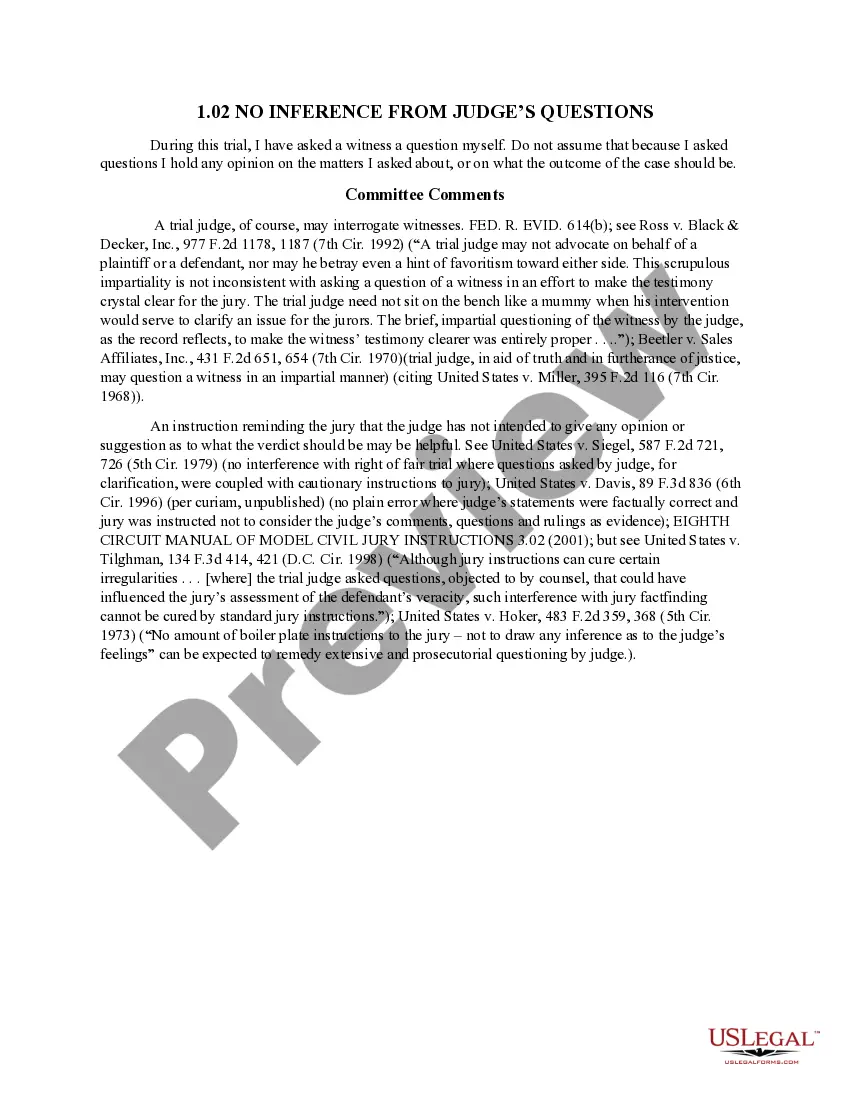
1.02 No inference from judges questions
Understanding this form
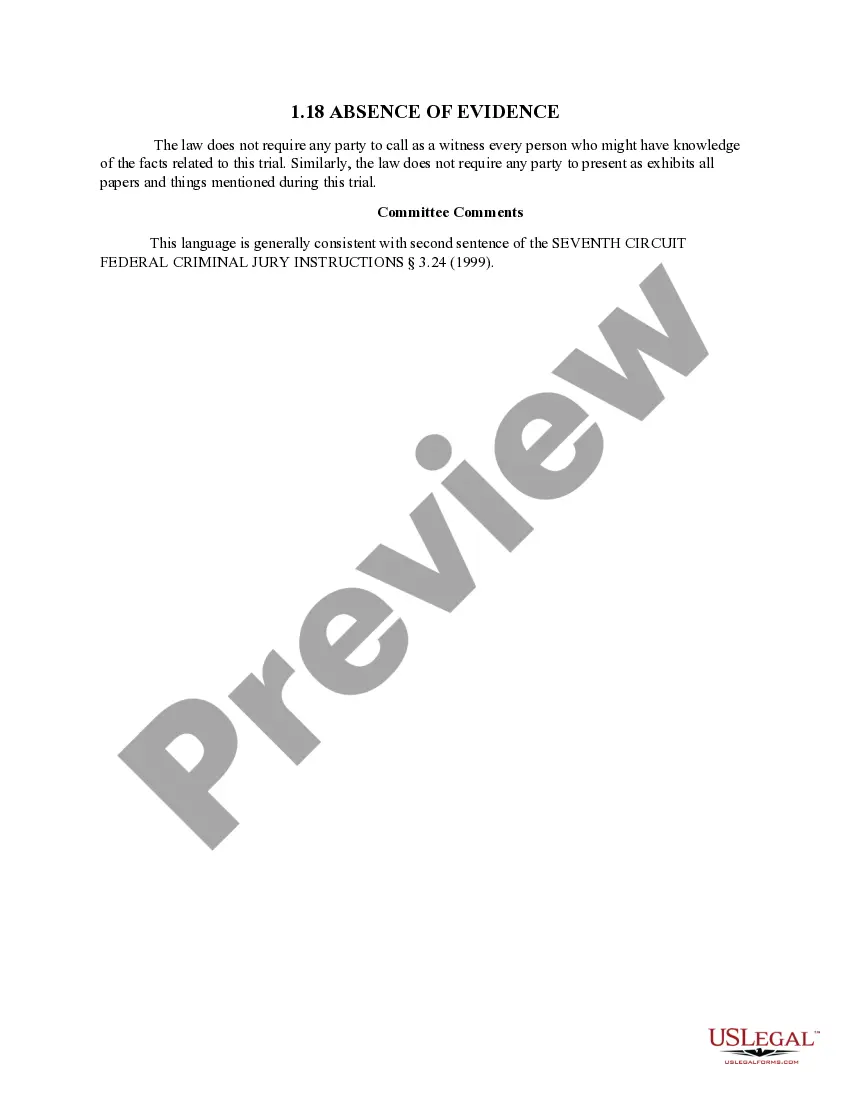
The "No Inference from Judgeâs Questions" instruction is part of the Official Pattern Jury Instructions adopted by the Federal 7th Circuit Court. This legal form guides juries on how to interpret the judge's inquiries during a trial. Specifically, it instructs jurors not to assume that the judgeâs questions imply any opinion on the case's outcomes. This ensures a fair trial by maintaining impartiality and clarity in jury deliberations.
What’s included in this form
- Clarification on the role of the judge in interrogating witnesses.
- Reminders for jurors regarding the neutrality of the judge's questions.
- Instructions to disregard any potential inferences from the judge's inquiries.
- Reference to relevant federal rules and case law supporting the instruction.
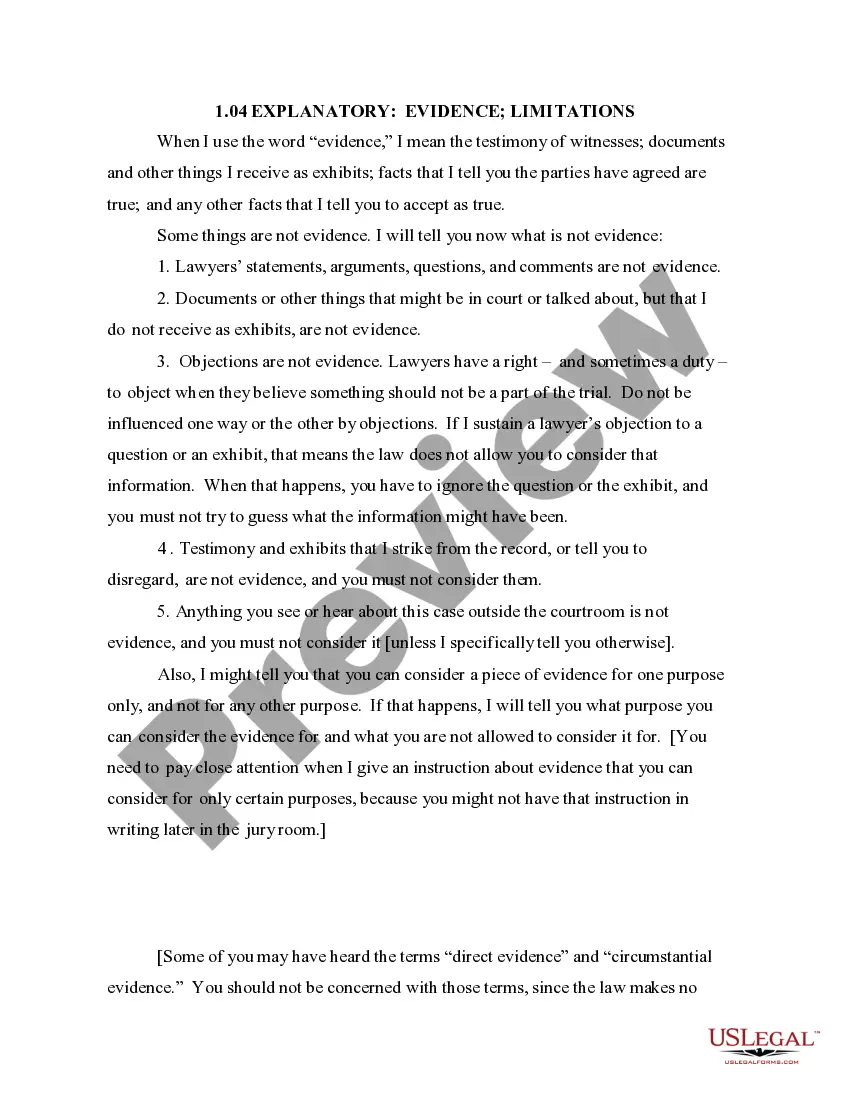
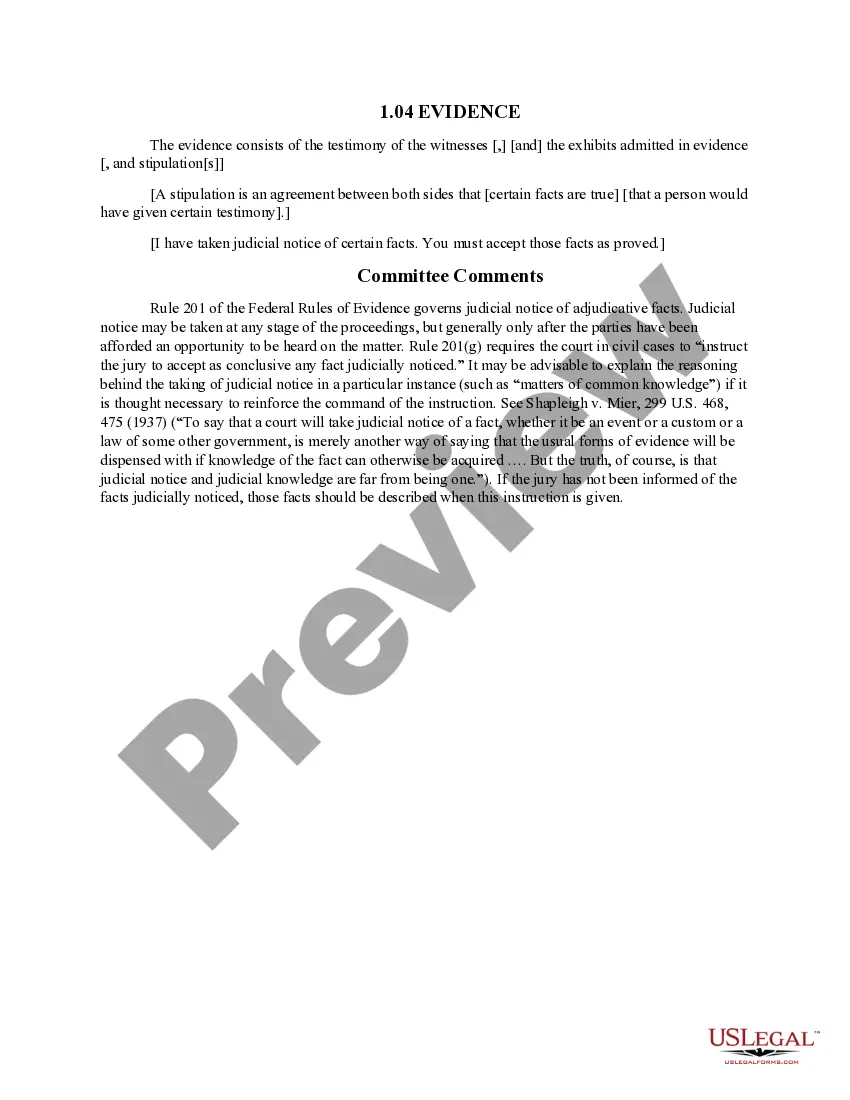
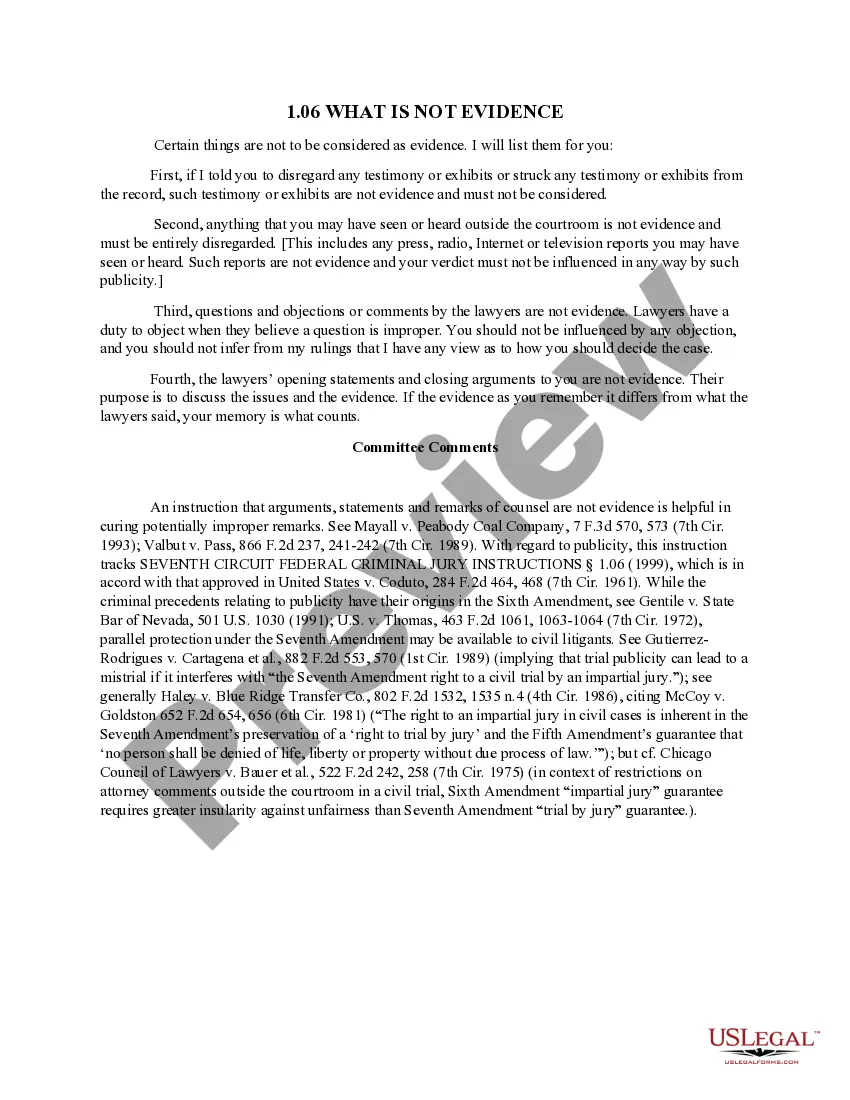
When to use this form
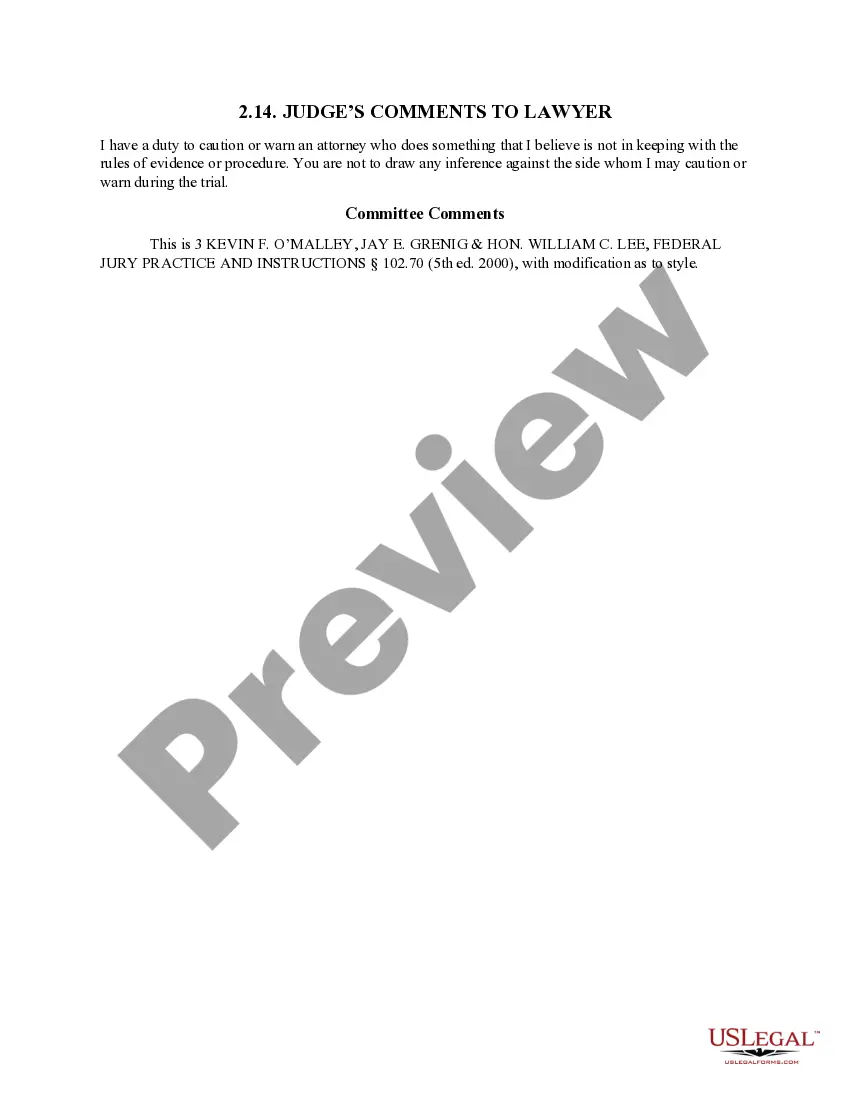
This instruction form is used during jury trials in the Federal 7th Circuit where a judge actively questions witnesses. It is essential to provide this clarification to jurors to prevent bias or misinterpretation of the judge's questioning as a signal of favoritism or opinion regarding any party's case. It is particularly important in trials with complex testimonies to ensure jurors understand the judge's impartiality.
Who needs this form
- Judges presiding over jury trials in the Federal 7th Circuit.
- Attorneys representing clients in jury trials who want to ensure juror understanding.
- Jury coordinators or legal teams preparing materials for jury instructions.
Instructions for completing this form
- Review the jury trial context to determine when to introduce this instruction.
- Select appropriate wording from the pattern jury instructions applicable in your court.
- Instruct the jury on the importance of impartiality regarding the judge's questions.
- Ensure all jurors understand they should not infer any opinion from the judge's inquiries.
- Provide copies of the instruction to jurors for reference during deliberations.
Notarization requirements for this form
Notarization is generally not required for this form. However, certain states or situations might demand it. You can complete notarization online through US Legal Forms, powered by Notarize, using a verified video call available anytime.
Get your form ready online
Our built-in tools help you complete, sign, share, and store your documents in one place.
Make edits, fill in missing information, and update formatting in US Legal Forms—just like you would in MS Word.
Download a copy, print it, send it by email, or mail it via USPS—whatever works best for your next step.
Sign and collect signatures with our SignNow integration. Send to multiple recipients, set reminders, and more. Go Premium to unlock E-Sign.
If this form requires notarization, complete it online through a secure video call—no need to meet a notary in person or wait for an appointment.
We protect your documents and personal data by following strict security and privacy standards.

Make edits, fill in missing information, and update formatting in US Legal Forms—just like you would in MS Word.

Download a copy, print it, send it by email, or mail it via USPS—whatever works best for your next step.

Sign and collect signatures with our SignNow integration. Send to multiple recipients, set reminders, and more. Go Premium to unlock E-Sign.

If this form requires notarization, complete it online through a secure video call—no need to meet a notary in person or wait for an appointment.

We protect your documents and personal data by following strict security and privacy standards.
Avoid these common issues
- Failing to provide the instruction can lead to jurors misinterpreting the judgeâs role.
- Using complex legal jargon that jurors may not understand.
- Not emphasizing the importance of maintaining impartiality in jury deliberations.
Advantages of online completion
- Convenient access to the most current jury instructions designed by legal experts.
- Editable Word format allows for easy customization based on trial needs.
- Provides assurance of reliability and adherence to federal guidelines.
Legal use & context
- The instruction is essential for maintaining a fair trial and protecting the rights of all parties.
- It helps prevent potential appeals based on claims of judicial bias.
- This form is grounded in established case law supporting the impartial role of judges during trials.
Looking for another form?
Form popularity
FAQ
Maryland Law on Missing Witness Rule Inferences if a party has it peculiarly within his power to produce witnesses whose testimony would elucidate a transaction, the fact that he does not do it creates a presumption that the testimony, if produced, would be unfavorable.
?The 'missing-witness' rule?which dates back to 1893 Supreme Court case Graves v. United States?allows one party to obtain an adverse inference against the other for failure to produce a witness under that party's control with material information.
In California, if you received a subpoena to testify as a witness in court or a subpoena ad testificandum, you are required by law to appear and testify. If you don't show up in court or refuse to testify after getting subpoenaed, you will be held in contempt of court. This is a crime.
?Where a party has been unable to call a witness (or one who would give an open and honest account) for reasons outside its control, where it would plainly be wrong for the court to hold that against the party, whether by drawing an adverse inference against that party on a particular issue or by taking the absence of
In a criminal case, the prosecution bears the burden of proving that the defendant is guilty beyond all reasonable doubt. This means that the prosecution must convince the jury that there is no other reasonable explanation that can come from the evidence presented at trial.
The trial judge's decisionmaking must determine what are the facts and the proper application of the law to these facts. To bring order to the confusion of contested facts and theories of law, the trial judge decides cases by hypothesis or a series of tentative hypotheses increasing in certainty.
Rule 5-615 - Exclusion of Witnesses (a)In General. Except as provided in sections (b) and (c) of this Rule, upon the request of a party made before testimony begins, the court shall order witnesses excluded so that they cannot hear the testimony of other witnesses.
Clear and convincing evidence is a showing that there is a high probability that a fact is true, as opposed to something simply being more likely than not. This standard is often used in California personal injury cases where the plaintiff seeks punitive damages in addition to compensatory damages.