Computer Fraud: Obtaining Financial Information
About this form
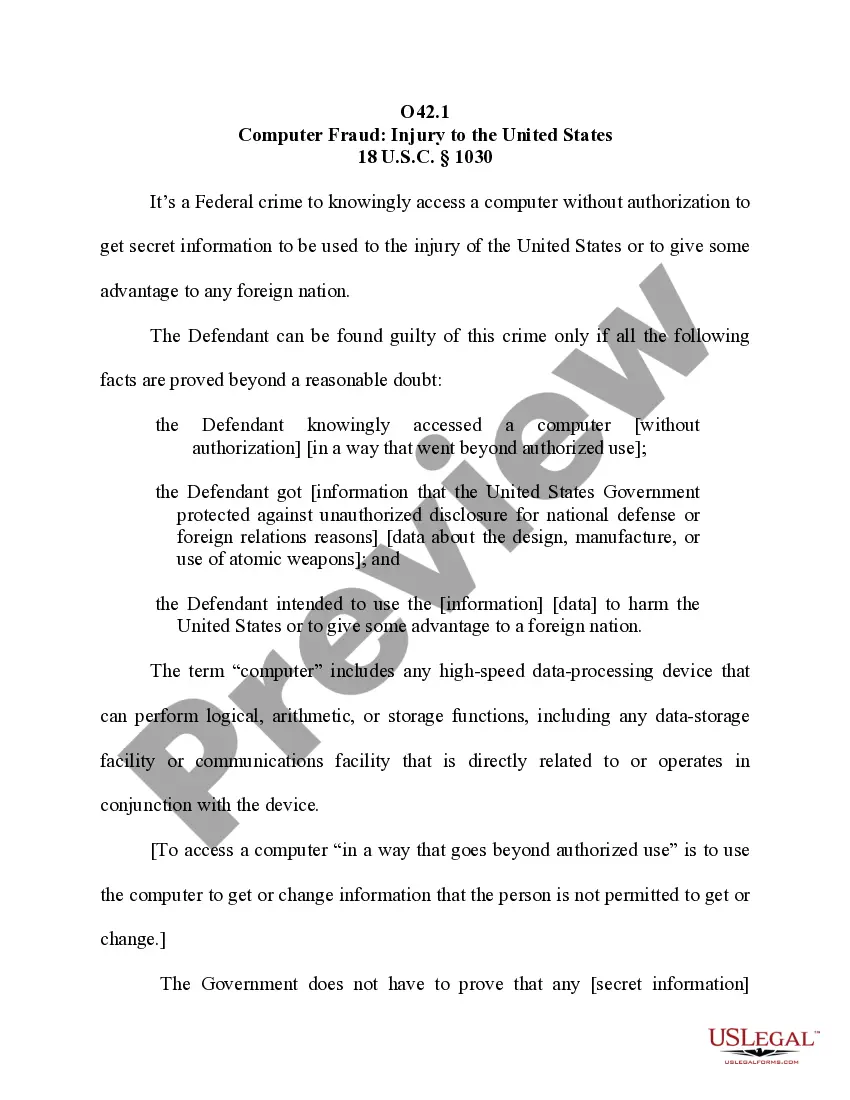
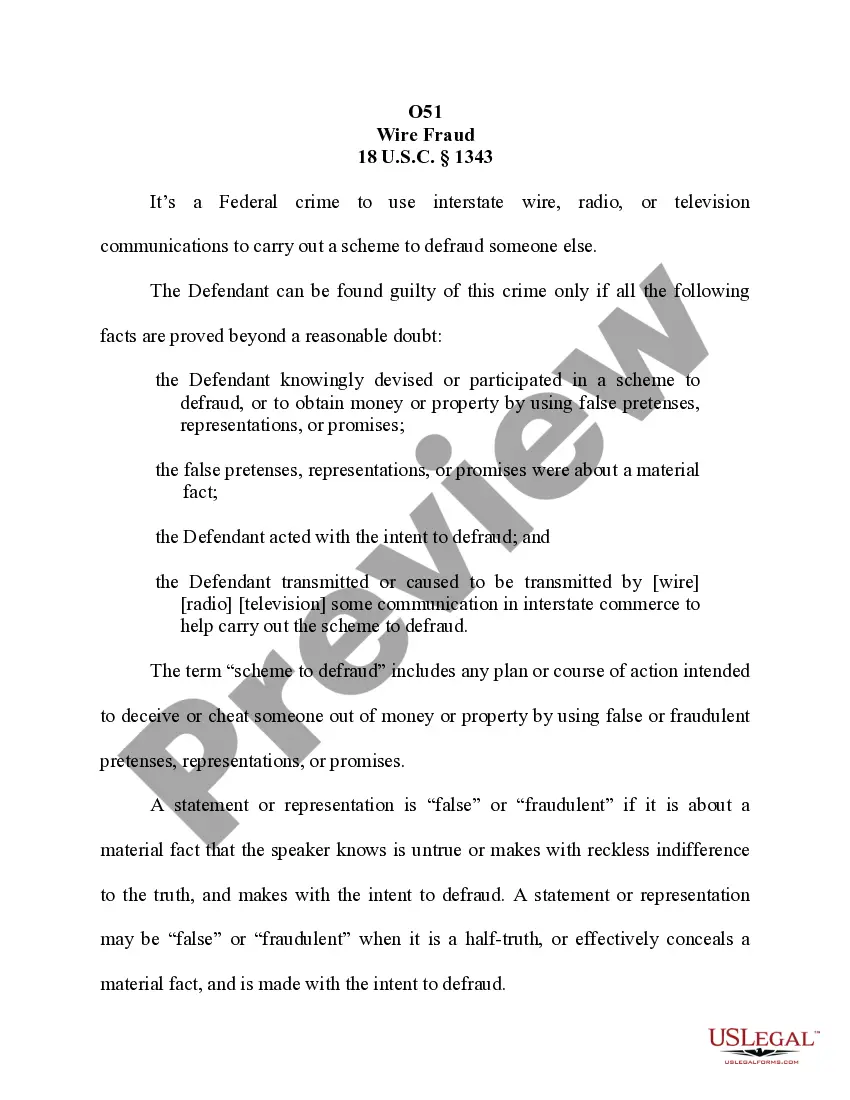
The Computer Fraud: Obtaining Financial Information form is a legal document used to outline the federal crime of accessing a computer system without authorization to obtain financial records. This form is crucial for establishing the legal framework around computer fraud and differs from similar documents as it specifically addresses financial information theft under federal law.
Form components explained
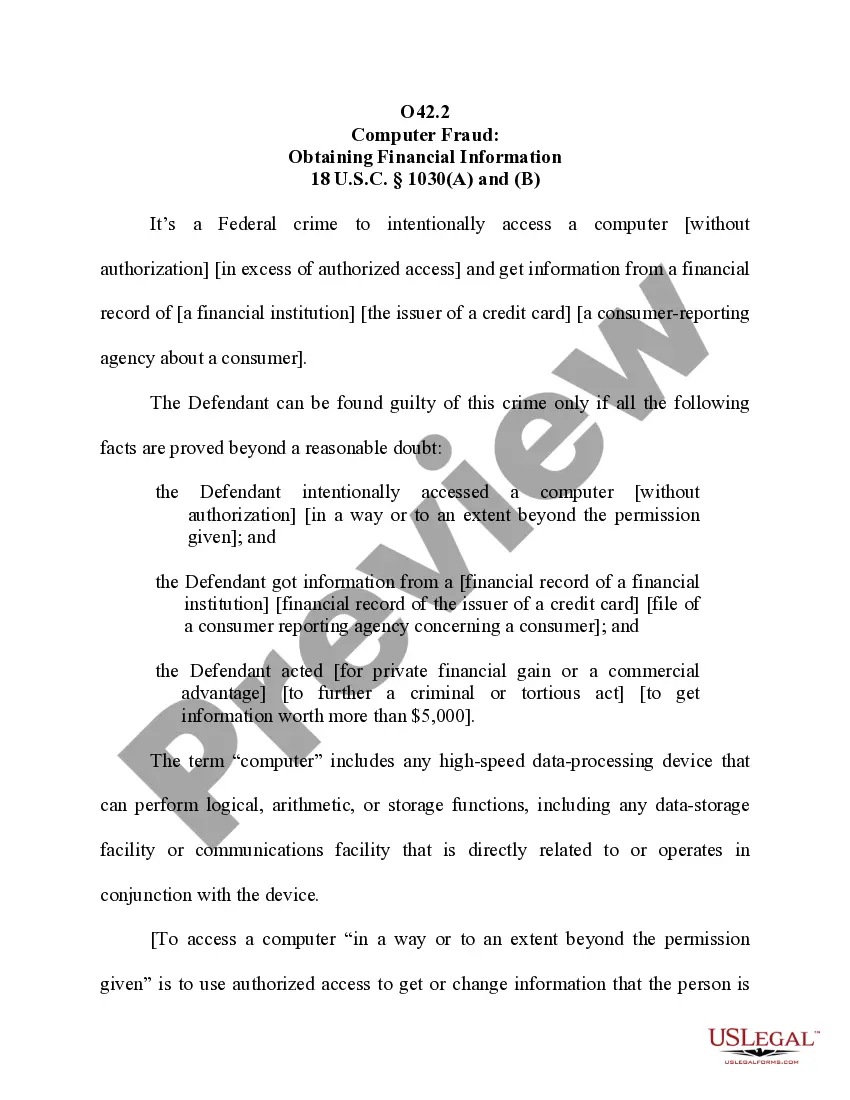
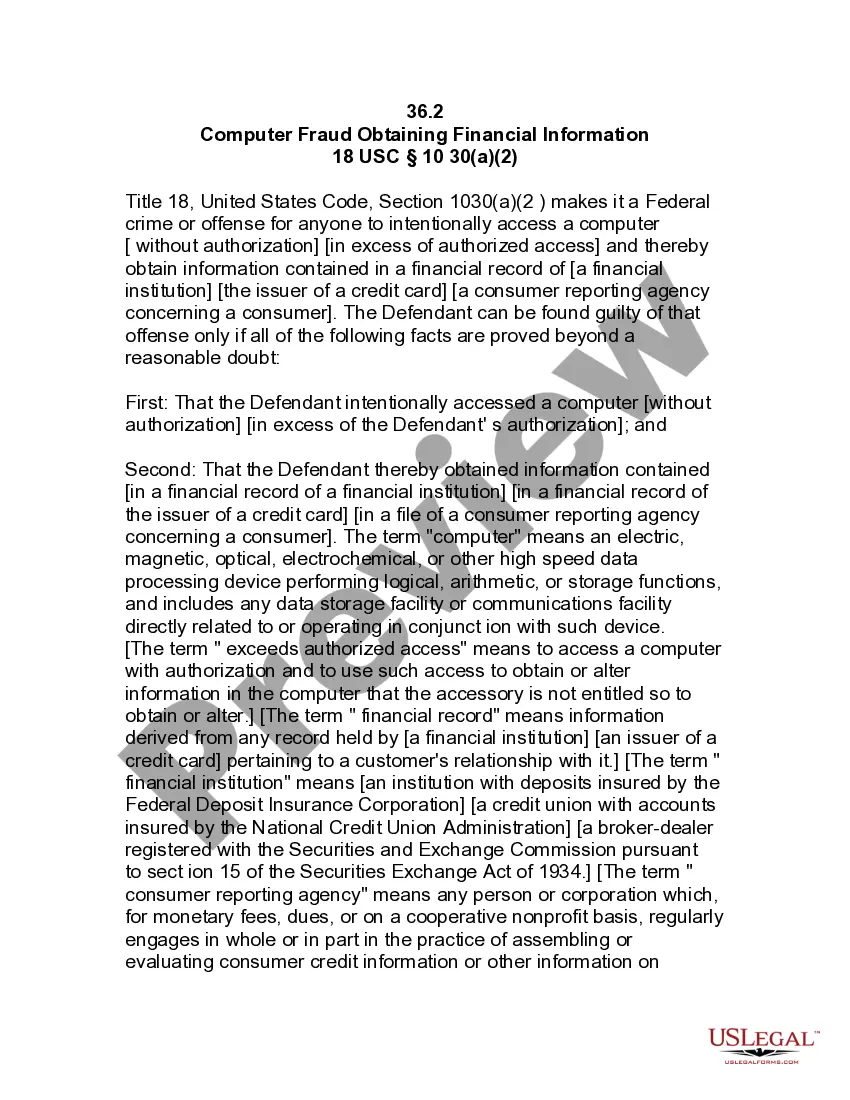
- Definition of computer fraud, including unauthorized access to financial records.
- Criteria for proving intent and gain from the fraudulent activity.
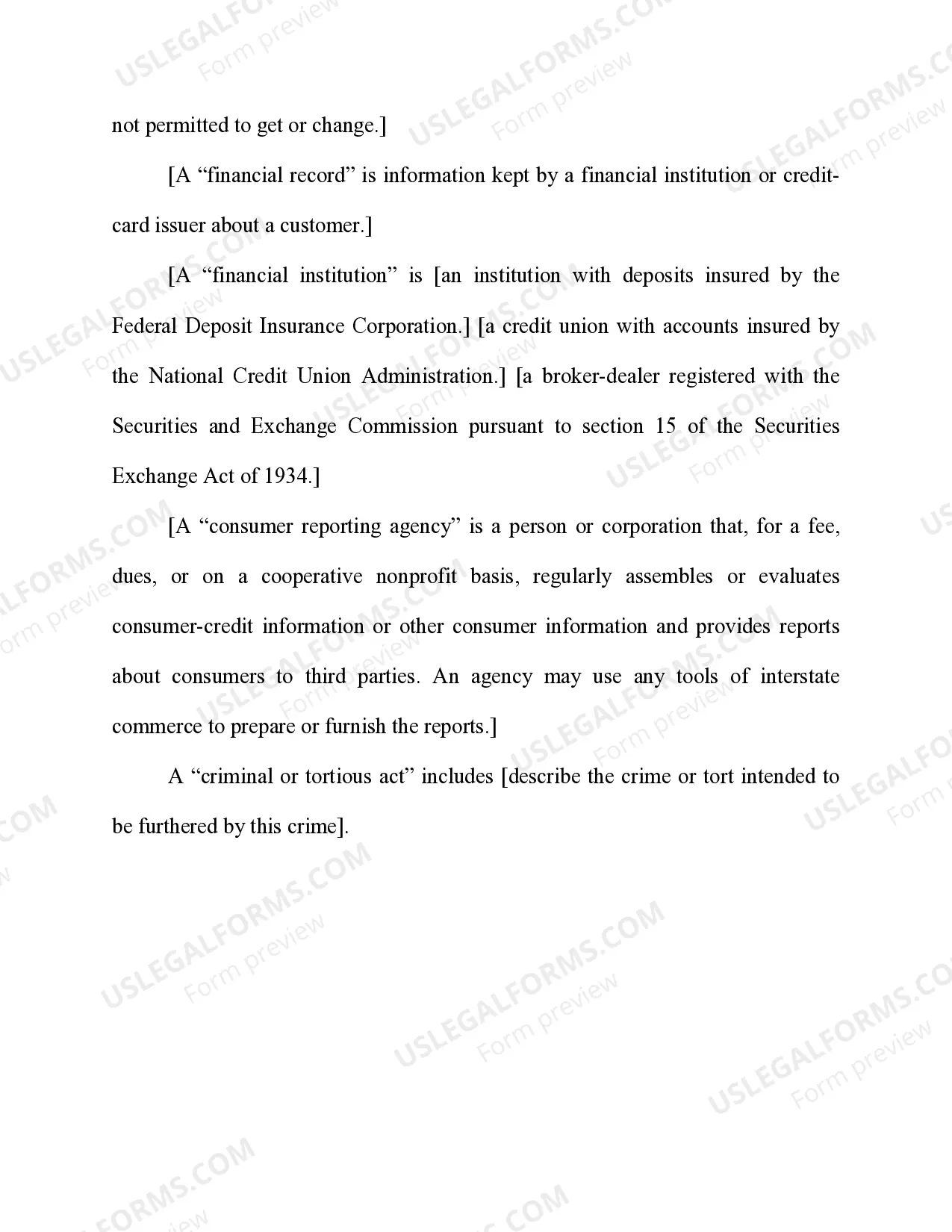
- Clarification of what constitutes a "computer" and âfinancial record.â
- Explanations of the roles of financial institutions and consumer reporting agencies.
- Details on associated criminal or tortious acts that may be furthered by the fraud.

When to use this document
This form should be used in cases where there is evidence of unauthorized computer access with the intent to obtain financial information. It is applicable in situations involving identity theft, credit card fraud, or any instance where an individual's financial records are accessed unlawfully for personal gain.
Who this form is for
Eligibility for this form includes:
- Law enforcement agencies pursuing a case of computer fraud.
- Legal professionals representing clients impacted by unauthorized access to financial data.
- Individuals seeking to understand their rights and protections under federal computer fraud regulations.
How to prepare this document
- Identify the defendant involved in the alleged computer fraud.
- Clearly outline the unauthorized access and detail how the defendant went beyond their permissions.
- Specify the financial information obtained and from which institution or agency.
- Document the motive behind the action, whether for personal financial gain or to enable further criminal activities.
- Ensure all allegations comply with the requirements set forth in 18 U.S.C. § 1030.
Is notarization required?
This form does not typically require notarization unless specified by local law.
Get your form ready online
Our built-in tools help you complete, sign, share, and store your documents in one place.
Make edits, fill in missing information, and update formatting in US Legal Forms—just like you would in MS Word.
Download a copy, print it, send it by email, or mail it via USPS—whatever works best for your next step.
Sign and collect signatures with our SignNow integration. Send to multiple recipients, set reminders, and more. Go Premium to unlock E-Sign.
If this form requires notarization, complete it online through a secure video call—no need to meet a notary in person or wait for an appointment.
We protect your documents and personal data by following strict security and privacy standards.

Make edits, fill in missing information, and update formatting in US Legal Forms—just like you would in MS Word.

Download a copy, print it, send it by email, or mail it via USPS—whatever works best for your next step.

Sign and collect signatures with our SignNow integration. Send to multiple recipients, set reminders, and more. Go Premium to unlock E-Sign.

If this form requires notarization, complete it online through a secure video call—no need to meet a notary in person or wait for an appointment.

We protect your documents and personal data by following strict security and privacy standards.
Typical mistakes to avoid
- Failing to adequately prove the intent of unauthorized access.
- Misidentifying the type of financial institution or agency involved.
- Overlooking the necessity to document the financial value of the information obtained.
- Neglecting to connect the act to a criminal or tortious purpose.
Why complete this form online
- Convenient access to professionally drafted legal templates.
- Editability allows you to customize the form easily.
- Reliable resources that ensure compliance with current legal standards.
Legal use & context
- This form is used in federal cases involving computer fraud, specifically violations of 18 U.S.C. § 1030.
- It helps establish criteria for proving unauthorized access and the intent behind obtaining financial records.
- Understanding the legal definitions and components is critical for successful prosecution or defense in such cases.
What to keep in mind
- The form addresses federal offenses related to unauthorized computer access for financial gain.
- It is applicable in various scenarios, particularly identity theft cases.
- The form remains consistent across different states as it is based on federal law.
Looking for another form?
Form popularity
FAQ
A major problem with the CFAA is the ambiguous nature of the statutory language. The term ?without authorization? is not defined in the statute. ?Exceeds authorized access? is defined, but only in a somewhat circular manner that does little to limit its scope.
COMPUTER FRAUD IS DEFINED AS ANY DECEPTION OR EMBEZZLEMENT ACCOMPLISHED BY TAMPERING WITH COMPUTER PROGRAMS, DATA FILES, OPERATIONS, EQUIPMENT, OR MEDIA WHICH RESULT IN FINANCIAL LOSSES TO THE ORGANIZATION WHOSE COMPUTER SYSTEM HAS BEEN MANIPULATED.
The law prohibits accessing a computer without authorization, or in excess of authorization.
Cybercrime can include many different types of profit-driven criminal activity, including ransomware attacks, email and internet fraud, and identity fraud, as well as attempts to steal financial account, credit card or other payment card information.
Federal law provides that first time offenders caught violating the CFAA may be punished with criminal fines of up to $5,000 per crime, imprisonment from 1 to 10 years, or a combination of both.
Cyber-bullying, hacking, identity theft, and even using a work PC for personal business are all examples of computer abuse. While not always enforced, acts that constitute computer abuse was codified in the 1984 Computer Fraud and Abuse Act (CFAA) which is enforceable at the federal level.
Provisions of the Computer Fraud & Abuse Act 18 U.S.C. § 1030 OffenseSectionAccessing a Computer and Obtaining Information(a)(2)Trespassing in a Government Computer(a)(3)Accessing a Computer to Defraud and Obtain Value(a)(4)Intentionally Damaging by Knowing Transmission(a)(5)(A)6 more rows
CFAA KEY LITIGATION ISSUES exceeded authorized access on a protected computer (see Exceeding Authorization). another factor under 18 U.S.C. 1030(c)(4)(A)(i) applies) (see $5,000 Loss Threshold). transmitted a program, information, code, or command to a protected computer (see Transmission).