Jury Instruction - Computer Fraud Obtaining Financial Information
What this document covers
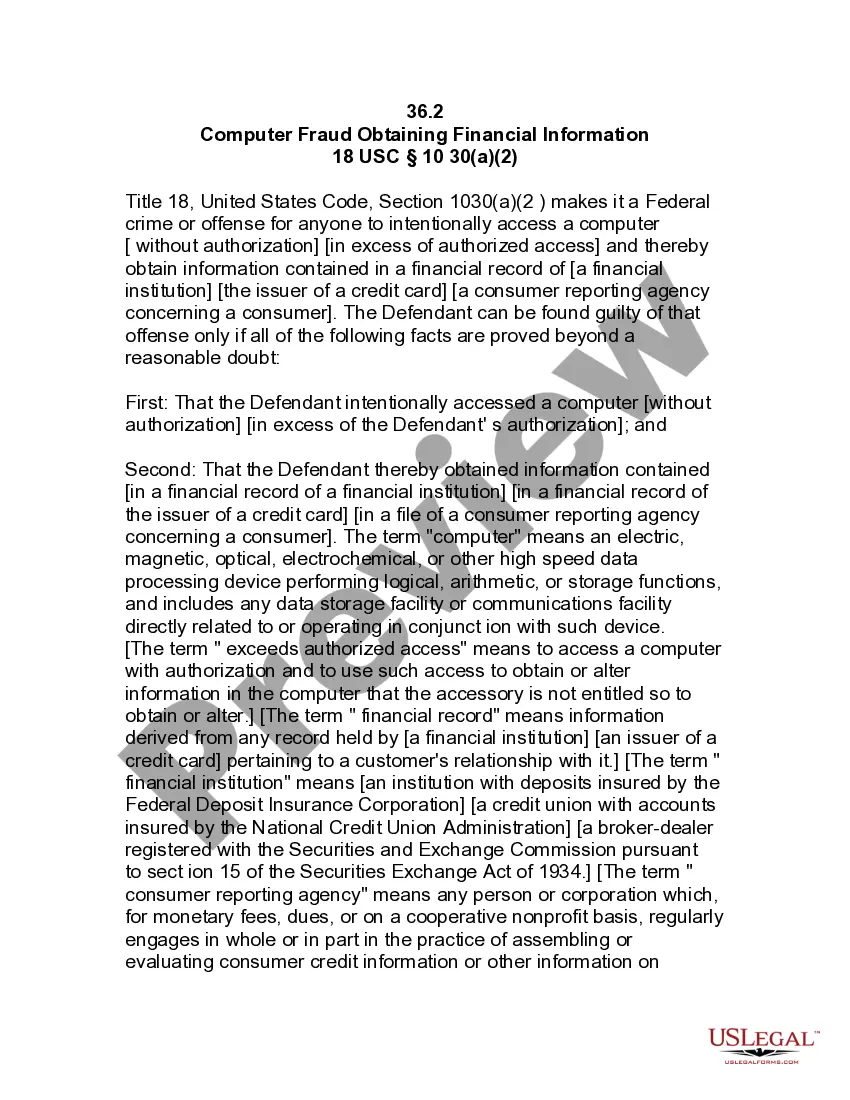
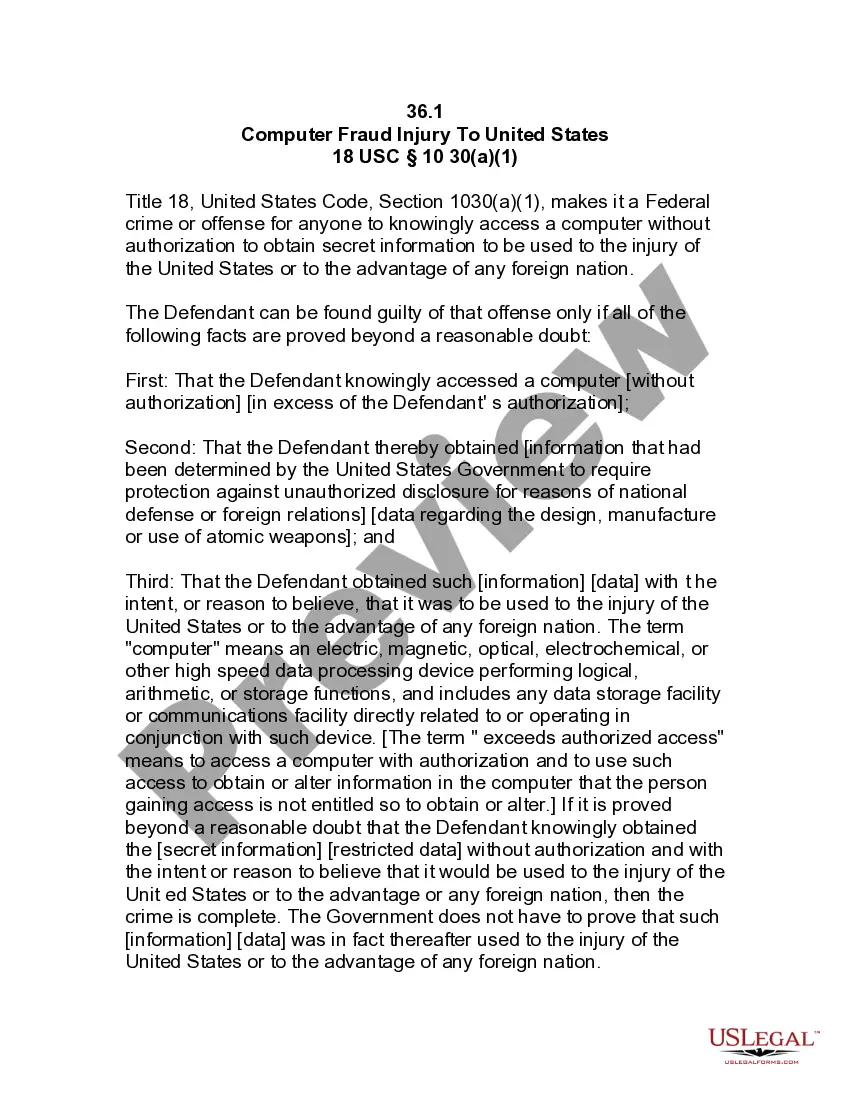
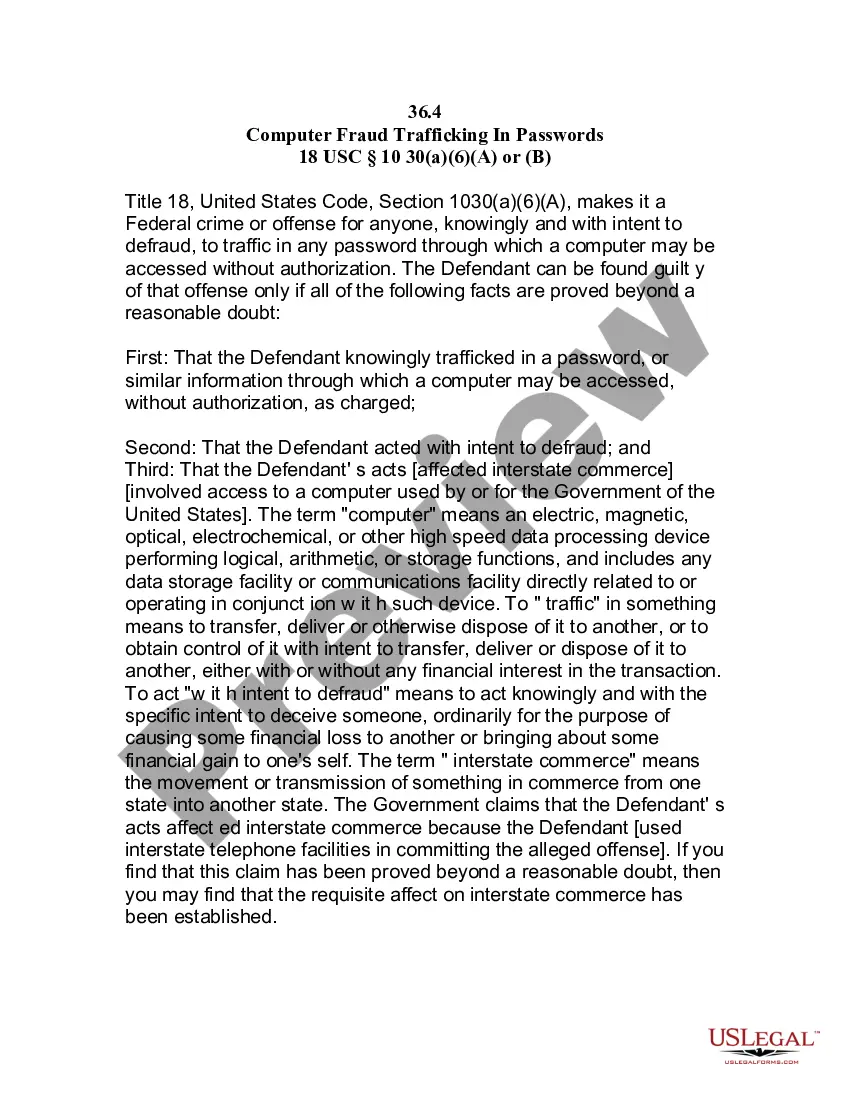
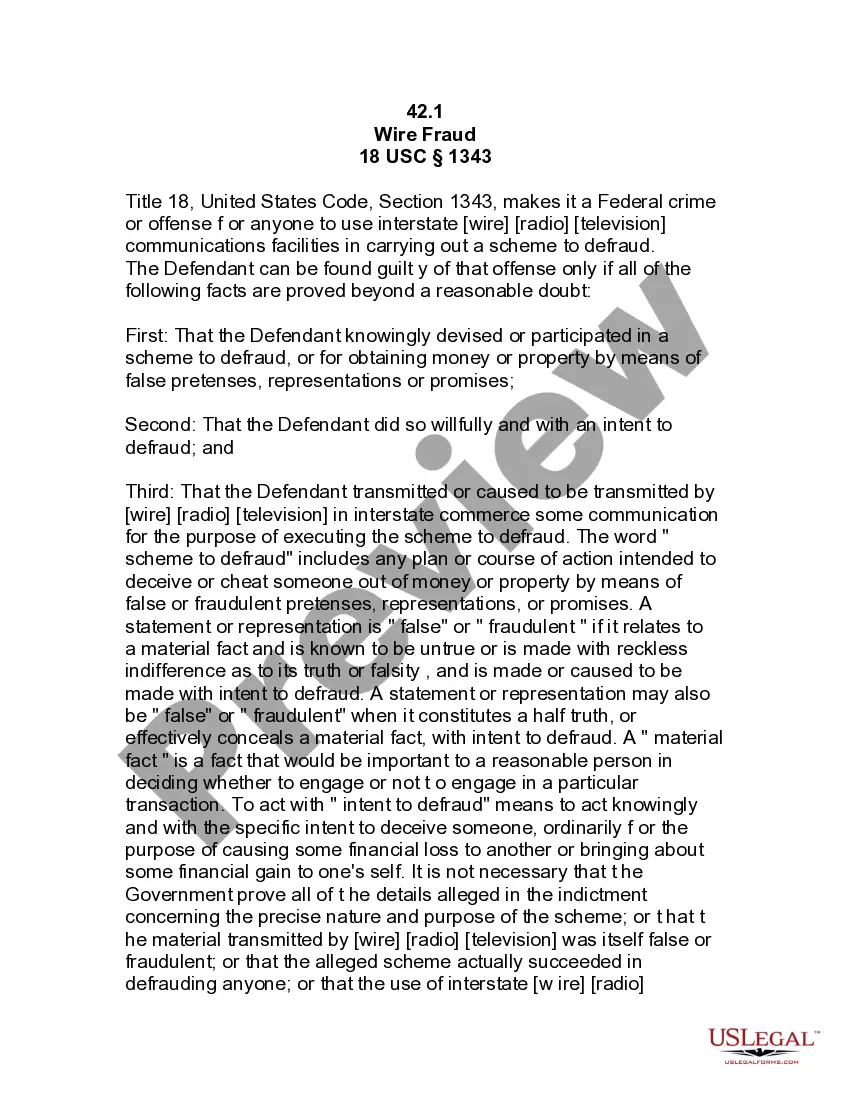
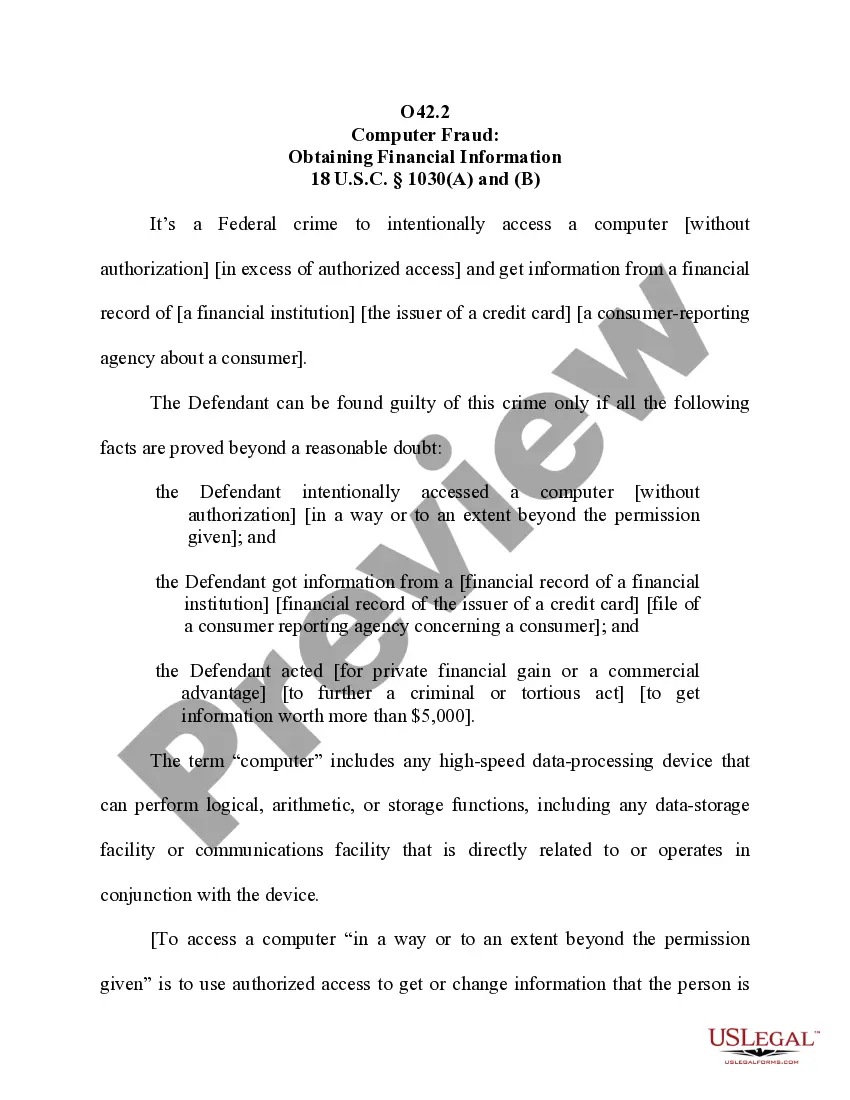
The Jury Instruction - Computer Fraud Obtaining Financial Information form provides standardized jury instructions related to computer fraud, specifically under Title 18, United States Code, Section 1030(a)(2). This form aids legal professionals and jurors in understanding the requirements for proving the crime of unauthorized access to financial information. It serves as a guideline, differentiating itself from other jury instruction forms by focusing specifically on cases involving financial fraud through computer means.
Key parts of this document
- Definition of computer fraud involving unauthorized access to information.
- Criteria for proving the defendant's guilt beyond a reasonable doubt.
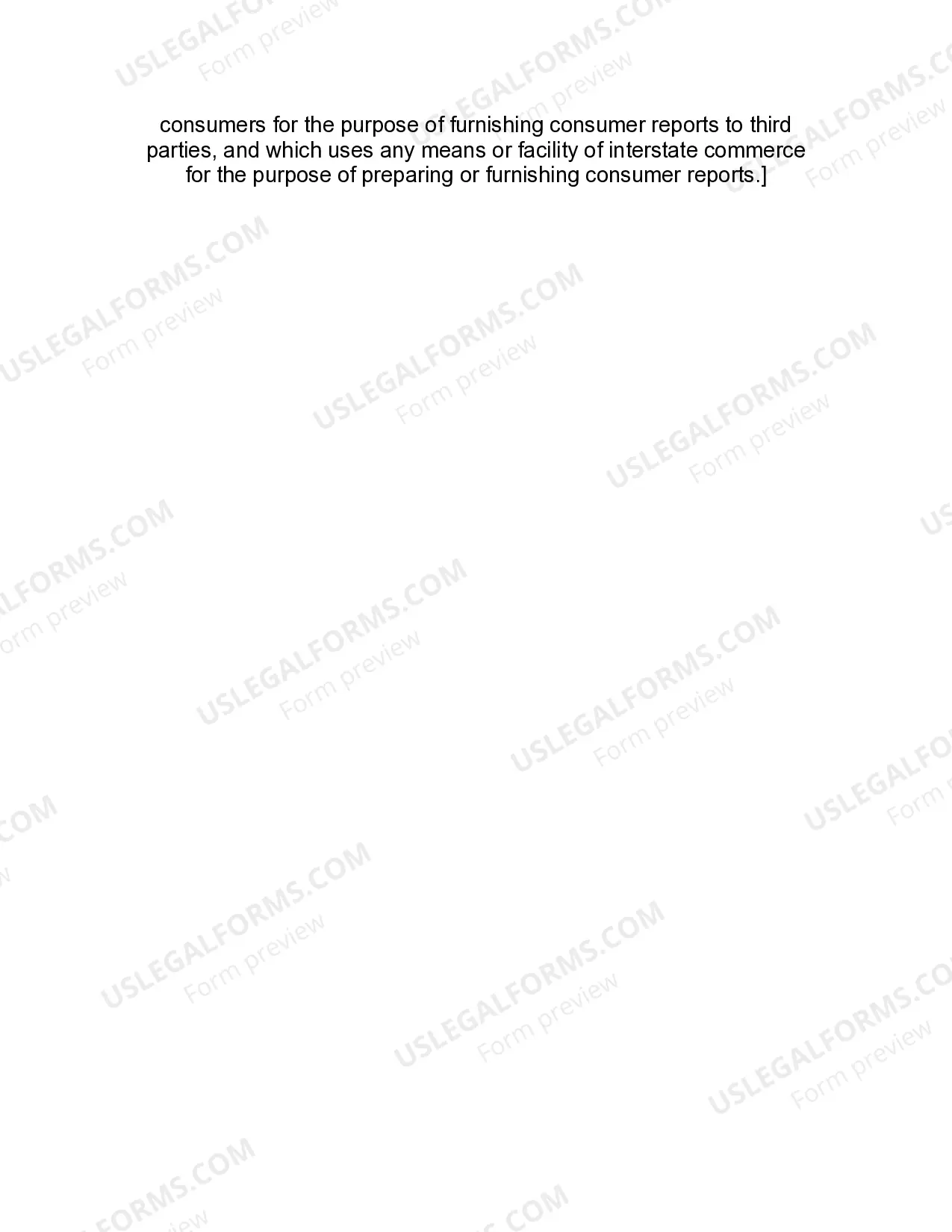
- Clarification of key terms such as "financial record," "financial institution," and "consumer reporting agency."
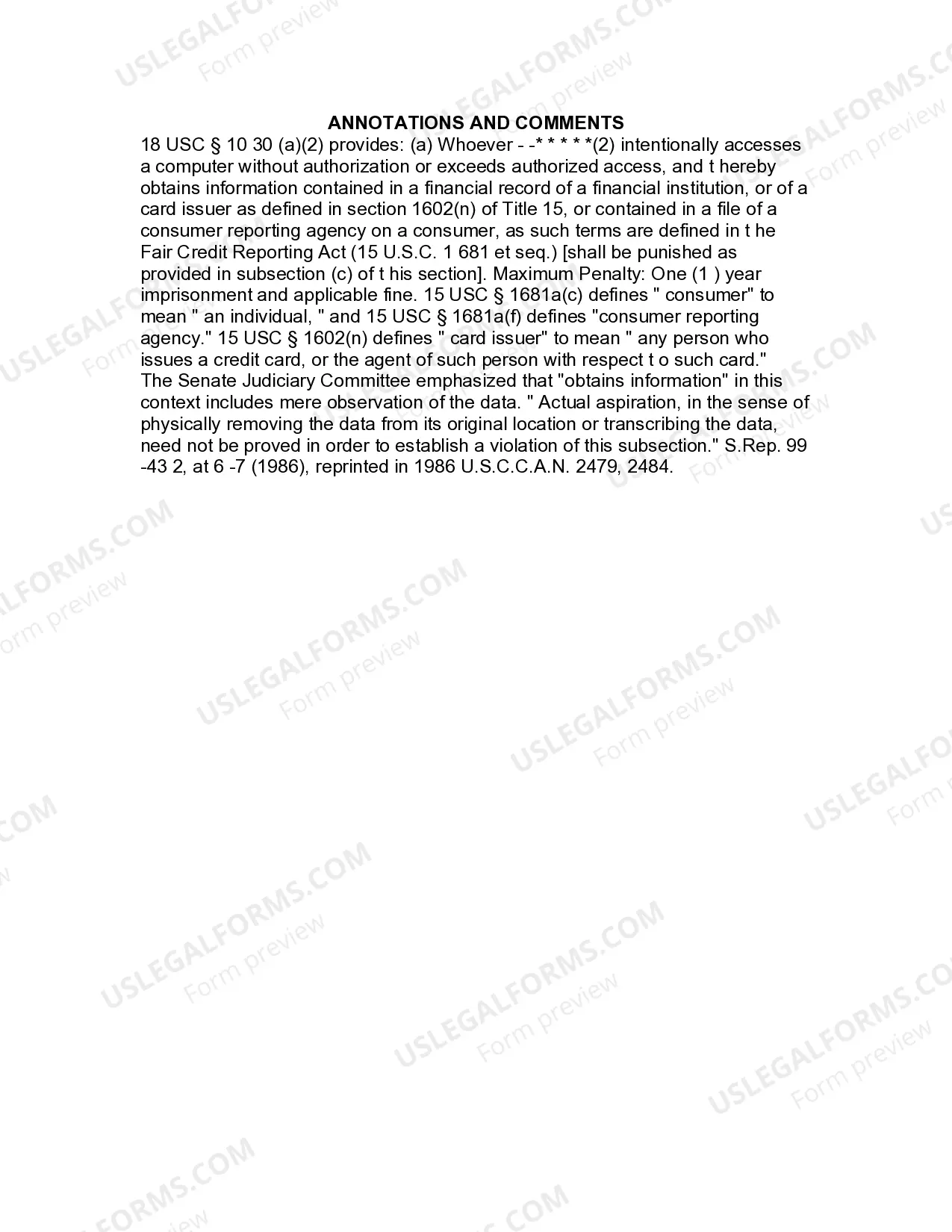
- Legal ramifications and penalties associated with violations.
Situations where this form applies
This form is used during jury trials involving charges of computer fraud related to the unauthorized access of financial information. It is applicable when a defendant is accused of exceeding authorized access to obtain sensitive financial records from a financial institution or consumer reporting agency.
Intended users of this form
- Judges in federal court cases involving computer fraud.
- Legal practitioners preparing jury instructions for trial.
- Jurors needing guidance on the legal criteria for assessing evidence in such cases.
Instructions for completing this form
- Review the factual background of the case being tried.
- Identify the specific elements of the offense that must be proved to the jury.
- Modify the sample instructions to align with the unique aspects of the case.
- Ensure the language is clear and accessible for the jury to understand.
- Finalize the jury instructions for submission before the trial proceedings.
Is notarization required?
This form usually doesn’t need to be notarized. However, local laws or specific transactions may require it. Our online notarization service, powered by Notarize, lets you complete it remotely through a secure video session, available 24/7.
Get your form ready online
Our built-in tools help you complete, sign, share, and store your documents in one place.
Make edits, fill in missing information, and update formatting in US Legal Forms—just like you would in MS Word.
Download a copy, print it, send it by email, or mail it via USPS—whatever works best for your next step.
Sign and collect signatures with our SignNow integration. Send to multiple recipients, set reminders, and more. Go Premium to unlock E-Sign.
If this form requires notarization, complete it online through a secure video call—no need to meet a notary in person or wait for an appointment.
We protect your documents and personal data by following strict security and privacy standards.

Make edits, fill in missing information, and update formatting in US Legal Forms—just like you would in MS Word.

Download a copy, print it, send it by email, or mail it via USPS—whatever works best for your next step.

Sign and collect signatures with our SignNow integration. Send to multiple recipients, set reminders, and more. Go Premium to unlock E-Sign.

If this form requires notarization, complete it online through a secure video call—no need to meet a notary in person or wait for an appointment.

We protect your documents and personal data by following strict security and privacy standards.
Mistakes to watch out for
- Failing to define legal terminology clearly for the jury.
- Using overly complex language that might confuse jurors.
- Neglecting to ensure that all elements of the crime are covered in the instructions.
Benefits of completing this form online
- Convenient access to standardized jury instructions at any time.
- Customizable templates that streamline the legal preparation process.
- Reliability based on content constructed by licensed attorneys.
Legal use & context
- This form is essential for guiding jurors in understanding their responsibilities in cases of computer fraud.
- It helps ensure that due process is followed during trial by providing clear legal standards.
- Effective use of this form can aid in delivering a fair verdict based on established legal definitions.
Main things to remember
- The form provides crucial guidance on computer fraud laws under federal statute.
- Clear definitions and criteria are necessary for jurors to accurately assess a case.
- Standardized language assists in maintaining clarity and consistency in jury instructions.
Glossary of terms
- Computer fraud: The act of accessing a computer system without authorization to obtain misleading or illegitimate financial information.
- Financial institution: An organization that conducts financial transactions, which may include banks and credit unions.
- Consumer reporting agency: An organization that collects and sells consumer credit information.
Looking for another form?

Form popularity
FAQ
2001. The PATRIOT Act further expanded the CFAA, increasing both its penalties and its effectiveness as a prosecution tool.Suspected violations of the CFAA were added to the list of felonies for which the FBI can conduct wiretap surveillance.
The Computer Fraud and Abuse Act (CFAA) was enacted in 1986, as an amendment to the first federal computer fraud law, to address hacking.
Fines for a conviction of various computer and internet crimes range widely. A misdemeanor conviction can result in relatively minor fines of a few hundred dollars, and possibly up to a $1,000 or more, while felony convictions can have fines that exceed $100,000. Jail or prison.
The National Information Infrastructure Protection Act of 1996 amended the Computer Fraud and Abuse Act of 1986. It modified several sections of the CFAA and increased the penalties for selected crimes.
An attempt to hack into a federal computer in violation of paragraph 1030(a)(3) is also punishable as a federal crime, 18 U.S.C. 1030(b).
The punishments under these provisions are different based upon the gravity of the committed cybercrime. Section 419 carries a punishment up to 3 years of imprisonment or fine and Section 420 carries up to 7 years of imprisonment or fine.
H.R. 4718 - 99th Congress (1985-1986): Computer Fraud and Abuse Act of 1986 Congress.gov Library of Congress.
The federal Computer Fraud and Abuse Act (CFAA), 18 U.S.C. § 1030, is the primary statutory mechanism for prosecuting cybercrime, and it provides for both criminal and civil penalties.
The CFAA covers a "protected computer," and speaking beyond the servers of the United States government or a financial institution, the CFAA defines a "protected computer" as meaning a computer "which is used in or affecting interstate or foreign commerce or communication, including a computer located outside the