Copyright - Ownership - Joint Authorship
Overview of this form
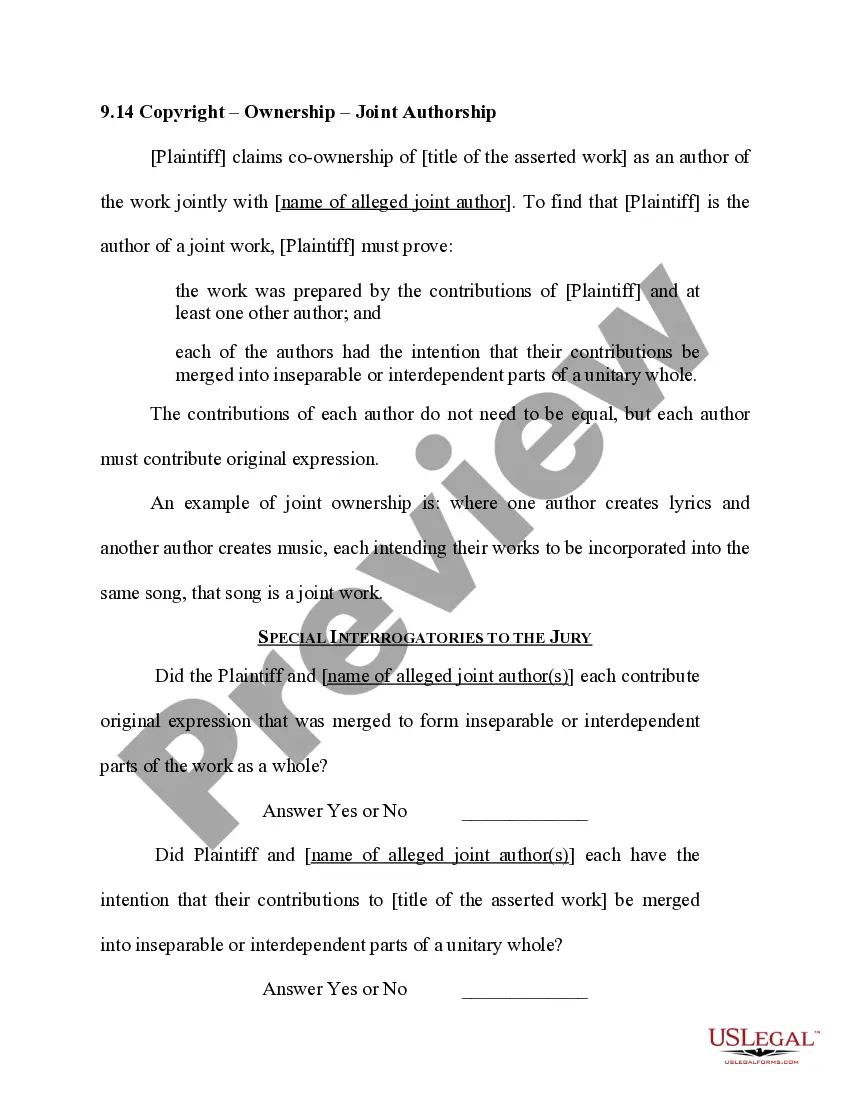
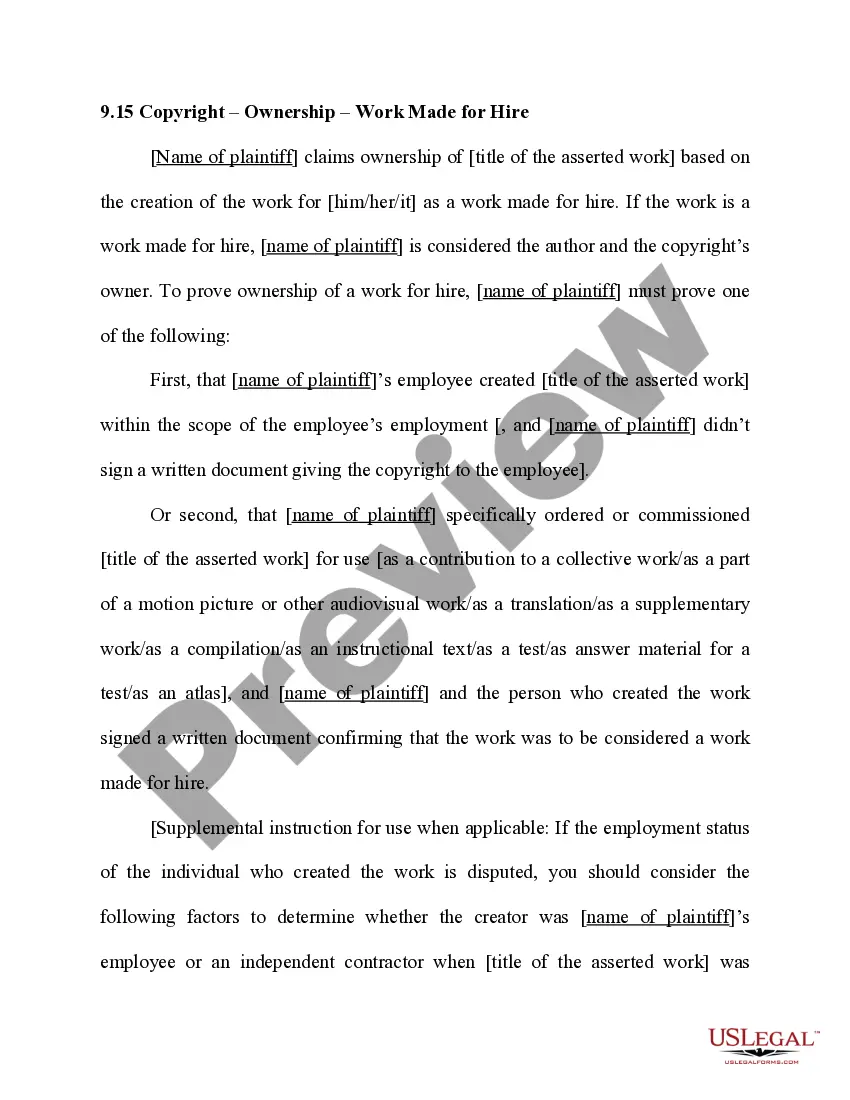
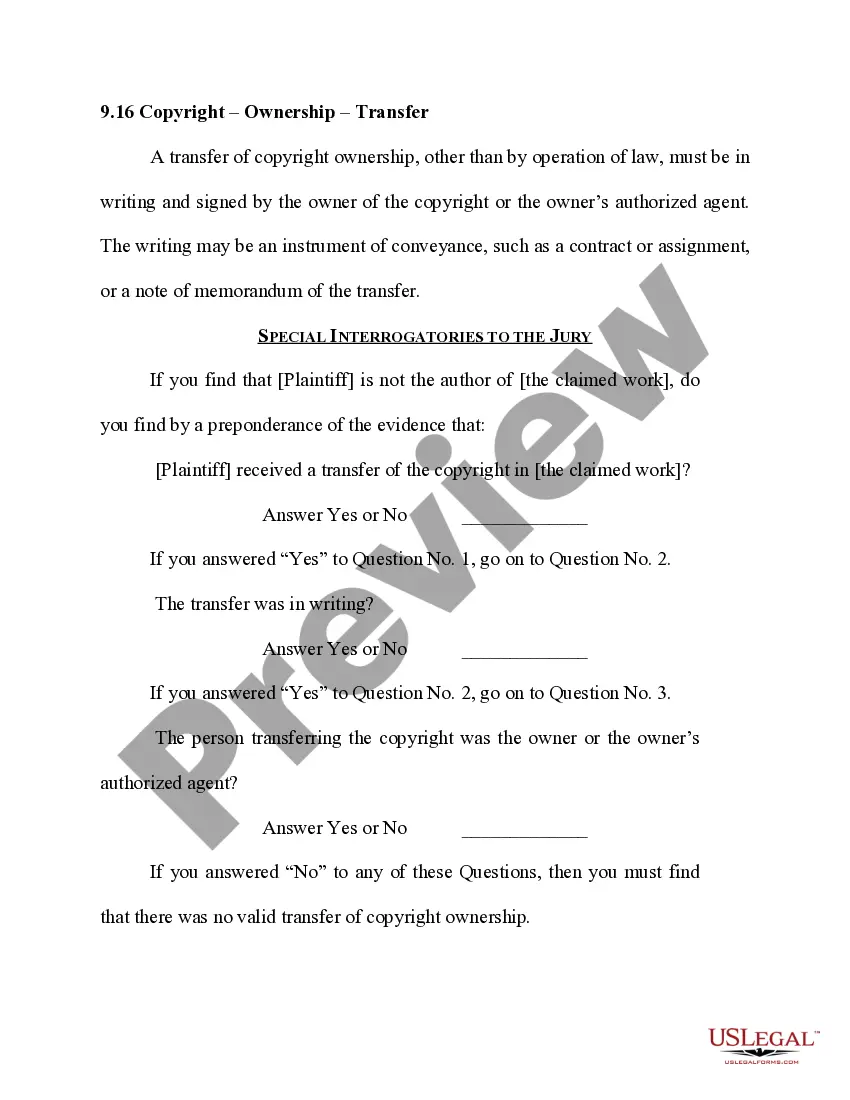
The Copyright - Ownership - Joint Authorship form is a legal document that enables authors to assert co-ownership of a creative work. This form is crucial when two or more individuals collaborate on a work and intend for their respective contributions to be merged into a unified whole. It clarifies each author's rights, helping to resolve disputes over authorship and ownership rights in creative fields, such as music, literature, or art.
Key parts of this document
- Claims of co-ownership in a specific work.
- Requirements proving joint authorship through contributions and intent.
- Special interrogatories to the jury regarding contributions and intentions.
Common use cases
This form is useful in situations where authors need to establish or confirm joint ownership of a creative work. For example, if two songwriters collaborate on a song, and one party claims they are entitled to rights over the work, this form helps formalize their joint authorship and clarify each party's contributions.
Intended users of this form
- Collaborative authors who have jointly created a work.
- Artists in partnership who need to assert their ownership rights.
- Individuals involved in a legal dispute regarding creative contributions.
Steps to complete this form
- Identify the parties involved in the joint authorship.
- Specify the title of the creative work and the alleged joint authors.
- Provide details regarding each author's contributions to the work.
- Clearly outline the intention of the authors to create a unified work.
- Answer the special interrogatories regarding the contributions and intentions.
Notarization guidance
This form does not typically require notarization unless specified by local law. However, having a notary can provide an additional layer of validation if desired by the parties involved.
Get your form ready online
Our built-in tools help you complete, sign, share, and store your documents in one place.
Make edits, fill in missing information, and update formatting in US Legal Forms—just like you would in MS Word.
Download a copy, print it, send it by email, or mail it via USPS—whatever works best for your next step.
Sign and collect signatures with our SignNow integration. Send to multiple recipients, set reminders, and more. Go Premium to unlock E-Sign.
If this form requires notarization, complete it online through a secure video call—no need to meet a notary in person or wait for an appointment.
We protect your documents and personal data by following strict security and privacy standards.

Make edits, fill in missing information, and update formatting in US Legal Forms—just like you would in MS Word.

Download a copy, print it, send it by email, or mail it via USPS—whatever works best for your next step.

Sign and collect signatures with our SignNow integration. Send to multiple recipients, set reminders, and more. Go Premium to unlock E-Sign.

If this form requires notarization, complete it online through a secure video call—no need to meet a notary in person or wait for an appointment.

We protect your documents and personal data by following strict security and privacy standards.
Common mistakes
- Failing to document the contributions of each author.
- Not establishing a clear intent for joint authorship.
- Ignoring the specific requirements of state laws regarding copyright.
Benefits of using this form online
- Convenient access to legal form templates without the need for in-person meetings.
- Edit the form as needed to reflect specific details of the joint authorship.
- Reliable format saved for future reference or modifications.
Legal use & context
- The form establishes a legal basis for joint authorship claims in copyright disputes.
- Ensuring the work is legally recognized as a collaboration protects rights for both authors.
- Using this form can help prevent future conflicts regarding ownership rights.
Quick recap
- Joint authorship requires contributions and mutual intent.
- It is vital to document all contributions clearly.
- This form is applicable across multiple jurisdictions.
Looking for another form?
Form popularity
FAQ
The authors of a joint work are co-owners of copyright in the work. Joint copyright owners share an equal interest in the copyright regardless of how much they contribute to the work. This gives all joint copyright owners the right to register as well as enforce the copyright.
Co-authors own the work's copyright jointly and equally, unless the authors make an agreement otherwise. Each joint author has the right to exercise any or all of the exclusive rights inherent in the joint work.
In the case of joint authorship, each author is the owner of not only the part he or she created but of the whole work. Every author can freely use the work and license it out for others to use it.
A copyright co-owner can unilaterally issue a non-exclusive license which prevents a co-owner from suing the licensee for any future use. However, a co-owner cannot issue a retroactive license that would prevent a co-owner from suing for infringements that have already occurred.
When a patent is jointly owned, this exclusivity is undermined. Each joint owner can independently sell, license, or otherwise exploit the patent without the approval of the other and without having to account to each other for their revenues.
For example, individuals may be joint authors if one individual devises the plot of a novel or play and the other writes the words, or if they share the labour of working out the plot, scenes and characters, or if they share the labour of writing.
Under the copyright law, the creator of the original expression in a work is its author. The author is also the owner of copyright unless there is a written agreement by which the author assigns the copyright to another person or entity, such as a publisher.
Each co-author has a duty to account to the other co-authors for any profits obtained from the exploitation of the work. A co-author has the right to assign his/her ownership share in the work to a third party or to bequeath his/her ownership share to his/her heirs.