Copyright - Ownership - General Charge
Overview of this form
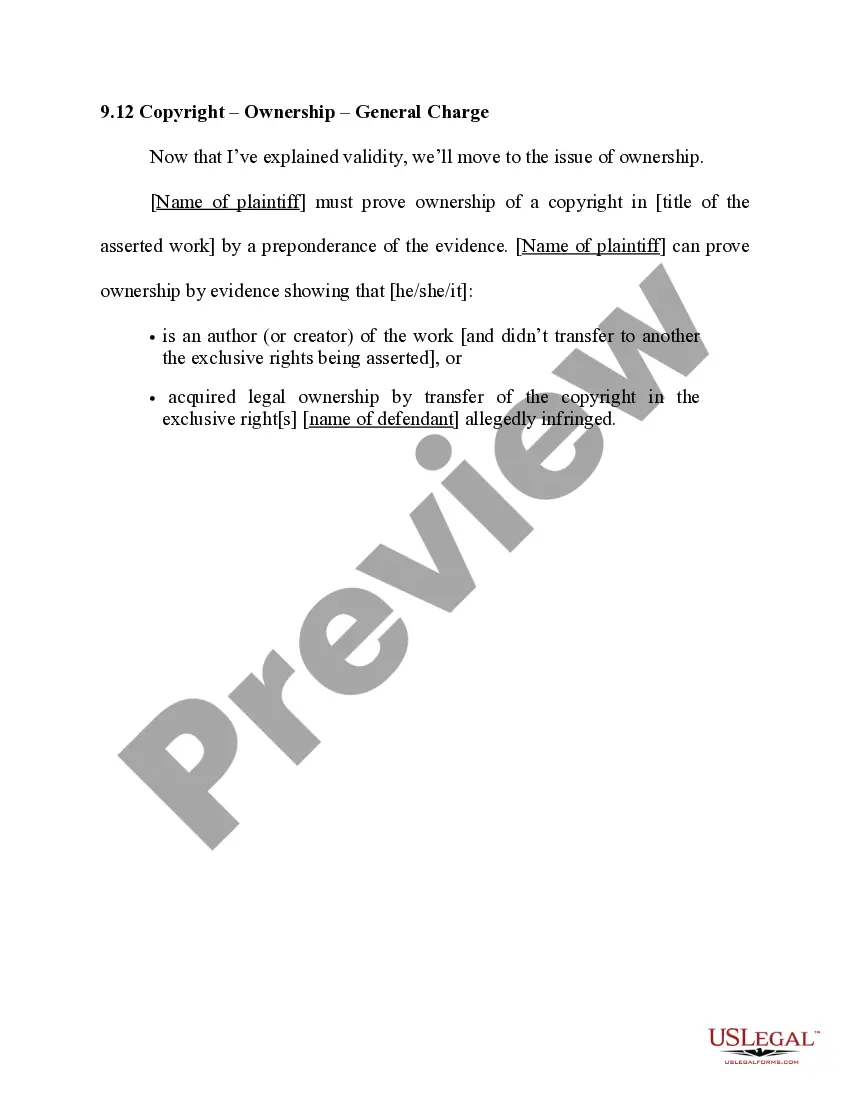
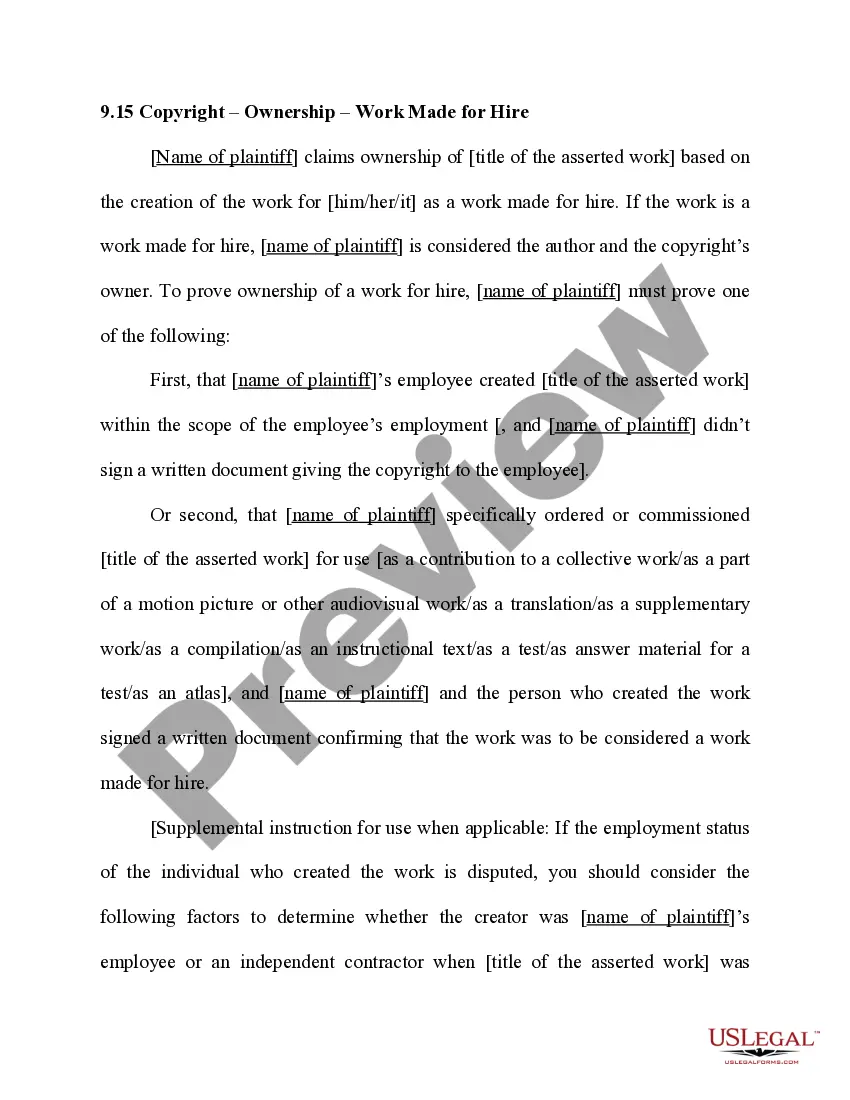
The Copyright - Ownership - General Charge form is a legal document that addresses the essential issue of copyright ownership in a court setting. It provides guidance on how a plaintiff can prove ownership of a copyright for an asserted work, distinguishing itself from similar forms by focusing specifically on the elements required to establish ownership in copyright litigation.
Key parts of this document
- Identification of the plaintiff's name.
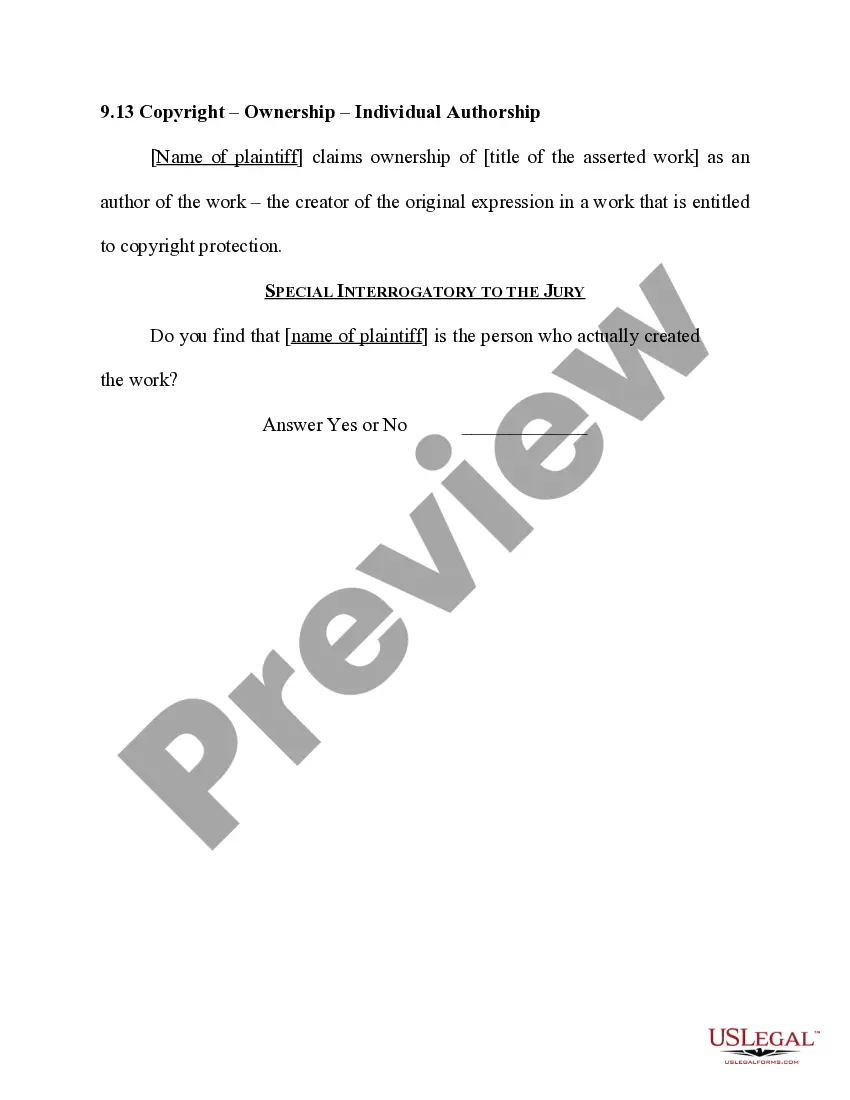
- Specification of the asserted work's title.
- Requirements to demonstrate authorship or legal ownership.
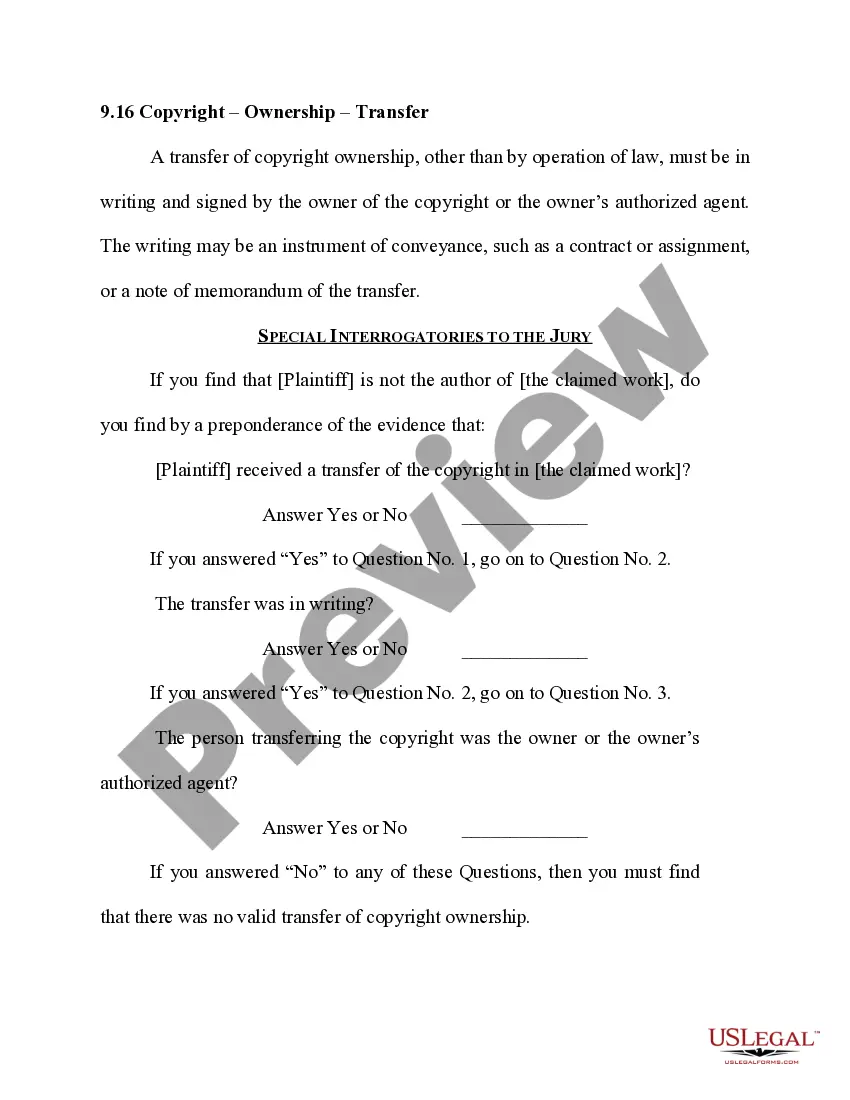
- Understanding of rights and transfers related to copyright ownership.
When this form is needed
This form is used in situations where a plaintiff needs to establish ownership of a copyright in a work that they believe has been infringed. It is ideal for cases where there is a dispute over who holds the copyright and the plaintiff must provide evidence to substantiate their claim.
Who can use this document
This form is intended for:
- Individuals or entities claiming copyright ownership of a creative work.
- Authors or creators involved in copyright litigation.
- Legal professionals representing clients in copyright infringement cases.
Completing this form step by step
- Identify and enter the name of the plaintiff.
- Specify the title of the asserted work.
- Determine if the plaintiff is the author or has acquired legal ownership.
- Ensure to collect evidence that supports the claim of ownership.
- Review and finalize the completed form before filing.
Does this document require notarization?
Notarization is generally not required for this form. However, certain states or situations might demand it. You can complete notarization online through US Legal Forms, powered by Notarize, using a verified video call available anytime.
Get your form ready online
Our built-in tools help you complete, sign, share, and store your documents in one place.
Make edits, fill in missing information, and update formatting in US Legal Forms—just like you would in MS Word.
Download a copy, print it, send it by email, or mail it via USPS—whatever works best for your next step.
Sign and collect signatures with our SignNow integration. Send to multiple recipients, set reminders, and more. Go Premium to unlock E-Sign.
If this form requires notarization, complete it online through a secure video call—no need to meet a notary in person or wait for an appointment.
We protect your documents and personal data by following strict security and privacy standards.

Make edits, fill in missing information, and update formatting in US Legal Forms—just like you would in MS Word.

Download a copy, print it, send it by email, or mail it via USPS—whatever works best for your next step.

Sign and collect signatures with our SignNow integration. Send to multiple recipients, set reminders, and more. Go Premium to unlock E-Sign.

If this form requires notarization, complete it online through a secure video call—no need to meet a notary in person or wait for an appointment.

We protect your documents and personal data by following strict security and privacy standards.
Common mistakes
- Failing to provide adequate evidence of ownership.
- Using incorrect or incomplete information about the asserted work.
- Not considering prior transfers of copyright that may affect ownership.
Benefits of using this form online
- Convenience of filling out the form from anywhere at any time.
- Editability to ensure accuracy and completeness before submission.
- Reliability of form compliance with legal standards and requirements.
Summary of main points
- The Copyright - Ownership - General Charge form is essential for asserting ownership in copyright disputes.
- Clear evidence of ownership is crucial for a successful claim.
- Understanding your rights and any prior transfers is key to effectively using this form.
Looking for another form?
Form popularity
FAQ
As a general rule, for works created after January 1, 1978, copyright protection lasts for the life of the author plus an additional 70 years.
The Copyright Office charges a fee to register copyright claims based on the method you use to apply and the type of work you are registering.
An important distinction to understand is the difference between ownership of a copyright in a work and ownership of a copy of a work. Ownership of a copy ? in other words, the material object in which a copyrighted work is embodied, like a book or DVD ? carries with it no interest in the copyright.
Fees Registration of a claim in an original work of authorshipElectronic filing$250Paper filing$250Registration of a renewal claim (Form RE):Claim without addendum$12523 more rows
There are three basic requirements for copyright protection: that which is to be protected must be a work of authorship; it must be original; and it must be fixed in a tangible medium of expression.
Only the creator of the work (or individual contracting for the creation of the work) may secure copyright protection. The copyright may later be licensed or assigned, but the original creator must originally secure those rights.
How do I register my copyright? To register a work, submit a completed application form, and a nonreturnable copy or copies of the work to be registered. See Circular 1, Copyright Basics, section ?Registration Procedures., and Circular 4, Copyright Office Fees?.
Copyright is a type of intellectual property that protects original works of authorship as soon as an author fixes the work in a tangible form of expression.