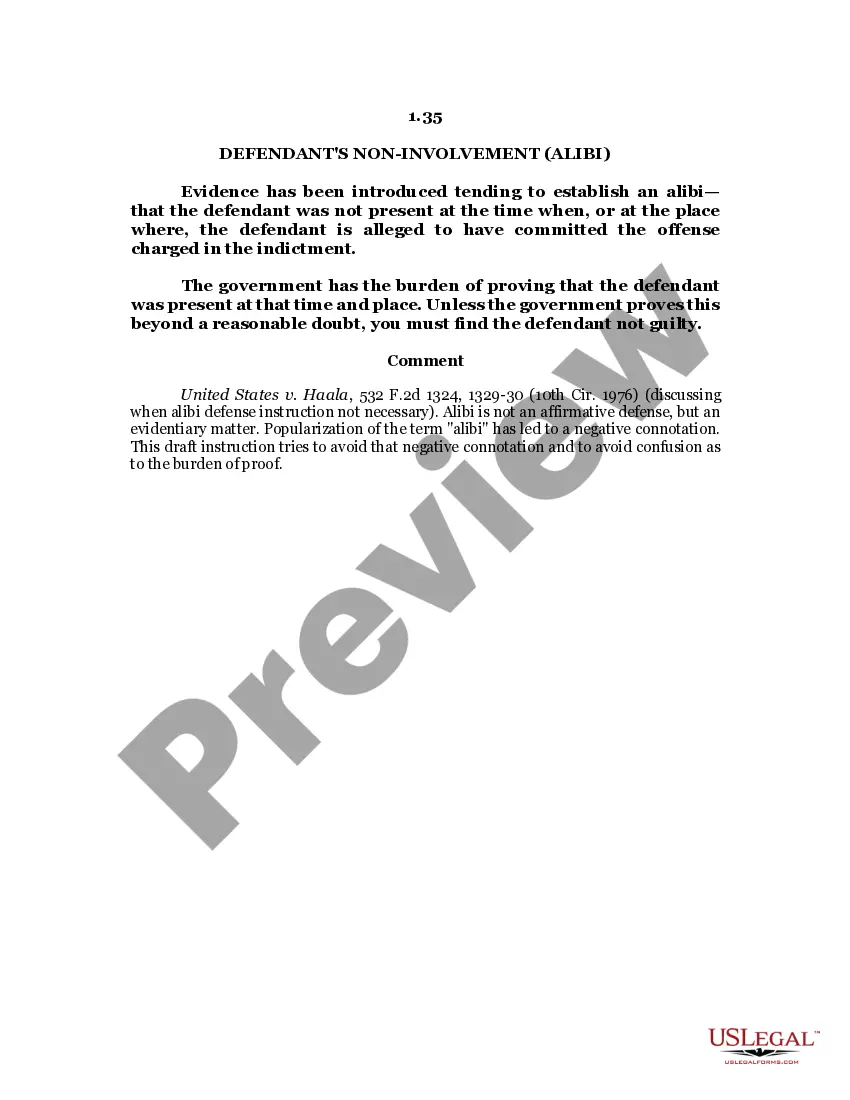
DEFENDANT'S NON-INVOLVEMENT (ALIBI)
What this document covers
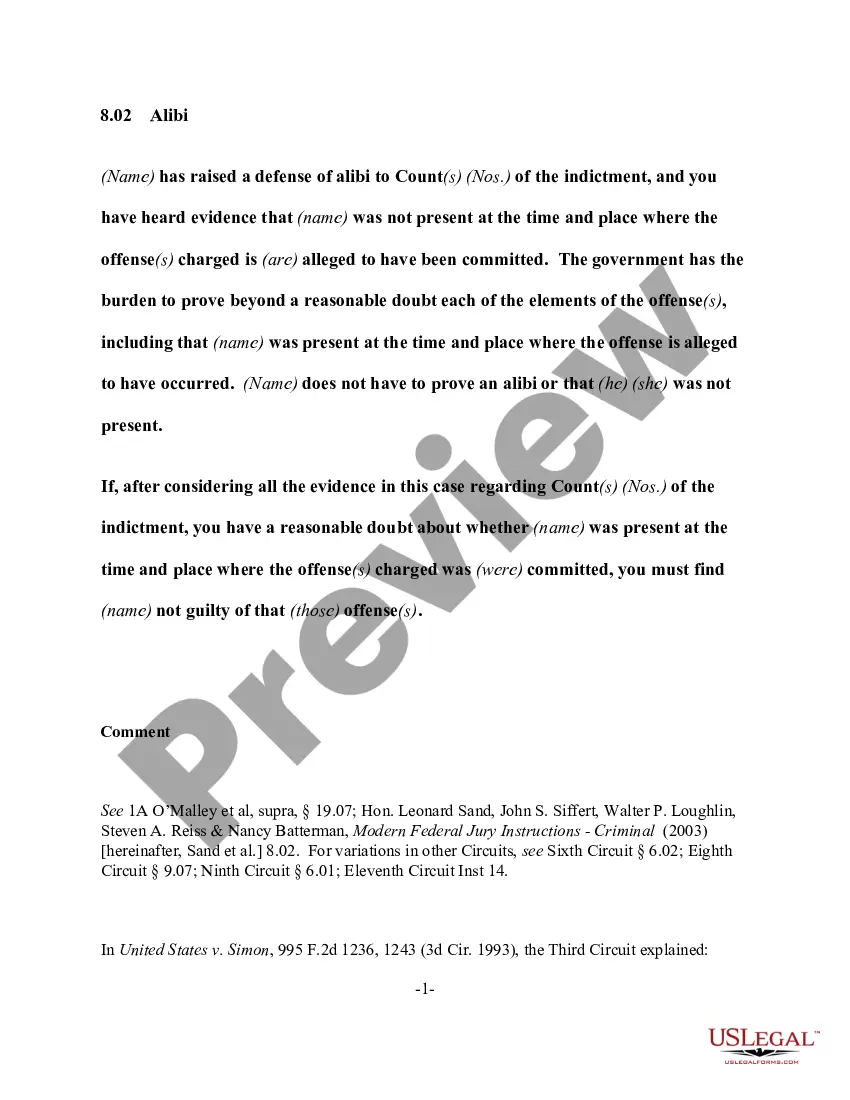
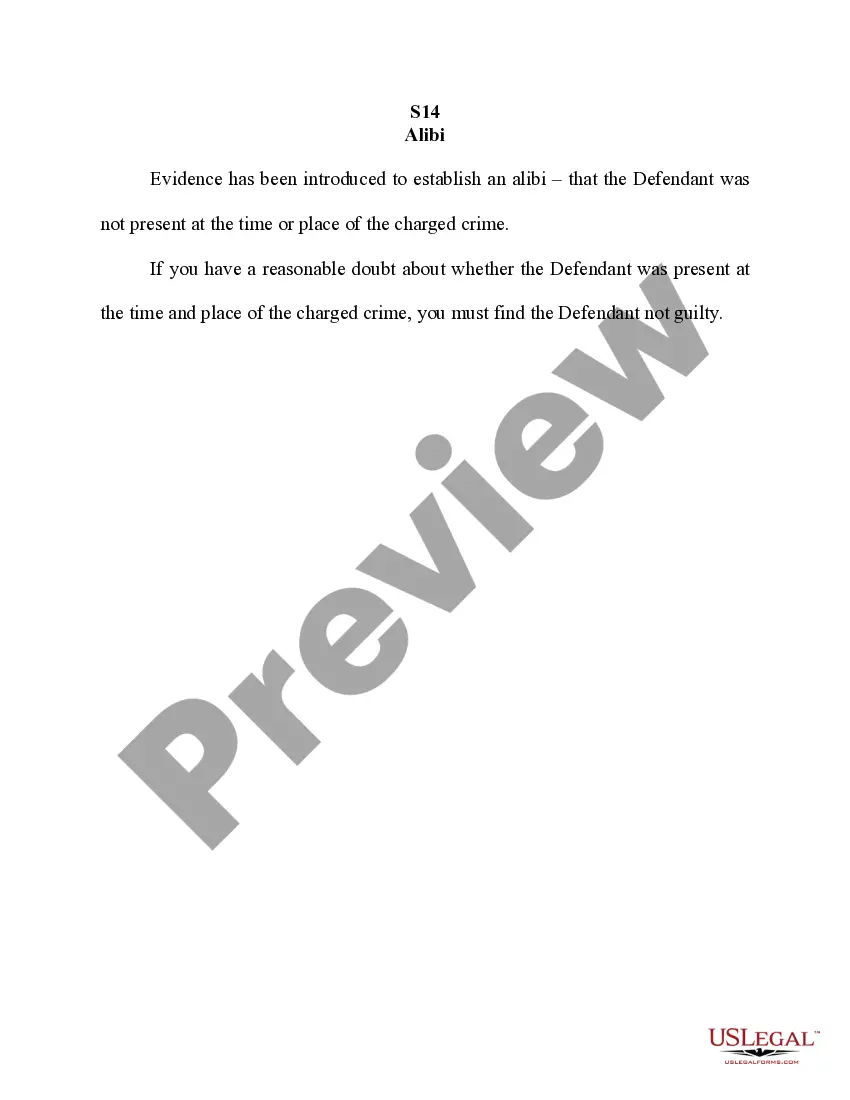
The Defendant's Non-Involvement (Alibi) form is a legal document used in criminal proceedings to assert that the defendant was not present at the location of the alleged crime at the specified time. This form differs from other defenses, as it does not establish an affirmative defense but rather provides evidence regarding the defendant's whereabouts. It places the burden of proof on the government to establish the defendant's presence beyond a reasonable doubt.
What’s included in this form
- Introduction of evidence for alibi - outlines the non-involvement claim.
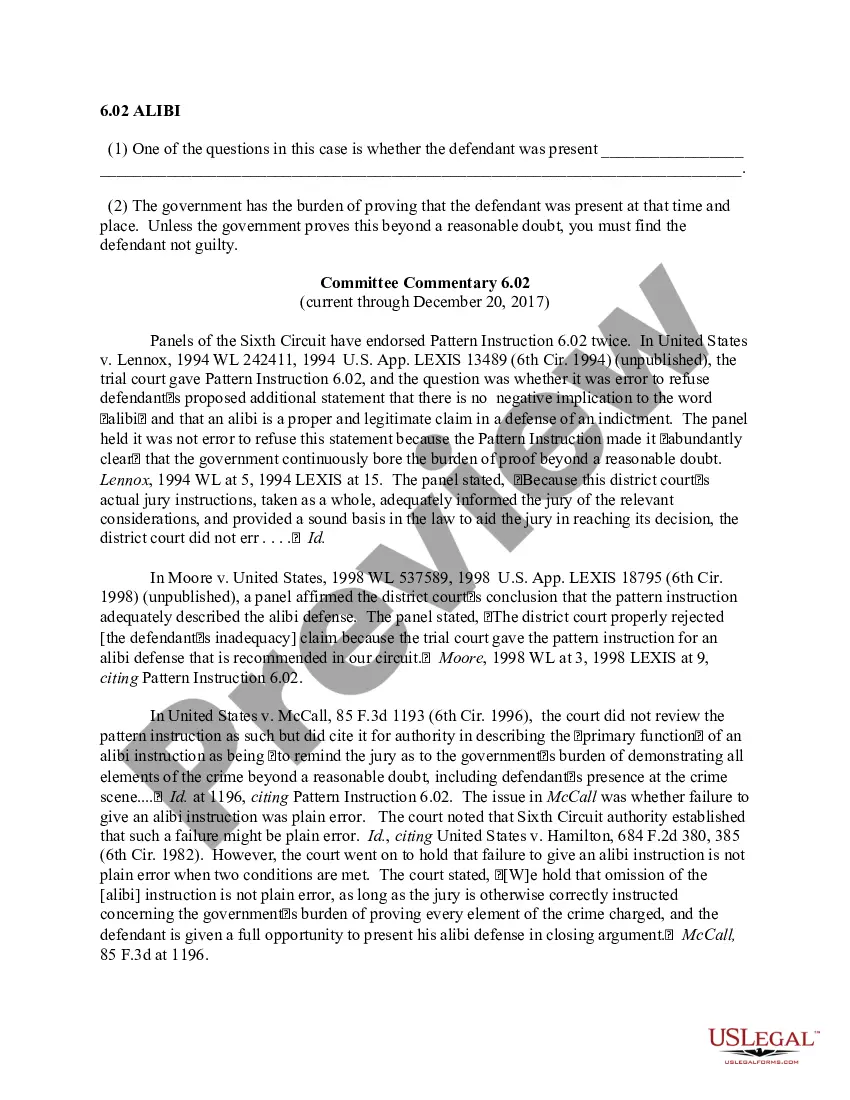
- Burden of proof - specifies that the government must prove presence at the scene.
- Not guilty verdict directive - states the requirement for a not guilty verdict if proof is insufficient.
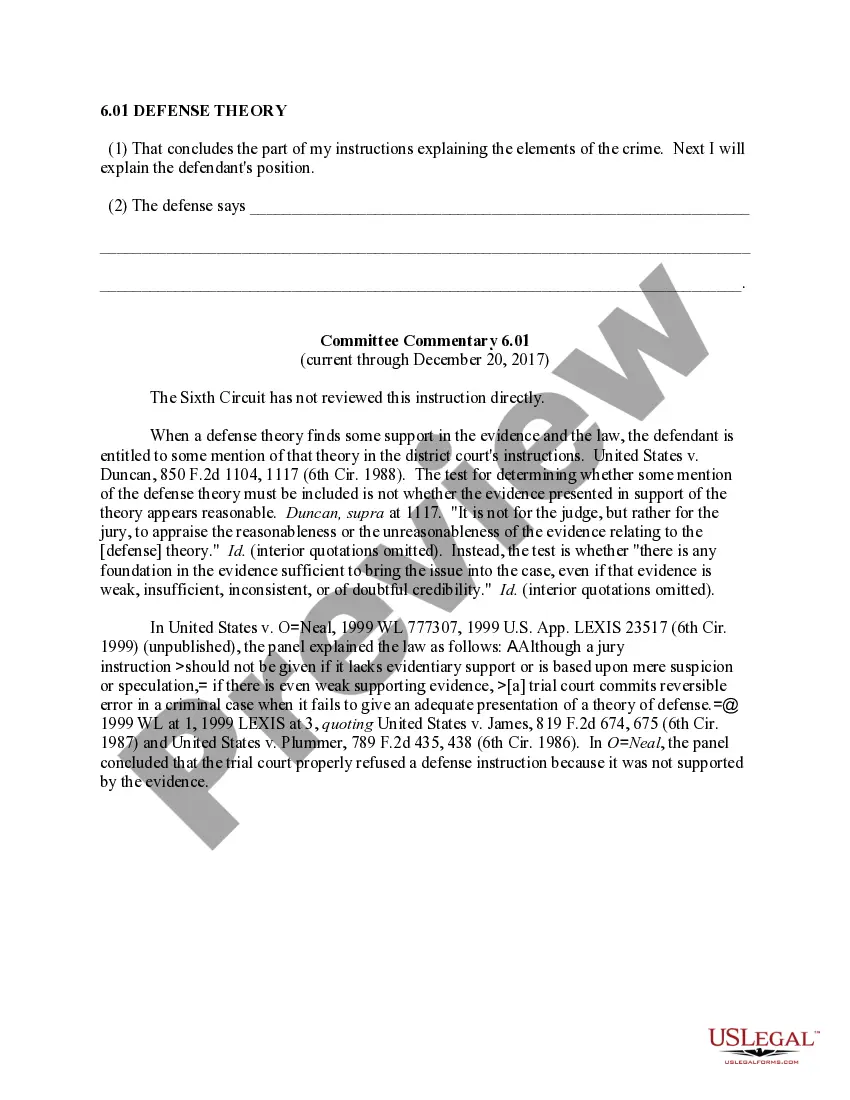
- Citation of legal precedent - references relevant case law for context.
When this form is needed
This form is used in scenarios where a defendant claims they were elsewhere during the time an alleged offense occurred. It is particularly relevant in criminal trials where establishing a credible alibi can impact the outcome of the case, helping to assert the defendant's innocence.
Who can use this document
- Defendants in a criminal trial who have an alibi.
- Attorneys representing clients who wish to assert a non-involvement defense.
- Individuals seeking to clarify their innocence concerning specific charges.
How to prepare this document
- Identify the evidence supporting the alibi claim.
- Detail the specific time and place the defendant was absent from the alleged crime scene.
- Indicate any witnesses who can corroborate the alibi.
- Sign and date the document to affirm authenticity.
Does this document require notarization?
In most cases, this form does not require notarization. However, some jurisdictions or signing circumstances might. US Legal Forms offers online notarization powered by Notarize, accessible 24/7 for a quick, remote process.
Get your form ready online
Our built-in tools help you complete, sign, share, and store your documents in one place.
Make edits, fill in missing information, and update formatting in US Legal Forms—just like you would in MS Word.
Download a copy, print it, send it by email, or mail it via USPS—whatever works best for your next step.
Sign and collect signatures with our SignNow integration. Send to multiple recipients, set reminders, and more. Go Premium to unlock E-Sign.
If this form requires notarization, complete it online through a secure video call—no need to meet a notary in person or wait for an appointment.
We protect your documents and personal data by following strict security and privacy standards.

Make edits, fill in missing information, and update formatting in US Legal Forms—just like you would in MS Word.

Download a copy, print it, send it by email, or mail it via USPS—whatever works best for your next step.

Sign and collect signatures with our SignNow integration. Send to multiple recipients, set reminders, and more. Go Premium to unlock E-Sign.

If this form requires notarization, complete it online through a secure video call—no need to meet a notary in person or wait for an appointment.

We protect your documents and personal data by following strict security and privacy standards.
Mistakes to watch out for
- Failing to provide sufficient evidence to support the alibi.
- Not clearly stating the timeline of events for the alibi.
- Omitting witness details or failing to secure witness statements.
- Not understanding the burden of proof and how it impacts the case.
Why complete this form online
- Convenient access to legal forms anytime and anywhere.
- Editable templates that can be customized to meet specific needs.
- Designed by licensed attorneys, ensuring reliability and accuracy.
Looking for another form?
Form popularity
FAQ
Examples of an Alibi Defense Witnesses could include Bill's boss, co-workers or the owner of the property ? any credible witness who knows Bill was at the site and did not leave around the time of the crime. Bill is not required to testify on his own behalf to raise this defense.
It provides that a defendant must notify the government of his intention to rely upon the defense of alibi. Upon receipt of such notice, the government must advise the defendant of the specific time, date, and place at which the offense is alleged to have been committed.
Simply put, under criminal law, an alibi is a legal defense strategy where a defendant provides evidence they couldn't have committed the crime because they were somewhere else when the crime occurred.
Once the court disbelieves the plea of alibi and the accused does not give any explanation in his statement under Section 313 CrPC, the Court is entitled to draw an adverse inference against the accused.
Examples of evidence you can use to back up your alibi include: Eyewitnesses?people who attest under oath that they saw you somewhere else when the crime occurred; Time-stamped pictures or video footage placing you at another location at the time of the crime; and.
1. EVIDENCE; ALIBI AS A DEFENSE; DEGREE OF ORAL PROOF. ? Alibi is the weakest defense that an accused can avail of, and oral proof thereof must be clearly and satisfactorily established because it is so easily manufactured and usually so unreliable that it cannot be given credit.
Alibi is the best evidence to show that the person accused had not participated in the crime because in the first place he was not there in that place instead he was somewhere else, if only he was in the crime scene he could be suspected if not there is no possibility for him to have committed the offence by