Underwriter Agreement - Self-Employed Independent Contractor
What is this form?
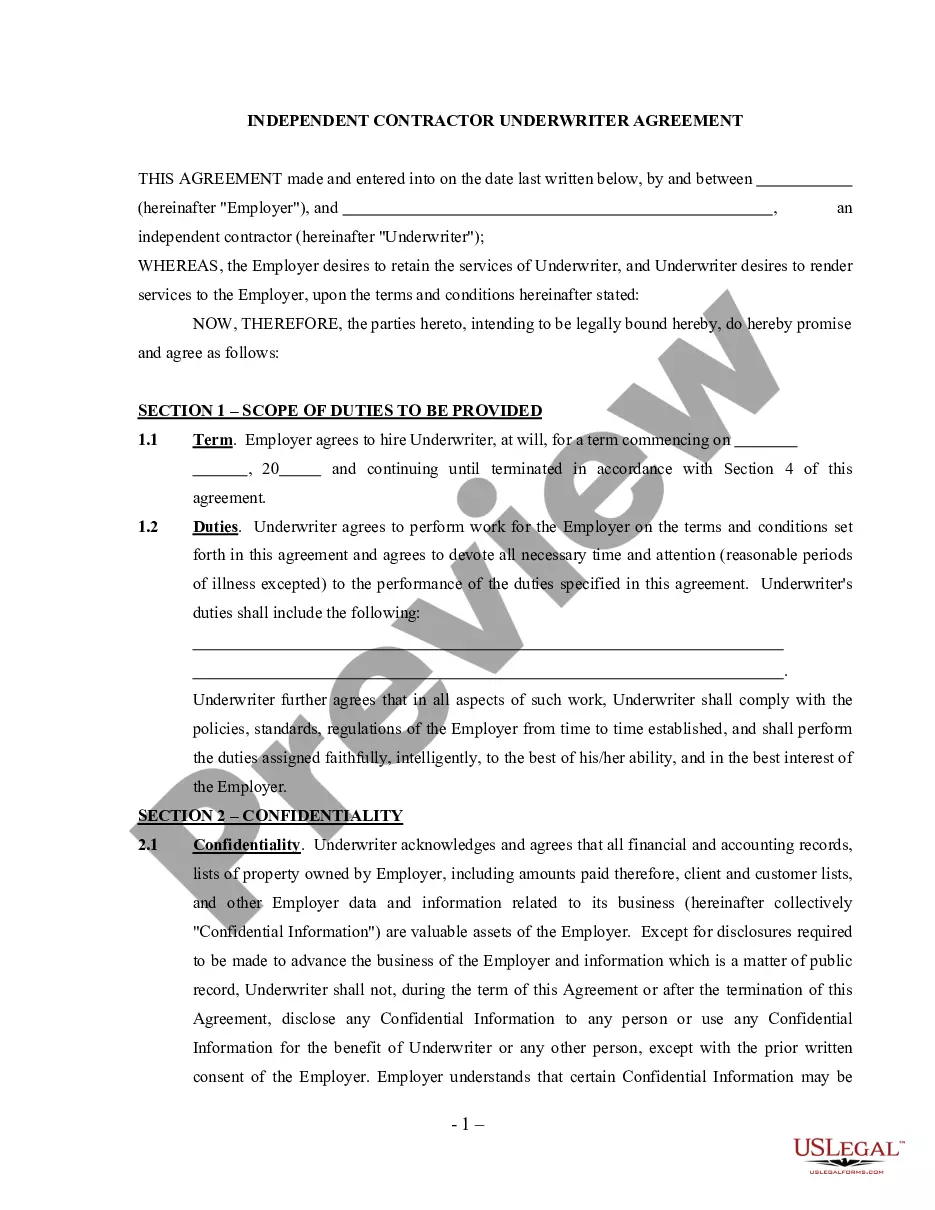
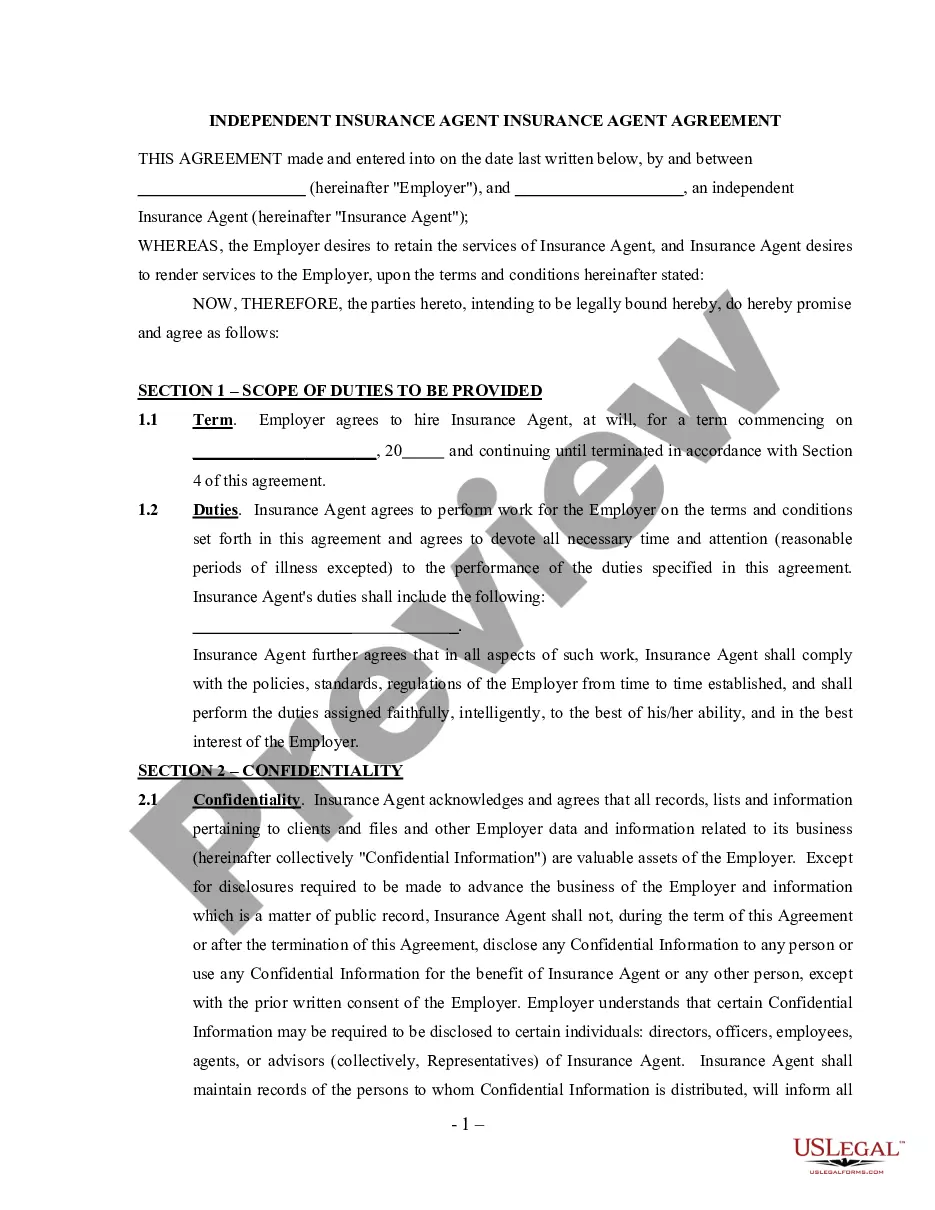
The Underwriter Agreement - Self-Employed Independent Contractor is a legal document used to formalize the relationship between an employer and an independent contractor providing underwriting services. This agreement is essential because it establishes the scope of duties, confidentiality obligations, and independent contractor status, ensuring that both parties understand their rights and responsibilities. It is specifically designed for situations where an independent contractor is engaged, differentiating it from traditional employment agreements.
Main sections of this form
- SCOPE OF DUTIES: Outlines the specific underwriting services to be performed by the independent contractor.
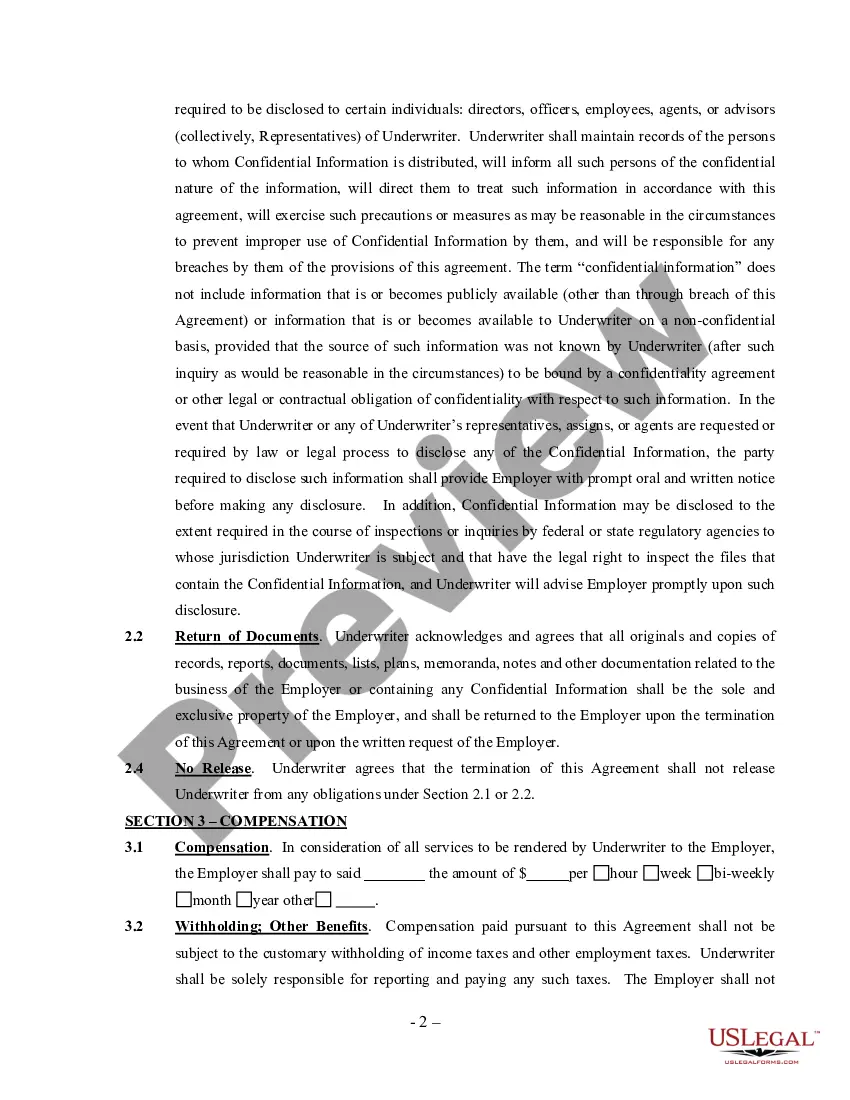
- CONFIDENTIALITY: Sets forth obligations regarding the non-disclosure of confidential information.
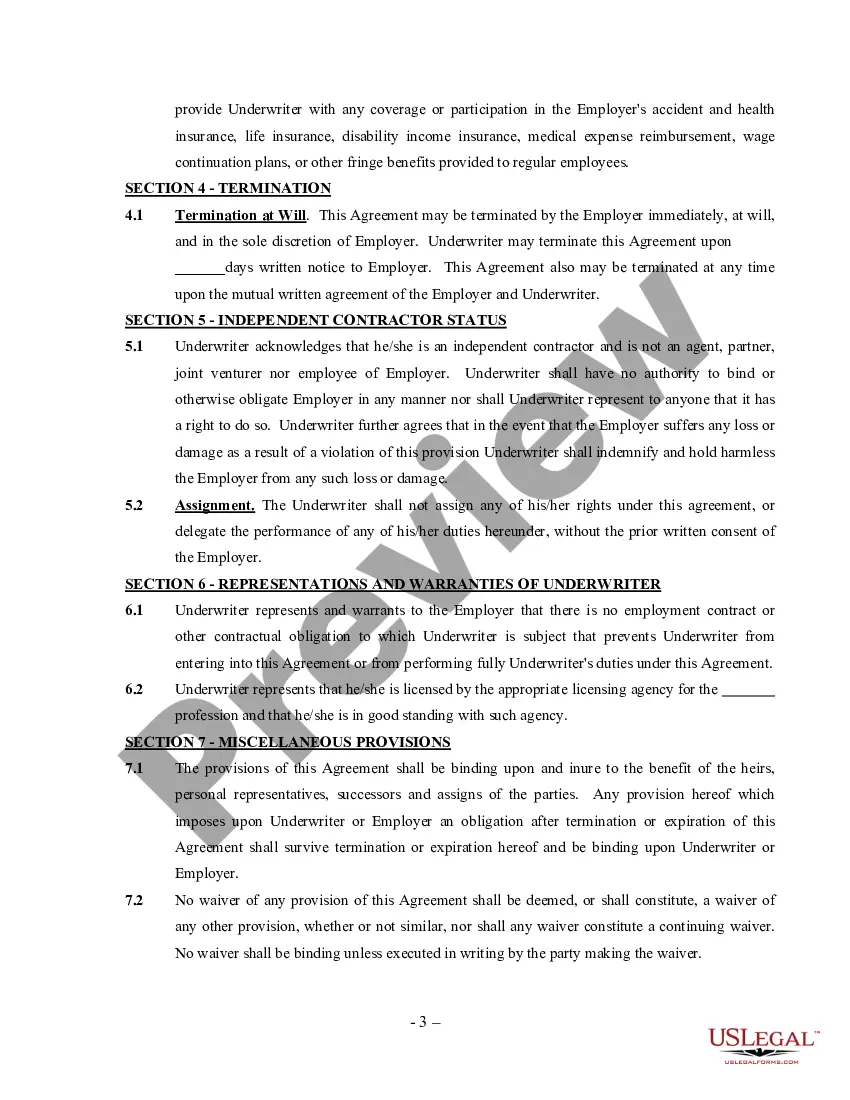
- INDEPENDENT CONTRACTOR STATUS: Clarifies that the underwriter is not an employee, agent, or partner of the employer.
- TERMINATION: Describes the conditions under which the agreement can be ended by either party.
- REPRESENTATIONS AND WARRANTIES: Confirms that the underwriter has the legal right to enter into the agreement.
When to use this document
This form should be used when an employer wishes to hire an independent contractor to provide underwriting services. It is applicable in various scenarios such as financial institutions engaging freelancers for insurance underwriting, real estate firms seeking to assess property risks, or any company requiring specialized underwriting expertise without their own staff. The agreement protects both parties by clearly defining expectations and legal parameters.
Who should use this form
- Employers looking to hire independent contractors for underwriting tasks.
- Underwriters who are self-employed and seeking to outline their relationship with clients.
- Businesses that need a structured agreement to maintain confidentiality and protect sensitive information in the course of their underwriting work.
Instructions for completing this form
- Identify the parties involved, including the employer and underwriter.
- Clearly define the scope of duties to ensure both parties have a mutual understanding of the tasks involved.
- Outline confidentiality obligations to protect sensitive information shared during the term of the agreement.
- Include termination conditions specifying how either party can end the agreement.
- Have both parties sign and date the agreement to make it legally binding.
Notarization guidance
This form does not typically require notarization unless specified by local law. However, having the agreement notarized can add an additional layer of verification and can be beneficial in disputes.
Get your form ready online
Our built-in tools help you complete, sign, share, and store your documents in one place.
Make edits, fill in missing information, and update formatting in US Legal Forms—just like you would in MS Word.
Download a copy, print it, send it by email, or mail it via USPS—whatever works best for your next step.
Sign and collect signatures with our SignNow integration. Send to multiple recipients, set reminders, and more. Go Premium to unlock E-Sign.
If this form requires notarization, complete it online through a secure video call—no need to meet a notary in person or wait for an appointment.
We protect your documents and personal data by following strict security and privacy standards.

Make edits, fill in missing information, and update formatting in US Legal Forms—just like you would in MS Word.

Download a copy, print it, send it by email, or mail it via USPS—whatever works best for your next step.

Sign and collect signatures with our SignNow integration. Send to multiple recipients, set reminders, and more. Go Premium to unlock E-Sign.

If this form requires notarization, complete it online through a secure video call—no need to meet a notary in person or wait for an appointment.

We protect your documents and personal data by following strict security and privacy standards.
Avoid these common issues
- Failing to define the scope of duties clearly, leading to misunderstandings.
- Neglecting to include confidentiality clauses, which can jeopardize sensitive information.
- Not properly executing the agreement with signatures from both parties.
- Forgetting to specify terms for termination, which can lead to disputes when ending the contract.
Why use this form online
- Convenience of downloading and completing the form anytime without the need for a physical meeting.
- Editability allows users to customize the agreement to meet their specific needs.
- Reliability from using professionally drafted templates that comply with legal standards.
Legal use & context
- The Underwriter Agreement legally binds both the employer and the independent contractor to specified terms.
- It is enforceable in a court of law, provided all parties understand the terms and comply with applicable regulations.
- Limitations could include jurisdiction-specific laws and regulations, so users should ensure compliance in their respective states.
Summary of main points
- Understand the importance of clearly defining the scope of duties and confidentiality in the agreement.
- Recognize that this form establishes an independent contractor relationship, not employment.
- Utilize the form to protect sensitive information during the underwriting process.
Looking for another form?

Form popularity
FAQ
OSHA literature doesn't typically use the term "independent contractor." It uses "self-employed." There's a pretty simple reason self-employed are exempted from OSHA. OSHA exists to protect workers from unsafe or "unhealthful" conditions that their employer might force them into using economic leverage.
1. Not Having a Written Contract.The taxing, labor and employment, and insurance authorities expect a written contract that states that the worker is an independent contractor and will be paid as such with no tax withholding, no benefits, etc.
You are eligible to apply for a PPP loan as an independent contractor or self-employed individual who has been or will be harmed by the pandemic if all of the following are true:You filed or will file a Form 1040 Schedule C for 2019 showing self-employment income.
The Paycheck Protection Program (PPP) allows lenders to offer low-interest loans that may be 100% forgiven in certain circumstances. Independent contractors and self-employed individuals that have been adversely impacted by the COVID-19 pandemic have been eligible to apply for these loans since April 10, 2020.
An independent contractor can be any type of business entity (sole proprietor, corporation, LLC, partnership), but most independent contractors are sole proprietors.
If you're an independent contractor, you can absolutely get a home loan if you meet the qualifying requirements. You just may have to provide your lender above and beyond the standard documentation that's required of other mortgage applicants.
Simply put, being an independent contractor is one way to be self-employed. Being self-employed means that you earn money but don't work as an employee for someone else.An independent contractor is someone who provides a service on a contractual basis.
The earnings of a person who is working as an independent contractor are subject to Self-Employment Tax. If you are an independent contractor, you are self-employed. To find out what your tax obligations are, visit the Self-Employed Tax Center.
Finally, the new stimulus bill provides independent contractors with paid sick and paid family leave benefits through March 14, 2021.Under CARES Act II, unemployed or underemployed independent contractors who have an income mix from self-employment and wages paid by an employer are still eligible for PUA.