Purchase Item - Resolution Form - Corporate Resolutions
What is this form?
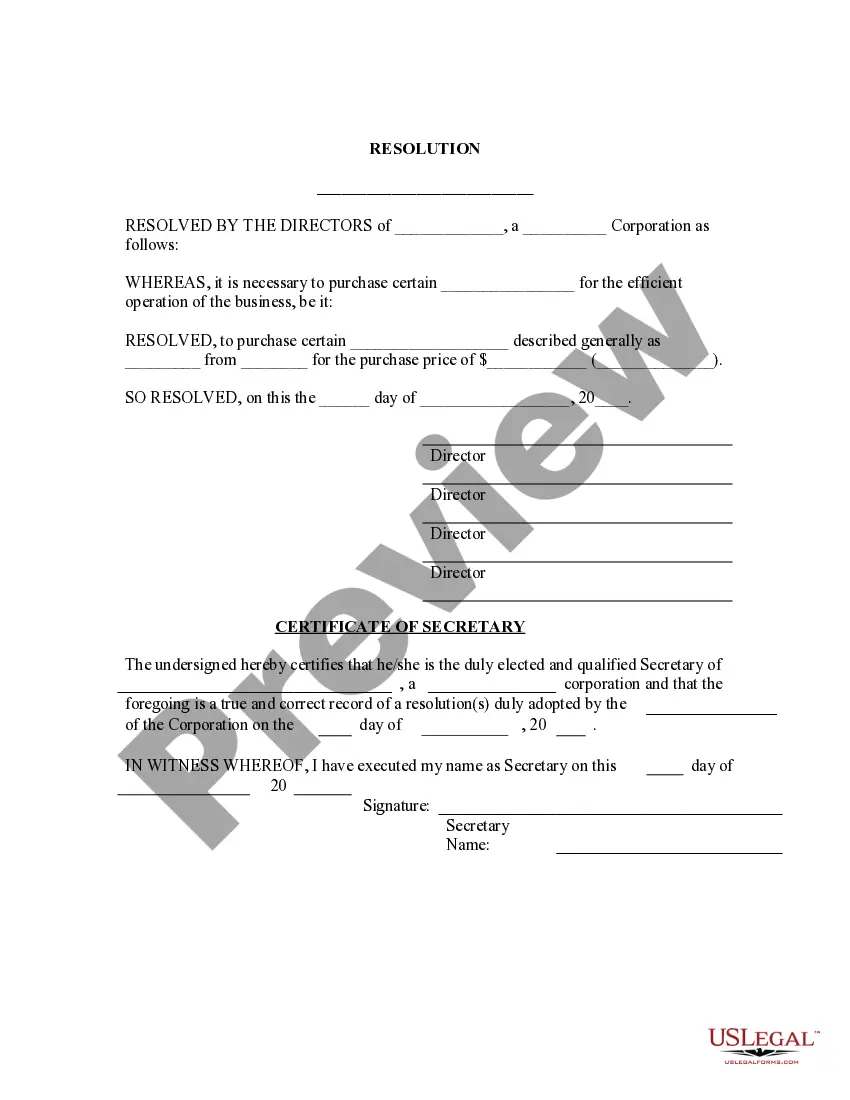
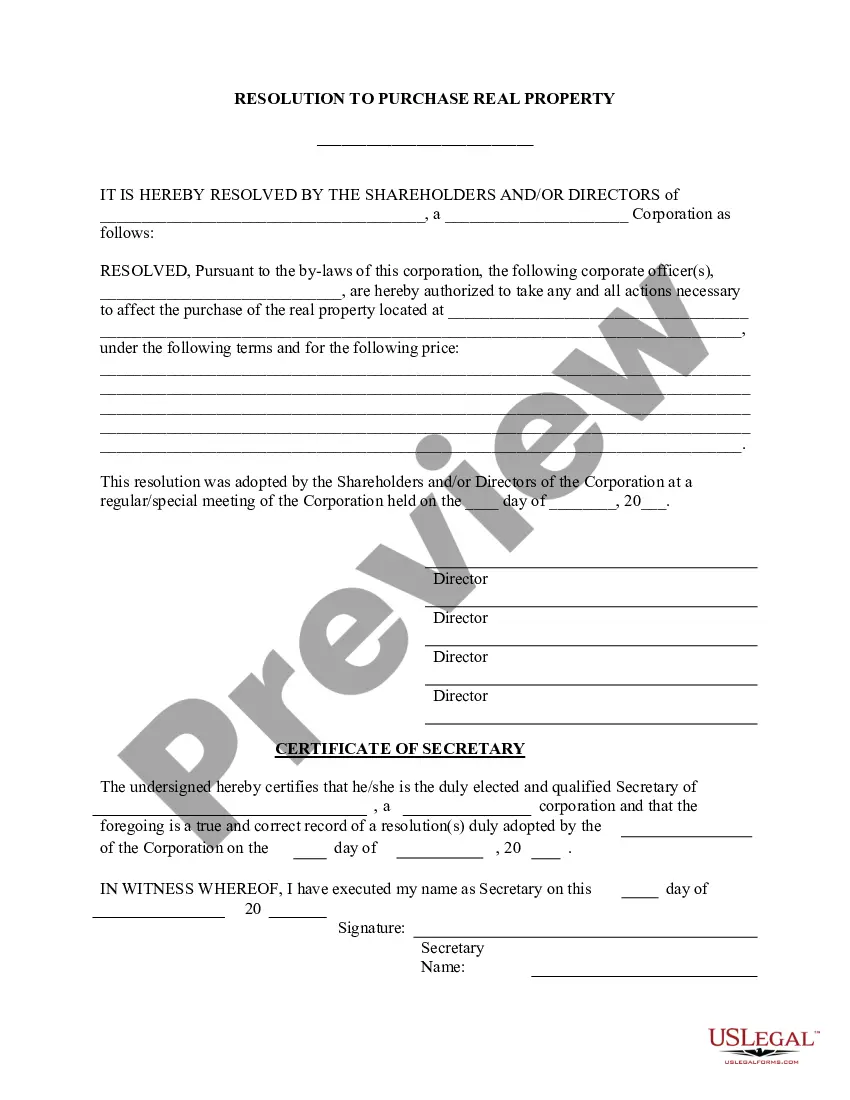
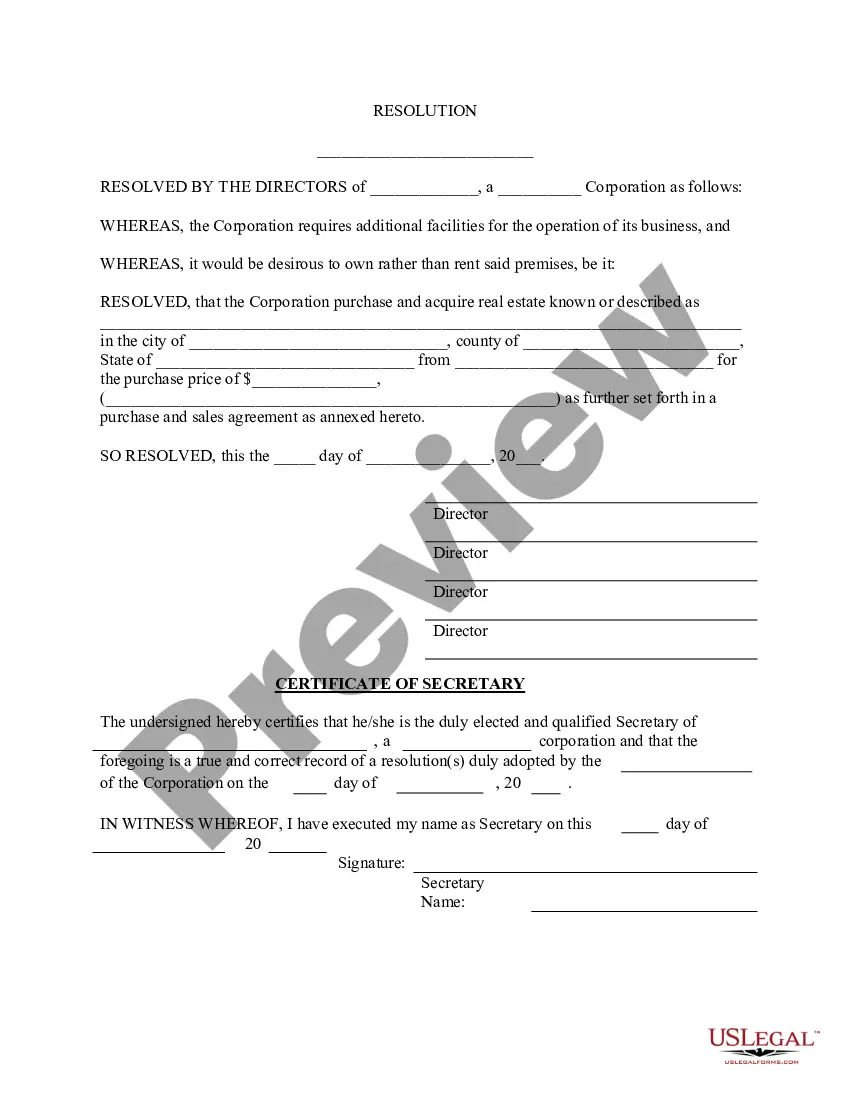
The Purchase Item - Resolution Form allows the directors of a corporation to formally authorize the purchase of specific items necessary for the corporation's operations. This documentation serves as a crucial element in the governance of corporate affairs, ensuring that purchases align with the company's interests and are legally recognized. Unlike other resolutions, this form is focused specifically on the approval of tangible purchases, making it essential for corporate record-keeping and compliance.
Main sections of this form
- Resolution header identifying the corporation and the specific item for purchase.
- Details of the item being purchased, including a description and the vendor.
- The total purchase price and details regarding payment terms.
- Signature lines for directors approving the resolution.
- Certification section for the corporate secretary to verify the resolution's legitimacy.
When to use this document
This form should be used when a corporation needs to make a significant purchase that requires official approval. For example, if the board of directors decides to acquire new equipment, office supplies, or any other significant assets, this resolution ensures that the decision is documented and authorized. It is crucial for maintaining proper corporate governance and compliance with legal requirements.
Who should use this form
- Corporation directors and officers responsible for making purchasing decisions.
- Corporate secretaries tasked with maintaining official records.
- Business professionals seeking to document approved purchases for governance standards.
How to prepare this document
- Fill in the corporation's name and type (e.g., LLC, Inc.).
- Describe the item(s) to be purchased and identify the seller.
- Specify the purchase price and the terms of payment.
- Obtain signatures from the required number of directors.
- Complete the certification section by having the secretary sign and date the document.
- Store the completed resolution in the corporation's official records for future reference.
Notarization requirements for this form
This form usually doesn’t need to be notarized. However, local laws or specific transactions may require it. Our online notarization service, powered by Notarize, lets you complete it remotely through a secure video session, available 24/7.
Get your form ready online
Our built-in tools help you complete, sign, share, and store your documents in one place.
Make edits, fill in missing information, and update formatting in US Legal Forms—just like you would in MS Word.
Download a copy, print it, send it by email, or mail it via USPS—whatever works best for your next step.
Sign and collect signatures with our SignNow integration. Send to multiple recipients, set reminders, and more. Go Premium to unlock E-Sign.
If this form requires notarization, complete it online through a secure video call—no need to meet a notary in person or wait for an appointment.
We protect your documents and personal data by following strict security and privacy standards.

Make edits, fill in missing information, and update formatting in US Legal Forms—just like you would in MS Word.

Download a copy, print it, send it by email, or mail it via USPS—whatever works best for your next step.

Sign and collect signatures with our SignNow integration. Send to multiple recipients, set reminders, and more. Go Premium to unlock E-Sign.

If this form requires notarization, complete it online through a secure video call—no need to meet a notary in person or wait for an appointment.

We protect your documents and personal data by following strict security and privacy standards.
Typical mistakes to avoid
- Failing to have enough directors sign the resolution.
- Not accurately describing the item or its purchase conditions.
- Omitting the date of approval, which can affect the validity.
- Forgetting to include the secretary's certification.
Why complete this form online
- Convenient access to legally vetted templates authored by licensed attorneys.
- Instant downloads available for quick and efficient use.
- Editability allows customization to fit specific corporate needs without hassle.
- 24/7 availability ensures you can complete your corporate governance tasks at any time.
Legal use & context
- The resolution serves as official documentation of the board's decision.
- Ensures compliance with corporate formalities, avoiding disputes over purchases.
- Provides evidence of authorization for the transaction, which can be important for financial audits.
Quick recap
- This form is essential for corporate directors approving purchases.
- It helps formalize decisions and maintains corporate governance standards.
- Filling out the form accurately ensures legal compliance for the purchase.
Looking for another form?

Form popularity
FAQ
A corporate resolution is a written document created by the board of directors of a company detailing a binding corporate action. A corporate resolution is the legal document that provides the rules and framework as to how the board can act under various circumstances.
No need to notarize a corporate resolution.
Write the Name of the Company. State at the top of the page, the governing body and the legal name of the organization making the corporate resolution. Add Further Legal Identification.
A corporate resolution is a document that formally records the important binding decisions into which a company enters. These decisions are made by such stakeholders as the corporation's managers, directors, officers or owners.
A corporate resolution is a written document created by the board of directors of a company detailing a binding corporate action. A corporate resolution is the legal document that provides the rules and framework as to how the board can act under various circumstances.
Sometimes the conflict is resolved in a way that is painful for characters, but ultimately, the conflict is resolved. Examples of Resolution: Two friends fight over a boy, but in the end, they realize that friendship is more important, and the boy ultimately moves away from the town anyway.
Step 1: Place a Resolution Number. Step 2: Write a Title for the Resolution. Step 3: Use Formal Language. Step 4: Clearly Indicate the Voted Resolution. Step 5: Include a List of Voting Board Members. Step 6: Have the President Sign the Resolution.
A corporate resolution form is used by a board of directors. Its purpose is to provide written documentation that a business is authorized to take specific action. This form is most often used by limited liability companies, s-corps, c-corps, and limited liability partnerships.