Adoption Agreement Format for Property
What is this form?
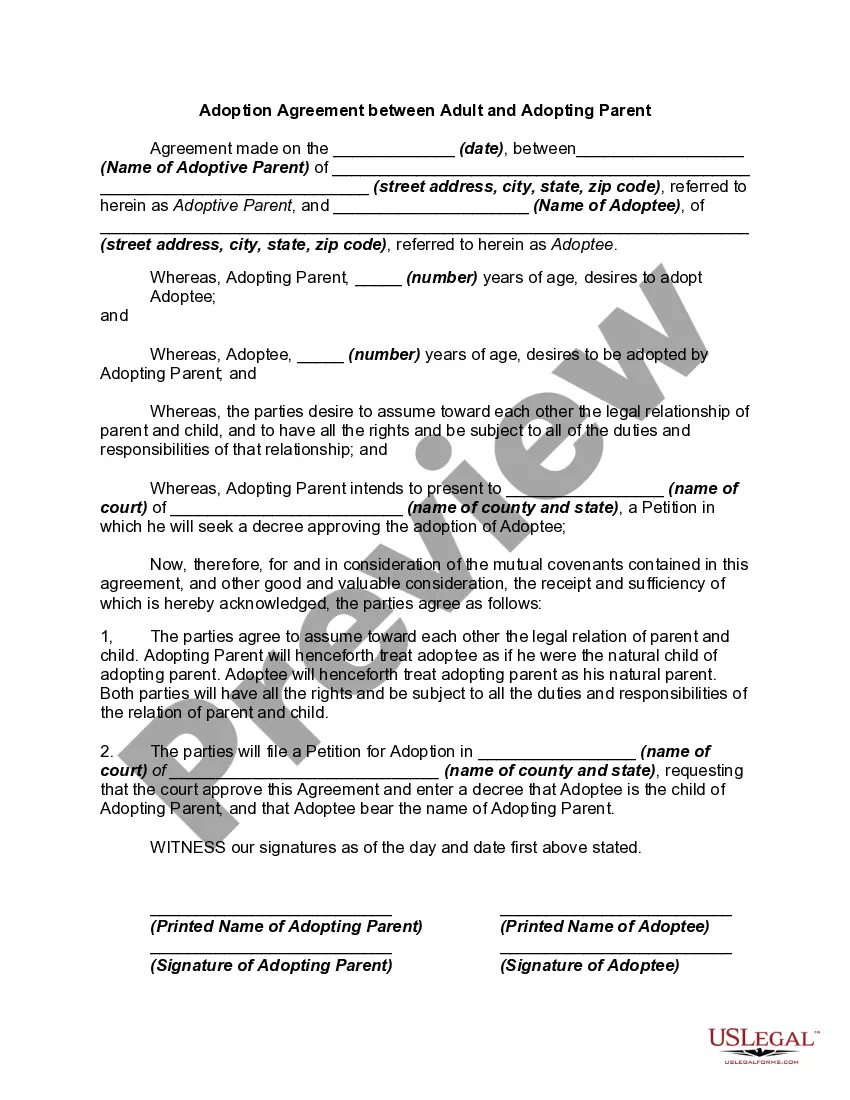
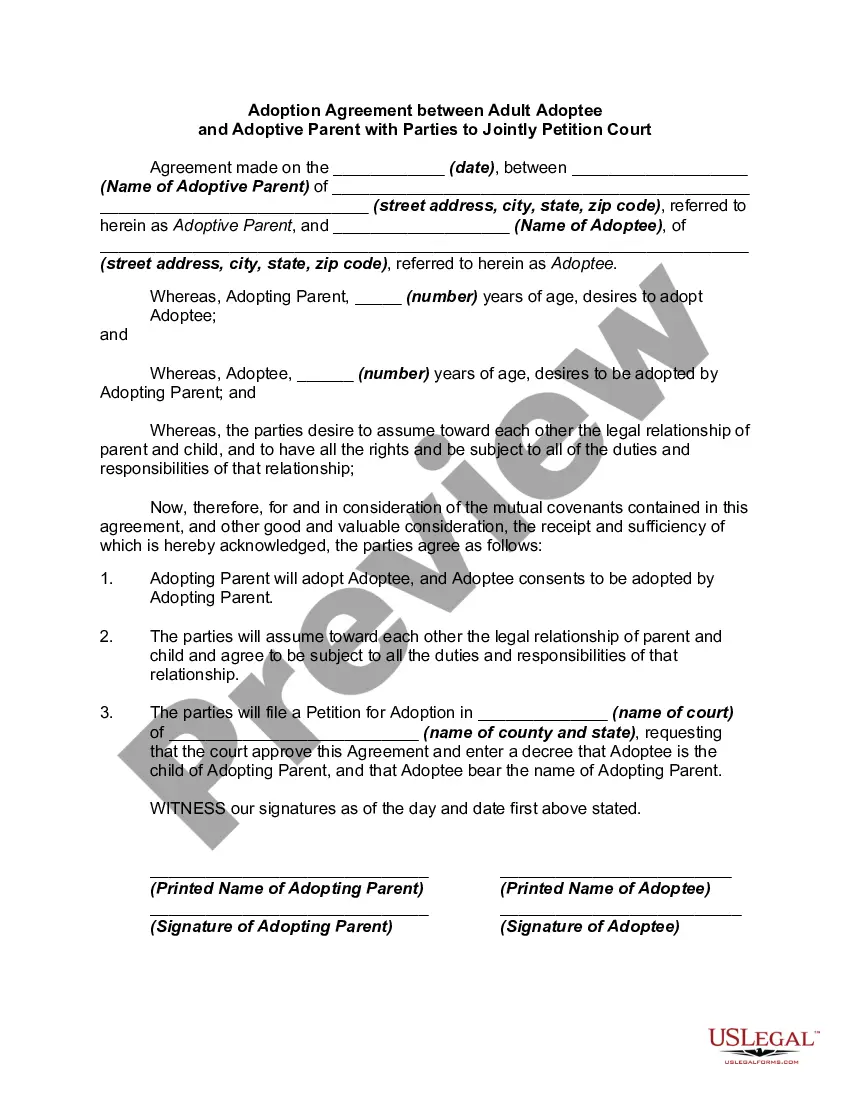
The Adoption Agreement Format for Property is a legal document specifically designed for adult adoptions, which allows a person over the age of majority to adopt another adult as their child. This form establishes a legal parent-child relationship, creating rights and responsibilities similar to those of biological parents. Unlike child adoptions, adult adoptions often occur between individuals who already have a close relationship and seek to formalize it legally.
Key components of this form
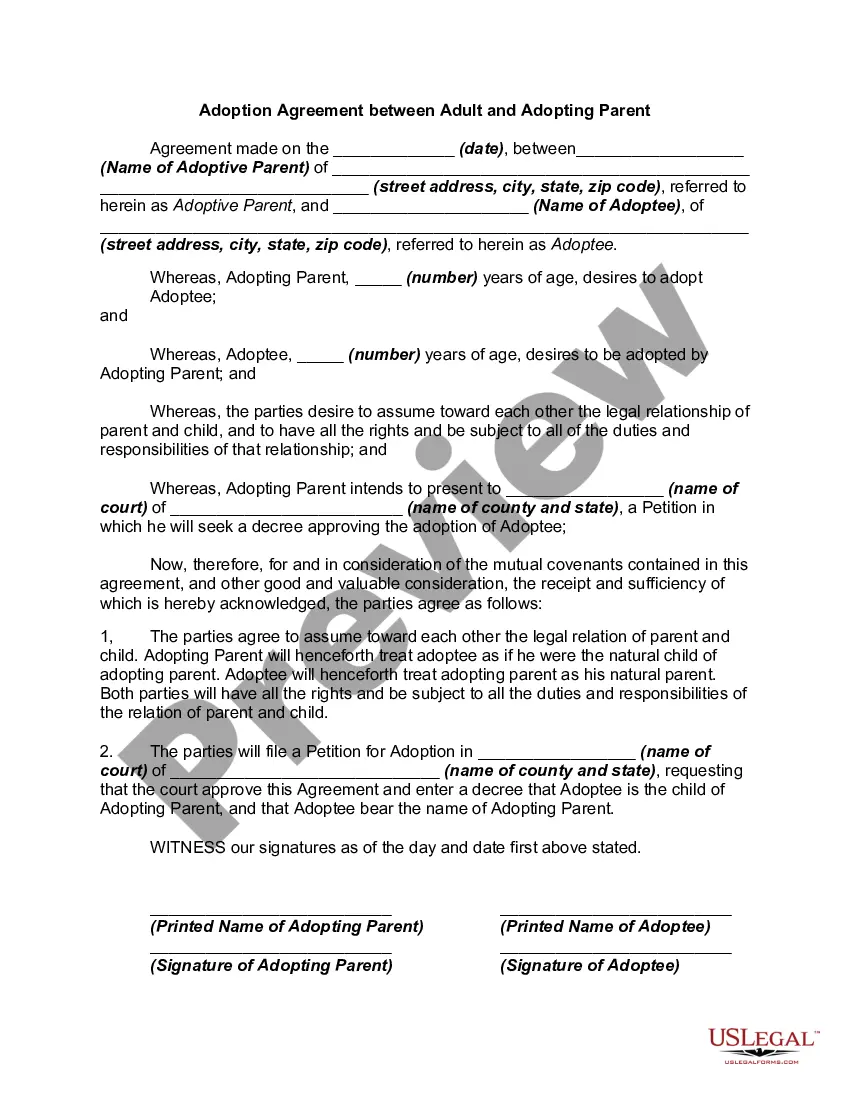
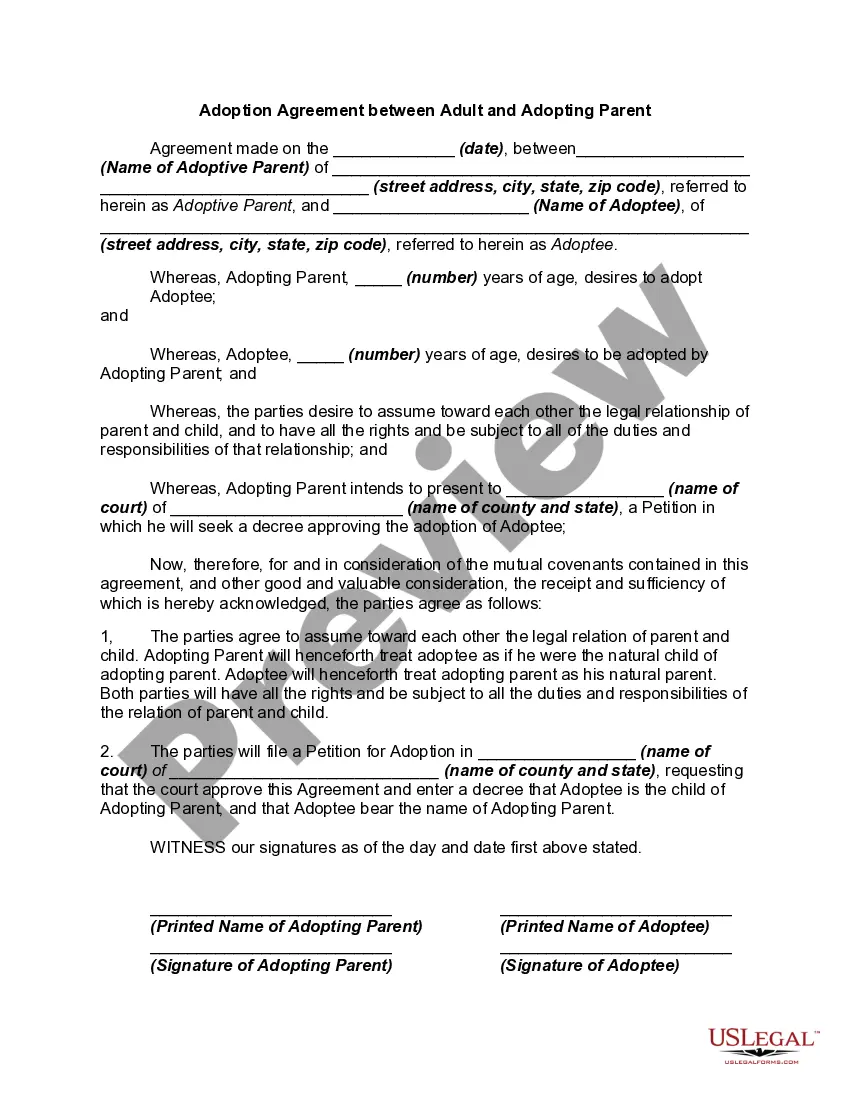
- Identification of the parties involved: names and addresses of the Adoptive Parent and Adoptee.
- Age of the parties: Specifies the ages of both the Adoptive Parent and Adoptee.
- Agreement section: Outlines mutual commitments to assume the legal relationship of parent and child.
- Petition for Adoption: Details about filing a legal petition in a specified court.
- Signatures: Required signatures of both parties to validate the agreement.

When to use this document
This form should be used when an adult wishes to adopt another adult and formalize their relationship legally. Typical scenarios include stepparents adopting their spouse's adult child, close family friends establishing a legal bond, or individuals wanting to secure inheritance rights or legal responsibilities.
Who can use this document
- Adults wishing to adopt another adult for legal or personal reasons.
- Individuals involved in a close relationship that seeks to formalize their bond.
- Those interested in ensuring legal rights related to inheritance, health care decisions, or parental responsibilities.
How to prepare this document
- Identify the parties by entering the names and addresses of both the Adoptive Parent and the Adoptee.
- Specify the ages of both parties in the designated fields.
- Clearly state the name of the court where the adoption petition will be filed.
- Fill in the date the agreement is made at the top of the form.
- Obtain signatures from both the Adoptive Parent and the Adoptee at the bottom of the form.
Notarization requirements for this form
This form does not typically require notarization unless specified by local law. Always check local regulations to ensure compliance with any additional requirements.
Get your form ready online
Our built-in tools help you complete, sign, share, and store your documents in one place.
Make edits, fill in missing information, and update formatting in US Legal Forms—just like you would in MS Word.
Download a copy, print it, send it by email, or mail it via USPS—whatever works best for your next step.
Sign and collect signatures with our SignNow integration. Send to multiple recipients, set reminders, and more. Go Premium to unlock E-Sign.
If this form requires notarization, complete it online through a secure video call—no need to meet a notary in person or wait for an appointment.
We protect your documents and personal data by following strict security and privacy standards.

Make edits, fill in missing information, and update formatting in US Legal Forms—just like you would in MS Word.

Download a copy, print it, send it by email, or mail it via USPS—whatever works best for your next step.

Sign and collect signatures with our SignNow integration. Send to multiple recipients, set reminders, and more. Go Premium to unlock E-Sign.

If this form requires notarization, complete it online through a secure video call—no need to meet a notary in person or wait for an appointment.

We protect your documents and personal data by following strict security and privacy standards.
Common mistakes to avoid
- Failing to include accurate names and addresses of both parties.
- Omitting signatures, which can lead to the form being considered invalid.
- Not verifying the requirements of the specific state where the adoption will take place.
Why use this form online
- Convenience: Easily download and complete the form from home.
- Editability: Make adjustments as needed before finalizing the document.
- Reliability: Forms are drafted by licensed attorneys, ensuring compliance with legal standards.
Looking for another form?
Form popularity
FAQ
Step 1: Learn About Adoption. Consider the Types of Adoption. Step 2: Explore Adoption. Learn About Adoption. Step 3: Prepare for Adoption. Decide What Type of Adoption You Want to Pursue. Step 4: Engage in the Placement Process. Begin Searching for a Child. Step 5: Learn More About the Child. Step 6: Adopt.
Adoption Agreement means the written agreement pursuant to which the Employer adopts the Plan. The Adoption Agreement is a part of the Plan as applied to the Employer.The provisions of the Adoption Agreement shall be an integral part of the Plan.
Adopting Through an Agency. Adopting Independently. Adopting Through Identification. Adopting Internationally. Adopt as Stepparents. Adopting as a Same-Sex Couple. Relative Adoptions. Adult Adoptions.
There are many ways a family can grow through adoption, the three most common being domestic infant adoption, foster care adoption, and international adoption. Each of these types has its own set of advantages, disadvantages, and necessary steps to complete the process.
There are three types of adoptions that may be chosen: "closed," "semi-open" and "open." These terms describe the approximate level of contact and interaction that the birth mother can expect to have with the adoptive parents both during the adoption process and afterwards.
The most common form of adoption, stepchild adoption is the process where someone assumes financial and legal responsibility for the child of their spouse. The stepparent must file for a petition to claim the child ("Stepchild Adoption").
5. Adopting an older child from foster care is also much more affordable. A common misconception about adoption is that it's an expensive process. Not only are older care adoptions quicker, but adoptions from foster care are also much cheaper than private and international adoptions.