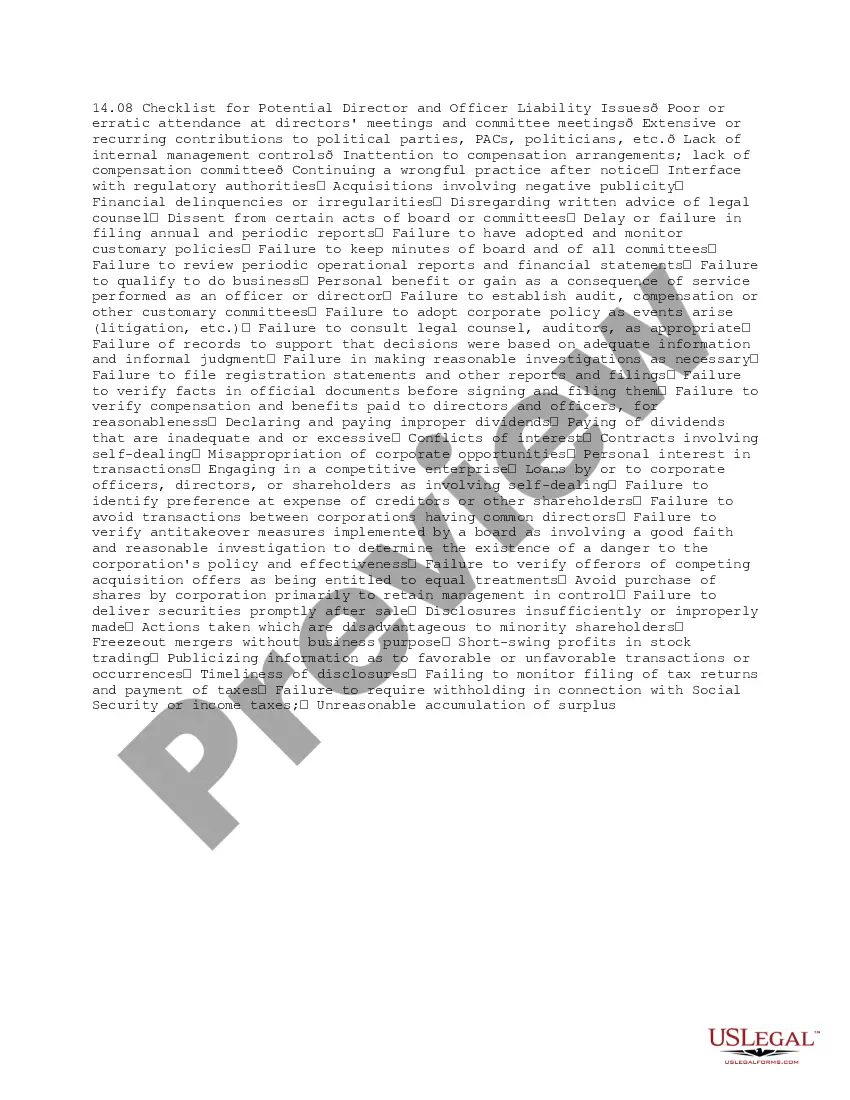
Checklist for Potential Director and Officer Liability Issues
What is this form?
The Checklist for Potential Director and Officer Liability Issues is a due diligence tool designed for individuals looking to understand potential liability risks associated with serving as a director or officer in a company. Unlike other corporate forms, this checklist helps identify specific situations and practices that could lead to personal liability in business transactions, allowing for proactive measures to be taken to mitigate risks.
What’s included in this form
- Assessment of attendance at directors and committee meetings.
- Review of contributions to political parties and other entities.
- Evaluation of internal management controls and compensation arrangements.
- Examination of interactions with regulatory authorities.
- Overview of financial delinquencies and irregularities.
- Consideration of conflicts of interest and self-dealing transactions.

Common use cases
This form should be used when assessing the risks associated with serving as a corporate director or officer, particularly before joining a board or if you are currently in such a position. It is also beneficial during times of significant corporate changes, such as mergers or when dealing with regulatory scrutiny, to ensure compliance and assess potential liabilities.
Who can use this document
- Candidates for director or officer positions in a corporation.
- Current directors or officers seeking to evaluate their liability risks.
- Corporate legal teams and compliance officers.
- Shareholders concerned about governance and liability issues.
Completing this form step by step
- Review each item on the checklist thoroughly.
- Identify any applicable liability concerns based on your corporate activities.
- Document any instances of non-compliance or areas needing improvement.
- Consult with legal counsel regarding any significant findings.
- Implement recommended practices to mitigate liability risk.
Does this document require notarization?
This form usually doesn’t need to be notarized. However, local laws or specific transactions may require it. Our online notarization service, powered by Notarize, lets you complete it remotely through a secure video session, available 24/7.
Get your form ready online
Our built-in tools help you complete, sign, share, and store your documents in one place.
Make edits, fill in missing information, and update formatting in US Legal Forms—just like you would in MS Word.
Download a copy, print it, send it by email, or mail it via USPS—whatever works best for your next step.
Sign and collect signatures with our SignNow integration. Send to multiple recipients, set reminders, and more. Go Premium to unlock E-Sign.
If this form requires notarization, complete it online through a secure video call—no need to meet a notary in person or wait for an appointment.
We protect your documents and personal data by following strict security and privacy standards.

Make edits, fill in missing information, and update formatting in US Legal Forms—just like you would in MS Word.

Download a copy, print it, send it by email, or mail it via USPS—whatever works best for your next step.

Sign and collect signatures with our SignNow integration. Send to multiple recipients, set reminders, and more. Go Premium to unlock E-Sign.

If this form requires notarization, complete it online through a secure video call—no need to meet a notary in person or wait for an appointment.

We protect your documents and personal data by following strict security and privacy standards.
Mistakes to watch out for
- Ignoring items on the checklist that may seem minor but could lead to significant issues.
- Failing to follow up on previously noted liabilities or compliance failures.
- Not involving legal counsel in the review process when necessary.
Benefits of completing this form online
- Immediate access to the form, allowing for timely assessments.
- Easy customization to fit specific corporate needs.
- Reliable templates drafted by licensed attorneys to ensure legal compliance.
Legal use & context
- Helps in maintaining compliance with corporate governance standards.
- Identifies potential risks that could lead to legal challenges.
- Provides a structured approach to evaluating directors' and officers' conduct.
What to keep in mind
- The form serves as a proactive tool to mitigate potential legal liabilities.
- It is essential for companies evaluating their corporate governance practices.
- Regular use of the checklist can enhance overall compliance and risk management.
Looking for another form?
Form popularity
FAQ
Typically, a corporate officer isn't held personally liable, as long as his or her actions fall within the scope of their position and the parameters of the law. An officer of a corporation may serve on the board of directors or fulfill a managerial role. A corporate officer may also be: A shareholder.
Overdrawn director's loan accounts. Signing a personal guarantee. Debts have accumulated due to fraudulent means (such as taking on credit you knew you wouldn't be able to repay) Director misconduct.
A director or officer of a nonprofit corporation can be held personally liable if he or she: personally and directly injures someone. personally guarantees a bank loan or a business debt on which the corporation defaults.
Limited liability protects shareholders, directors, officers and employees against personal liability for actions taken in the name of the corporation and corporate debts. Ordinarily, an officer of the corporation, whether also a shareholder, director or employee, cannot be held personally liable.
Typically, a corporate officer isn't held personally liable, as long as his or her actions fall within the scope of their position and the parameters of the law. An officer of a corporation may serve on the board of directors or fulfill a managerial role. A corporate officer may also be: A shareholder.
Typically, officers and employees of corporations or limited liability companies are not personally liable for acts taken in a corporate capacity.Even though the officer was personally involved in the actions leading to the alleged breach, he cannot be held individually or personally liable for it.
Liabilities are obligations your company incurs. Your company's liabilities may be finance-related, accounting-related or legal. Financial liabilities typically involve a claim, such as a lien or promissory note, against your company's assets. Accounting liabilities are generally those that appear on the balance sheet.
Breach their duty of care to the corporation. Breach their duty of loyalty to the corporation. Misappropriate a corporate asset for personal use or use by another business. Commingle personal and business assets.