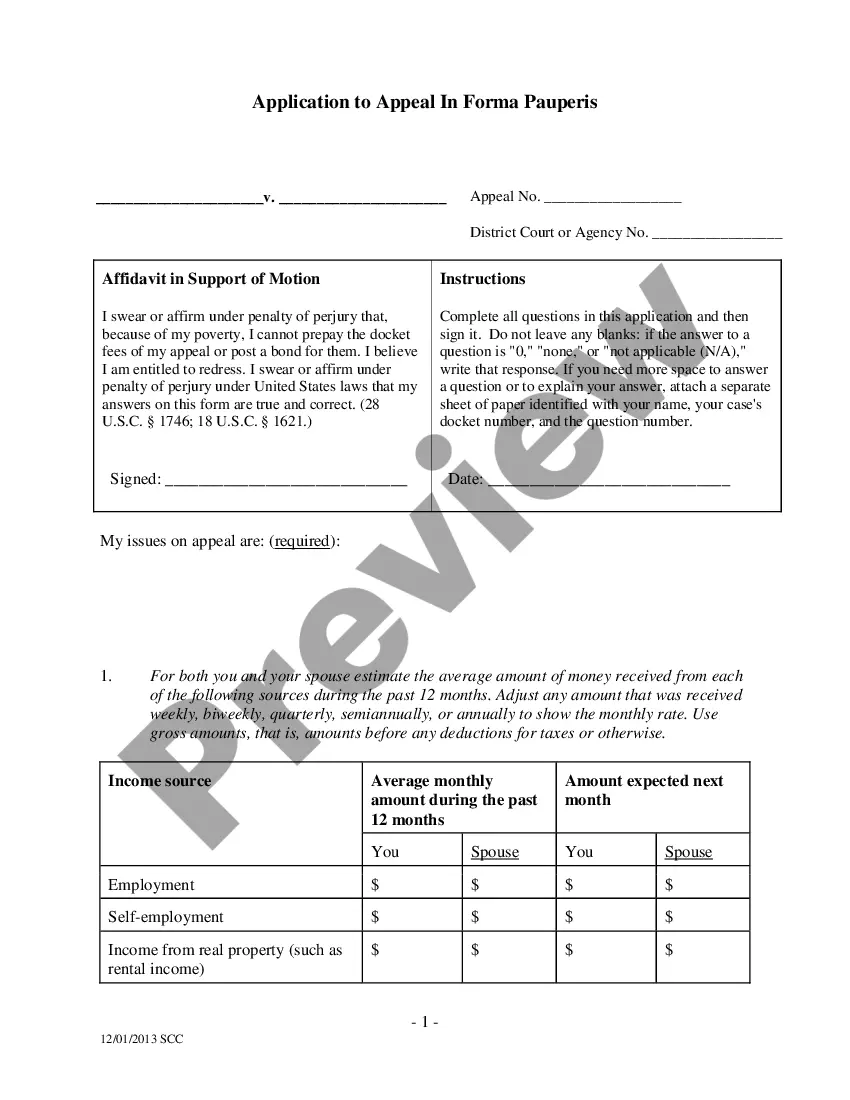
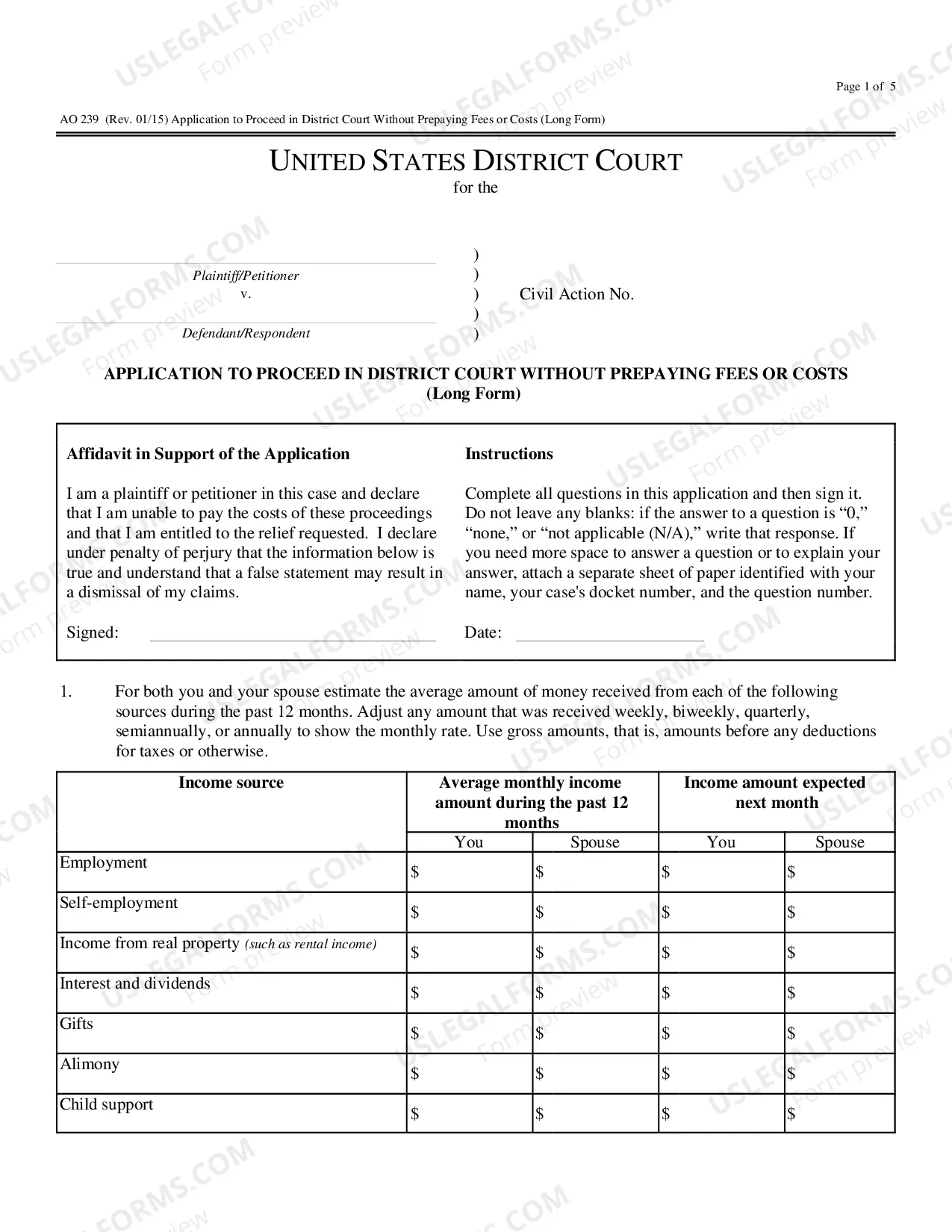
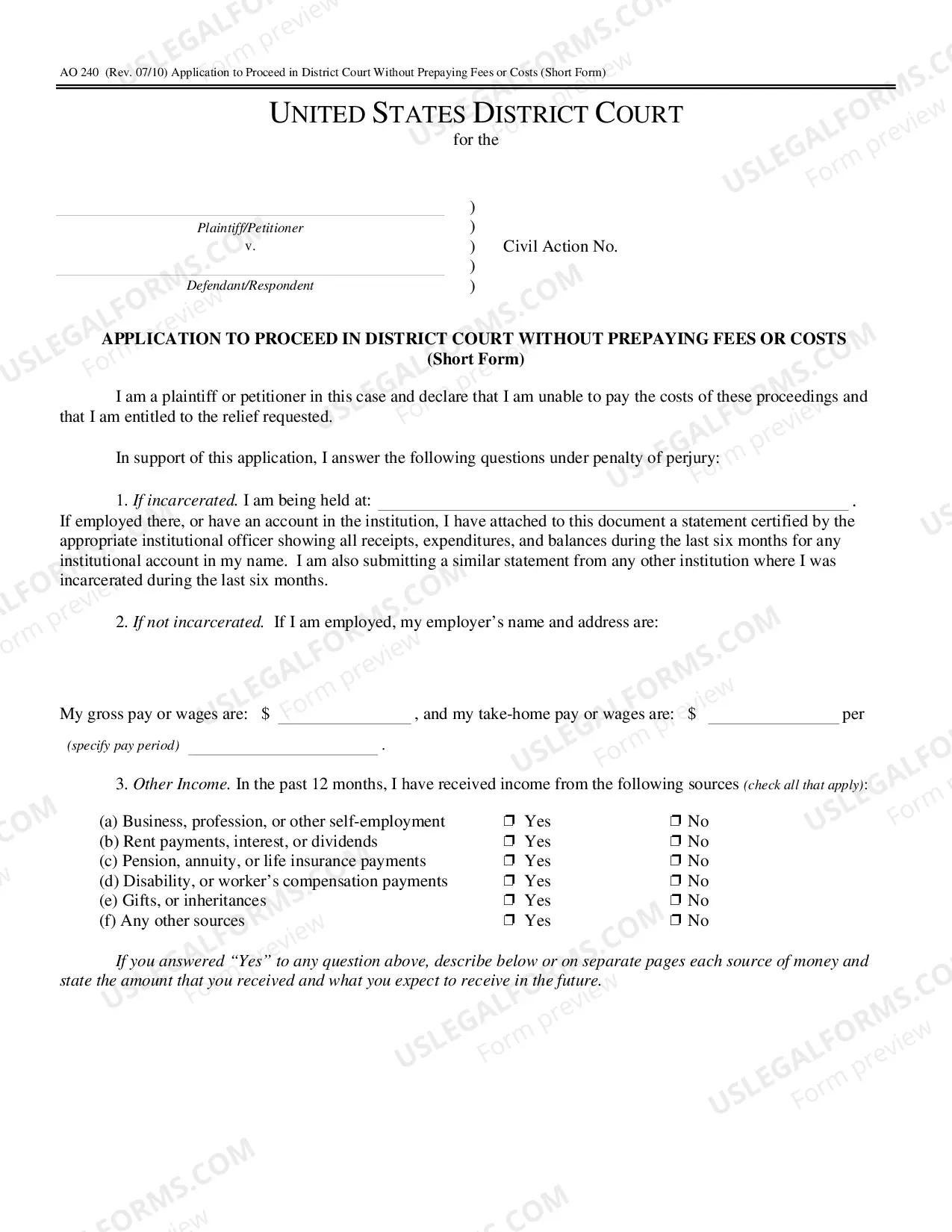
Application to Proceed in District Court Without Prepaying Fees or Costs - Indigency or In Forma Pauperis - Short Form
What is this form?
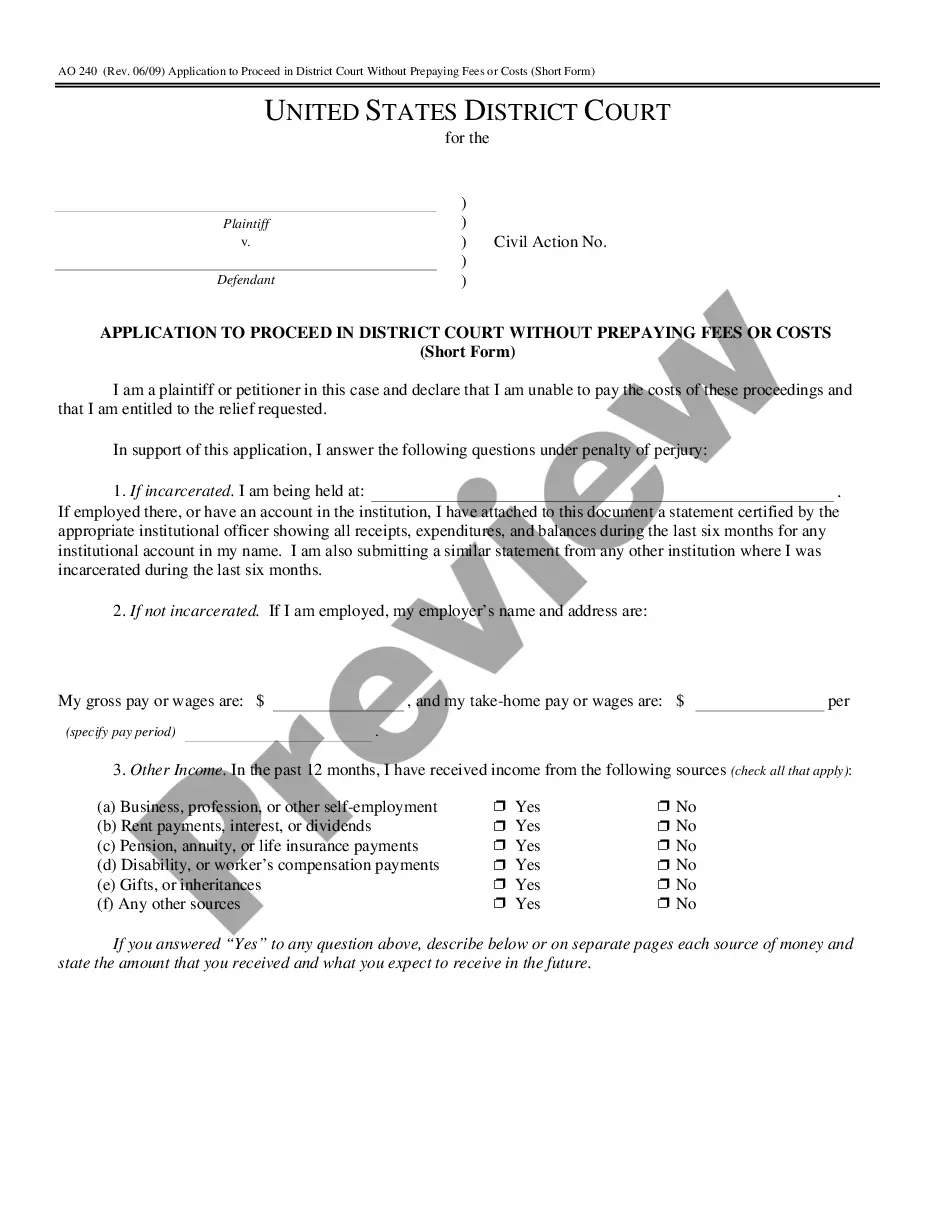
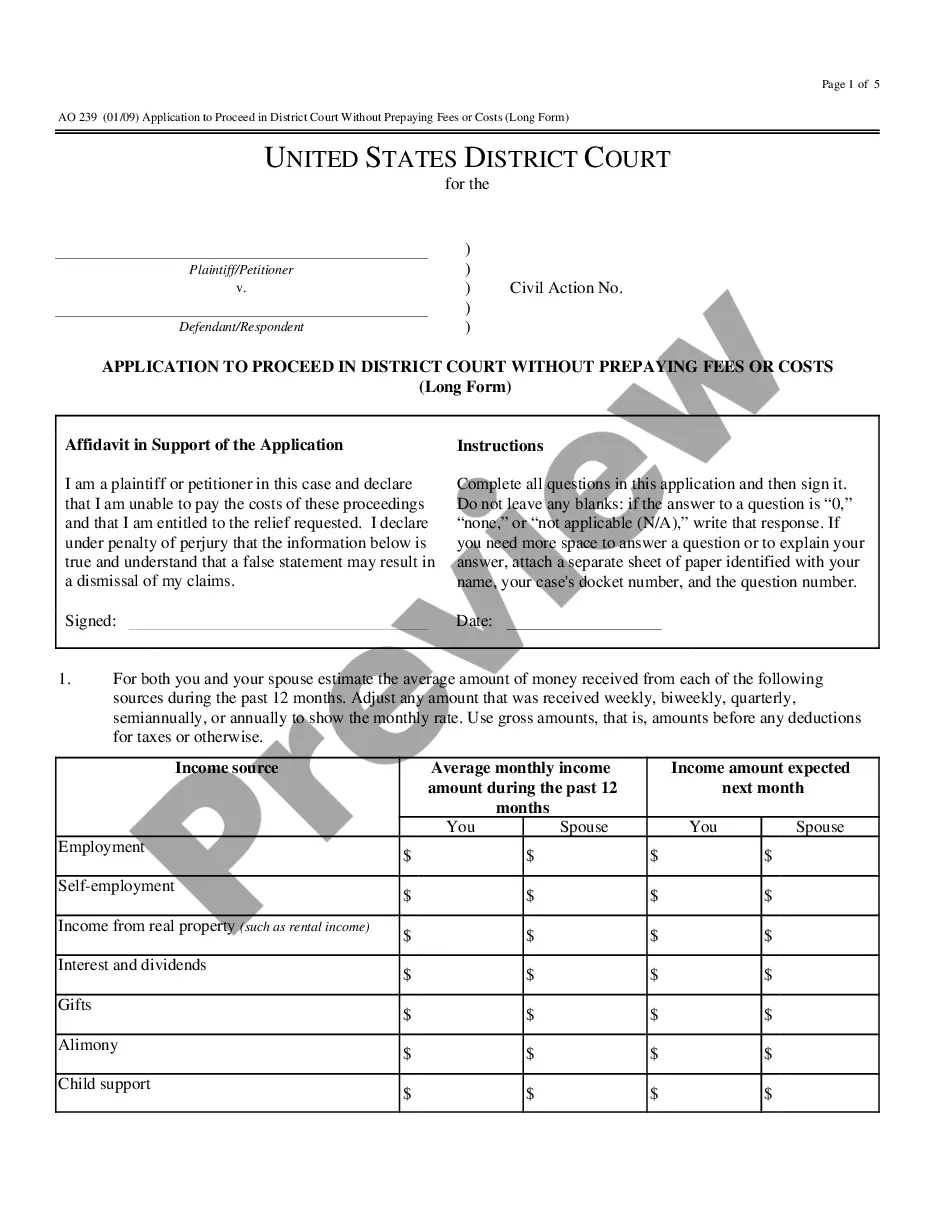
The Application to Proceed in District Court Without Prepaying Fees or Costs - Short Form is a legal document that allows individuals who cannot afford court fees to request permission to file a lawsuit without upfront payments. This form is particularly important for low-income individuals seeking access to the judicial system. Unlike the full application, this short form simplifies the process by reducing the amount of information required, making it easier to submit a request for fee waivers in federal district courts.
Form components explained
- Identification of the court and parties involved in the case
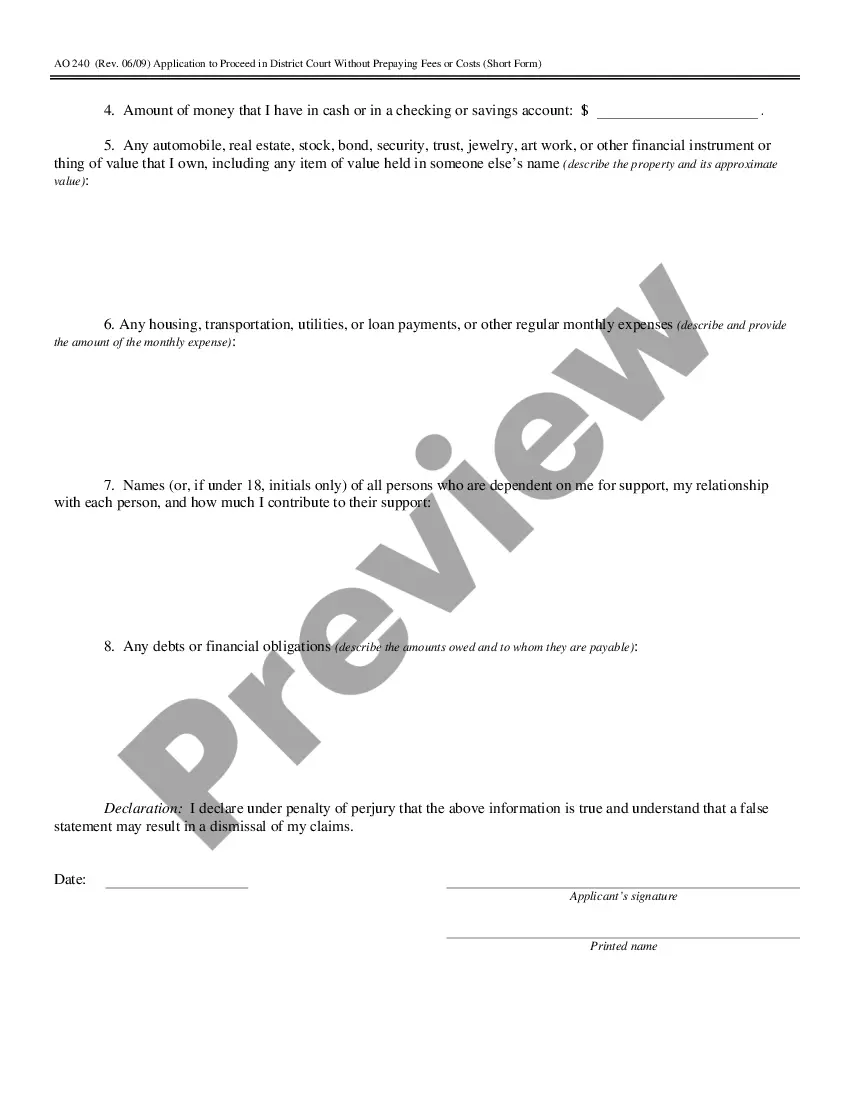
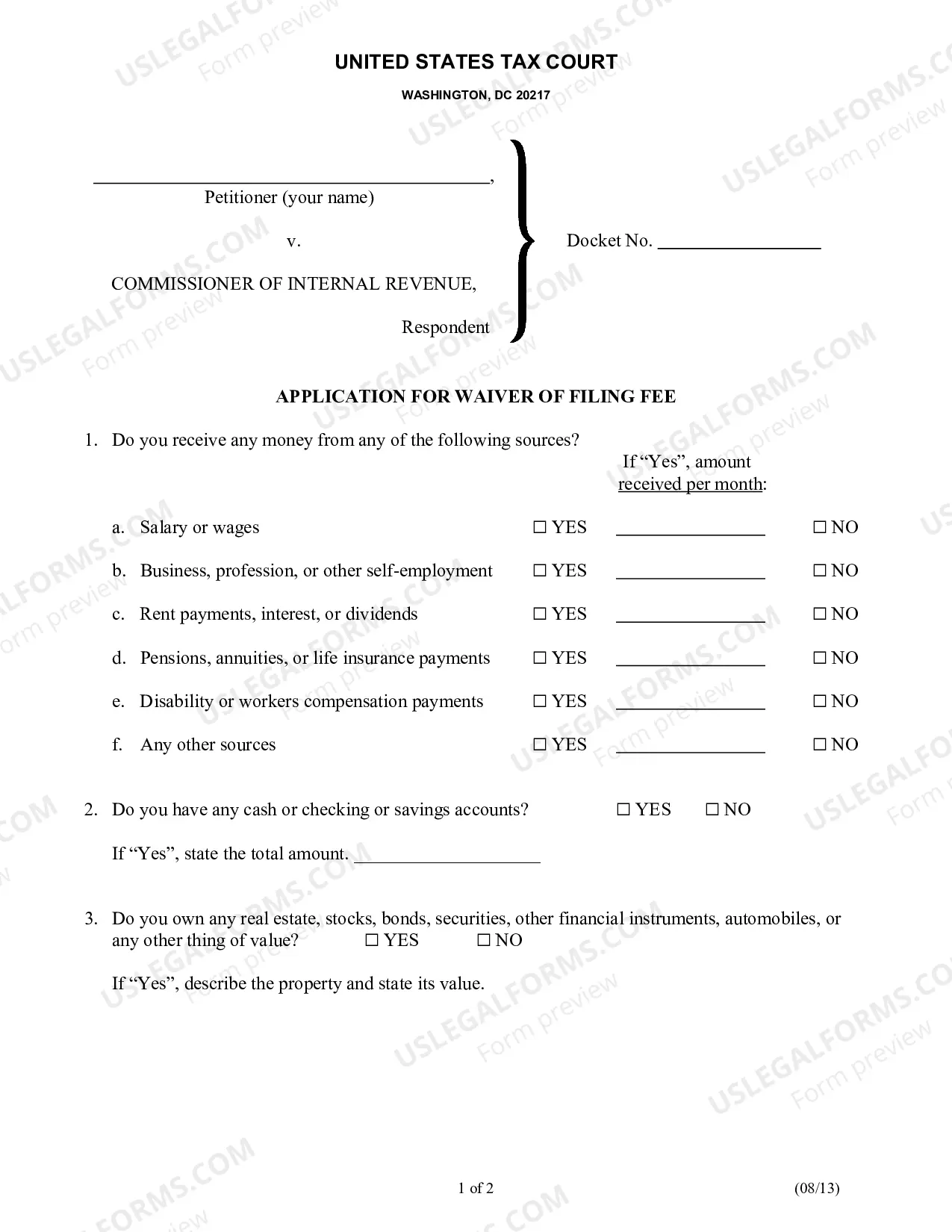
- Statement of financial situation, including income and expenses
- Declaration of dependent individuals and contribution to their support
- Certification of provided information under penalty of perjury
- Signature and date fields for the applicant
Common use cases
This form should be used when an individual wishes to initiate a civil lawsuit in a federal district court but lacks the financial resources to pay court fees upfront. It is applicable in cases involving personal disputes, civil rights violations, or other legal matters where access to the court is necessary but economically unfeasible.
Who should use this form
- Individuals who are plaintiffs or petitioners in a civil case
- Those experiencing financial hardship or indigency
- Anyone needing to waive court fees in federal district court
Completing this form step by step
- Identify the district court where the case will be filed and enter the names of the plaintiff and defendant.
- Provide details about your employment, income sources, and any financial assistance received in the last 12 months.
- Disclose any assets you may own, including cash and property.
- List monthly expenses and any financial obligations to give a complete picture of your financial situation.
- Sign and date the application, certifying that all information is accurate.
Is notarization required?
This form does not typically require notarization unless specified by local law. It is important to check with the relevant district court to confirm if any additional authentication is necessary.
Get your form ready online
Our built-in tools help you complete, sign, share, and store your documents in one place.
Make edits, fill in missing information, and update formatting in US Legal Forms—just like you would in MS Word.
Download a copy, print it, send it by email, or mail it via USPS—whatever works best for your next step.
Sign and collect signatures with our SignNow integration. Send to multiple recipients, set reminders, and more. Go Premium to unlock E-Sign.
If this form requires notarization, complete it online through a secure video call—no need to meet a notary in person or wait for an appointment.
We protect your documents and personal data by following strict security and privacy standards.

Make edits, fill in missing information, and update formatting in US Legal Forms—just like you would in MS Word.

Download a copy, print it, send it by email, or mail it via USPS—whatever works best for your next step.

Sign and collect signatures with our SignNow integration. Send to multiple recipients, set reminders, and more. Go Premium to unlock E-Sign.

If this form requires notarization, complete it online through a secure video call—no need to meet a notary in person or wait for an appointment.

We protect your documents and personal data by following strict security and privacy standards.
Avoid these common issues
- Failing to provide complete and accurate financial information.
- Not signing the form, which can result in delays or rejections.
- Omitting important details about dependents and contributions to their support.
- Submitting the form without checking local court requirements.
Why use this form online
- Convenience of completing the form from home at your own pace.
- Editable format to allow for easy corrections and modifications before printing.
- Guaranteed access to up-to-date and legally compliant templates.
Looking for another form?

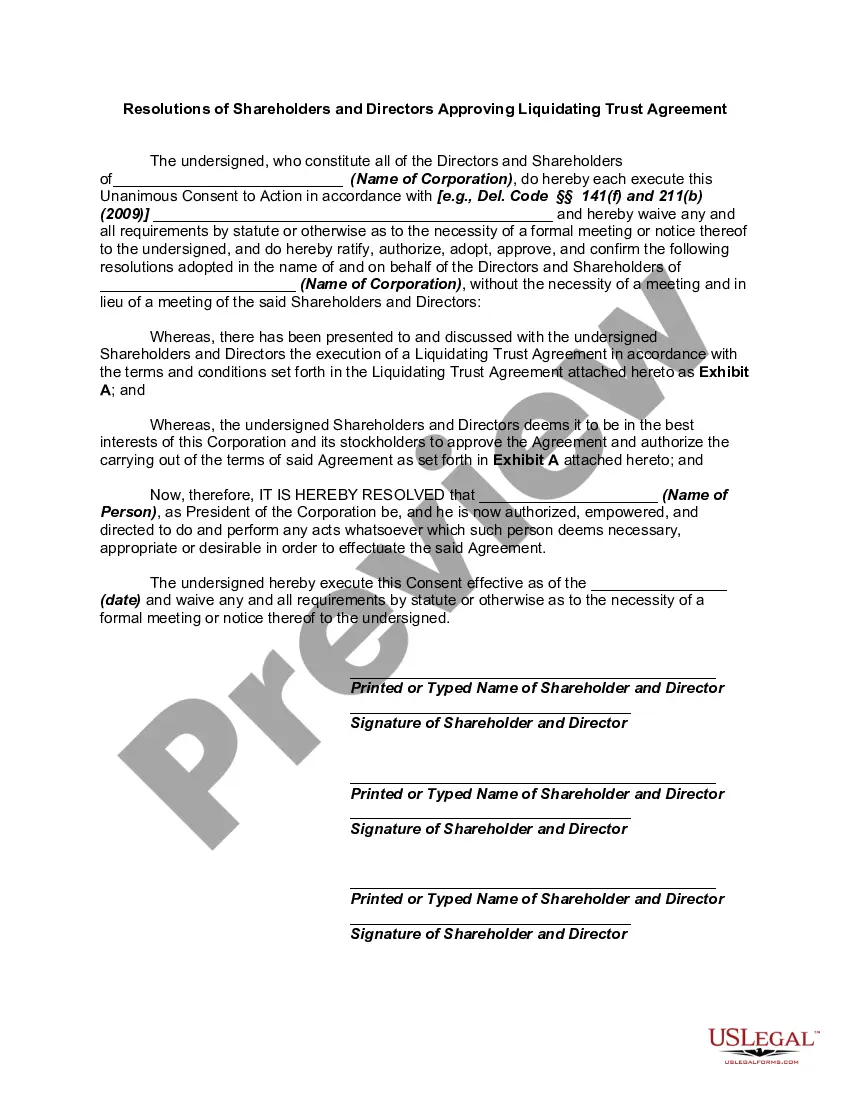
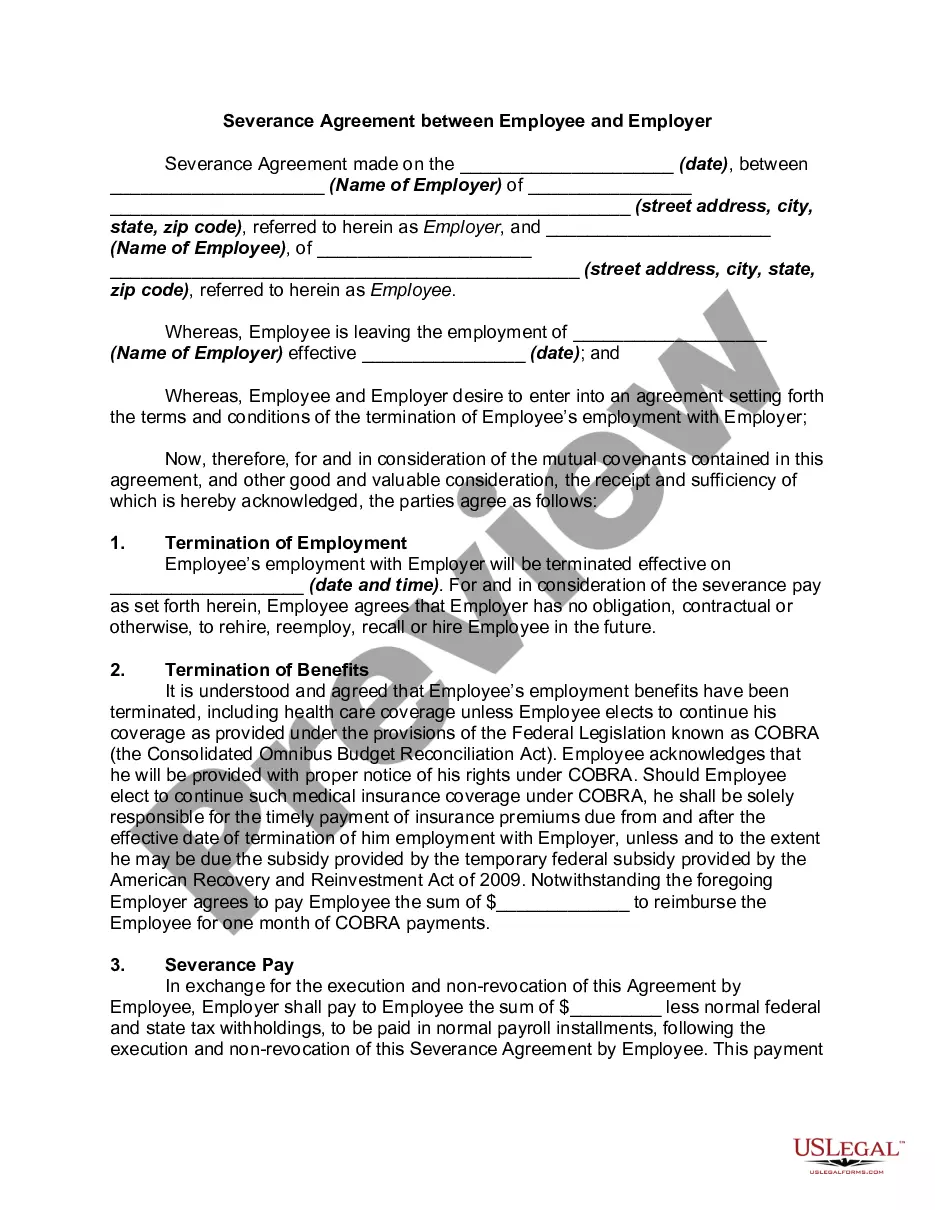
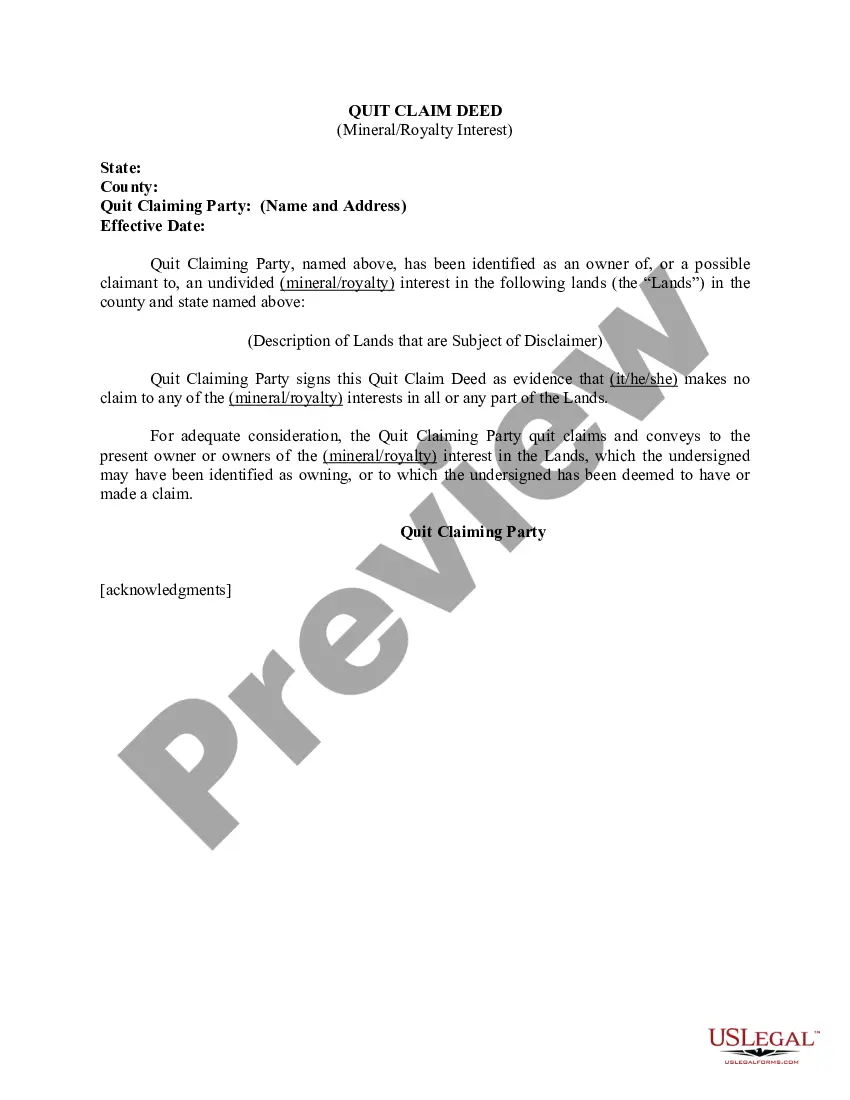
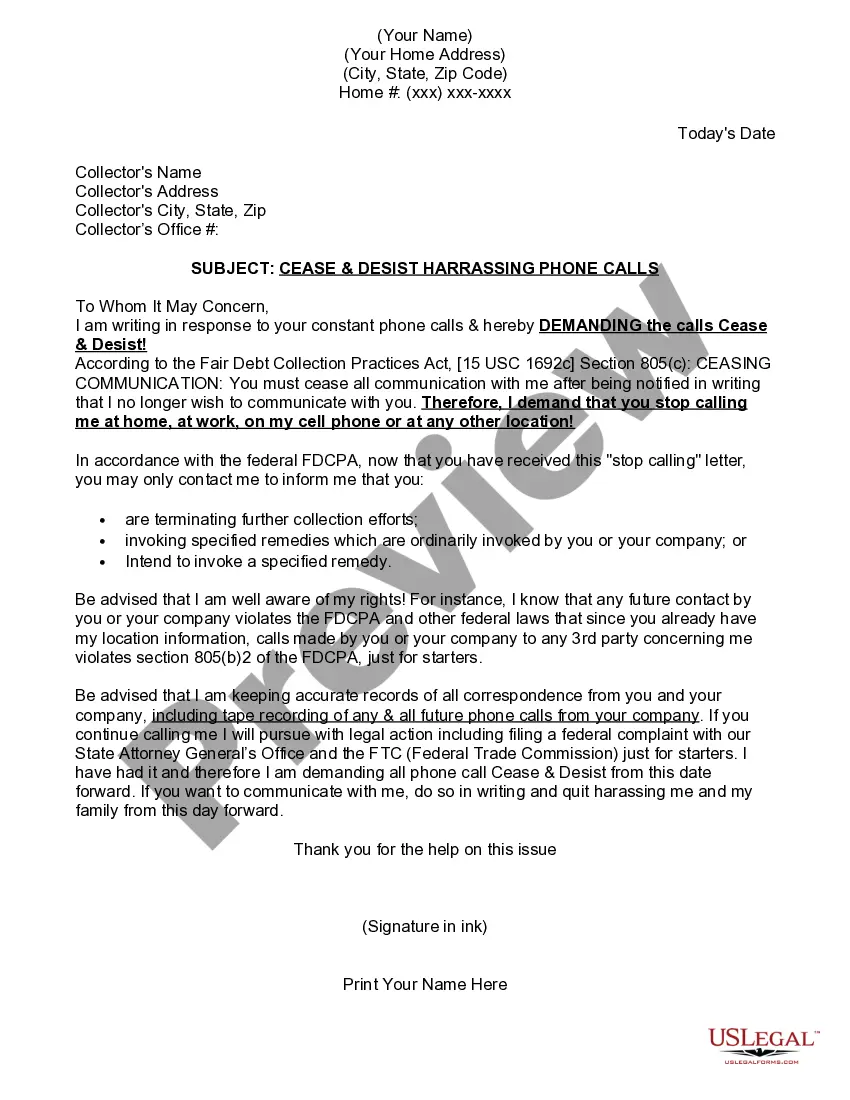
Form popularity
FAQ
Primary tabs. A Latin term meaning "in the manner of a pauper." Allowing a poor person to bring suit without liability for the costs of the suit.
In forma pauperis (/026an 02c8f025402d0rm0259 02c8p025402d0p0259r026as/; IFP or i.f.p.) is a Latin legal term meaning "in the character or manner of a pauper". It refers to the ability of an indigent person to proceed in court without payment of the usual fees associated with a lawsuit or appeal.
(a) Intervention of Right. On timely motion, the court must permit anyone to intervene who: (1) is given an unconditional right to intervene by a federal statute; or.
In forma pauperis (/026an 02c8f025402d0rm0259 02c8p025402d0p0259r026as/; IFP or i.f.p.) is a Latin legal term meaning "in the character or manner of a pauper". It refers to the ability of an indigent person to proceed in court without payment of the usual fees associated with a lawsuit or appeal.
33 of the Code of Civil Procedure negative the idea of anybody but an actual pauper, a real pauper, a man without means, being permitted to maintain or defend a suit in forma pauperis and that the privilege of maintaining a pauper suit is a personal privilege granted to people who have no means of carrying on or
What is IFP status? ( Filing without paying a filing fee) In forma pauperis (IFP) is Latin for in the form of a pauper. IFP status is generally granted to those who the Court determines do not have the resources to pay the $400.00 filing fee.