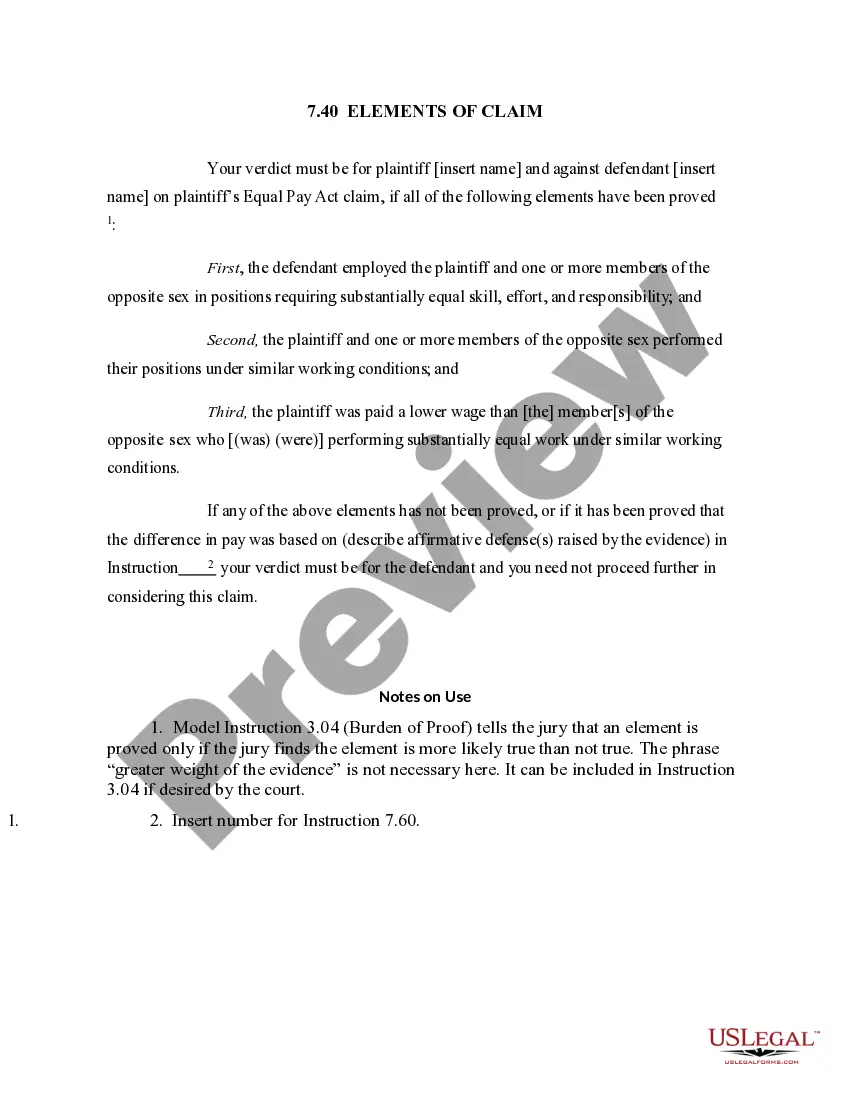
7.40 ELEMENTS OF CLAIM
Understanding this form
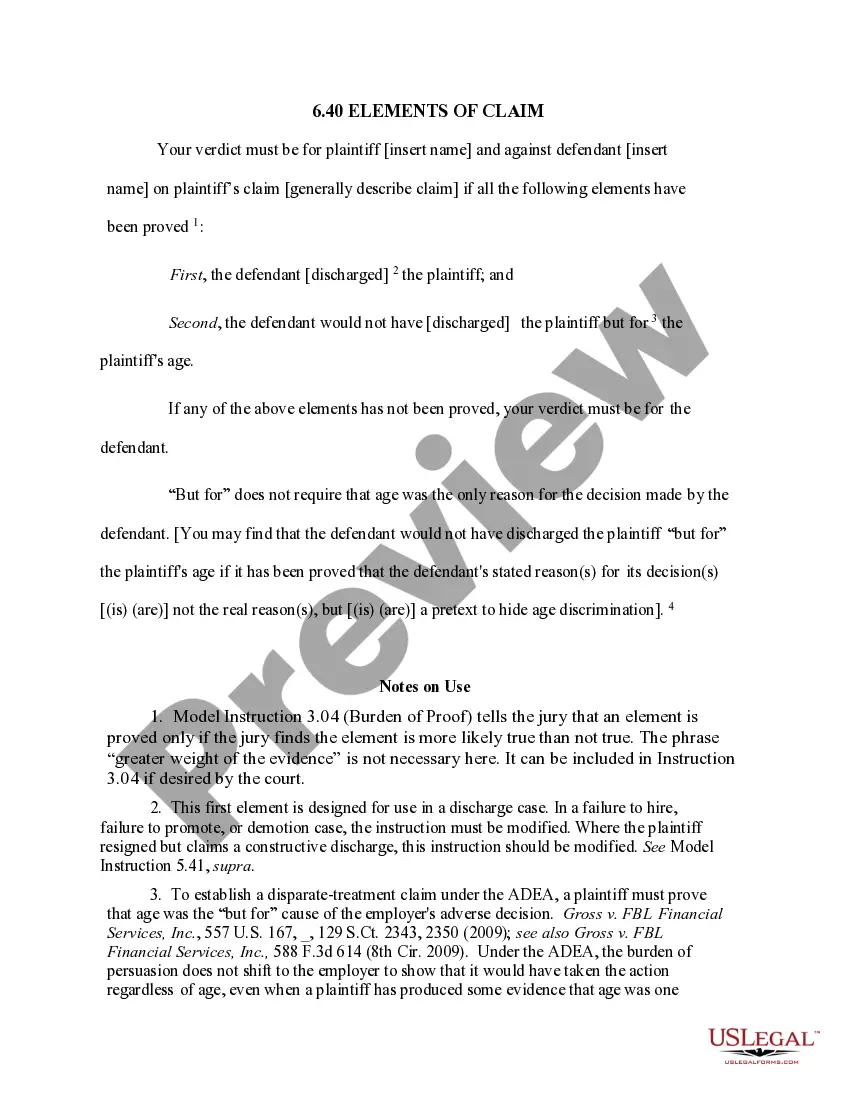
The 7.40 Elements of Claim form serves as a legal guideline used in Equal Pay Act claims. It outlines the essential elements that must be proven for a plaintiff to win their case against a defendant regarding wage discrimination based on sex. This form is crucial for structuring arguments in court and helps clarify the criteria necessary for establishing a claim, thus differing from other legal forms related to employment law.
Main sections of this form
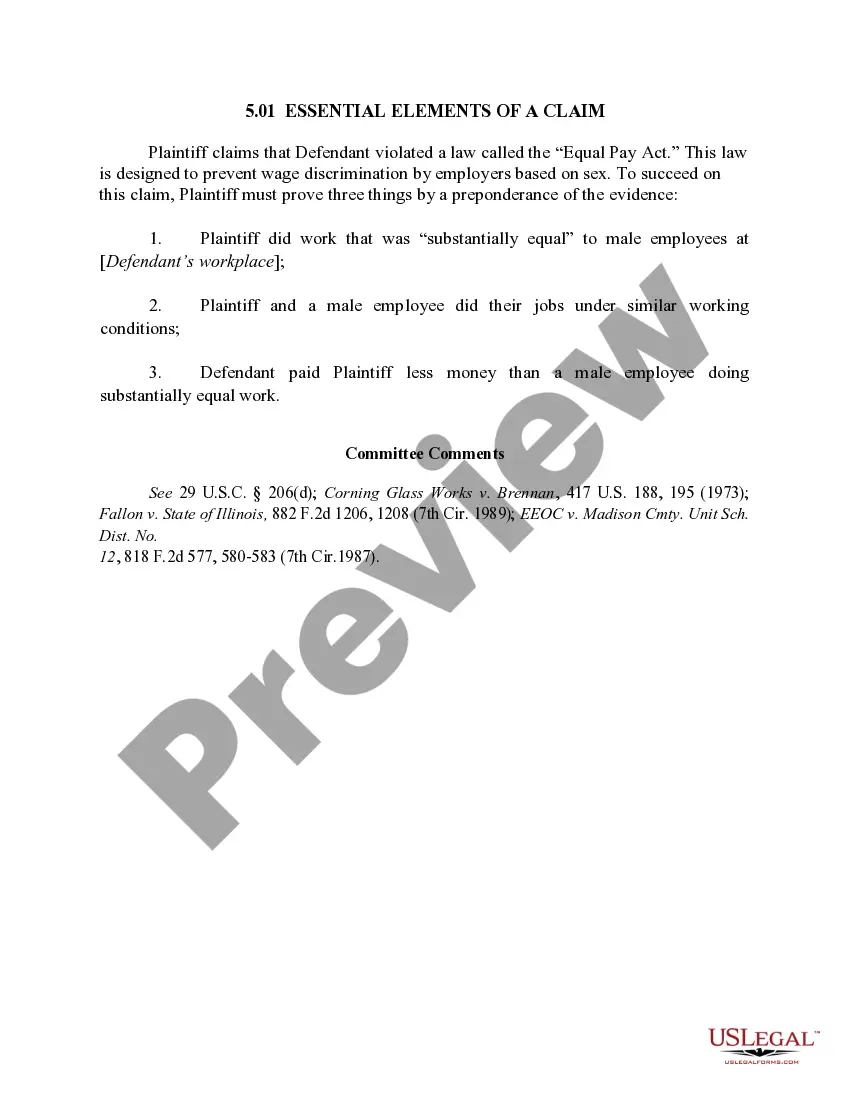
- First element: Defendant's employment of the plaintiff and opposite-sex employees in equal skill positions.
- Second element: Similar working conditions for the plaintiff and those performing substantially equal work.
- Third element: Evidence that the plaintiff was paid less than opposite-sex employees under similar conditions.
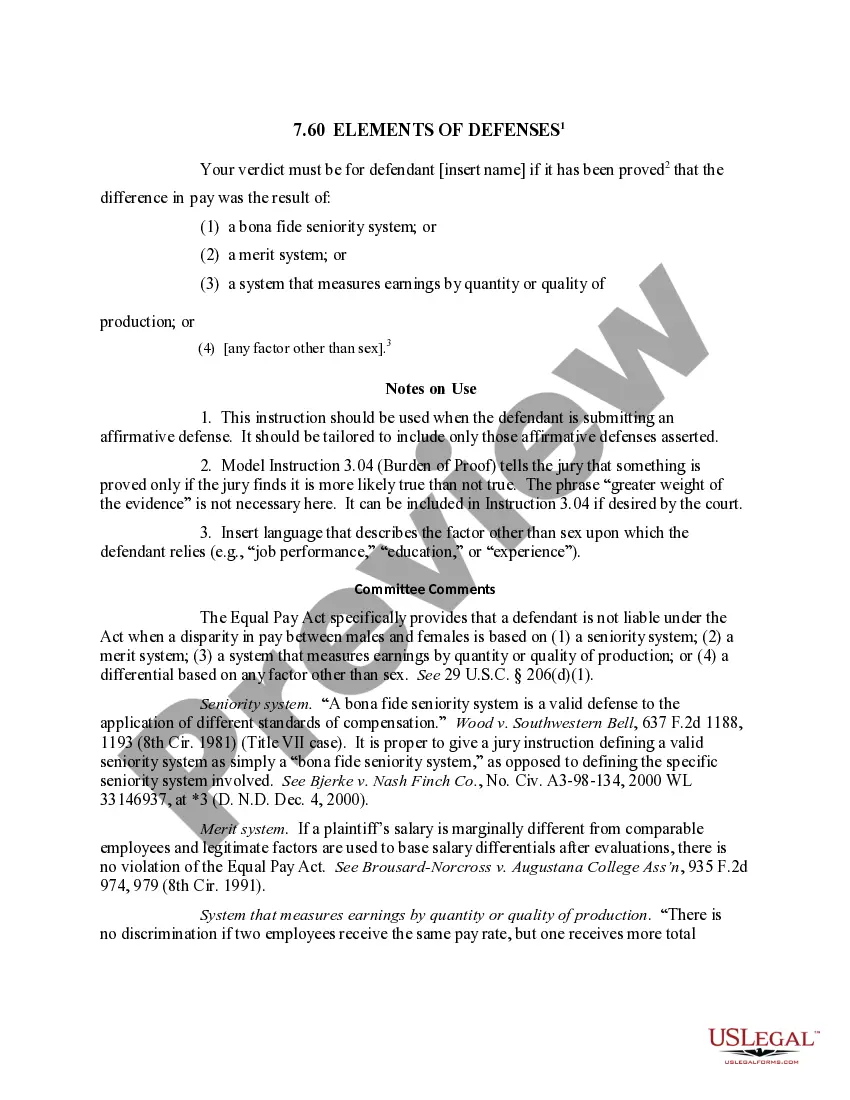
- Affirmative defenses: Possible reasons for pay disparity provided by the defendant.
Common use cases
This form should be used when an employee believes they have been unfairly compensated compared to colleagues of another sex performing similar work. It is appropriate in legal cases involving wage discrimination claims under the Equal Pay Act, particularly when preparing arguments for a jury or during legal proceedings.
Who can use this document
- Employees who suspect they are underpaid compared to colleagues of the opposite sex.
- Attorneys representing clients in wage discrimination cases.
- Individuals seeking to understand the legal framework of the Equal Pay Act.
Instructions for completing this form
- Identify and insert the names of the plaintiff and defendant in the appropriate fields.
- Establish employment relationships, detailing the positions and roles held by both the plaintiff and opposite-sex colleagues.
- Collect evidence demonstrating similar working conditions for all involved parties.
- Document salary comparisons between the plaintiff and opposite-sex employees performing equivalent work.
- Note any affirmative defenses that may be presented by the defendant concerning pay differences.
Notarization requirements for this form
This form does not typically require notarization to be legally valid. However, some jurisdictions or document types may still require it. US Legal Forms provides secure online notarization powered by Notarize, available 24/7 for added convenience.
Get your form ready online
Our built-in tools help you complete, sign, share, and store your documents in one place.
Make edits, fill in missing information, and update formatting in US Legal Forms—just like you would in MS Word.
Download a copy, print it, send it by email, or mail it via USPS—whatever works best for your next step.
Sign and collect signatures with our SignNow integration. Send to multiple recipients, set reminders, and more. Go Premium to unlock E-Sign.
If this form requires notarization, complete it online through a secure video call—no need to meet a notary in person or wait for an appointment.
We protect your documents and personal data by following strict security and privacy standards.

Make edits, fill in missing information, and update formatting in US Legal Forms—just like you would in MS Word.

Download a copy, print it, send it by email, or mail it via USPS—whatever works best for your next step.

Sign and collect signatures with our SignNow integration. Send to multiple recipients, set reminders, and more. Go Premium to unlock E-Sign.

If this form requires notarization, complete it online through a secure video call—no need to meet a notary in person or wait for an appointment.

We protect your documents and personal data by following strict security and privacy standards.
Common mistakes to avoid
- Failing to provide adequate evidence of equal skill, effort, and responsibility among coworkers.
- Overlooking the need to establish similar working conditions.
- Missing affirmative defenses raised by the defendant that can invalidate the claim.
Why complete this form online
- Convenient access to a comprehensive legal template ready for download.
- Editability allows users to customize the form to suit their specific case.
- Reliable guidance based on established legal standards ensures you are on the right path.
Legal use & context
- Provides a structured approach to presenting a claim under the Equal Pay Act.
- Enforceable in cases where wage discrimination criteria are met, backed by evidence.
- Important for establishing a legal precedent in employment discrimination claims.
Quick recap
- The form clarifies the essential elements for proving claims under the Equal Pay Act.
- It is vital for individuals who believe they are victims of wage discrimination.
- Proper completion can significantly impact the outcome of a legal dispute regarding pay equity.
Looking for another form?
Form popularity
FAQ
The three main instances of an injunction are restraining orders, preliminary (temporary) injunctions, and permanent injunctions. Cease and desist orders are a common type of injunction that demands an individual or entity to stop some activity.
An injunction is a court order stating that a company must do something or seize from doing a certain action. Injunctions are often granted when monetary damages are not sufficient to remedy a given situation. For example, an industrial plant dumping waste into a lake may be served an injunction to stop that activity.
An injunction is a court order requiring a person to do or cease doing a specific action. There are three types of injunctions: Permanent injunctions, Temporary restraining orders and preliminary injunctions. Temporary restraining orders (TRO) and preliminary injunctions are equitable in nature.
An injunction is a legal remedy which is imposed by a court. In simple terms, an injunction means that one of the parties to a certain action must either do something or refrain from doing something. Once the court makes its decision, the parties must abide by the ruling.
The refusal to grant claims because the subject matter as claimed is considered unpatentable is called a "rejection." The term "rejected" must be applied to such claims in the examiner's action. If the form of the claim (as distinguished from its substance) is improper, an "objection" is made.
An unseaworthiness claim is a type of maritime law claim. A person may file a claim against the owner of a vessel and seek the recovery of damages if the person suffered injuries due to unsafe conditions on the vessel, including unsafe tools and equipment.
It is a court order prohibiting a person from taking a particular action (a prohibitory injunction) or requiring them to take a particular action (a mandatory injunction). ( Basically the court will tell someone explicitly that must, or must not carry out a certain action.)
An injunction is a court order stating that a company must do something or seize from doing a certain action. Injunctions are often granted when monetary damages are not sufficient to remedy a given situation. For example, an industrial plant dumping waste into a lake may be served an injunction to stop that activity.