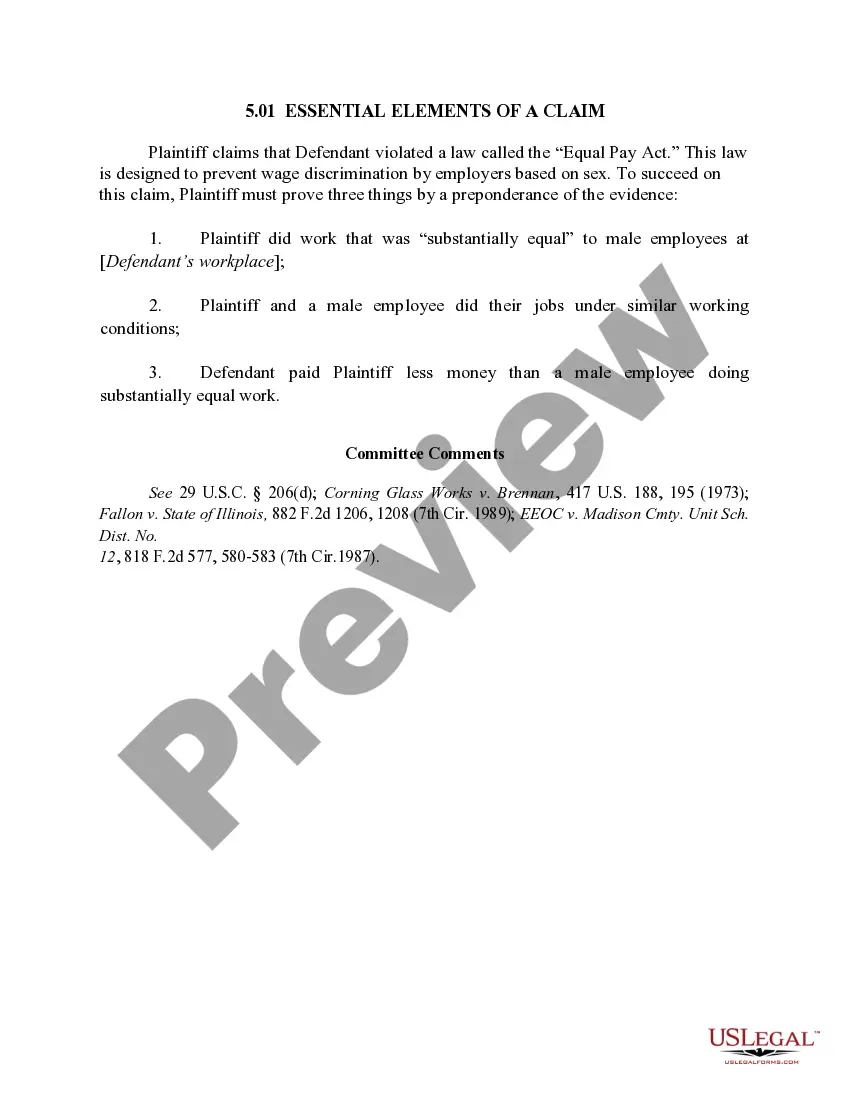
5.01 Essential Elements of a Claim
Overview of this form
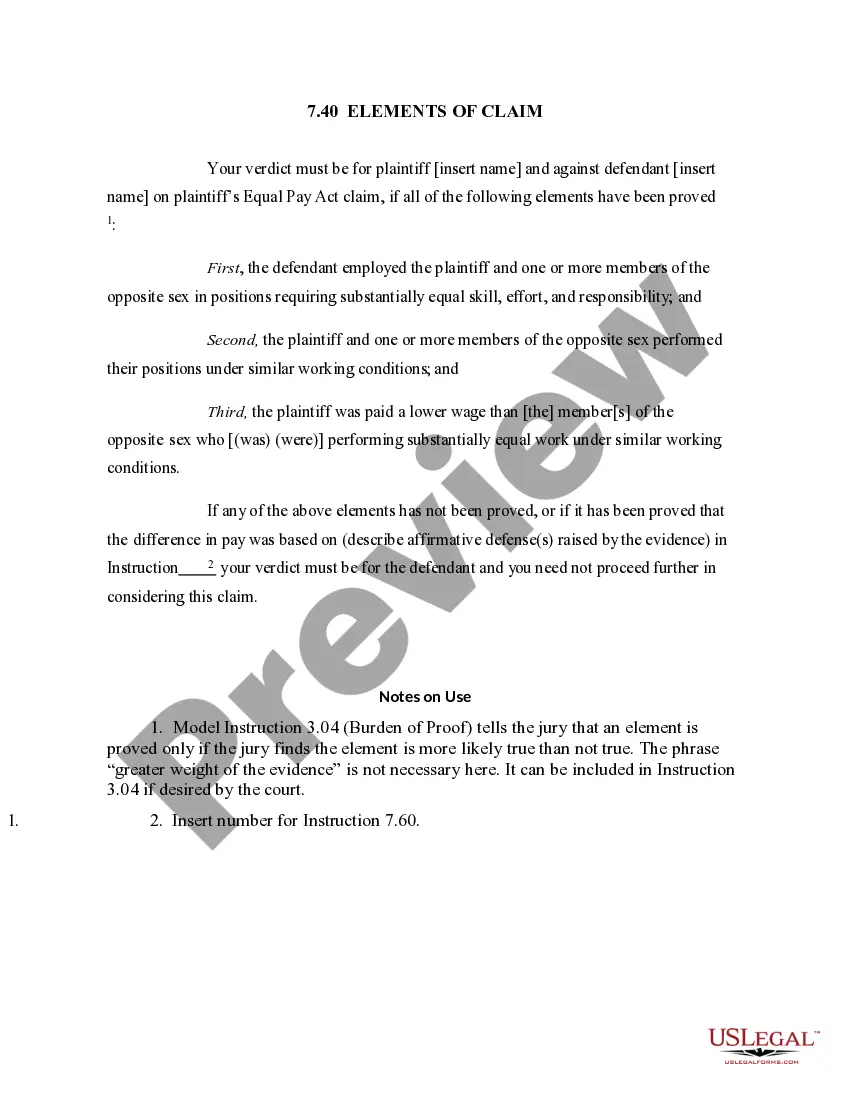
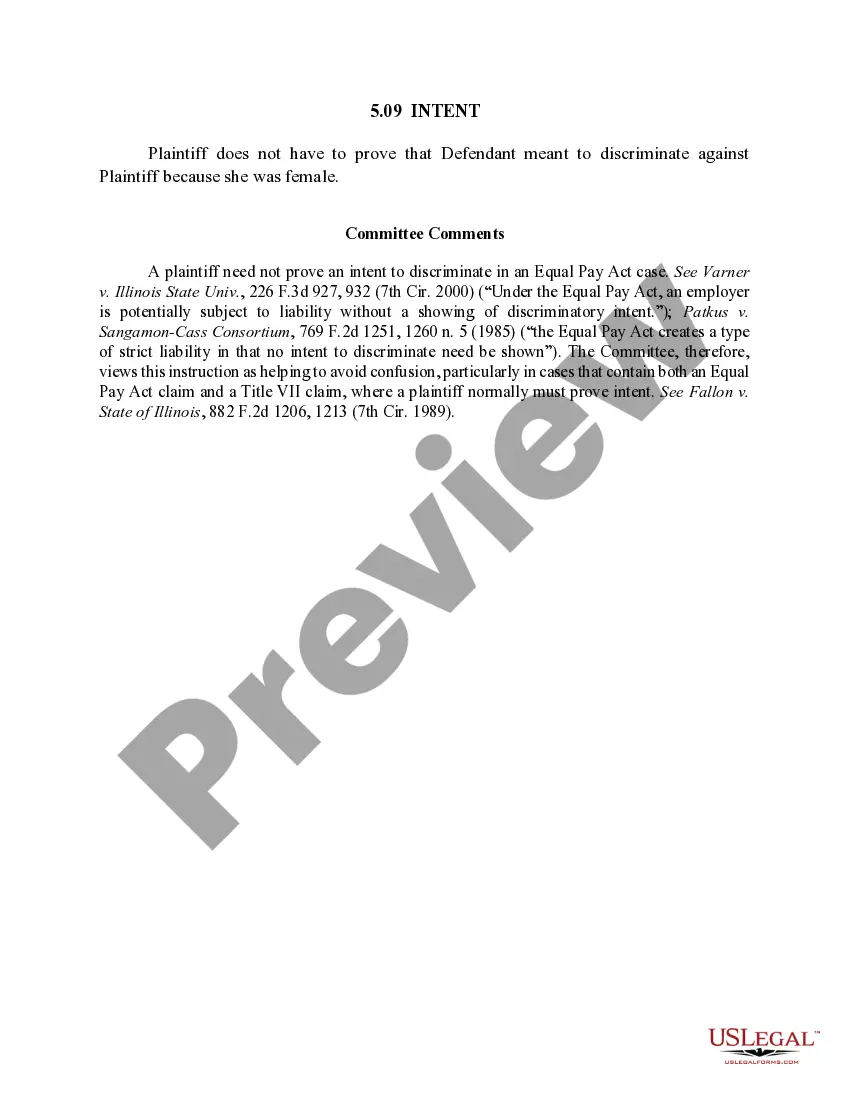
The 5.01 Essential Elements of a Claim is an official pattern jury instruction adopted by the Federal 7th Circuit Court. This legal document outlines the specific components necessary for a plaintiff to prove a violation of the Equal Pay Act, which aims to eliminate wage discrimination based on sex. This form is essential for legal proceedings involving wage equality, making it distinct from other employment-related forms that may not focus specifically on wage discrimination claims.
Key parts of this document
- Claims that the defendant violated the Equal Pay Act.
- Requirements for proof that the plaintiff performed work that is "substantially equal" to a male employee.
- Working conditions need to be similar for both the plaintiff and the male employee.
- Evidence that demonstrates the plaintiff received less pay than the male employee for substantially equal work.

Situations where this form applies
This form is useful when an individual believes they have been discriminated against in the workplace under the Equal Pay Act. It is essential in legal claims that seek to address wage discrepancies based on sex. For instance, if an employee has evidence that they are being paid less than their male counterparts for the same work, this form helps outline their claim in court.
Intended users of this form
This form is intended for:
- Employees who suspect wage discrimination based on sex.
- Individuals pursuing legal action against an employer under the Equal Pay Act.
- Attorneys representing clients in equal pay claims.
Steps to complete this form
- Identify the plaintiff and the defendant involved in the claim.
- State the nature of work performed by the plaintiff and the corresponding male employee.
- Describe the working conditions of both the plaintiff and the male employee.
- Provide evidence of the wage disparity between the plaintiff and the male employee.
- Ensure all claims and evidence are supported by documentation and are clear and factual.
Does this form need to be notarized?
In most cases, this form does not require notarization. However, some jurisdictions or signing circumstances might. US Legal Forms offers online notarization powered by Notarize, accessible 24/7 for a quick, remote process.
Get your form ready online
Our built-in tools help you complete, sign, share, and store your documents in one place.
Make edits, fill in missing information, and update formatting in US Legal Forms—just like you would in MS Word.
Download a copy, print it, send it by email, or mail it via USPS—whatever works best for your next step.
Sign and collect signatures with our SignNow integration. Send to multiple recipients, set reminders, and more. Go Premium to unlock E-Sign.
If this form requires notarization, complete it online through a secure video call—no need to meet a notary in person or wait for an appointment.
We protect your documents and personal data by following strict security and privacy standards.

Make edits, fill in missing information, and update formatting in US Legal Forms—just like you would in MS Word.

Download a copy, print it, send it by email, or mail it via USPS—whatever works best for your next step.

Sign and collect signatures with our SignNow integration. Send to multiple recipients, set reminders, and more. Go Premium to unlock E-Sign.

If this form requires notarization, complete it online through a secure video call—no need to meet a notary in person or wait for an appointment.

We protect your documents and personal data by following strict security and privacy standards.
Mistakes to watch out for
- Failing to gather sufficient evidence to support claims of wage disparity.
- Not clearly identifying the similar working conditions between employees.
- Neglecting to specify the nature of the work that is "substantially equal."
- Overlooking jurisdiction-specific requirements that may affect the claim.
Why complete this form online
- Convenience of accessing and downloading the form immediately.
- Editable format allows for personalized input and adjustments.
- Reliability from templates drafted by licensed attorneys, ensuring legal compliance.
Legal use & context
- The 5.01 Essential Elements of a Claim supports legal actions based on wage discrimination under the Equal Pay Act.
- Properly documenting claims is crucial for enforceability in a court of law.
- Failure to meet the necessary legal standards can result in a dismissal of the case.
Quick recap
- This form outlines essential elements required to prove an Equal Pay Act violation.
- Clearly documenting evidence is vital for success in claims against wage discrimination.
- Understanding the legal context can help improve the chances of a favorable outcome in court.
Looking for another form?
Form popularity
FAQ
Illinois Pattern Jury Instruction (I.P.I.) 30.04. 02 defines loss of a normal life, as ?When I use the expression ?loss of a normal life,? I mean the temporary or permanent diminished ability to enjoy life. This includes a person's inability to pursue the pleasurable aspects of life.?
In Illinois, the Illinois Pattern Jury Instructions (IPI) sets out that there is a rebuttable presumption that states: ?Where a decedent leaves (lineal next of kin), the law recognizes a presumption that the (lineal next of kin) have sustained some substantial pecuniary loss by reason of the death.
You must resist jumping to conclusions based on personal likes or dislikes. You must not let bias, prejudice, or public opinion influence your decision.
Under express assumption of risk, plaintiff and defendant explicitly agree, in advance, that defendant owes no legal duty to plaintiff and therefore, that plaintiff cannot recover for injuries caused either by risks inherent in the situation or by dangers created by defendant's negligence.
(5) Overt Act. No person may be convicted of conspiracy to commit a crime, other than a felony of the first or second degree, unless an overt act in pursuance of such conspiracy is alleged and proved to have been done by him or by a person with whom he conspired.
Jury instructions are instructions for jury deliberation that are written by the judge and given to the jury. At trial, jury deliberation occurs after evidence is presented and closing arguments are made.
The Model Penal Code disallows factual impossibility as a defense by stating that conduct is an attempt when the defendant ?purposely engages in conduct which would constitute the crime if the attendant circumstances were as he believes them to be? (Model Penal Code § 5.01(1) (a)).
(4) Under the Model Penal Code, a defendant commits an attempt if he or she performs an act that, "under the circumstances as he/she believes them to be," constitutes a substantial step toward commission of a crime. Model Penal Code § 5.01(1)(c); see also Dworken, 855 F. 2d at 19.