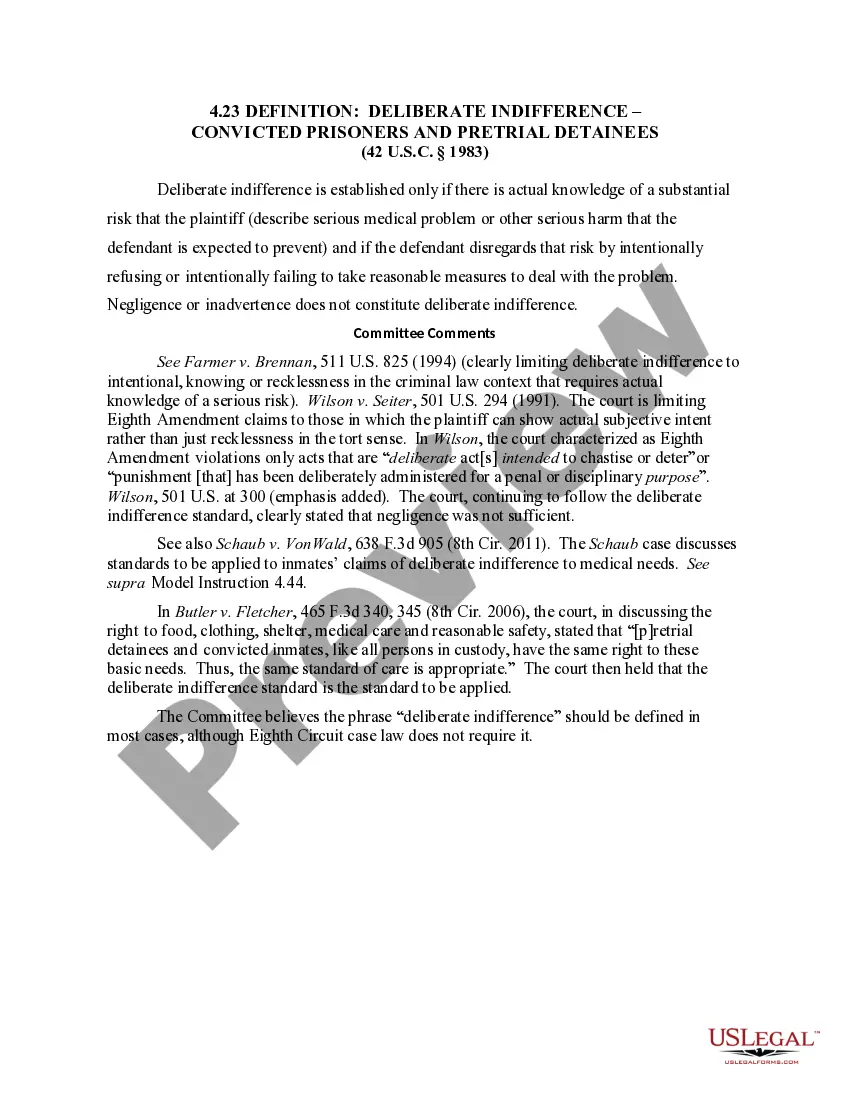
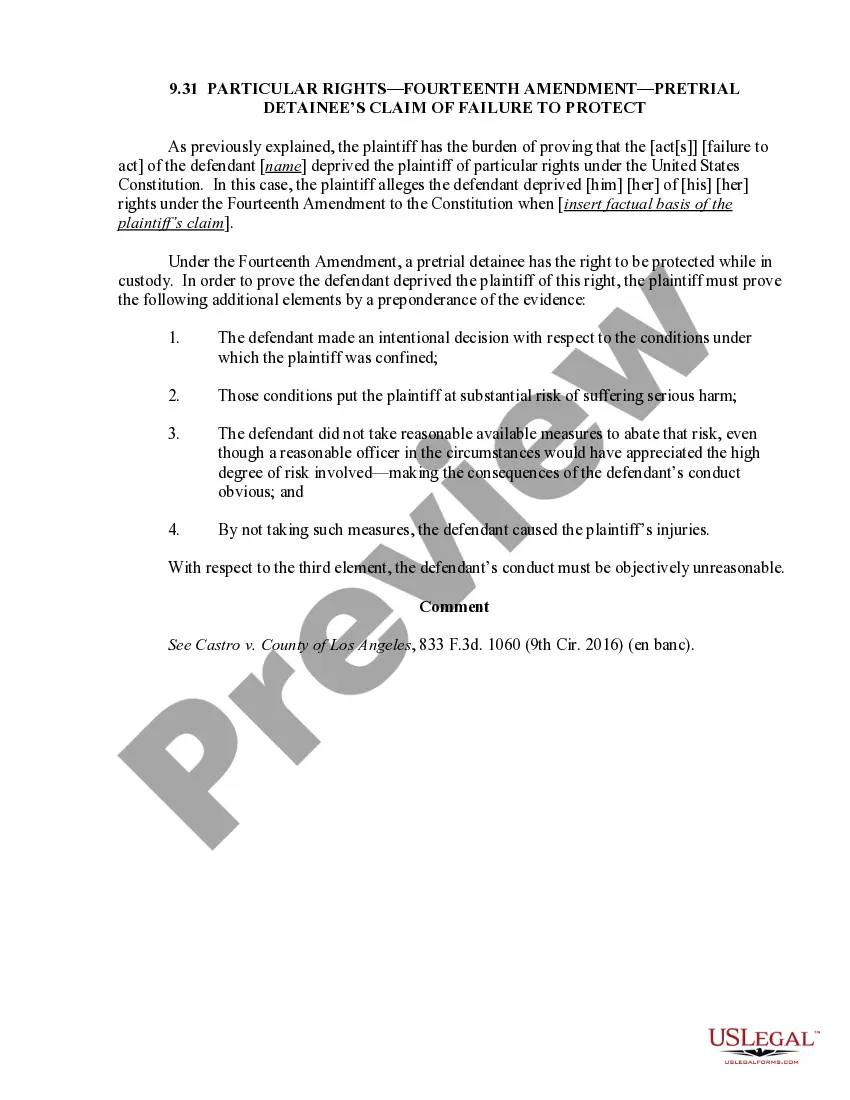
4.23 DEFINITION: DELIBERATE INDIFFERENCE - CONVICTED PRISONERS AND PRETRIAL DETAINEES
Overview of this form
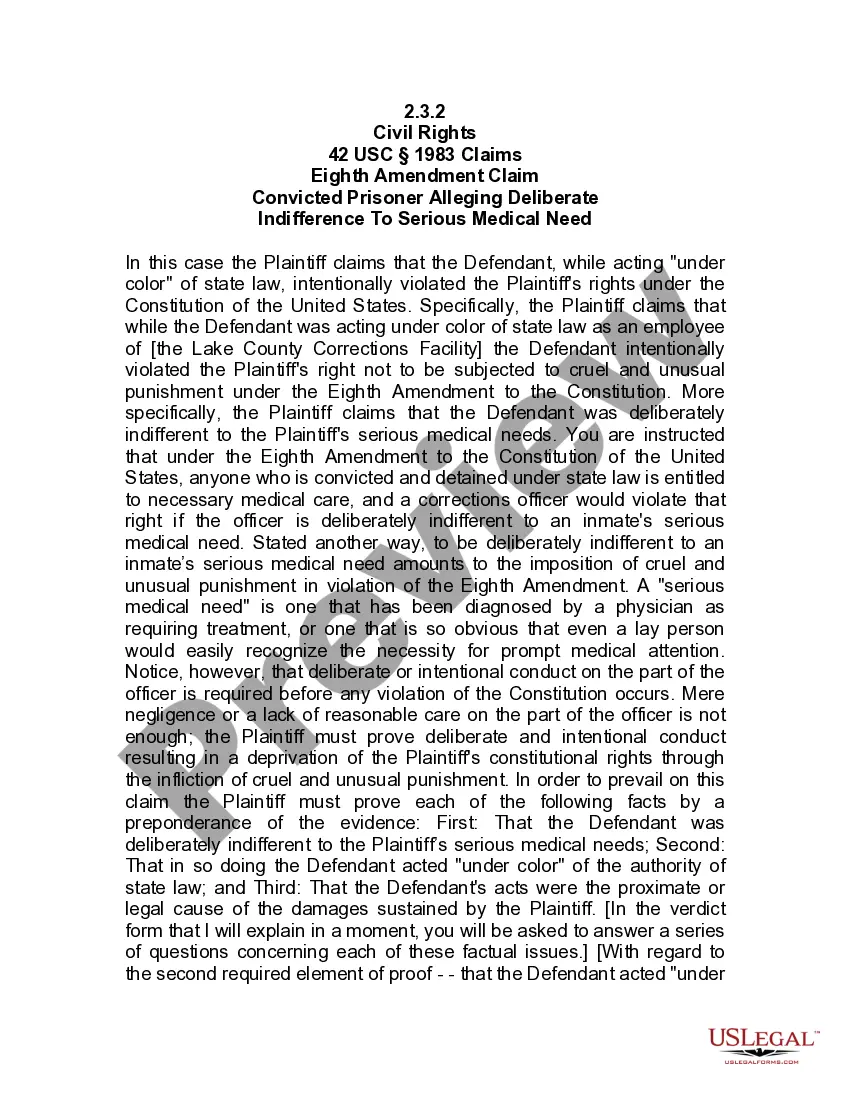
The "Deliberate Indifference â Convicted Prisoners and Pretrial Detainees" form pertains to claims under 42 U.S.C. § 1983, where a plaintiff alleges that their constitutional rights were violated due to an official's deliberate indifference to their serious medical needs. This form is essential for establishing the specific legal standards required to prove such claims, emphasizing the difference between negligence and deliberate indifference. This form is crucial for individuals seeking to understand how to address severe mistreatment while in custody.
What’s included in this form
- Description of serious medical problems or substantial harm the defendant is expected to prevent.
- Criteria for establishing actual knowledge of substantial risks by the defendant.
- Evidence of intentional refusal or failure to take reasonable measures to address the problem.
- Reference to key legal precedents, including Farmer v. Brennan and Wilson v. Seiter, outlining the legal framework.
- Clarifications on what constitutes negligence versus deliberate indifference.

When to use this form
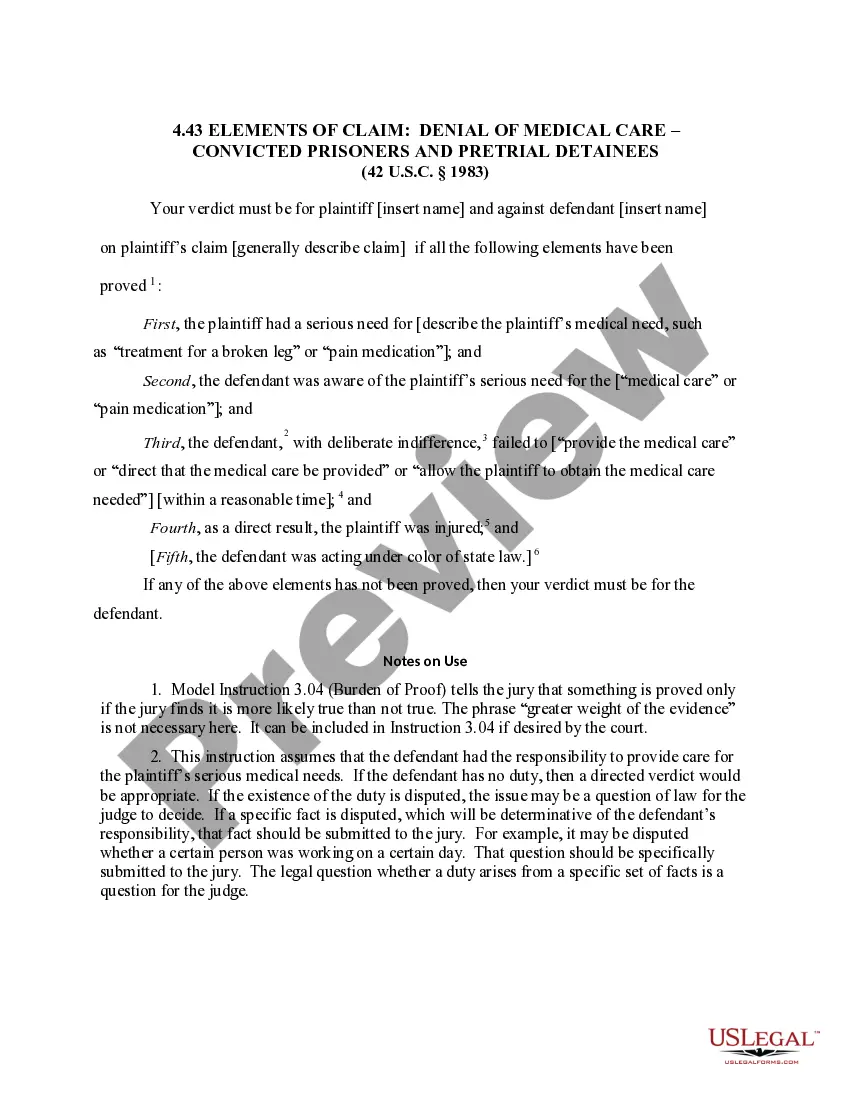
This form is applicable in scenarios where convicted prisoners or pretrial detainees believe that their rights under the Eighth Amendment have been violated due to the failure of prison officials to provide necessary medical care or protection from harm. It is particularly critical when serious medical conditions are present, and the response from officials is deemed inadequate. Use this form if you are questioning the care provided or lack thereof during your incarceration.
Who should use this form
This form is intended for:
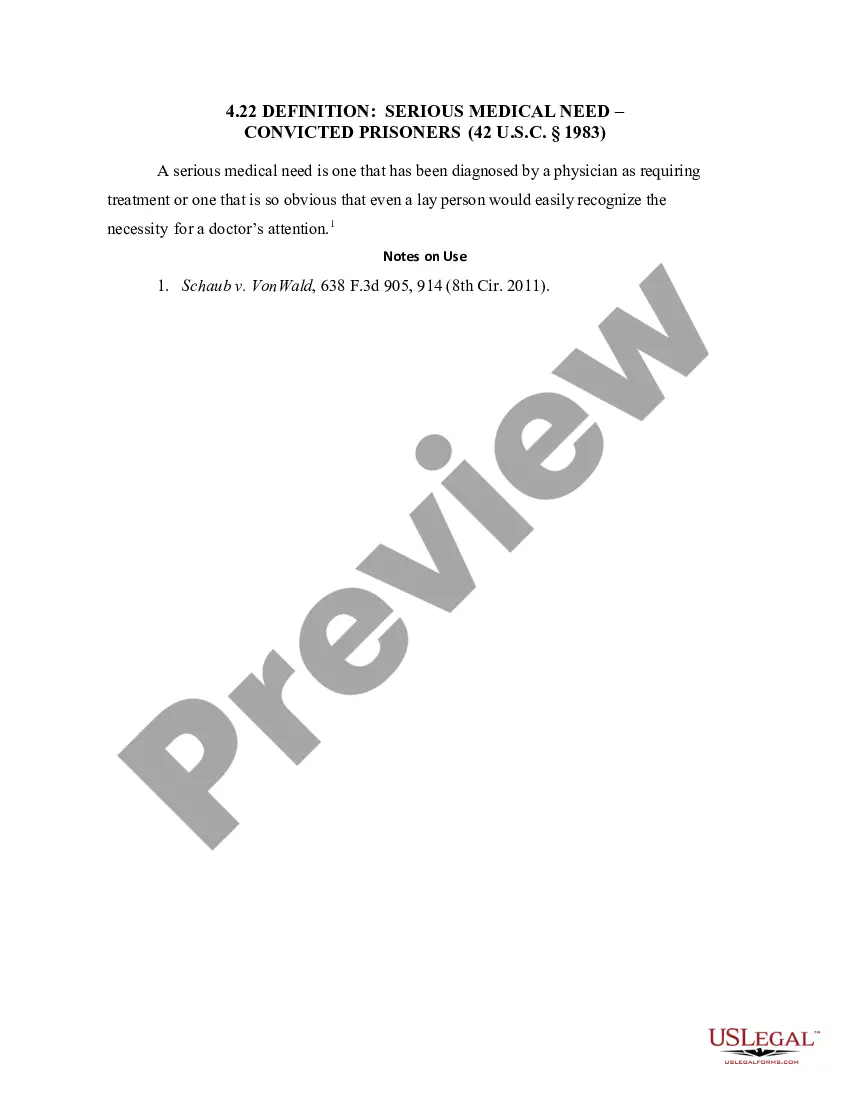
- Convicted prisoners who believe their medical needs are being disregarded.
- Pretrial detainees facing serious risks and unable to access appropriate health care.
- Legal representatives or advocates assisting prisoners in filing complaints regarding constitutional rights violations.
Instructions for completing this form
- State the identity of the plaintiff (the individual alleging rights violations).
- Describe the serious medical problem or harm that needs attention.
- Provide evidence or examples of actions that demonstrate deliberate indifference.
- Include all relevant dates and details surrounding the incidents of care or neglect.
- Sign and date the form as required, ensuring all information is accurate and complete.
Notarization requirements for this form
This form does not typically require notarization unless specified by local law. Ensure to verify any state-specific requirements that may apply.
Get your form ready online
Our built-in tools help you complete, sign, share, and store your documents in one place.
Make edits, fill in missing information, and update formatting in US Legal Forms—just like you would in MS Word.
Download a copy, print it, send it by email, or mail it via USPS—whatever works best for your next step.
Sign and collect signatures with our SignNow integration. Send to multiple recipients, set reminders, and more. Go Premium to unlock E-Sign.
If this form requires notarization, complete it online through a secure video call—no need to meet a notary in person or wait for an appointment.
We protect your documents and personal data by following strict security and privacy standards.

Make edits, fill in missing information, and update formatting in US Legal Forms—just like you would in MS Word.

Download a copy, print it, send it by email, or mail it via USPS—whatever works best for your next step.

Sign and collect signatures with our SignNow integration. Send to multiple recipients, set reminders, and more. Go Premium to unlock E-Sign.

If this form requires notarization, complete it online through a secure video call—no need to meet a notary in person or wait for an appointment.

We protect your documents and personal data by following strict security and privacy standards.
Common mistakes to avoid
- Failing to provide sufficient detail about the medical issues involved.
- Misunderstanding the distinction between negligence and deliberate indifference.
- Not referencing relevant legal precedents that support your claim.
- Omitting critical evidence of knowledge or disregard of substantial risks.
Why complete this form online
- Immediate access to necessary legal forms, reducing wait times and expediting filing.
- Convenience of downloading and printing forms at your convenience.
- Editability allows customization of the form to fit specific individual circumstances.
- Availability of resources and additional information to assist with form completion.
Legal use & context
- The form is used in civil rights litigation under 42 U.S.C. § 1983.
- Claims must demonstrate actual knowledge of serious risks by prison officials.
- Negligence alone is insufficient; intentional actions must be proven.
What to keep in mind
- The form focuses on establishing deliberate indifference in prison conditions.
- Understanding the legal context is crucial for filing valid claims.
- Users must carefully document all relevant details to support their claims.
Looking for another form?


Form popularity
FAQ
Deliberate indifference is the appropriate standard of culpability for all claims that prison officials failed to provide pretrial detainees with adequate food, clothing, shelter, medical care, and reasonable safety.
To state a claim of ?deliberate indifference to serious medical needs? under the Eighth Amendment, a plaintiff must show (1) that the risk of harm was objectively serious, and (2) the official consciously knew of, but disregarded that serious risk of harm.
What is deliberate indifference? A prison official demonstrates "deliberate indifference" if he or she recklessly disregards. a substantial risk of harm to the prisoner.4.
Deliberate indifference cases To establish deliberate indifference, a Santa Fe civil rights lawyer must prove that the prison guard or other prison official was subjectively aware of the prisoners serious medical condition and chose to do nothing or to delay taking action.
To prove deliberate indifference in a civil case, the victim generally must prove that the victim faced a substantial risk of serious harm, that the officer had knowledge of the risk of injury, and that the officer failed to take reasonable measures to decrease it.
Deliberate Indifference to Medical Care Attorneys When a jail or prison is knowledgeable of an inmate's needs but purposefully disregards a serious medical condition, resulting in the death of an inmate or pretrial detainee, the jail or prison can be liable for wrongful death.
Deliberate indifference means that the institution's response was clearly unreasonable in light of the known circumstances. It requires a showing that the institution's response was inadequate, willfully indifferent, or clearly unreasonable, thereby causing harm or denying the complainant educational benefits.