Sample Letter for Directive - Establish, Change, or Reaffirm Policies
Overview of this form
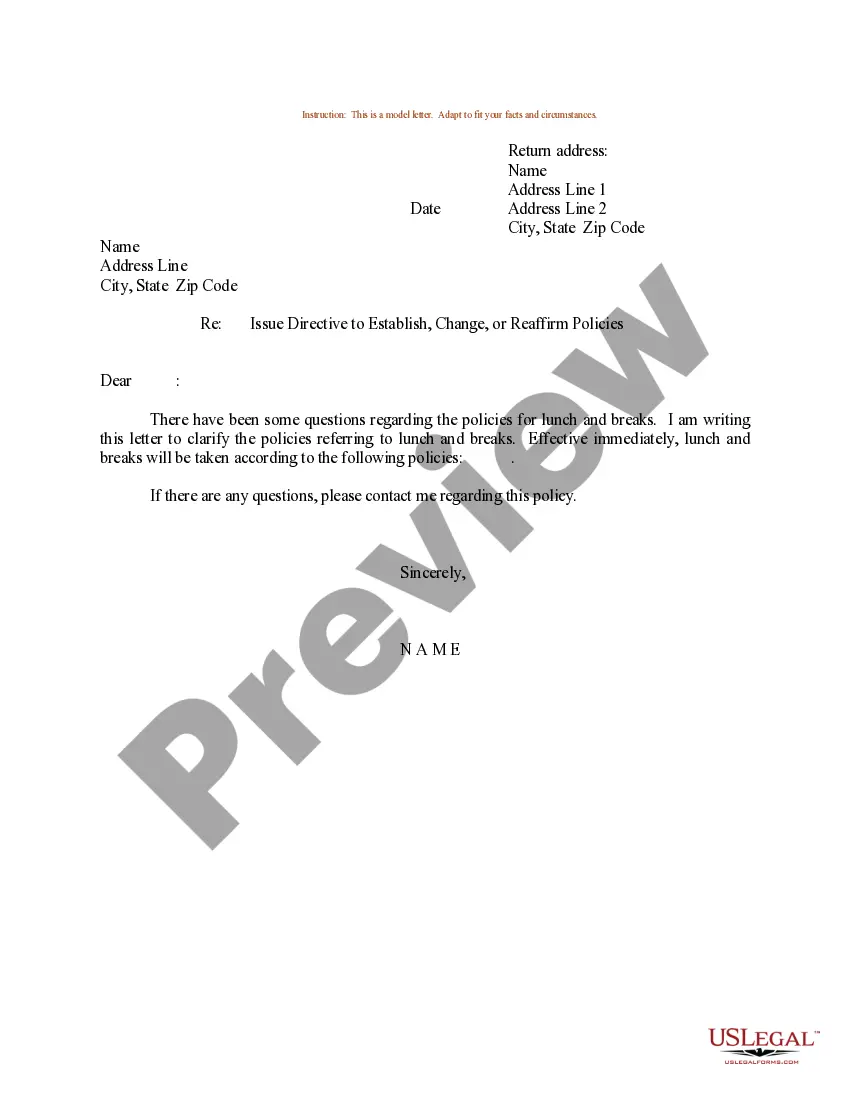
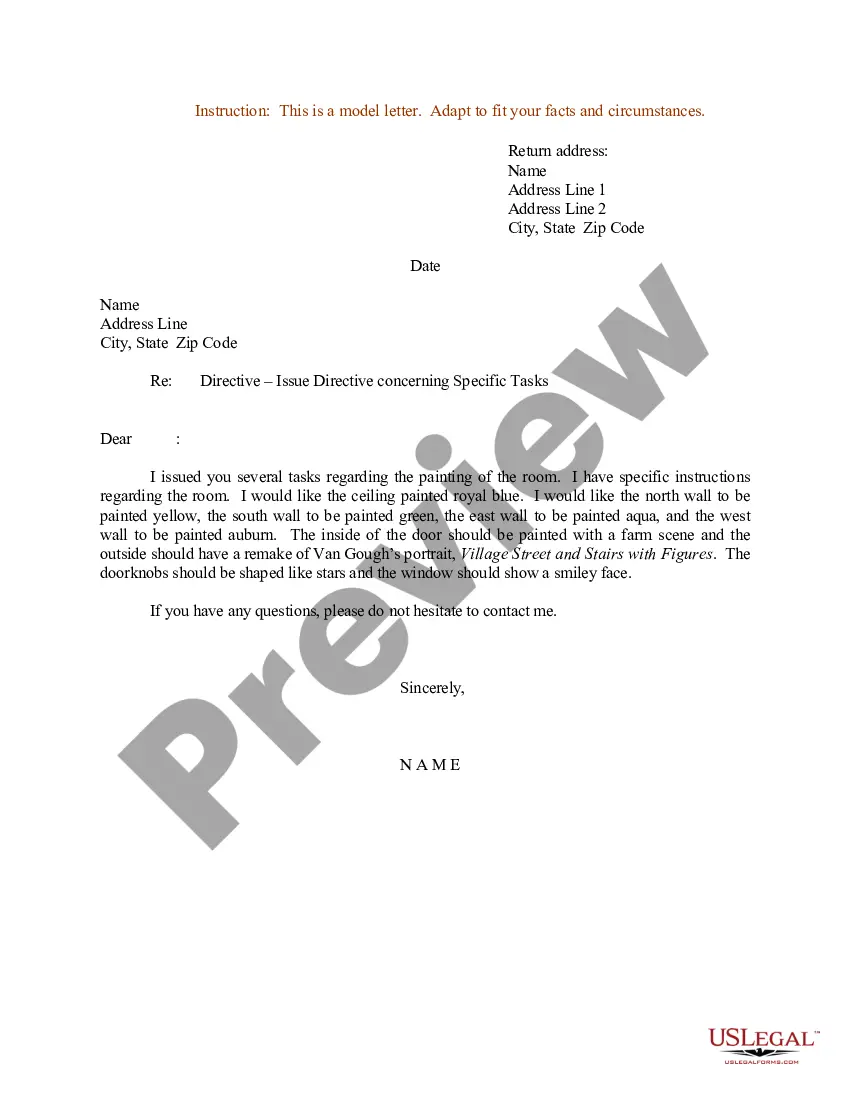
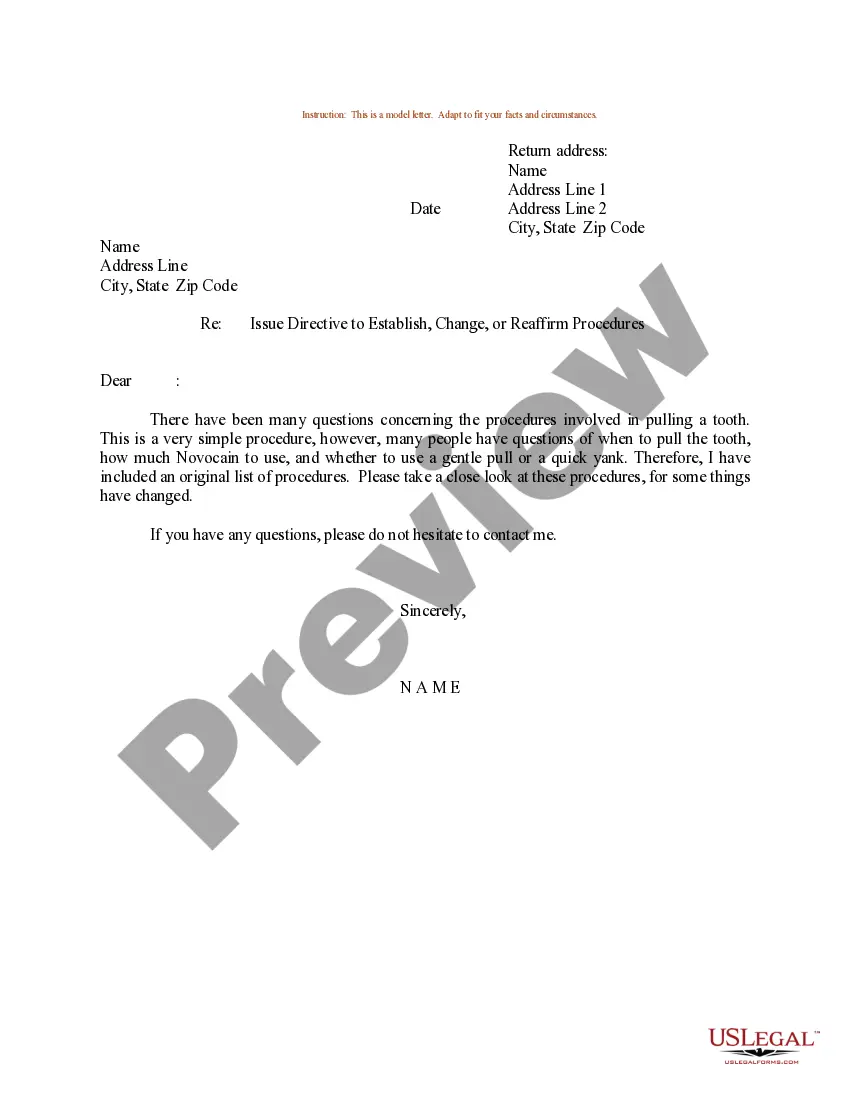
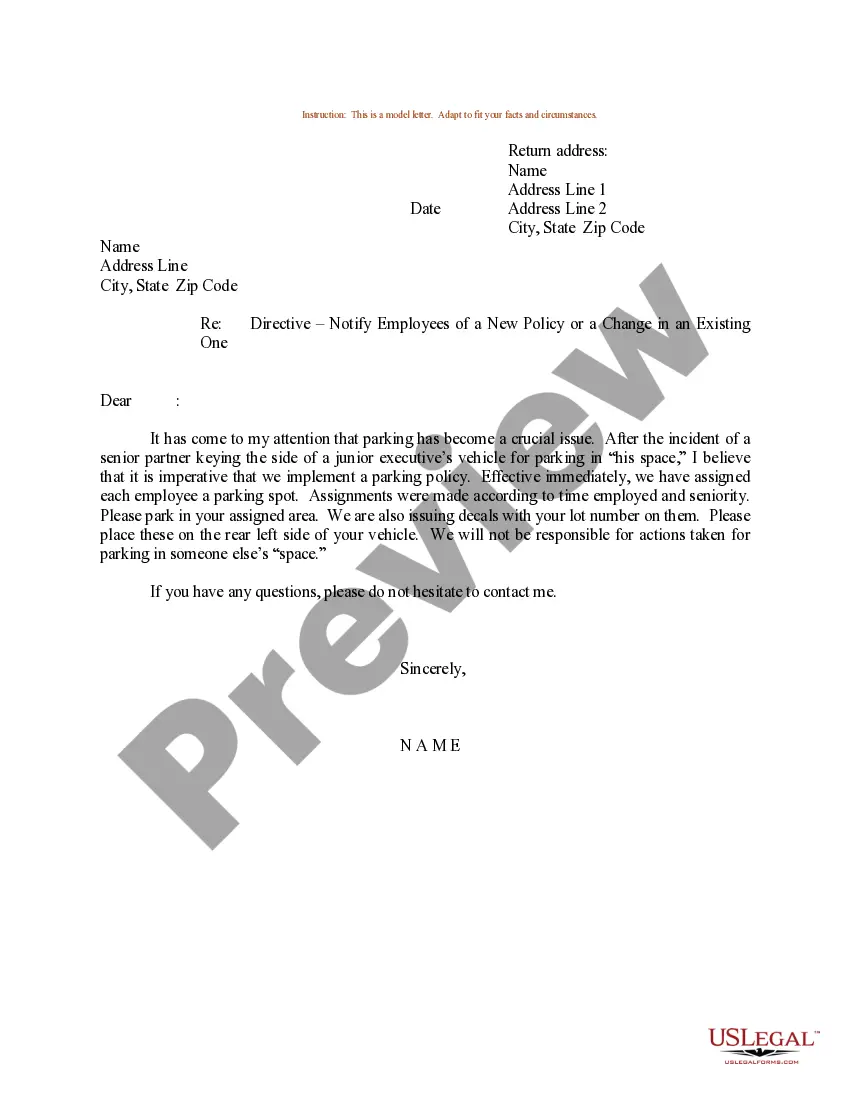
The Sample Letter for Directive - Establish, Change, or Reaffirm Policies is a legal document used to communicate the establishment, modification, or confirmation of policies within an organization. This form serves as a clear directive, ensuring that changes or continuations of policies are formally recognized and documented.
Main sections of this form
- Return address: Indicates the sender's contact information.
- Date: The date when the letter is sent.
- Recipient address: Details the recipient's contact information.
- Subject line: Clearly states the purpose of the letter.
- Body of the letter: Contains the specific directives regarding policy changes or affirmations.
When to use this form
This form is ideal for scenarios where an organization needs to implement new policies, amend existing ones, or reaffirm current policies. Examples include changes in company protocols, updates to employee guidelines, or when reiterating compliance with regulatory requirements.
Who this form is for
This form is suitable for:
- Business owners or managers needing to communicate policy changes.
- Human resources professionals updating employee handbooks.
- Non-profit organizations implementing new operational procedures.
Completing this form step by step
Follow these steps to complete the Sample Letter for Directive:
- Identify and enter your return address at the top of the letter.
- Write the date to indicate when the letter is being sent.
- Fill in the recipient's address to ensure proper delivery.
- Specify the subject of the letter clearly in the subject line.
- Compose the body of the letter detailing the changes or affirmations to policies.
Does this form need to be notarized?
This form does not typically require notarization to be legally valid. However, some jurisdictions or document types may still require it. US Legal Forms provides secure online notarization powered by Notarize, available 24/7 for added convenience.
Get your form ready online
Our built-in tools help you complete, sign, share, and store your documents in one place.
Make edits, fill in missing information, and update formatting in US Legal Forms—just like you would in MS Word.
Download a copy, print it, send it by email, or mail it via USPS—whatever works best for your next step.
Sign and collect signatures with our SignNow integration. Send to multiple recipients, set reminders, and more. Go Premium to unlock E-Sign.
If this form requires notarization, complete it online through a secure video call—no need to meet a notary in person or wait for an appointment.
We protect your documents and personal data by following strict security and privacy standards.

Make edits, fill in missing information, and update formatting in US Legal Forms—just like you would in MS Word.

Download a copy, print it, send it by email, or mail it via USPS—whatever works best for your next step.

Sign and collect signatures with our SignNow integration. Send to multiple recipients, set reminders, and more. Go Premium to unlock E-Sign.

If this form requires notarization, complete it online through a secure video call—no need to meet a notary in person or wait for an appointment.

We protect your documents and personal data by following strict security and privacy standards.
Common mistakes to avoid
- Not including the recipient's full address.
- Failing to specify the date.
- Vague language in the body that does not clearly state the policy changes.
Why use this form online
- Convenience: Download and complete the form at your own pace.
- Editability: Easily modify the template to fit your specific policy needs.
- Reliability: Forms are drafted by licensed attorneys to ensure legality.
Legal use & context
- This form serves as a formal communication tool within an organization.
- It establishes clear documentation of policies that can be referenced in the future.
- Using this form helps protect the organization from legal disputes over policy implementation.
Main things to remember
- Clearly communicate changes or affirmations of policies within your organization.
- Use this form to ensure proper documentation and compliance.
- Always review for state-specific requirements before sending.
Looking for another form?
Form popularity
FAQ
Sending emails to employees. Putting information on your company intranet site. Sharing the policies on your internal social media platforms. Write directly to employees. Having managers discuss the changes at team meetings. Including information about the policy in internal newsletters.
A directive is an order or direction issued for other by an authority. Your reason should be clear and the reason of issuing the letter must be obvious and understandable.You can also mention that you want follow up of the task and when it should be sent.
Directive letters are letters written to give official or authoritative instructions. These letters allow individuals or companies to carry out tasks in an efficient way. There are countless scenarios that may require one to write a directive letter.
A directive memo states a set of instructions or directions for the reader to follow. Directive memos are also used when a change in policy or something of the like happens in the workplace.
1. emails written to give command or order to do something.
How to Write a Directive Letter. Clearly state your request or indicate what needs to be done and give as much detail as necessary for the task, project, or other assignment to be accomplished. If a problem needs to be resolved, clearly indicate what the problem is and, if desired, how you would like it to be solved.
Provide Clear Instructions. Once you have a clear idea of what you want to achieve write it clearly. Be Concise and to the Point. Create Your Plan Step-by-Step. One Issue Per Directive. When in Doubt, Refer to Your Previous Directives. Use Exact Numbers.
A directive is defined as an order or an official instruction. When your boss orders you to call a client, this is an example of a directive.
In this letter, announce a new policy or changes in the existing ones. Give the reason for doing so in detail. Make an announcement about the new or changed policy. Give the reasons for this change and explain its benefits to the company and its employees. Express gratitude for everyone's cooperation.