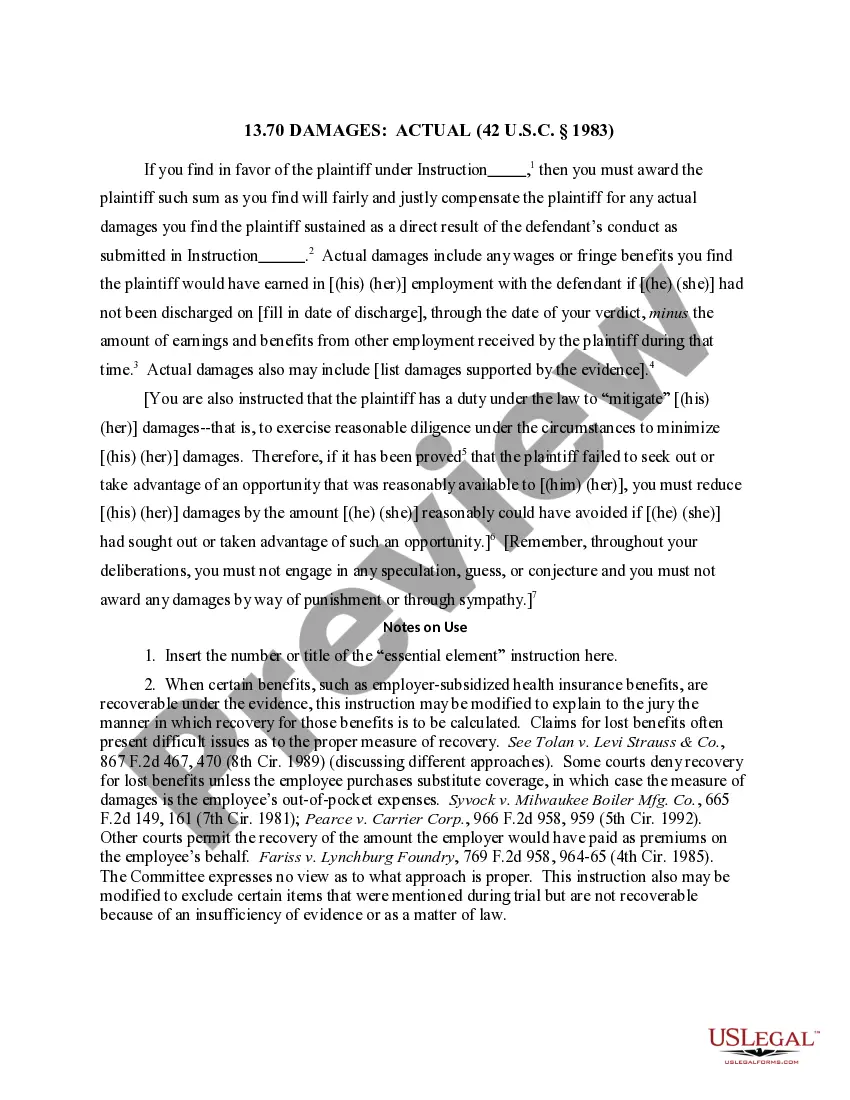
12.70 DAMAGES: ACTUAL (42 U.S.C. CIV. 1983) are a type of compensatory damages available for civil rights violations brought under the Civil Rights Act of 1871, also known as Section 1983. This type of damages is available to compensate a victim for any actual loss or harm suffered as a result of the violation, including economic and non-economic losses, such as pain and suffering, emotional distress, and lost wages. There are two types of 12.70 Damages: Actual (42 U.S.C. CIV. 1983): compensatory damages and punitive damages. Compensatory damages are intended to compensate the victim for any actual losses suffered, while punitive damages are intended to punish the wrongdoer and deter future wrongdoing.
12.70 DAMAGES: ACTUAL (42 U.S.C. Civ. 1983)
State:
Multi-State
Control #:
US-8THCIR-JURY-12-70
Format:
Word
Instant download
This website is not affiliated with any governmental entity
Public form
Description
http://www.juryinstructions.ca8.uscourts.gov/8th%20Circuit%20Manual%20of%20Model%20Civil%20Jury%20Instructions.pdf
How to fill out 12.70 DAMAGES: ACTUAL (42 U.S.C. Civ. 1983)?
US Legal Forms is the most straightforward and affordable way to locate suitable legal templates. It’s the most extensive web-based library of business and individual legal documentation drafted and checked by lawyers. Here, you can find printable and fillable blanks that comply with federal and local laws - just like your 12.70 DAMAGES: ACTUAL (42 U.S.C. Civ. 1983).
Obtaining your template takes just a couple of simple steps. Users that already have an account with a valid subscription only need to log in to the website and download the form on their device. Later, they can find it in their profile in the My Forms tab.
And here’s how you can get a properly drafted 12.70 DAMAGES: ACTUAL (42 U.S.C. Civ. 1983) if you are using US Legal Forms for the first time:
- Look at the form description or preview the document to guarantee you’ve found the one meeting your requirements, or find another one using the search tab above.
- Click Buy now when you’re certain about its compatibility with all the requirements, and judge the subscription plan you like most.
- Create an account with our service, log in, and pay for your subscription using PayPal or you credit card.
- Select the preferred file format for your 12.70 DAMAGES: ACTUAL (42 U.S.C. Civ. 1983) and download it on your device with the appropriate button.
After you save a template, you can reaccess it anytime - just find it in your profile, re-download it for printing and manual fill-out or upload it to an online editor to fill it out and sign more proficiently.
Take full advantage of US Legal Forms, your trustworthy assistant in obtaining the corresponding official documentation. Try it out!
Form popularity
FAQ
Compensatory damages are intended to compensate the plaintiff of a lawsuit with enough money to cover the actual amount of the injury or loss. There are two basic types of compensatory damages, actual and general.
In a case where you anticipate there will be such evidence, it is likely that the plaintiff will seek bifurcation on the issues of liability, compensatory damages and punitive damages. I cannot imagine any other way this evidence would not have a spillover effect on compensatory damages.
There are two types of damages that may be awarded: compensatory and punitive damages. Compensatory damages are intended to compensate for actual losses, while punitive damages aim to punish the defendant.
DAMAGES ARE RECOVERABLE IN A § 1983 ACTION 42 U. S. C. § 1983 creates "'a species of tort liability' in favor of persons who are deprived of 'rights, privileges, or immunities secured' to them by the Constitution." Carey v. Piphus, 435 U.S. 247, 253 (1978). See also Smith v.
In Smith v. Wade, the Supreme Court held that a § 1983 plaintiff may recover punitive damages against an official in her personal capacity if the official acted with malicious or evil intent or in callous disregard of the plaintiff's federally protected rights.
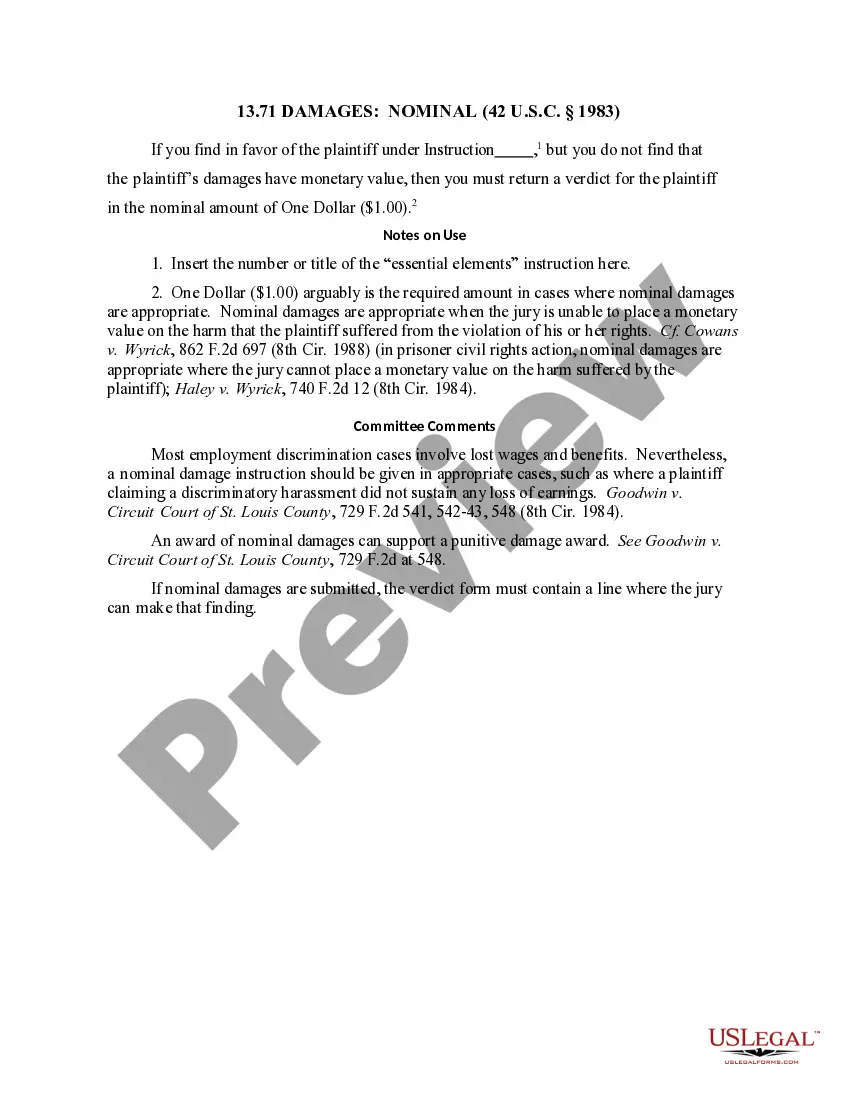
Nominal damages of $1 are awarded when a section 1983 plaintiff who seeks compensatory damages proves that a defendant has violated his or her constitutional rights, but is unable to persuade the fact-finder, typically a jury, that the plaintiff suffered actual damages of any kind, whether physical and financial (?
The elements of a § 1983 claim are (1) the action occurred ?under color of state law? and (2) the action resulted in the deprivation of a constitutional right or federal statutory right.