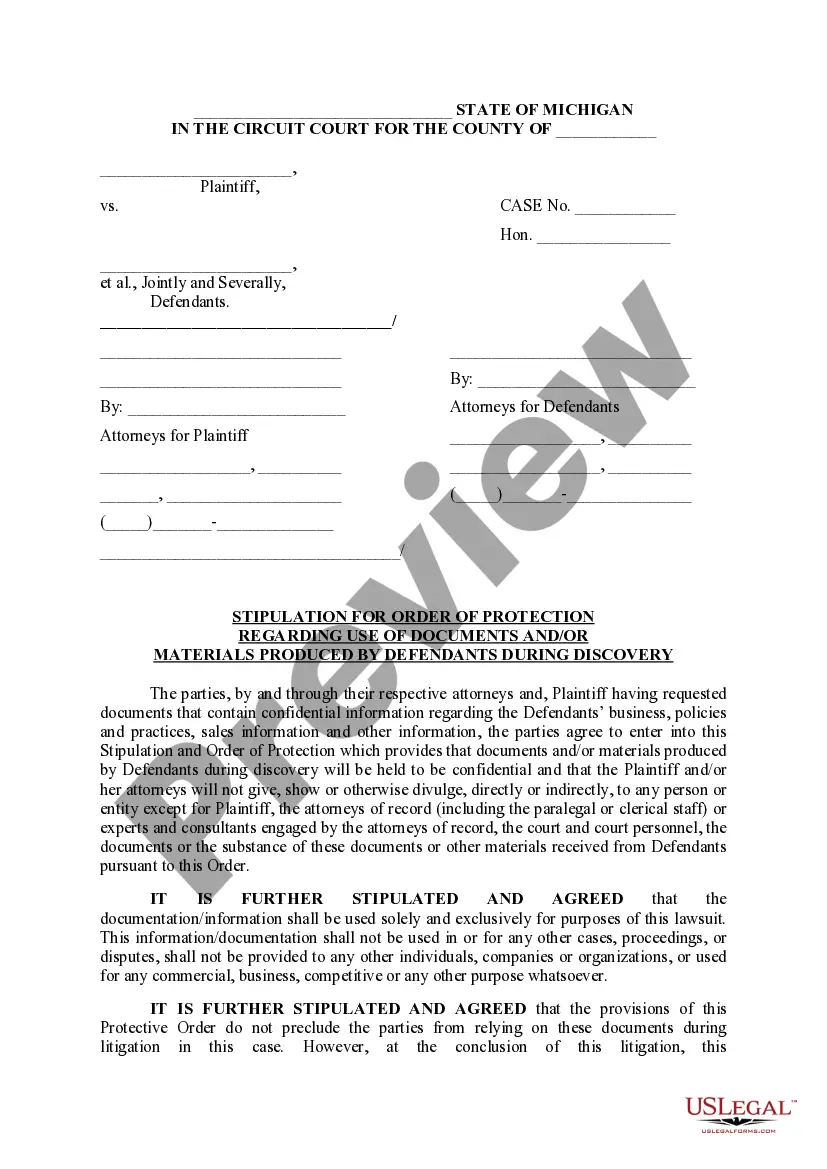
Michigan Stipulation For Order Of Protection Regarding Use Of Documents And /Or Materials Produced By Defendants During Discovery
What this document covers
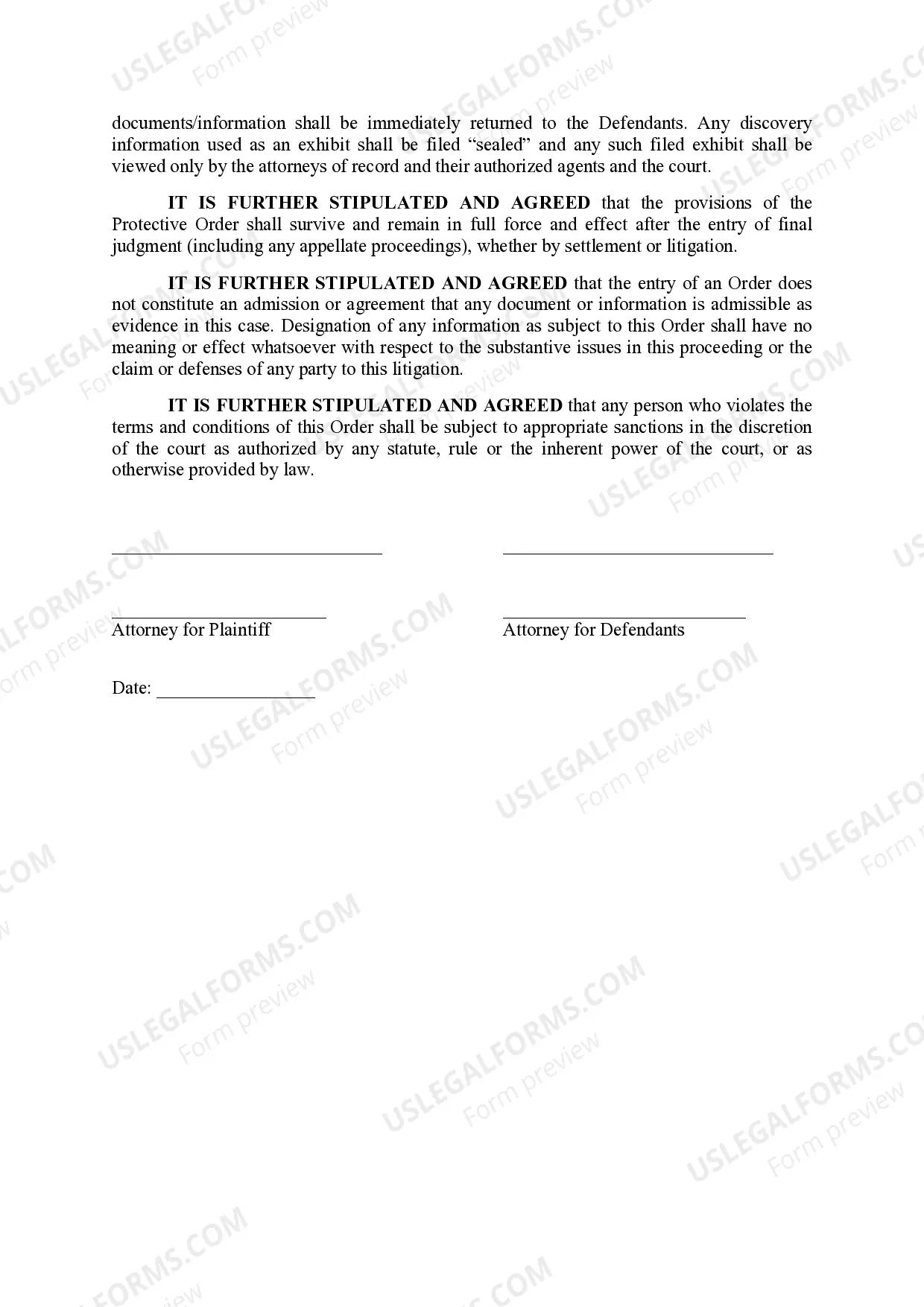
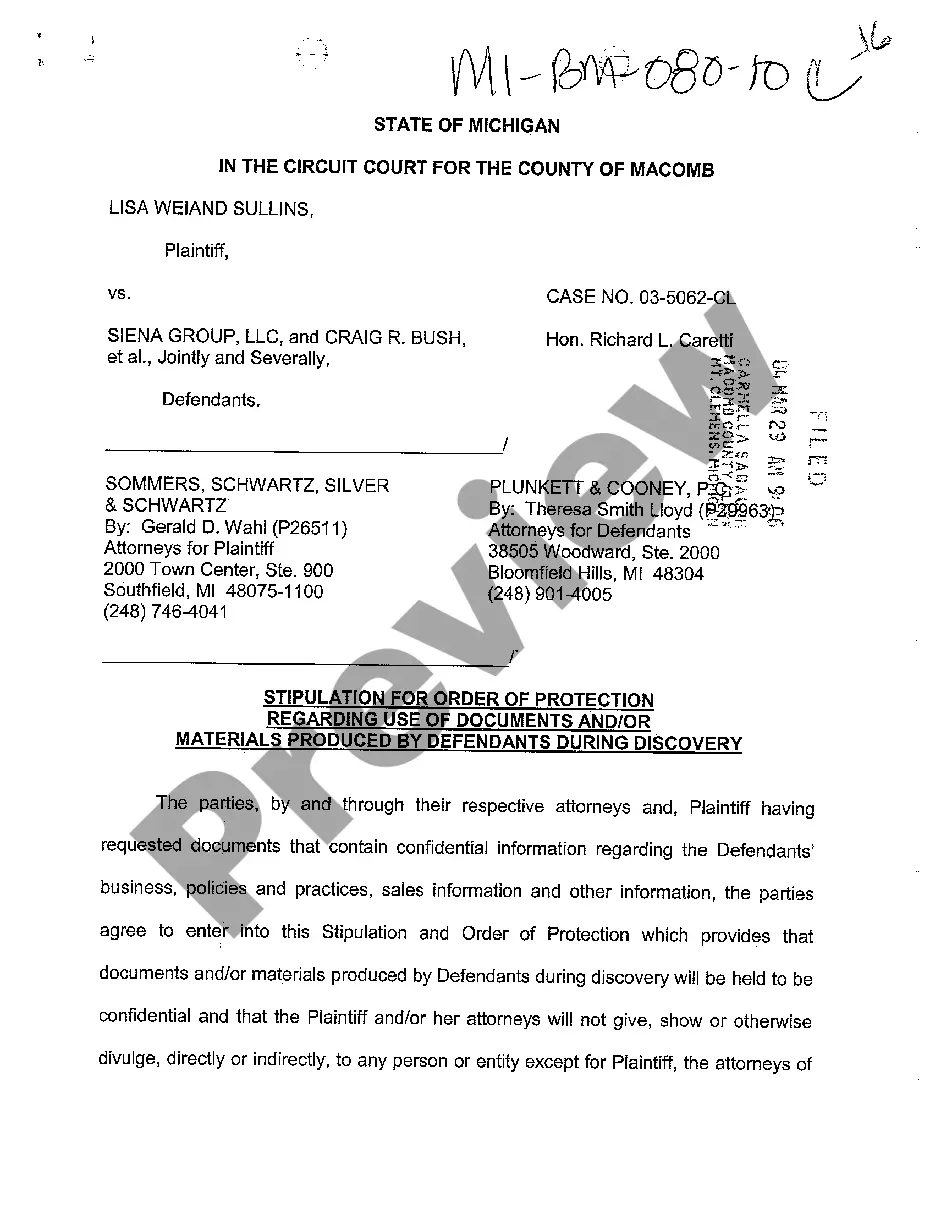
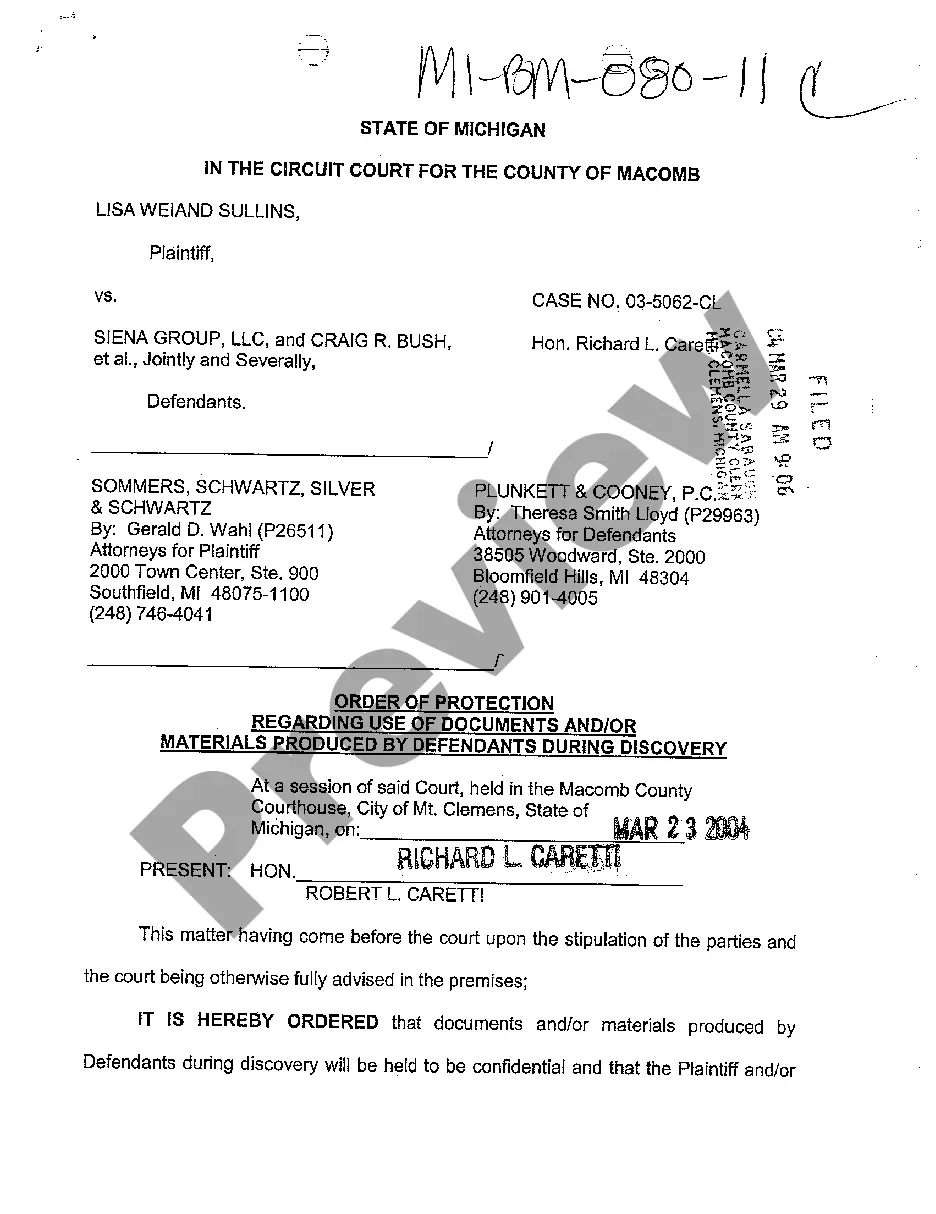
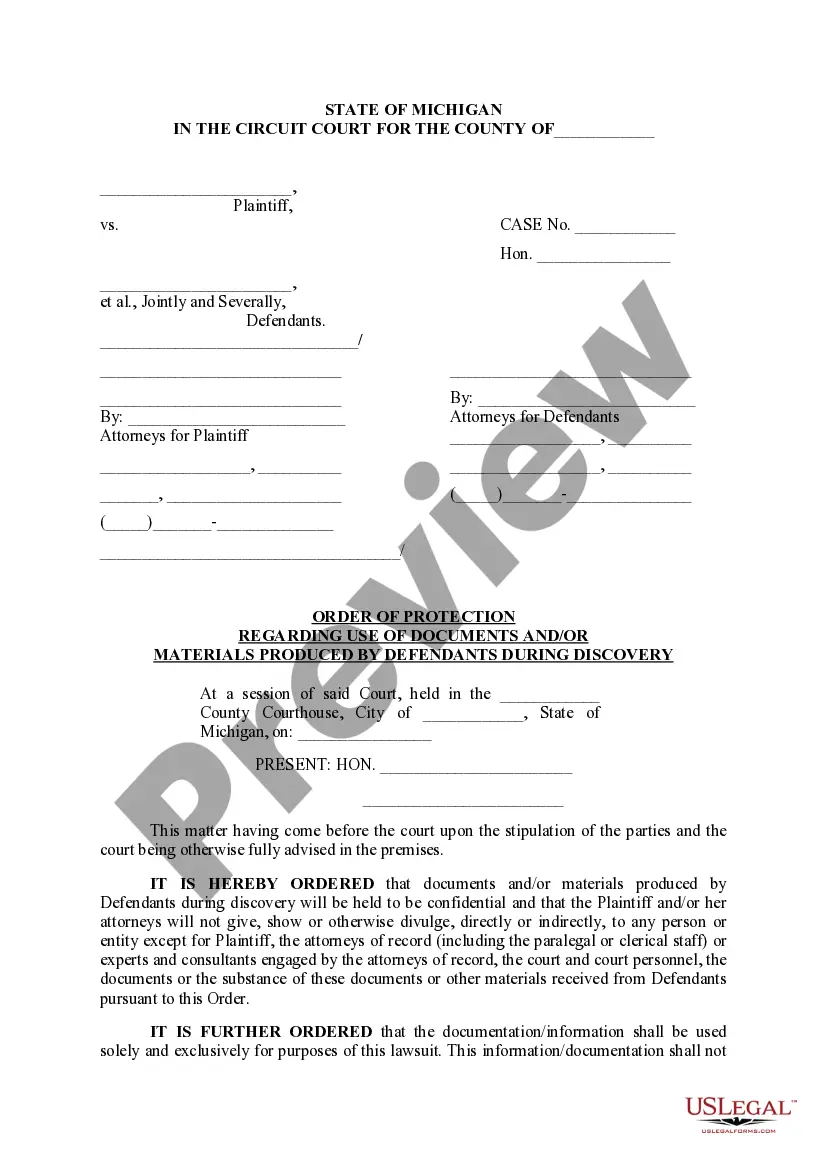
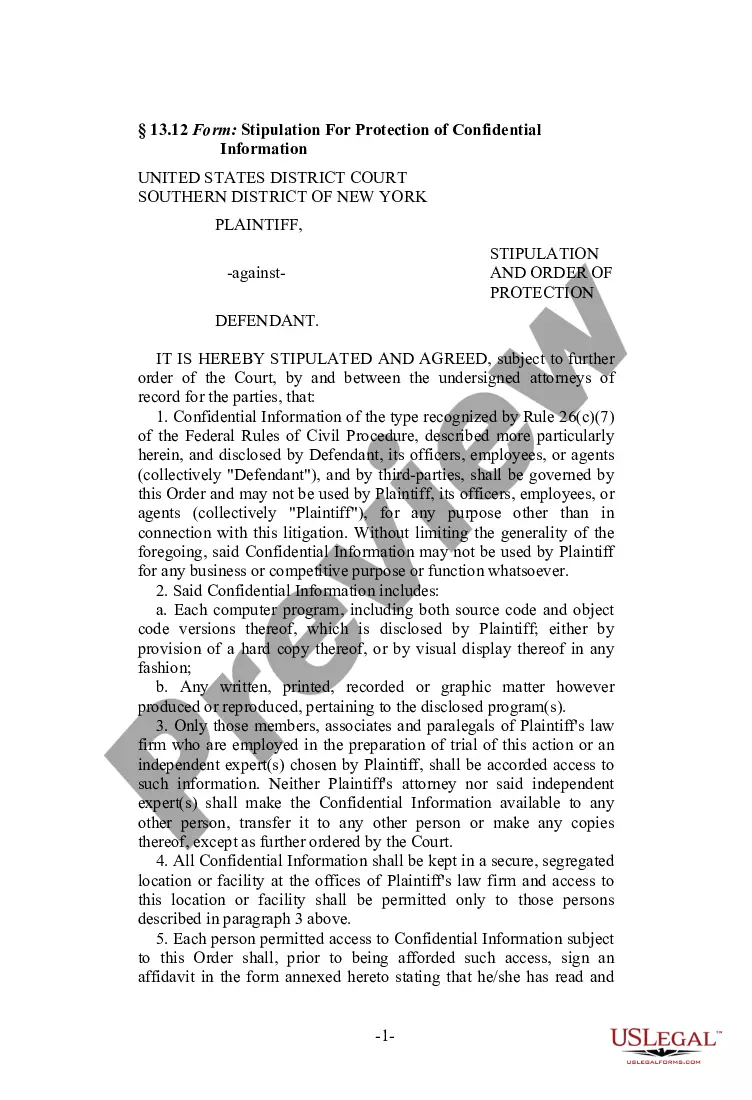
The Stipulation For Order Of Protection Regarding Use Of Documents And / or Materials Produced By Defendants During Discovery is a legal document that establishes the confidentiality of documents exchanged between parties during a lawsuit. This form protects sensitive information obtained by the plaintiff from being disclosed to unauthorized individuals and ensures it is used solely for the purpose of the litigation. Unlike other discovery-related forms, this stipulation specifically addresses the handling of confidential materials shared during the discovery phase of a legal proceeding.
Key components of this form
- Identification of the parties involved in the case.
- Definition of the confidential materials and documents covered by the stipulation.
- Terms outlining the limited use of the documents during litigation.
- Provisions for the return or destruction of documents after the case concludes.
- Consequences for violating the stipulation.
Situations where this form applies
This form should be used when the plaintiff requests documents from the defendant that contain confidential or proprietary information during the discovery phase of a lawsuit. It is essential when parties wish to protect sensitive business practices, sales information, or other private data from being exposed during legal proceedings.
Who can use this document
- Plaintiffs seeking to protect confidential information obtained from defendants in a lawsuit.
- Defendants who are producing documents that contain sensitive data.
- Attorneys representing either party in a legal case involving discoverable documents.
Instructions for completing this form
- Identify the parties by entering their names and roles in the case.
- Clearly define the documents and materials that will be treated as confidential.
- Specify the limitations on the use of these documents during the litigation process.
- Include provisions for the return of documents upon conclusion of the case.
- Ensure all parties sign the document to agree to the terms of confidentiality.
Does this form need to be notarized?
This form does not typically require notarization unless specified by local law. However, it is important to check your jurisdiction's rules to ensure compliance with any specific requirements.
Get your form ready online
Our built-in tools help you complete, sign, share, and store your documents in one place.
Make edits, fill in missing information, and update formatting in US Legal Forms—just like you would in MS Word.
Download a copy, print it, send it by email, or mail it via USPS—whatever works best for your next step.
Sign and collect signatures with our SignNow integration. Send to multiple recipients, set reminders, and more. Go Premium to unlock E-Sign.
If this form requires notarization, complete it online through a secure video call—no need to meet a notary in person or wait for an appointment.
We protect your documents and personal data by following strict security and privacy standards.

Make edits, fill in missing information, and update formatting in US Legal Forms—just like you would in MS Word.

Download a copy, print it, send it by email, or mail it via USPS—whatever works best for your next step.

Sign and collect signatures with our SignNow integration. Send to multiple recipients, set reminders, and more. Go Premium to unlock E-Sign.

If this form requires notarization, complete it online through a secure video call—no need to meet a notary in person or wait for an appointment.

We protect your documents and personal data by following strict security and privacy standards.
Mistakes to watch out for
- Failing to clearly specify which documents are considered confidential.
- Not including a return or destruction clause for the confidential documents.
- Forgetting to have all parties sign the stipulation before submitting it to the court.
- Using vague language that may lead to misinterpretation of the terms.
Why complete this form online
- Convenience of accessing and downloading the form quickly.
- Editability allows customization to fit the specific circumstances of the case.
- Increased reliability with forms drafted by licensed attorneys.
- Easy storage and retrieval of completed forms for future reference.
Looking for another form?
Form popularity
FAQ
Michigan Court Rule 2.102 D outlines the procedures for protecting confidential information during legal proceedings. This rule emphasizes the need for a stipulation or a court order, like the Michigan Stipulation For Order Of Protection Regarding Use Of Documents And /Or Materials Produced By Defendants During Discovery, to manage how certain materials are used in a case. By adhering to this rule, parties can ensure that sensitive documents are treated with the appropriate level of confidentiality throughout the litigation process.
In legal proceedings, certain types of information are always protected from discovery to ensure privacy and confidentiality. This typically includes attorney-client communications, trade secrets, and privileged information. Specifically, when you utilize the Michigan Stipulation For Order Of Protection Regarding Use Of Documents And /Or Materials Produced By Defendants During Discovery, you can safeguard sensitive documents that do not fall within the scope of disclosure. Understanding these protections helps you maintain control over critical information during your case.
The scope of discovery in Michigan is designed to allow both parties to gather relevant information that pertains to the case. This includes documents, materials, and testimony that can help to clarify issues or support claims. Under the Michigan Stipulation For Order Of Protection Regarding Use Of Documents And /Or Materials Produced By Defendants During Discovery, parties can request specific materials while ensuring that any sensitive information is protected. For comprehensive guidance on navigating discovery rules, the uslegalforms platform offers valuable templates and insights.
A motion to exclude evidence not produced in discovery is a formal request to the court to forbid the introduction of certain evidence during a trial. This is important for maintaining fairness, as all parties should have access to the same materials. In the context of the Michigan Stipulation For Order Of Protection Regarding Use Of Documents And /Or Materials Produced By Defendants During Discovery, such a motion could prevent unexpected evidence from tainting the trial. You may want to explore our uslegalforms platform for additional support on how to craft this motion effectively.
Filling out a motion for court involves several key steps. First, you need to clearly identify the type of motion you are filing, such as the Michigan Stipulation For Order Of Protection Regarding Use Of Documents And /Or Materials Produced By Defendants During Discovery. Next, complete the relevant forms with precise information about your case and the specific relief you are seeking. Lastly, consider utilizing resources from uslegalforms, which can provide templates and guidance to ensure you submit the motion correctly.
In Michigan, the 7-day order rule mandates that when a stipulation for an order of protection regarding the use of documents and/or materials produced by defendants during discovery is filed, the court must issue a ruling within seven days. This ensures that parties involved receive timely decisions about important protective measures. Adhering to this rule can help prevent unnecessary delays and uncertainties during the legal process. Utilizing platforms like USLegalForms can streamline your understanding and compliance with the Michigan Stipulation For Order Of Protection Regarding Use Of Documents And /Or Materials Produced By Defendants During Discovery.
Examples of production of documents include contracts, financial statements, invoices, meeting minutes, and any other records relevant to the case. These documents can play a critical role in supporting your positions in court. Proper management of these materials is essential, particularly under the Michigan Stipulation For Order Of Protection Regarding Use Of Documents And /Or Materials Produced By Defendants During Discovery.
To answer a request for production, review each request thoroughly and determine if you can provide the requested documents. If you do not have certain documents, indicate that clearly in your response. It is vital to comply with the Michigan Stipulation For Order Of Protection Regarding Use Of Documents And /Or Materials Produced By Defendants During Discovery to ensure the confidentiality of sensitive materials.
Rule 2.313 in Michigan governs discovery, including the requirements for producing evidence and allowing access to documents. This rule ensures parties can share necessary evidence while respecting protected information. Familiarity with this rule is essential for effectively navigating the Michigan Stipulation For Order Of Protection Regarding Use Of Documents And /Or Materials Produced By Defendants During Discovery.
When drafting a request for production, specify the types of documents or materials you seek, such as reports, communications, or agreements. Be precise with your language, as broad requests may lead to objections. Including the Michigan Stipulation For Order Of Protection Regarding Use Of Documents And /Or Materials Produced By Defendants During Discovery can ensure necessary protections for what is disclosed.