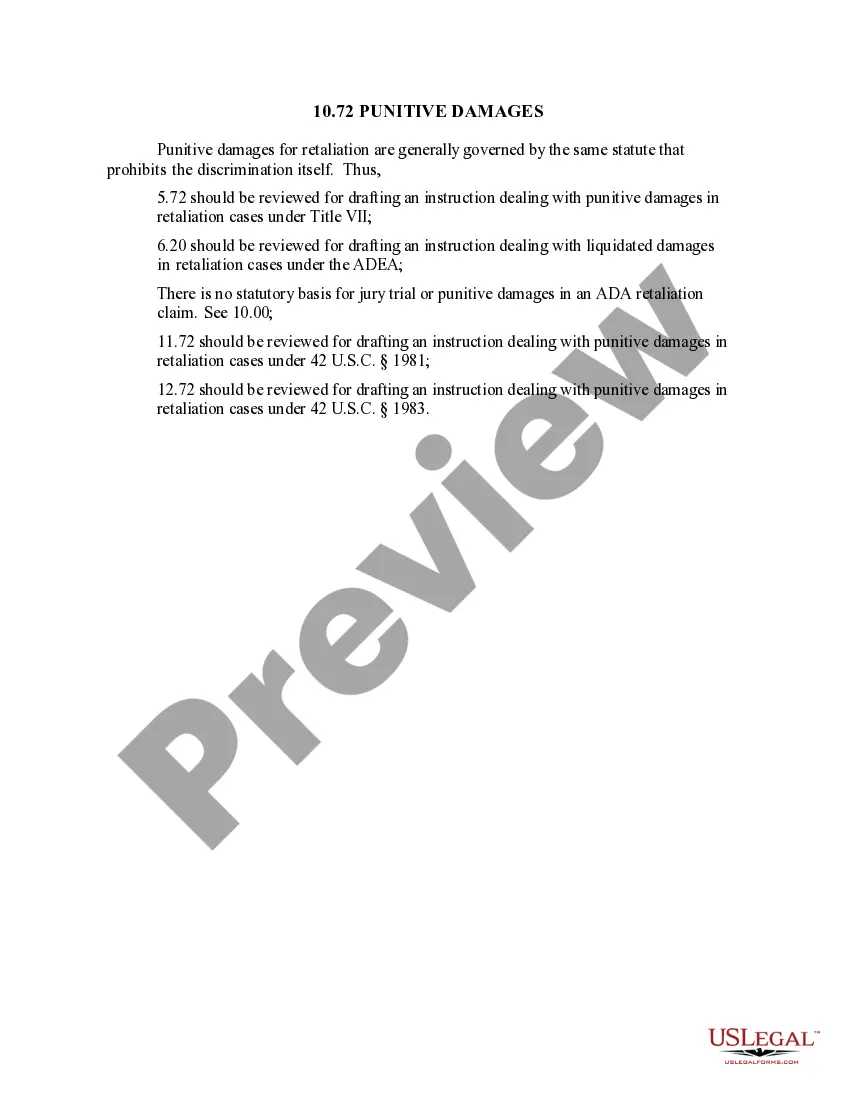
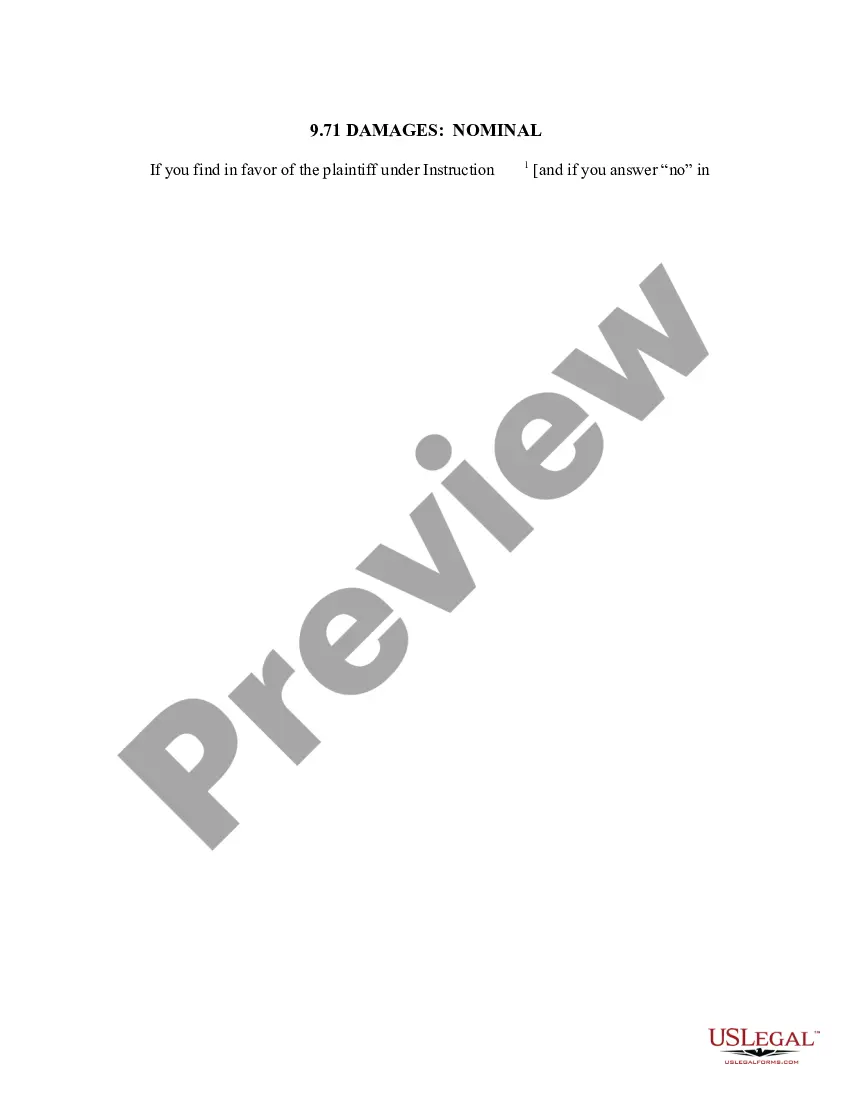
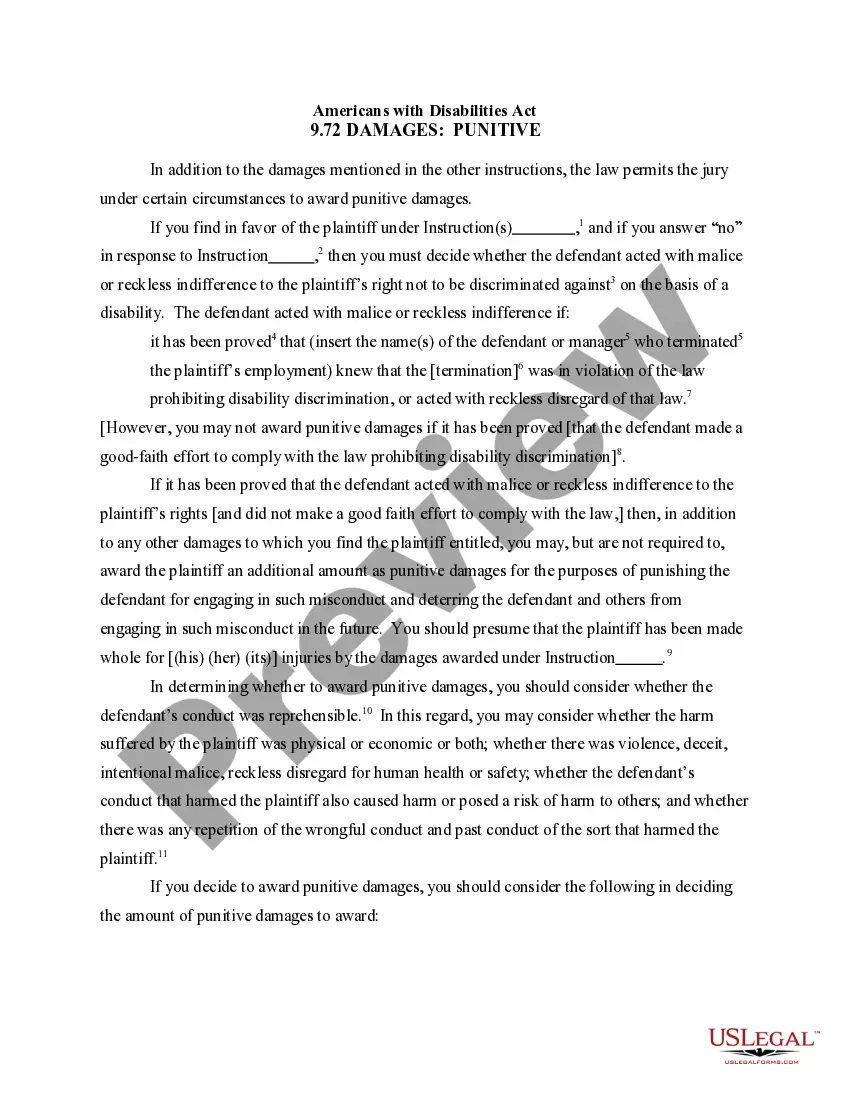
10.72 PUNITIVE DAMAGES
What this document covers
The 10.72 Punitive Damages form is used to seek exemplary damages in instances of retaliation, particularly under federal laws like Title VII and the ADEA. Unlike compensatory damages, which are designed to cover actual losses, punitive damages aim to punish wrongful behavior and deter similar conduct in the future. This form is specifically used in legal contexts where the plaintiff is claiming that a retaliatory act took place after an individual filed a complaint or participated in a legal proceeding. It is important to distinguish this form from others that deal with basic damages or specific claims under various statutes.
Key parts of this document
- Identification of the parties involved in the case.
- Clear statement of the alleged retaliatory actions.
- Basis for the punitive damages claim, referencing appropriate statutes.
- Specifics about the harm experienced due to retaliation.
- Calculation of the punitive damages sought by the plaintiff.
Common use cases
This form should be used when a person believes they have been wrongfully retaliated against for exercising their rights under employment discrimination laws. Common scenarios include cases where an employee has filed a complaint regarding workplace discrimination or harassment, and subsequently faced adverse action from their employer as a result. It is crucial to establish a connection between the retaliatory action and the protected activity to successfully utilize this form.
Who this form is for
This form is intended for individuals who have experienced retaliation in the workplace due to asserting their rights. It is particularly relevant for:
- Employees who have filed discrimination complaints under Title VII of the Civil Rights Act.
- Workers claiming retaliation under the Age Discrimination in Employment Act (ADEA).
- Individuals pursuing claims under 42 U.S.C. § 1981 or § 1983 regarding retaliation.
How to prepare this document
- Identify all parties involved, including the claimant and the employer.
- Clearly outline the retaliatory actions taken against you.
- Reference the applicable statutes under which you are claiming punitive damages.
- Detail the specific harm suffered as a result of the retaliation.
- Calculate and state the amount of punitive damages you are requesting.
Notarization guidance
This form does not typically require notarization unless specified by local law. However, reviewing your stateâs requirements is essential to ensure compliance.
Get your form ready online
Our built-in tools help you complete, sign, share, and store your documents in one place.
Make edits, fill in missing information, and update formatting in US Legal Forms—just like you would in MS Word.
Download a copy, print it, send it by email, or mail it via USPS—whatever works best for your next step.
Sign and collect signatures with our SignNow integration. Send to multiple recipients, set reminders, and more. Go Premium to unlock E-Sign.
If this form requires notarization, complete it online through a secure video call—no need to meet a notary in person or wait for an appointment.
We protect your documents and personal data by following strict security and privacy standards.

Make edits, fill in missing information, and update formatting in US Legal Forms—just like you would in MS Word.

Download a copy, print it, send it by email, or mail it via USPS—whatever works best for your next step.

Sign and collect signatures with our SignNow integration. Send to multiple recipients, set reminders, and more. Go Premium to unlock E-Sign.

If this form requires notarization, complete it online through a secure video call—no need to meet a notary in person or wait for an appointment.

We protect your documents and personal data by following strict security and privacy standards.
Avoid these common issues
- Failing to connect the retaliatory action directly to the protected activity.
- Providing insufficient details about the actions taken by the employer.
- Neglecting to reference pertinent statutes related to the claim.
Why complete this form online
- Convenient access to legal documents without needing to visit a lawyer in person.
- The ability to fill out and edit forms as needed before finalizing.
- Reliability in obtaining forms that are drafted by licensed attorneys.
Legal use & context
- Punitive damages are awarded as a deterrent against wrongful conduct.
- The standard for awarding punitive damages requires a showing of malice or reckless disregard.
- Jury instructions should be clearly articulated to avoid confusion.
Summary of main points
- The 10.72 Punitive Damages form is critical for addressing retaliation in discrimination cases.
- Understanding the legal framework of punitive damages is essential for correct application.
- Using an online form can streamline the legal process while ensuring compliance with standards.
Looking for another form?
Form popularity
FAQ
Punitive damages are awarded when the defendant's conduct is determined to have been so "willful, malicious, or fraudulent" that it exceeds the legal criteria for mere or gross negligence. Punitive damages typically involve awards over and above the compensatory damage award.
To determine the amount of punitive damages to award, the Book of Approved Jury Instructions (BAJI) states that the jury should consider: (1) The reprehensibility of the conduct of the defendant. (2) The defendant's financial condition and (3) the relationship to actual damages.
Individuals can also be ordered to pay punitive damages that injure someone else due to negligent behavior. Examples of this would be drunk driving or distracted driving. In both cases, the defendant would have made a conscious decision to engage in behavior that could easily harm another person.
Although there is no maximum sum, punitive damages typically do not exceed four times the amount of compensatory damages. For example, if a plaintiff recovers $100,000 in compensatory damages and is awarded punitive damages, they most likely will receive up to $400,000 in punitive damages.
The median amount of punitive damages that are awarded is around $64,000.
These are (1) how reprehensible the defendant's conduct was, (2) the disparity between the harm experienced by the plaintiff and the punitive damages award, and (3) the difference between the punitive damages award and the civil penalties and remedies imposed in similar cases.
Punitive damages are considered punishment and are typically awarded at the court's discretion when the defendant's behavior is found to be especially harmful. Punitive damages are normally not awarded in the context of a breach of contract claim. See e.g. O'Gilvie Minors v.