Deadlocked Jury - Discharge (comment only)
Overview of this form
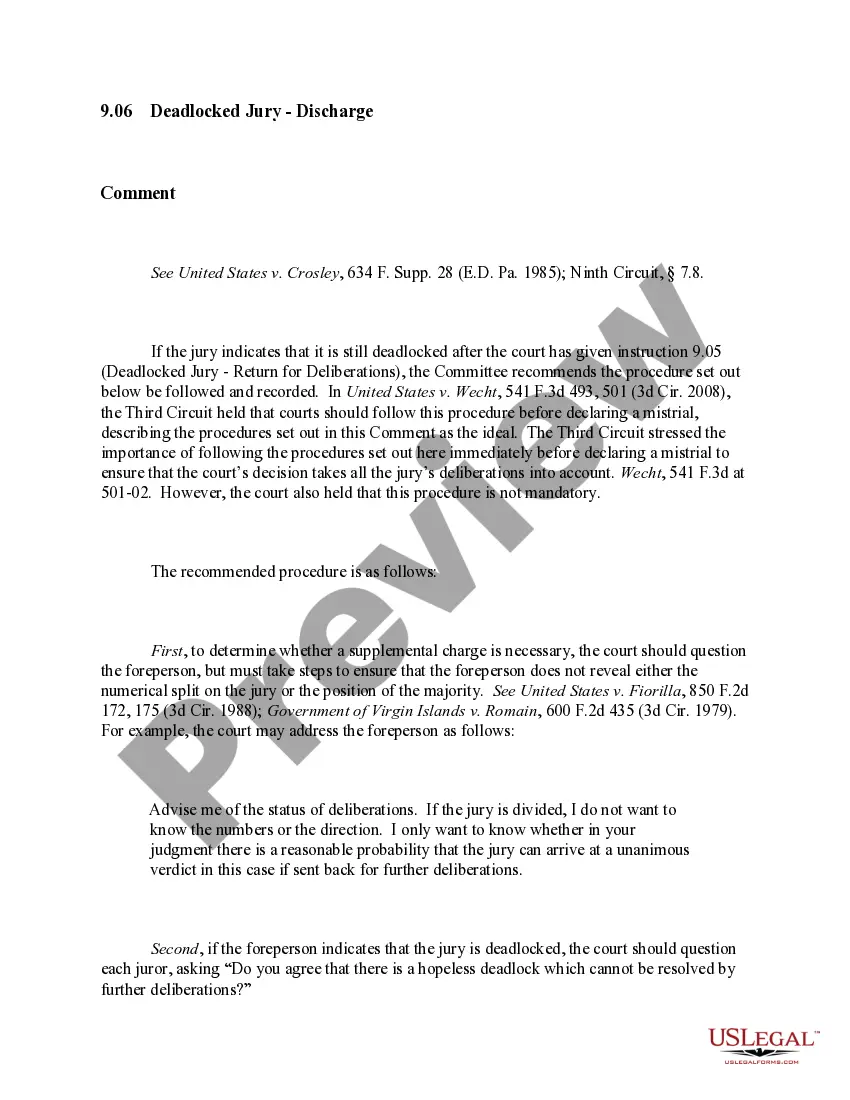
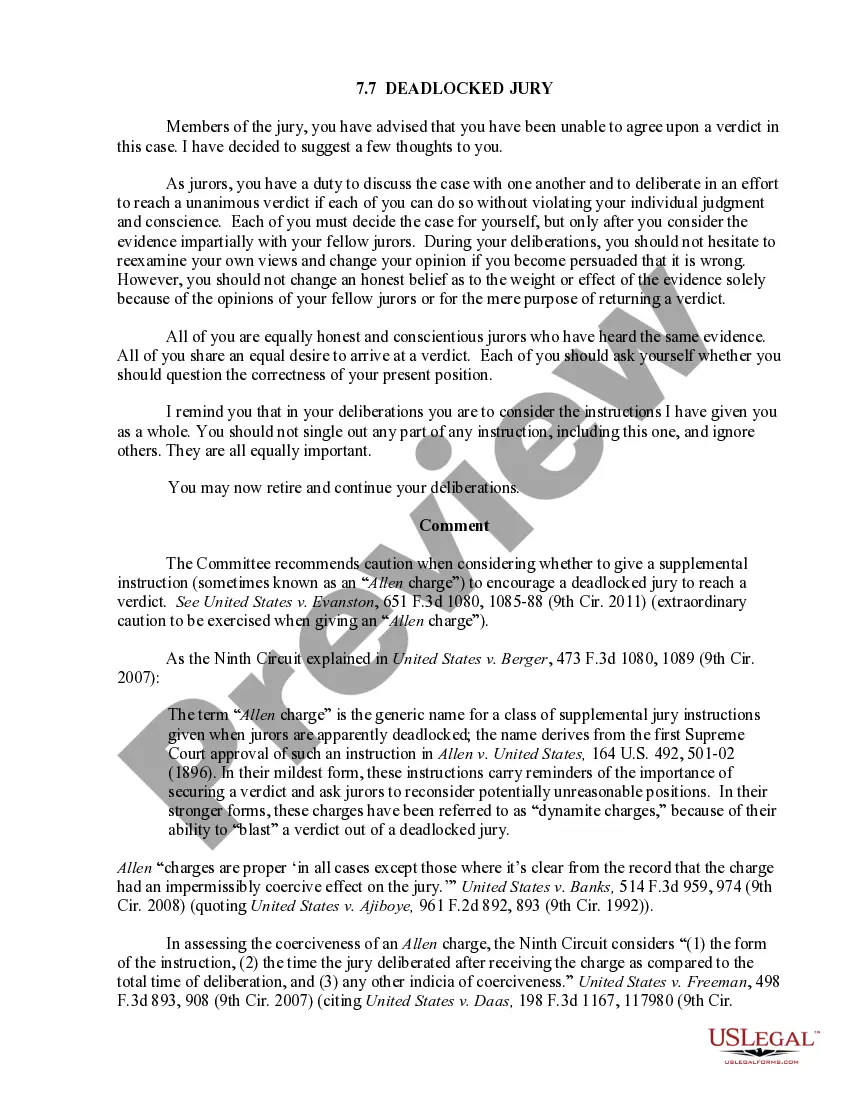
The Deadlocked Jury - Discharge form is a legal document used by courts when a jury cannot reach a unanimous verdict after extensive deliberation. This form outlines the proper procedures for the court to follow before declaring a mistrial due to a deadlocked jury. It is crucial because it ensures the court takes into account all jury deliberations before making a final decision. Unlike other trial-related forms, this one specifically addresses the situation of a jury being deadlocked and details the steps courts should take in such cases.
Key parts of this document
- Instructions for the court on questioning the jury foreperson about deliberation status.
- Guidelines for determining if the jury is hopelessly deadlocked.
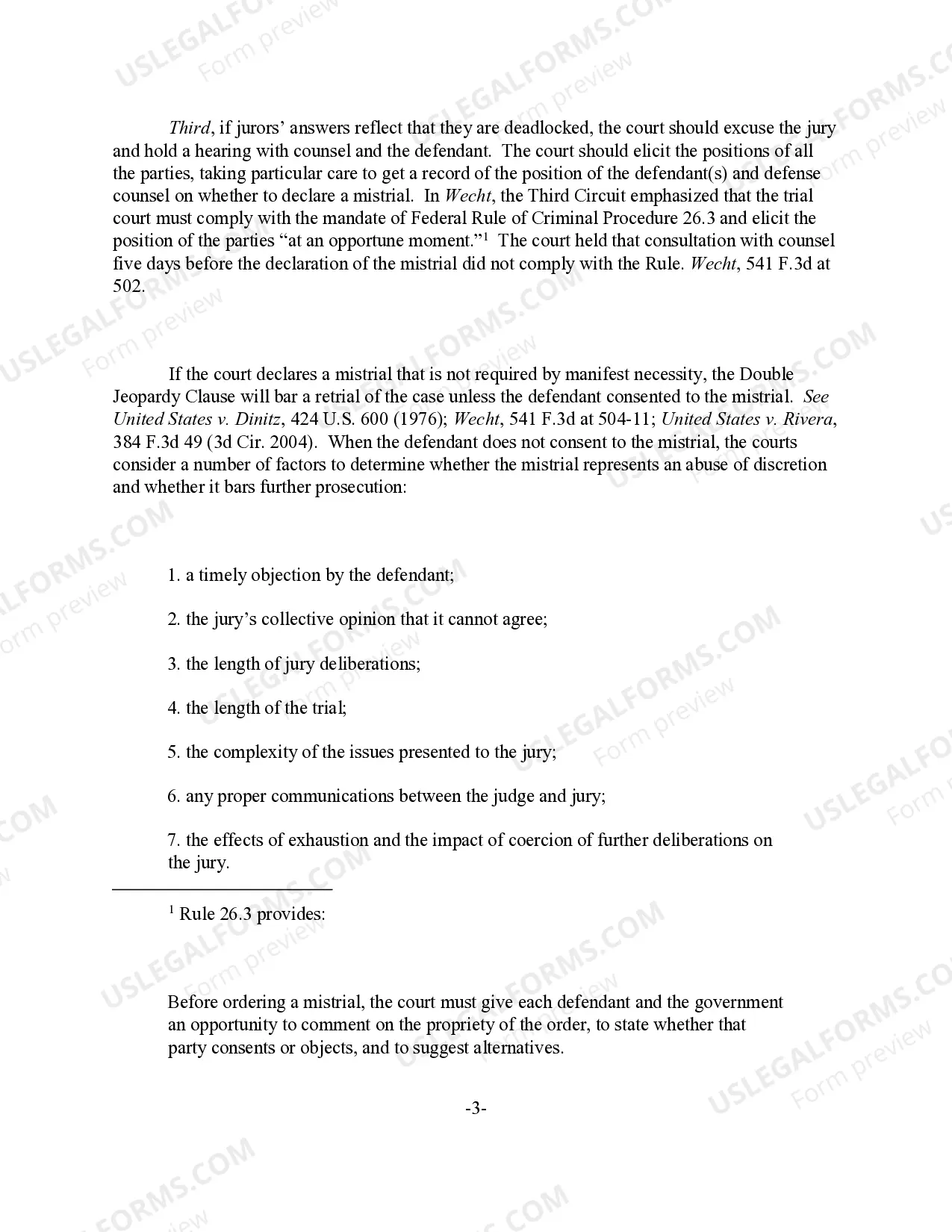
- Requirements for a hearing with counsel to gather positions on declaring a mistrial.
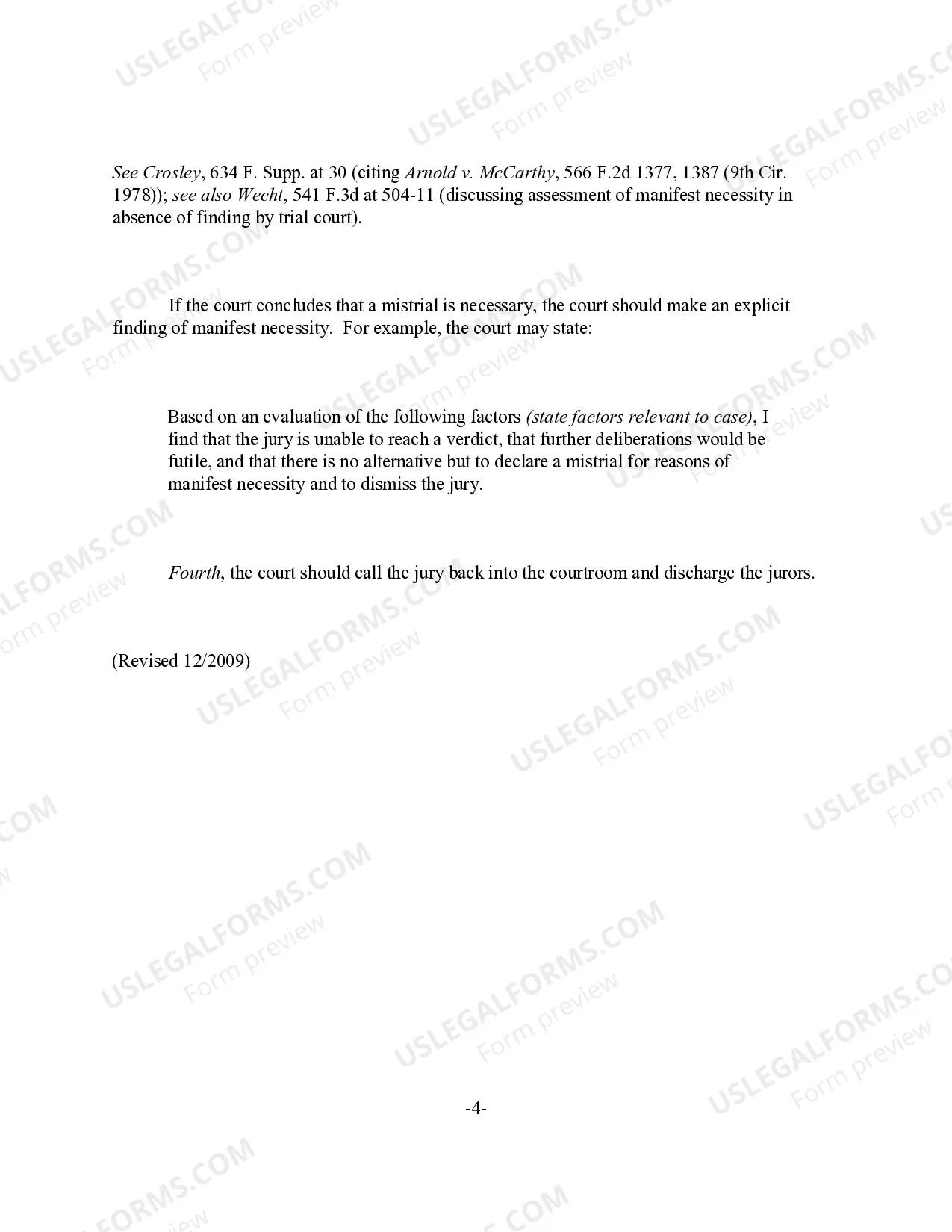
- Criteria needed to establish manifest necessity for a mistrial.
- Procedure for formally discharging the jury after a deadlock.

When to use this document
This form should be used when a jury indicates it is unable to reach a unanimous verdict after significant deliberations. Courts typically consider this situation when jurors express doubts about their ability to agree on a verdict, and it is essential to document the court's procedures before declaring a mistrial. It ensures that all parties involved are aware of the legal context leading to a mistrial decision.
Who should use this form
- Judges presiding over a trial with a deadlocked jury.
- Court clerks responsible for documenting the proceedings.
- Attorneys representing defendants or the prosecution involved in a trial.
- Court staff needing to ensure proper legal procedures are followed.
How to prepare this document
- Review the jury's status and determine if further deliberation is possible.
- Interview the jury foreperson without revealing the numerical split of the votes.
- Question each juror about whether they believe there is a hopeless deadlock.
- Hold a hearing with all parties involved to discuss the potential mistrial.
- Make a formal decision on declaring a mistrial and document the reasons clearly.
- Discharge the jury once the necessary legal steps are completed.
Does this document require notarization?
This form does not typically require notarization to be legally valid. However, some jurisdictions or document types may still require it. US Legal Forms provides secure online notarization powered by Notarize, available 24/7 for added convenience.
Get your form ready online
Our built-in tools help you complete, sign, share, and store your documents in one place.
Make edits, fill in missing information, and update formatting in US Legal Forms—just like you would in MS Word.
Download a copy, print it, send it by email, or mail it via USPS—whatever works best for your next step.
Sign and collect signatures with our SignNow integration. Send to multiple recipients, set reminders, and more. Go Premium to unlock E-Sign.
If this form requires notarization, complete it online through a secure video call—no need to meet a notary in person or wait for an appointment.
We protect your documents and personal data by following strict security and privacy standards.

Make edits, fill in missing information, and update formatting in US Legal Forms—just like you would in MS Word.

Download a copy, print it, send it by email, or mail it via USPS—whatever works best for your next step.

Sign and collect signatures with our SignNow integration. Send to multiple recipients, set reminders, and more. Go Premium to unlock E-Sign.

If this form requires notarization, complete it online through a secure video call—no need to meet a notary in person or wait for an appointment.

We protect your documents and personal data by following strict security and privacy standards.
Avoid these common issues
- Failing to properly question the foreperson, risking disclosure of the jury's numerical split.
- Not holding a hearing with counsel to properly address the potential mistrial.
- Overlooking the requirement to determine manifest necessity before declaring a mistrial.
- Neglecting to document all proceedings related to the deadlocked jury.
Why complete this form online
- Convenient access to templates created by licensed attorneys.
- Editable sections allow customization for specific cases.
- Secure and reliable download to ensure legal compliance.
Legal use & context
- This form is essential for documentation in cases where a mistrial may be necessary due to jury deadlock.
- It helps protect defendants' rights under the Double Jeopardy Clause by ensuring proper procedures are followed.
- Judges are advised to adhere to the procedures outlined in this form to avoid potential challenges to the mistrial decision.
Looking for another form?

Form popularity
FAQ
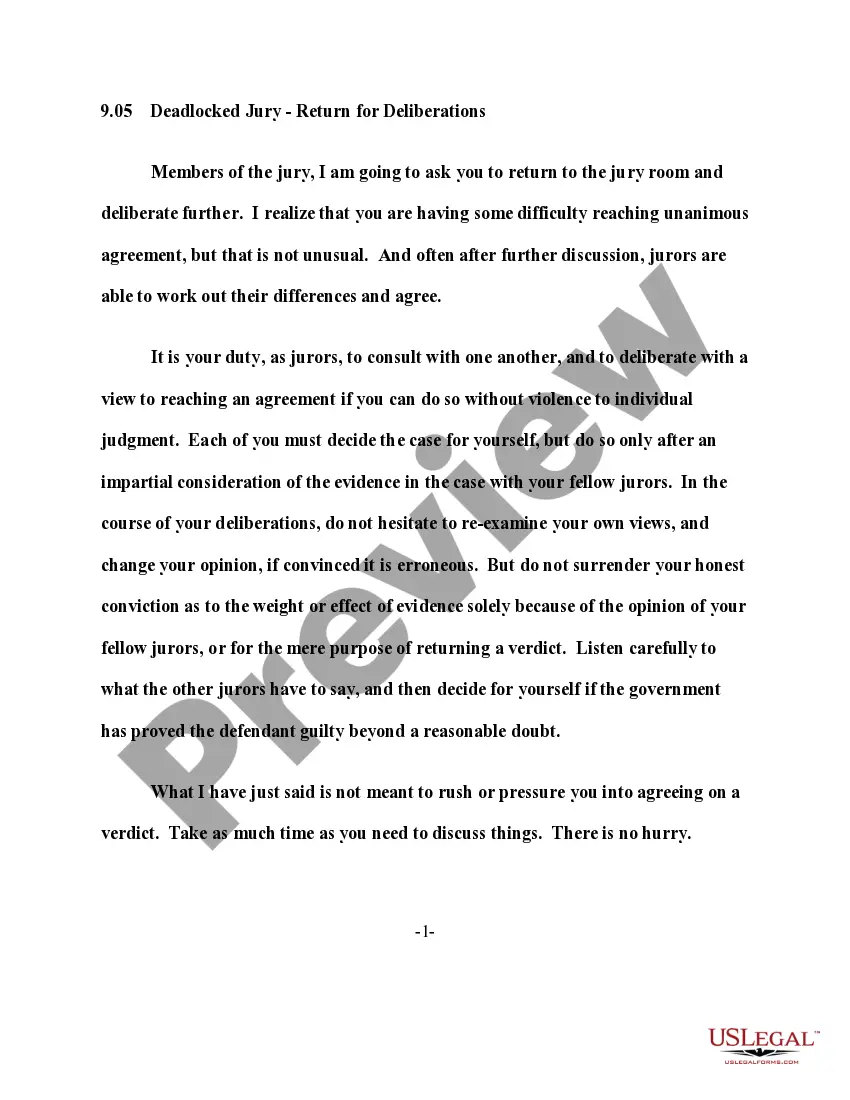
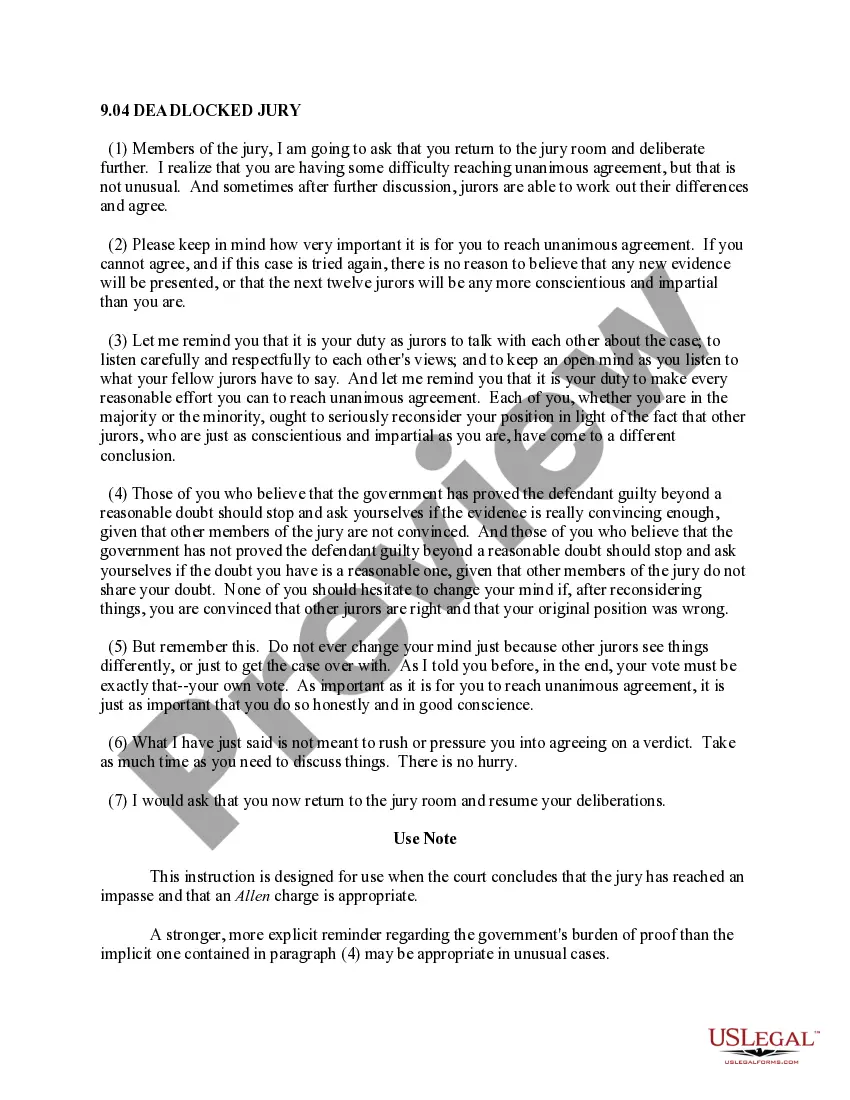
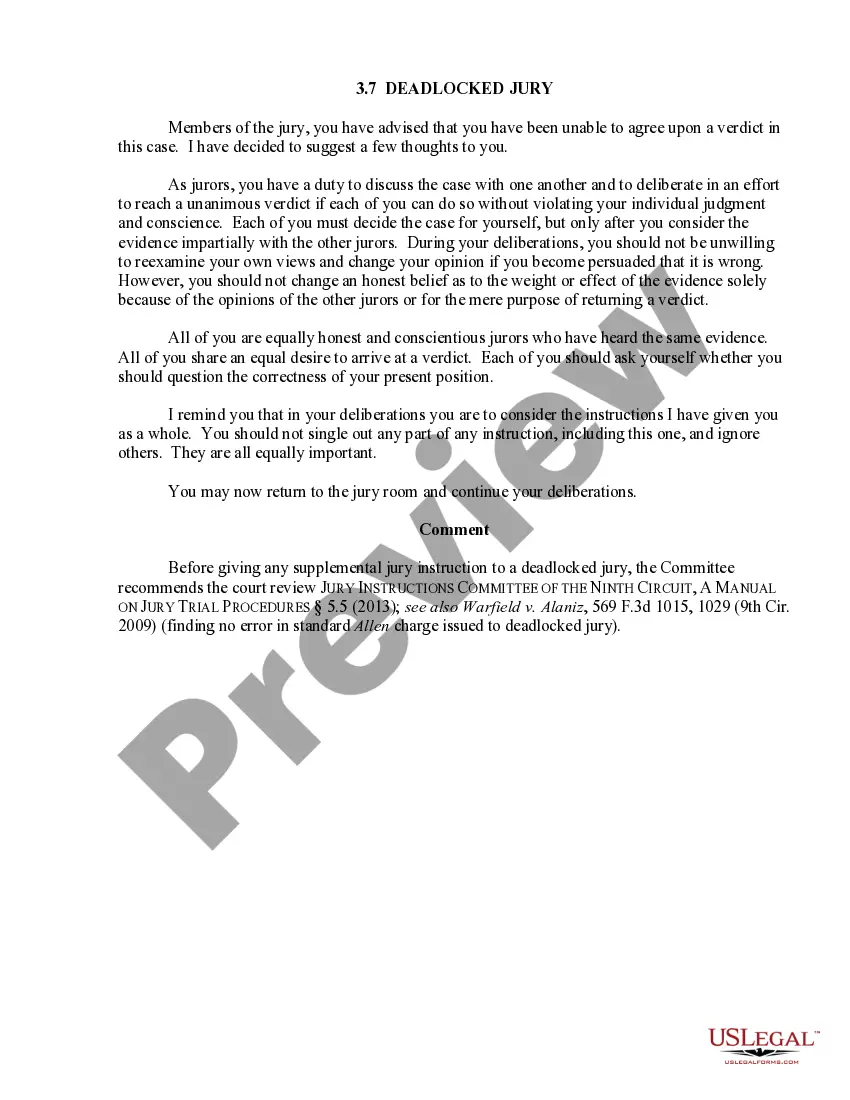
If there is a hung jury, the judge may order the jurors to deliberate further. This is known as an Allen charge and is generally only given once or twice. Often, juries will report that they are deadlocked after only deliberating for a short period of time.
A hung jury, also called a deadlocked jury, is a judicial jury that cannot agree upon a verdict after extended deliberation and is unable to reach the required unanimity or supermajority. Hung juries usually result in the case being tried again.
Can You Be Prosecuted Again After a Mistrial? A second trial may be permitted where a mistrial is the result of manifest necessity,6 as when, for example, the jury cannot reach a verdict7 or circumstances plainly prevent the continuation of the trial.
If the jury still cannot reach a verdict after further deliberation, the judge can declare a mistrial due to the hung jury. A mistrial means that the defendant is neither convicted or acquitted.
The judge will declare a mistrial if the jury cannot come to a decision. After more discussion, if the jury is still unable to agree on a decision, the judge may declare a mistrial because of the hung jury. In the event of a mistrial, the defendant is neither found guilty nor exonerated.
The court will grant a mistrial. This is generally considered a ?win? by defense lawyers, because it is extremely difficult to win a complete acquittal. However, if you think a mistrial is the end of the case, you'd be wrong. After a mistrial, the government can decide to take the case to trial a second time.
If a jury is unable to reach a unanimous verdict and results in a hung jury, the case may be retried with a new jury. If the second jury is also unable to reach a verdict, the judge may declare a mistrial.
Criminal proceedings that end in a mistrial can result in an acquittal of the defendant. An acquittal results in a complete dismissal of the case, and the defendant can move on with their life. However, prosecutors can choose to pursue a new trial against the defendant or provide an option for a plea bargain.