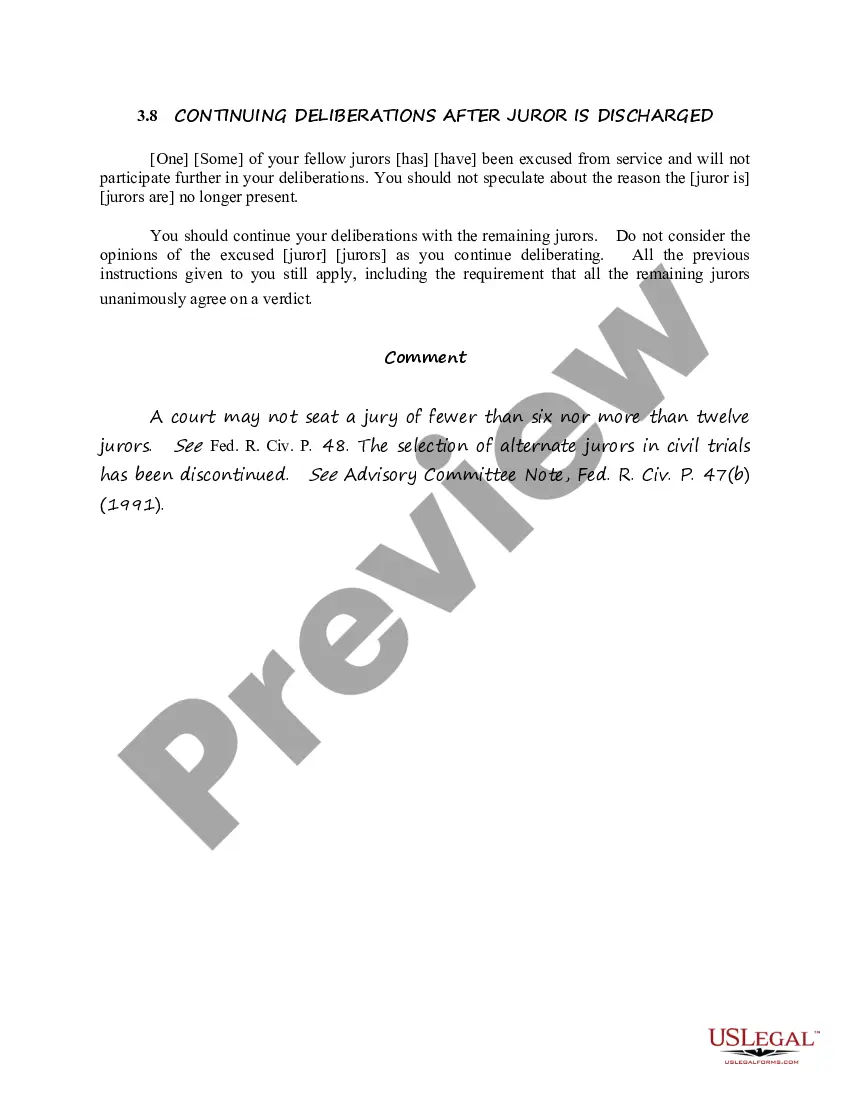
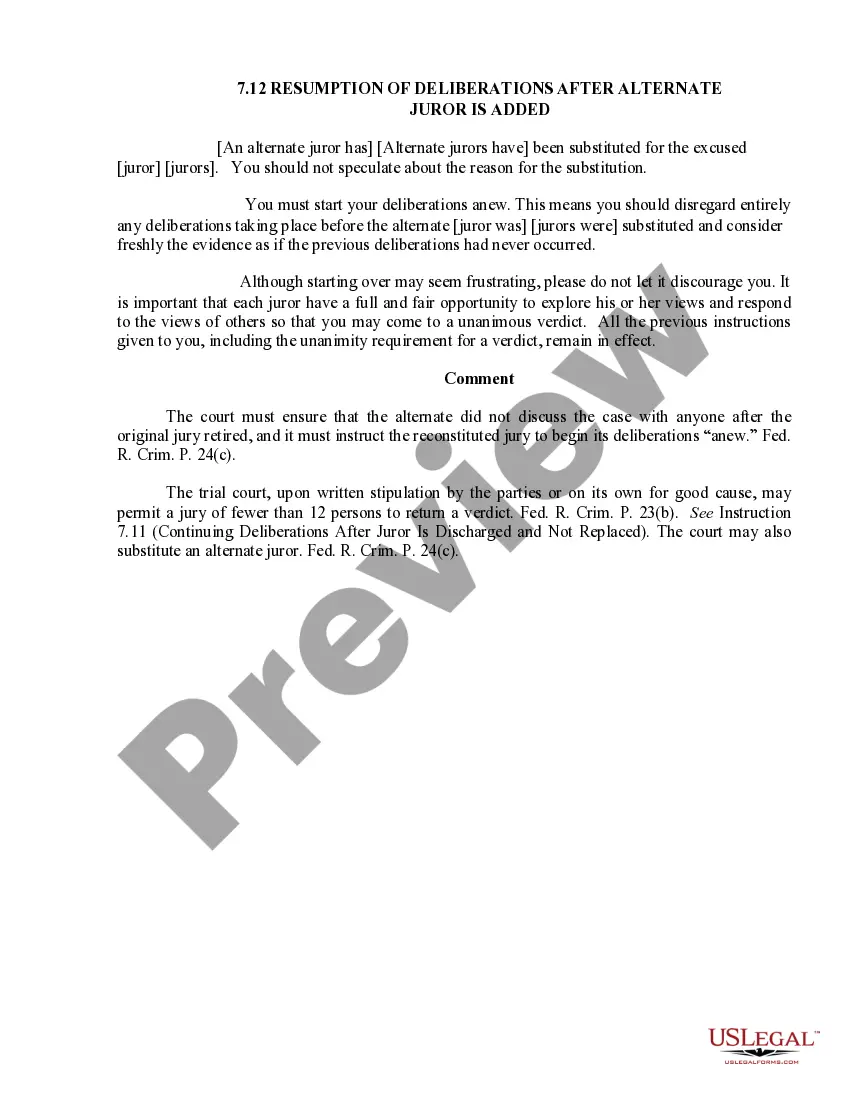
3.8 Continuing Deliberations after Juror Is Discharged
Notarization requirements for this form
Notarization is not commonly needed for this form. However, certain documents or local rules may make it necessary. Our notarization service, powered by Notarize, allows you to finalize it securely online anytime, day or night.
Get your form ready online
Our built-in tools help you complete, sign, share, and store your documents in one place.
Make edits, fill in missing information, and update formatting in US Legal Forms—just like you would in MS Word.
Download a copy, print it, send it by email, or mail it via USPS—whatever works best for your next step.
Sign and collect signatures with our SignNow integration. Send to multiple recipients, set reminders, and more. Go Premium to unlock E-Sign.
If this form requires notarization, complete it online through a secure video call—no need to meet a notary in person or wait for an appointment.
We protect your documents and personal data by following strict security and privacy standards.

Make edits, fill in missing information, and update formatting in US Legal Forms—just like you would in MS Word.

Download a copy, print it, send it by email, or mail it via USPS—whatever works best for your next step.

Sign and collect signatures with our SignNow integration. Send to multiple recipients, set reminders, and more. Go Premium to unlock E-Sign.

If this form requires notarization, complete it online through a secure video call—no need to meet a notary in person or wait for an appointment.

We protect your documents and personal data by following strict security and privacy standards.
Looking for another form?


Form popularity
FAQ
Alternate jurors are selected in some cases to take the place of jurors who may become ill during the trial. Alternate jurors hear the evidence just as the other jurors do, but they don't participate in the deliberations unless they replace an original juror.
Jury deliberations have traditionally been secret only insofar as no juror could be compelled to talk about what happened. Every state and the federal government have variations on a ?no impeachment? rule, which prevents jurors from testifying about their deliberations after a verdict has been reached.
SECRETS OF THE JURY ROOM follows two separate juries as they pass judgement on the same fictional case. The intention is to reveal the difficulty of the jury's task, and how easily miscarriages of justice can occur. The case - an assisted suicide - is designed to trigger the emotions of the jury members.
After hearing the jury instructions, the jury moves to the jury room to consider the case and reach its verdict. All the jury's discussion of testimony and evidence takes place only when all the jurors are present, in the jury room - nowhere else.
Jury sequestration is the isolation of a jury to avoid accidental or deliberate tainting of the jury by exposing them to outside influence or information that is not admissible in court.
In fact, they won't even know they are alternates. The judge won't reveal who the alternative jurors are until attorneys have finished making their cases.
The federal grand jury is a place and a process of secrecy. This secrecy protects innocent individuals from disclosure of the fact that they may be under investigation. It protects witnesses from being pressured or threatened by potential defendants.
Nothing in the Constitution prohibits the recording or publication of jury deliberations. As with any other judicial function in our democratic society, the public relies on the work and product of the jury to ensure that justice is done.