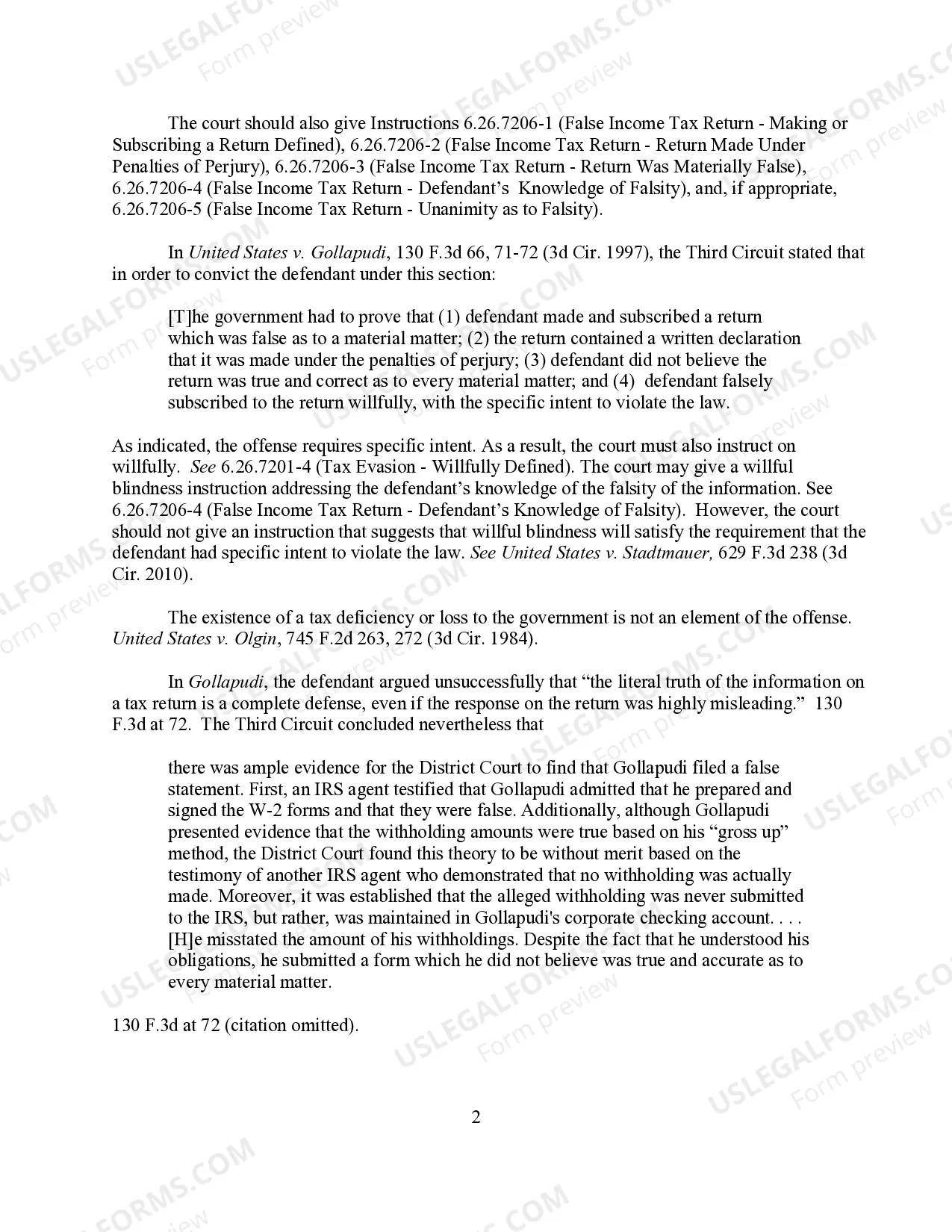
False Income Tax Return - Elements of the Offense (26 U.S.C. Sec. 7206(1))
Overview of this form
The False Income Tax Return form addresses allegations of fraudulent tax filings under 26 U.S.C. Sec. 7206(1). This legal document is essential for outlining the specific elements of the offense that the government must prove in court, distinguishing it from other tax-related forms. It serves as a guideline for legal proceedings involving claims of submitting false information within tax returns, aimed at ensuring compliance with federal laws.
Key components of this form
- Identification of the defendant and the tax return in question.
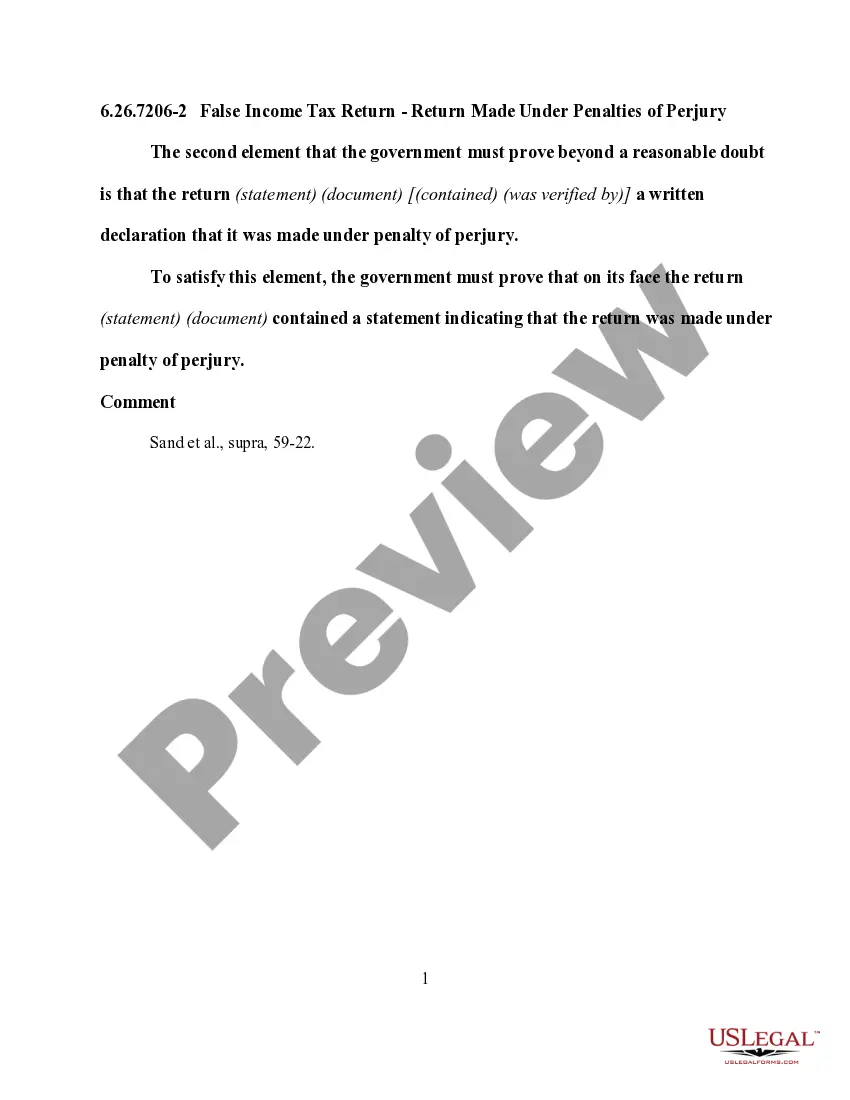
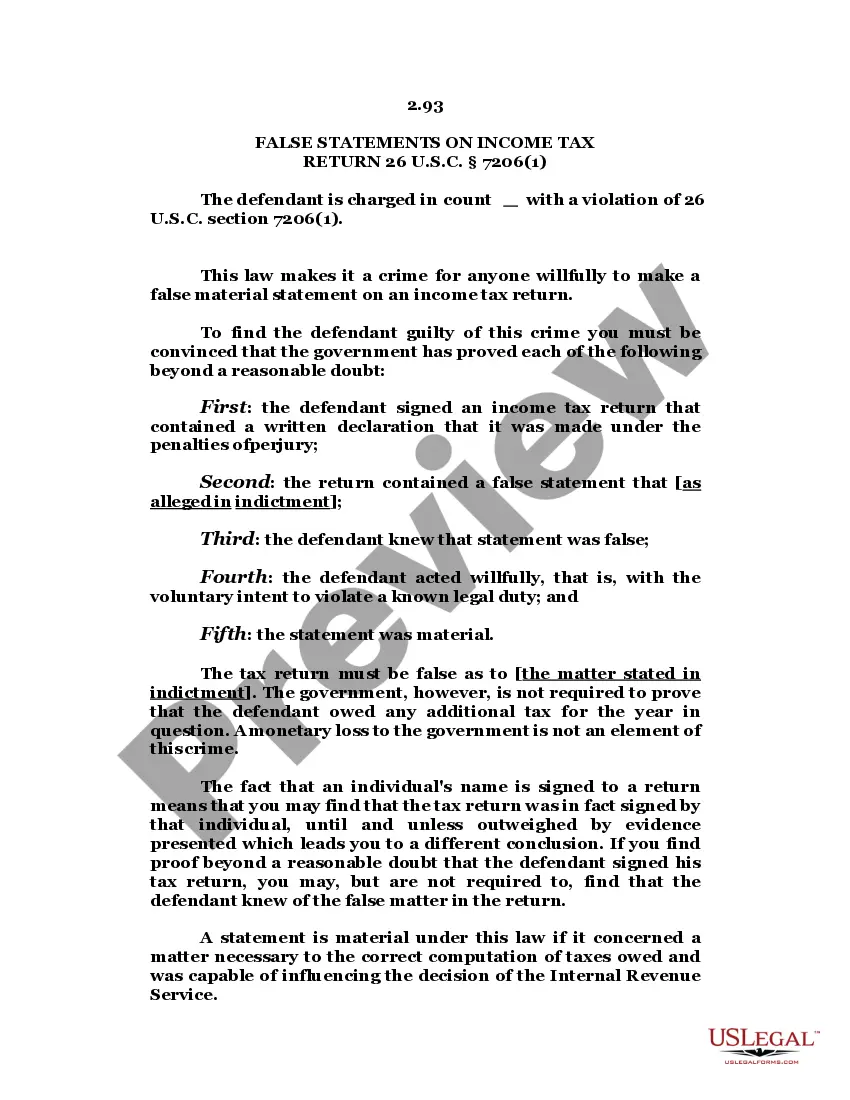
- Statement that the return was signed and filed under penalties of perjury.
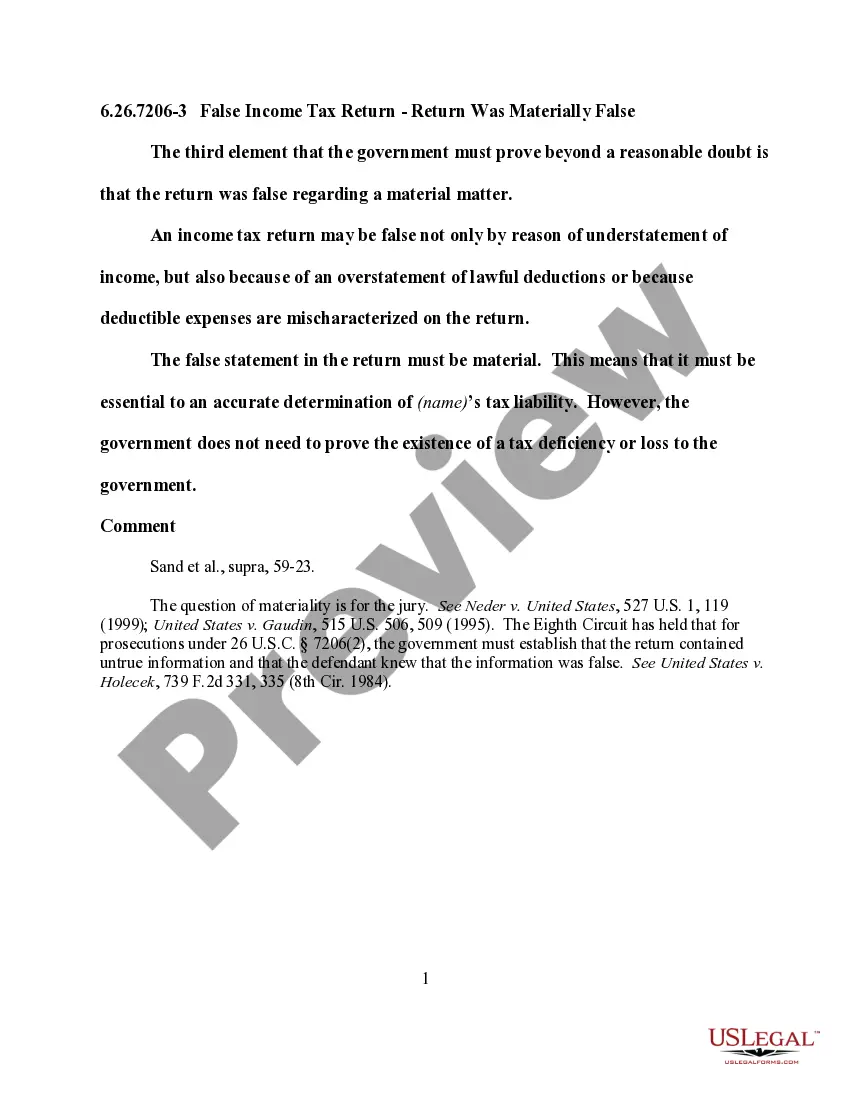
- Details about the falsehood regarding a material matter in the return.
- Confirmation that the defendant did not believe the return was accurate.
- Evidence that the defendant acted willfully in submitting the false return.

When to use this document
This form is used during legal proceedings when a defendant faces charges for filing a false income tax return. It is relevant in cases where the government claims that a tax return submitted contains incorrect information and highlights its materiality. This form is also instrumental for defense attorneys to understand the elements their clients must contest to establish reasonable doubt.
Who can use this document
This form is particularly useful for:
- Defendants charged with filing a false income tax return.
- Defense attorneys representing clients in tax fraud cases.
- Legal professionals needing to understand the specific elements of the tax-related offense.
- Individuals preparing for a legal defense regarding perjury in tax filings.
How to complete this form
- Identify the defendant's name and the specific tax return involved.
- Ensure the return is appropriately signed under penalties of perjury.
- Outline the material falsehoods present in the tax return.
- Provide evidence of the defendant's understanding that the return was false.
- Demonstrate the willfulness of the defendant in submitting the false return.
Does this form need to be notarized?
This form does not typically require notarization unless specified by local law. However, it's important to ensure that all signatures are well-documented for legal validity.
Get your form ready online
Our built-in tools help you complete, sign, share, and store your documents in one place.
Make edits, fill in missing information, and update formatting in US Legal Forms—just like you would in MS Word.
Download a copy, print it, send it by email, or mail it via USPS—whatever works best for your next step.
Sign and collect signatures with our SignNow integration. Send to multiple recipients, set reminders, and more. Go Premium to unlock E-Sign.
If this form requires notarization, complete it online through a secure video call—no need to meet a notary in person or wait for an appointment.
We protect your documents and personal data by following strict security and privacy standards.

Make edits, fill in missing information, and update formatting in US Legal Forms—just like you would in MS Word.

Download a copy, print it, send it by email, or mail it via USPS—whatever works best for your next step.

Sign and collect signatures with our SignNow integration. Send to multiple recipients, set reminders, and more. Go Premium to unlock E-Sign.

If this form requires notarization, complete it online through a secure video call—no need to meet a notary in person or wait for an appointment.

We protect your documents and personal data by following strict security and privacy standards.
Mistakes to watch out for
- Failing to accurately list all elements of the offense as required by law.
- Submitting the form without sufficient evidence to substantiate claims.
- Misunderstanding the materiality of the false statements made in the tax return.
- Overlooking the necessity of establishing the defendant's intent to deceive.
Advantages of online completion
- Instant access to legal templates from licensed attorneys.
- The ability to download, edit, and customize the form to fit specific legal needs.
- Convenient and quick access to necessary legal documents without needing to visit an attorney in person.
- Reliable, up-to-date templates that comply with current legal standards.
Legal use & context
- The False Income Tax Return form is enforceable under federal law, specifically 26 U.S.C. § 7206(1).
- Failure to adhere to the legal requirements may result in felony charges.
- Tax deficiencies are not requirements for the offense, focusing instead on willful falsity.
What to keep in mind
- The False Income Tax Return form outlines essential elements necessary for legal proceedings related to tax fraud.
- This form must clearly demonstrate the willfulness and knowledge of the defendant concerning the false information.
- Understanding and accurately completing this form can significantly impact a defendant's legal strategy.
Looking for another form?

Form popularity
FAQ
7206 filing a fraudulent and false statement verified via written declaration under penalty of perjury is a felony and carries a penalty of imprisonment for up to 3 years, a $100,000 fine for individuals or a $500,000 fine for corporations, or both, and reimbursement to the federal government to cover the costs of
Three Elements of Tax Evasion Omitting or understating income. Claiming improper deductions or credits. Providing false income information.
The Internal Revenue Code (IRC) is the body of law that codifies all federal tax laws, including income, estate, gift, excise, alcohol, tobacco, and employment taxes.
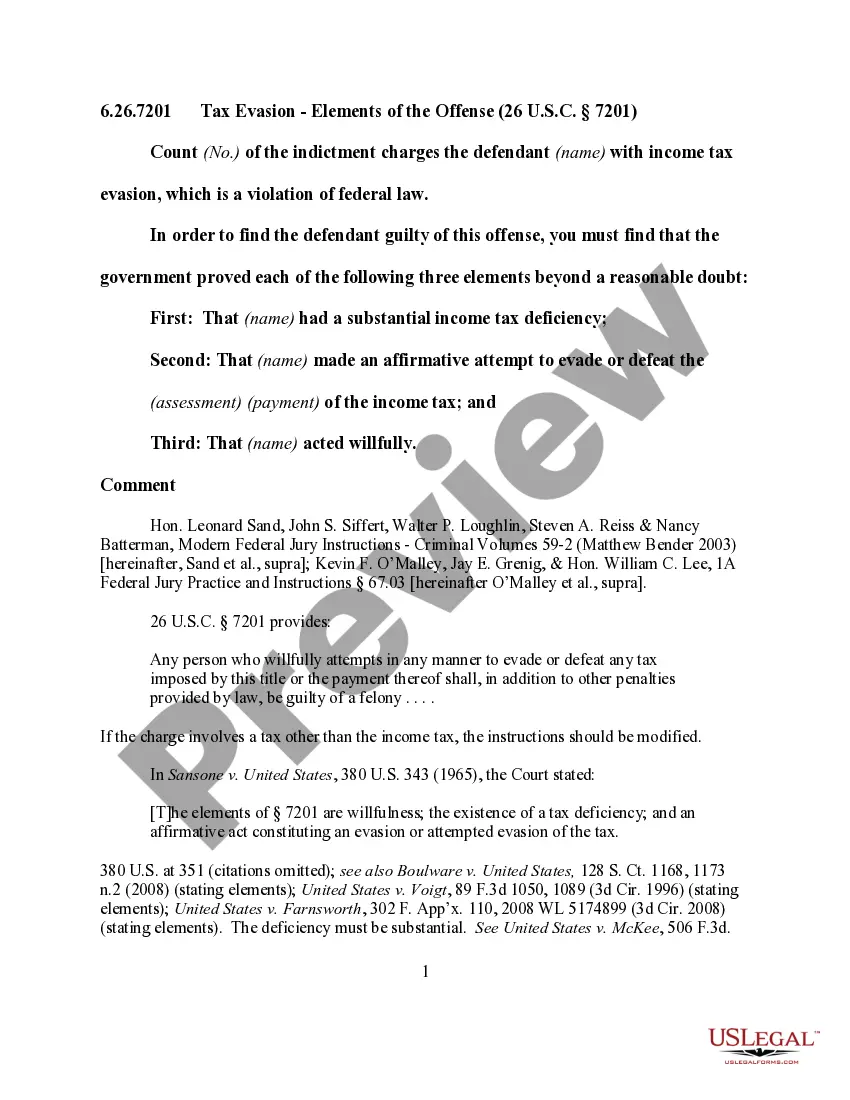
The elements of § 7201 are willfulness; the existence of a tax deficiency; and an affirmative act constituting an evasion or attempted evasion of the tax.
Title 26, United States Code, Section 7206(2), makes it a crime to willfully aid or assist in preparing or presenting a false return or document and provides as follows: Any person who?? (2) Aid or Assistance.
Shall be guilty of a felony and, upon conviction thereof, shall be fined not more than $100,000 ($500,000 in the case of a corporation), or imprisoned not more than 3 years, or both, together with the costs of prosecution.
Section 7201 creates two offenses: (a) the willful attempt to evade or defeat the assessment of a tax, and (b) the willful attempt to evade or defeat the payment of a tax. Sansone v. United States, 380 U.S. 343, 354 (1965).