Firearm Offenses - Knowing Possession Defined (revised 2014)
What this document covers
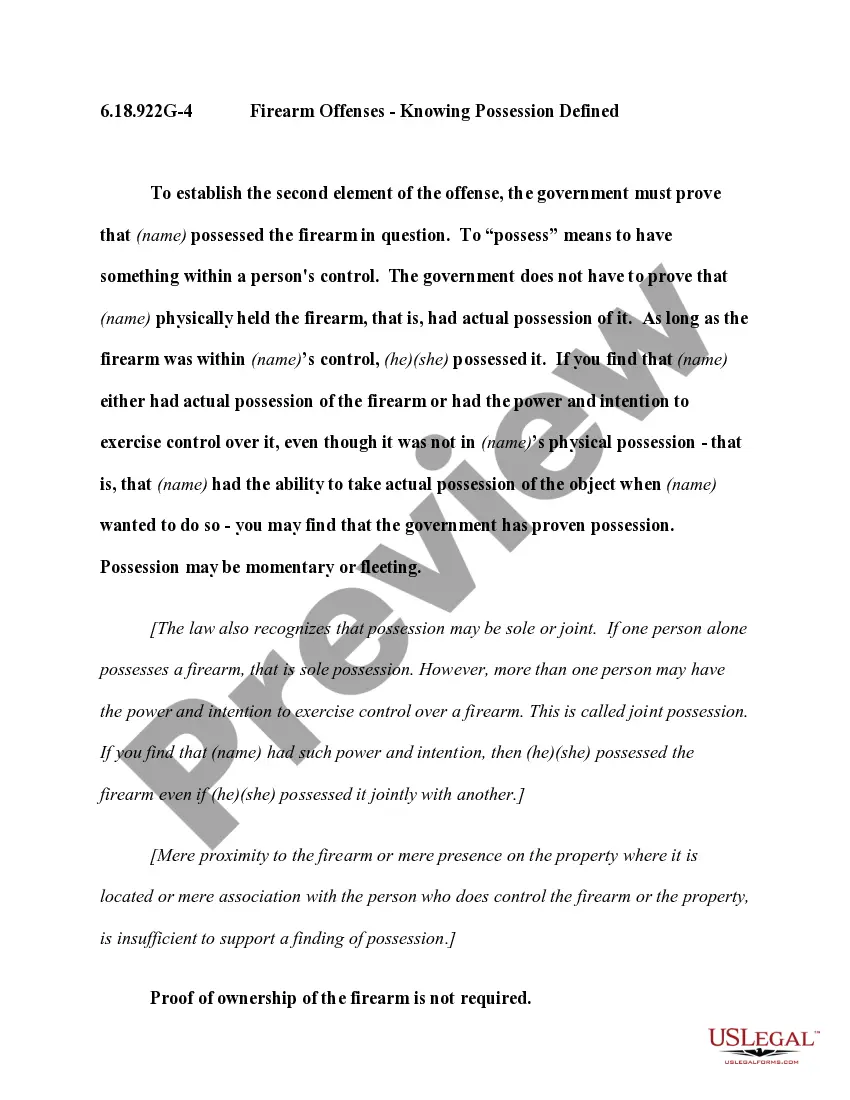
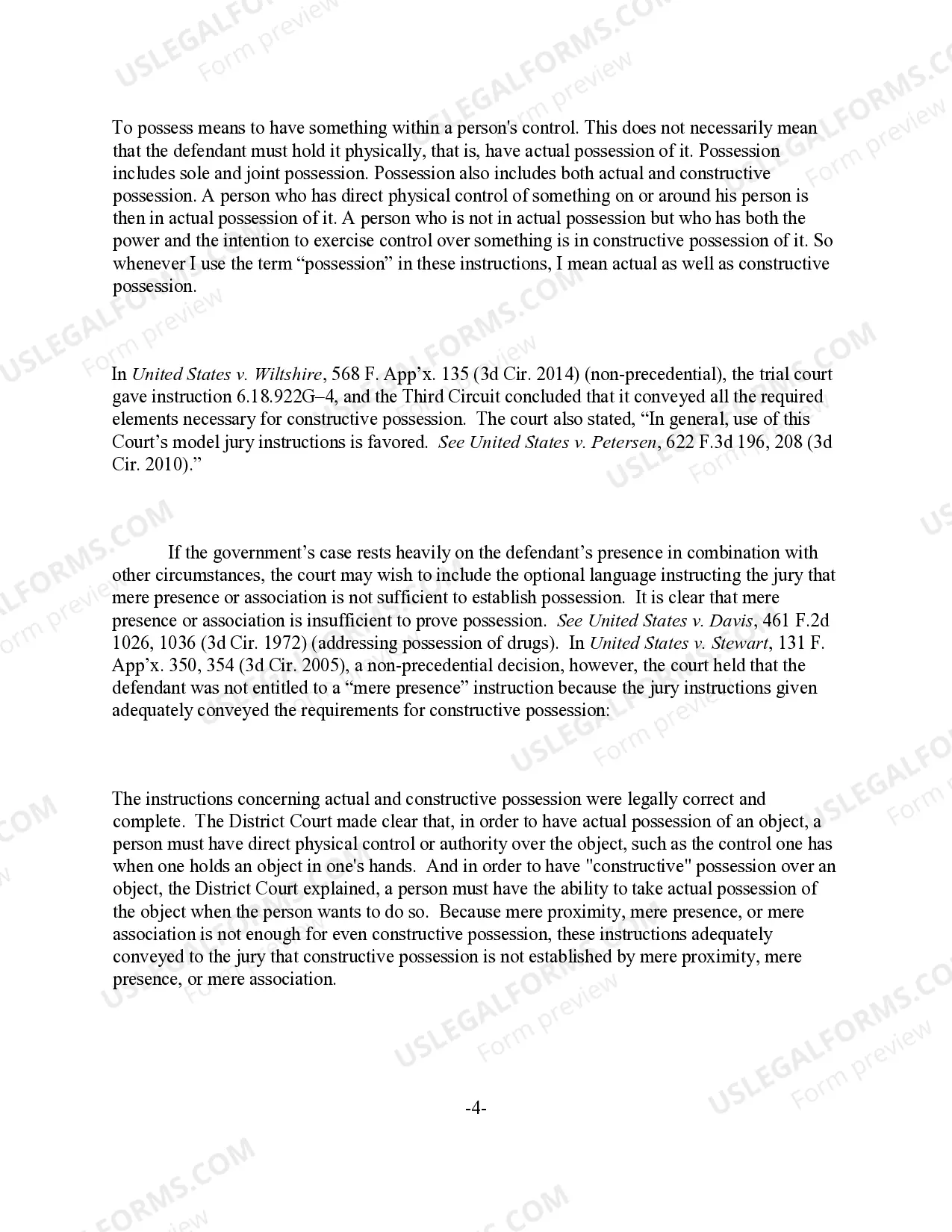
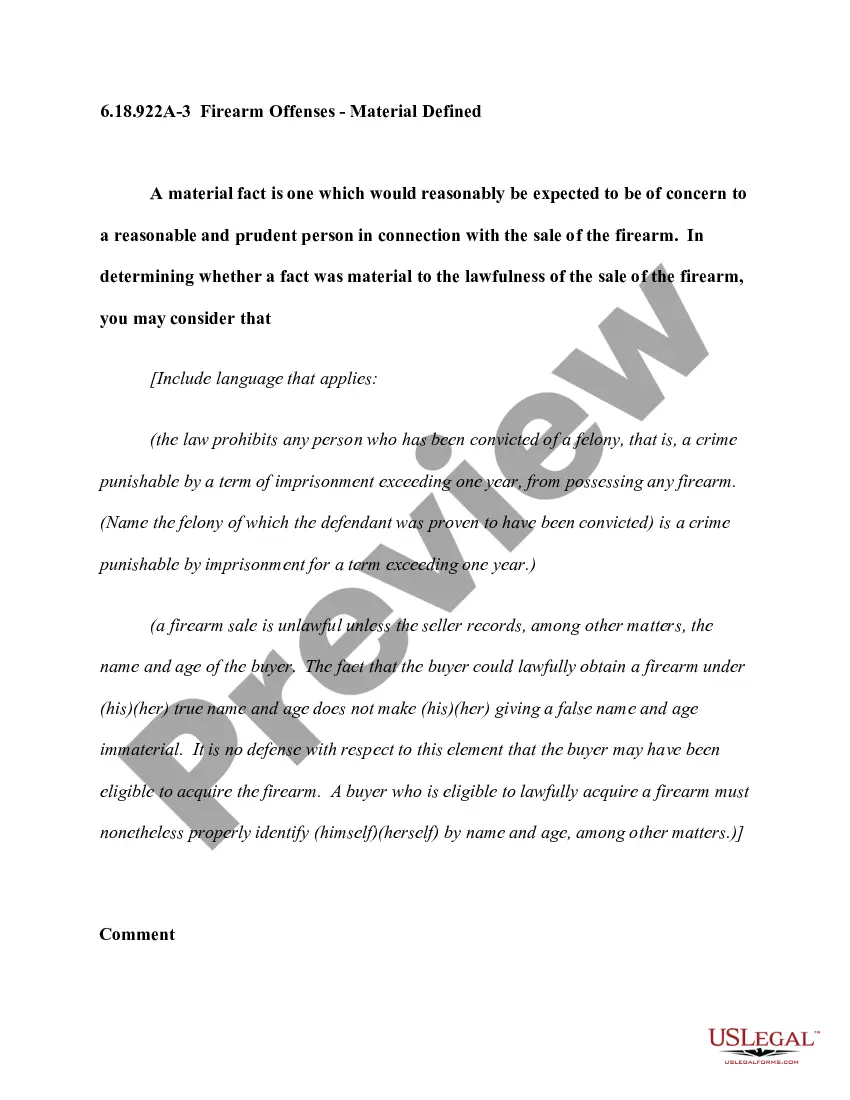
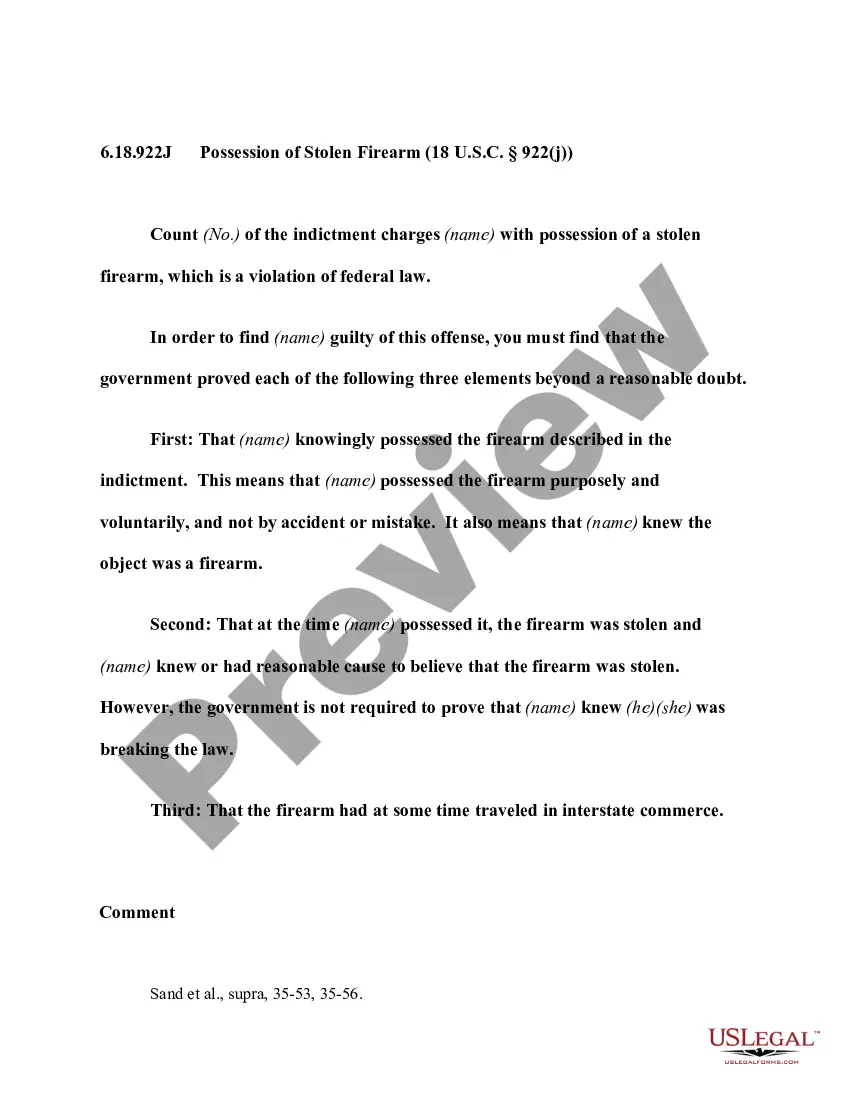
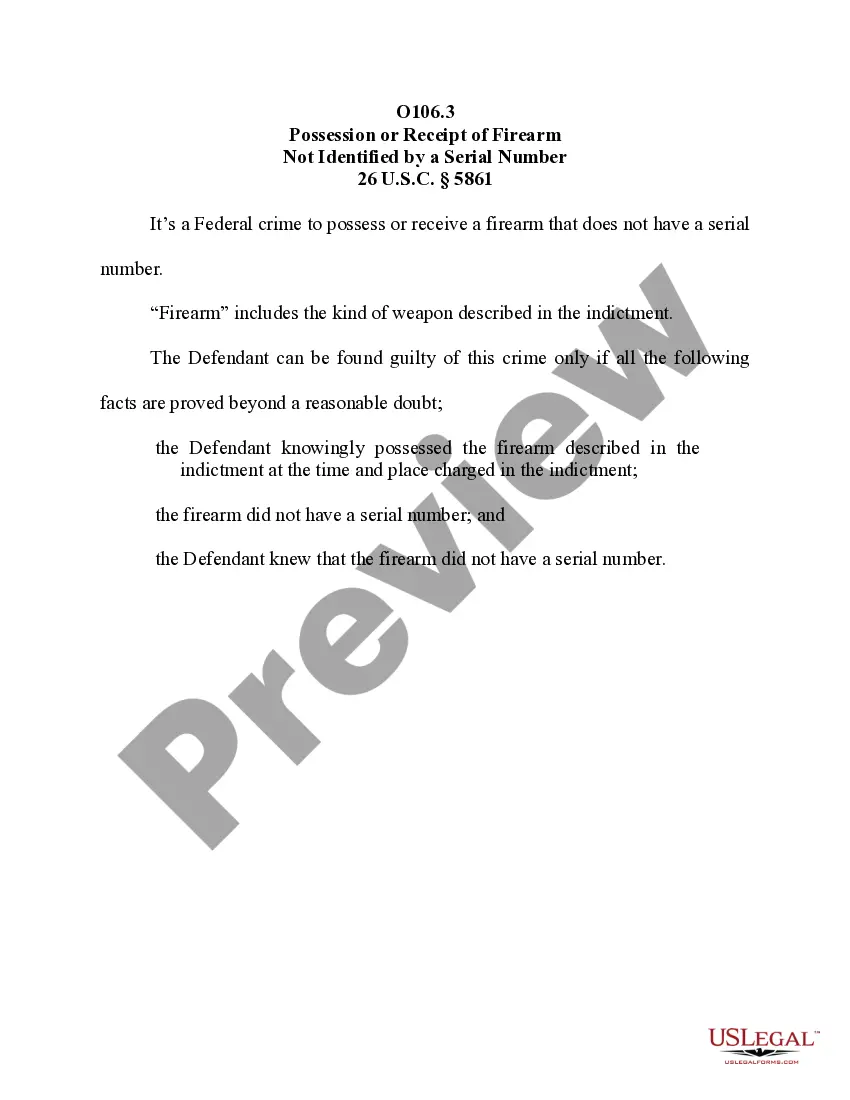
The "Firearm Offenses - Knowing Possession Defined" form provides a legal framework for understanding the concept of firearm possession under federal law. This form aims to clarify the definitions and requirements necessary to establish possession in firearm-related criminal cases, differentiating between actual and constructive possession. It serves as a crucial resource for legal professionals, defendants, and anyone involved in firearm cases to ensure accurate comprehension of legal terms and obligations.
Main sections of this form
- Definition of possession, including actual and constructive possession.
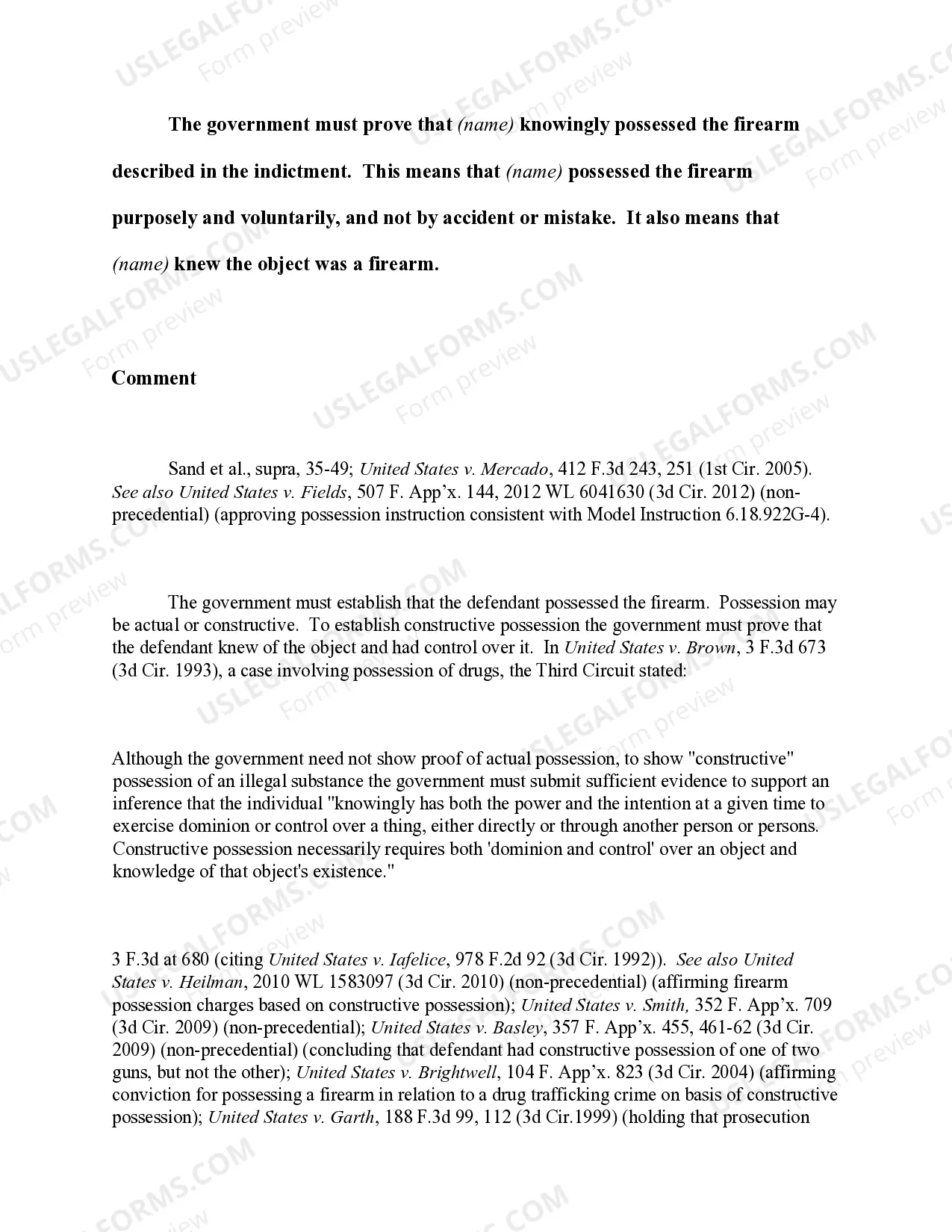
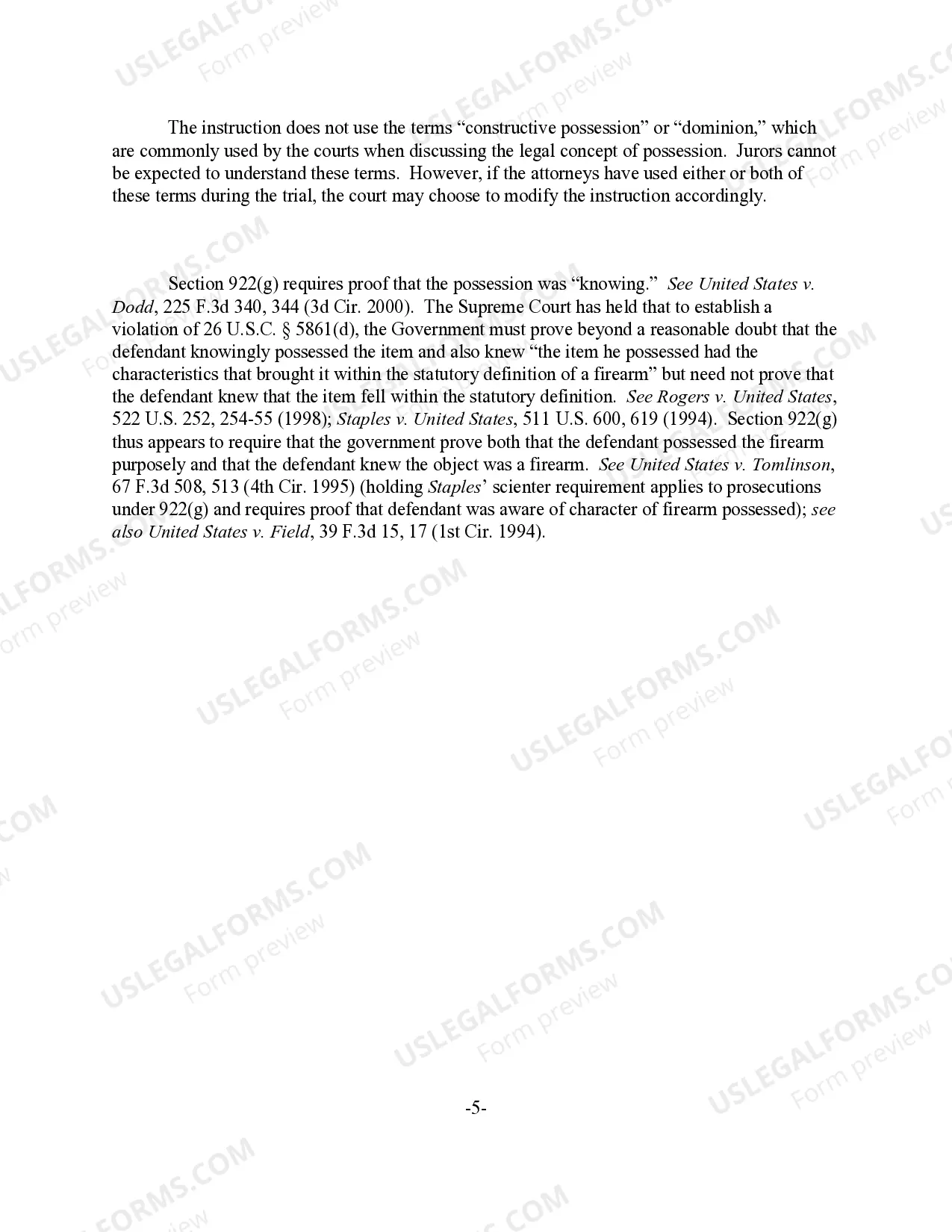
- Criteria for establishing knowing possession of a firearm.
- Clarification between sole and joint possession.
- Explanation that mere proximity or association does not equate to possession.
- Legal precedents that support the definitions provided.
When to use this document
This form is essential when facing firearm-related charges, particularly to understand the nuances of possession. It is relevant in criminal cases where the government needs to prove that the defendant knowingly possessed a firearm, which can help in formulating a defense or for educational purposes for legal practitioners.
Who needs this form
- Defendants facing firearm possession charges.
- Legal professionals representing clients in criminal cases.
- Individuals seeking to understand the implications of firearm laws.
- Students of law or anyone interested in firearm legal issues.
How to complete this form
- Read through the definitions provided to understand "possession."
- Identify whether the context involves actual or constructive possession.
- Assess the evidence related to the firearm in question.
- Determine if there is sole or joint possession involved.
- Ensure that any arguments about presence or association are well-grounded based on the criteria discussed.
Notarization requirements for this form
In most cases, this form does not require notarization. However, some jurisdictions or signing circumstances might. US Legal Forms offers online notarization powered by Notarize, accessible 24/7 for a quick, remote process.
Get your form ready online
Our built-in tools help you complete, sign, share, and store your documents in one place.
Make edits, fill in missing information, and update formatting in US Legal Forms—just like you would in MS Word.
Download a copy, print it, send it by email, or mail it via USPS—whatever works best for your next step.
Sign and collect signatures with our SignNow integration. Send to multiple recipients, set reminders, and more. Go Premium to unlock E-Sign.
If this form requires notarization, complete it online through a secure video call—no need to meet a notary in person or wait for an appointment.
We protect your documents and personal data by following strict security and privacy standards.

Make edits, fill in missing information, and update formatting in US Legal Forms—just like you would in MS Word.

Download a copy, print it, send it by email, or mail it via USPS—whatever works best for your next step.

Sign and collect signatures with our SignNow integration. Send to multiple recipients, set reminders, and more. Go Premium to unlock E-Sign.

If this form requires notarization, complete it online through a secure video call—no need to meet a notary in person or wait for an appointment.

We protect your documents and personal data by following strict security and privacy standards.
Typical mistakes to avoid
- Assuming physical possession is the only form of possession.
- Misinterpreting proximity or association as proof of possession.
- Overlooking the requirement for the government to prove knowing possession.
Why complete this form online
- Immediate access to legally sound definitions and explanations.
- Ability to download and print at your convenience.
- Clear, comprehensible language suitable for individuals with varying legal knowledge.
Legal use & context
- This form is based on established guidelines set out in federal law regarding firearm offenses.
- Understanding the definitions can aid in preparing a defense against firearm charges.
- The form is supported by relevant case law, ensuring it reflects current legal standards.
Main things to remember
- The form clarifies the legal definitions of firearm possession.
- It emphasizes the importance of knowing possession as a critical element in firearm-related charges.
- Understanding the difference between actual and constructive possession is crucial for legal defense.
Looking for another form?
Form popularity
FAQ
18 USC § 922(g)(8) is an unconstitutional exercise of congressional power under the Commerce Clause. 3. 18 USC § 922(g)(8) is unconstitutional because it exceeds the authority granted to Congress under the Tenth Amendment by violating long established principles of comity and federalism.
Title 18, United States Code, Section 922(g) makes it unlawful for certain classes of individuals to ship, transport, possess or receive any firearm or ammunition with the required interstate commerce nexus.
Further, the GCA at 18 U.S.C. § 922(d) makes it unlawful to sell or otherwise dispose of firearms or ammunition to any person who is prohibited from shipping, transporting, receiving, or possessing firearms or ammunition.
POSSESSION OF A FIREARM OR AMMUNITION BY A PROHIBITED PERSON: 18 USC § 922(g) & (n). Punishable by up to 10 years imprisonment.
POSSESSION OF A FIREARM OR AMMUNITION BY A PROHIBITED PERSON: 18 USC § 922(g) & (n). Punishable by up to 10 years imprisonment.
(6)(A) Any transferor who sells, delivers, or otherwise transfers a handgun to a transferee shall retain the copy of the statement of the transferee with respect to the handgun transaction, and shall retain evidence that the transferor has complied with subclauses (III) and (IV) of paragraph (1)(A)(i) with respect to
§ 922(g)(8) Title 18 U.S.C. §§ 922(d)(8) and (g)(8) concern the prohibition against disposal of firearms to, or receipt or possession of firearms by, persons who are subject to domestic violence protection orders.
To obtain a conviction under Section 922(g), the government must prove beyond a reasonable doubt that (1) the defendant had previously been convicted of a crime punishable by imprisonment for a term exceeding one year; (2) the defendant knowingly possessed a firearm; and (3) the firearm had previously passed in