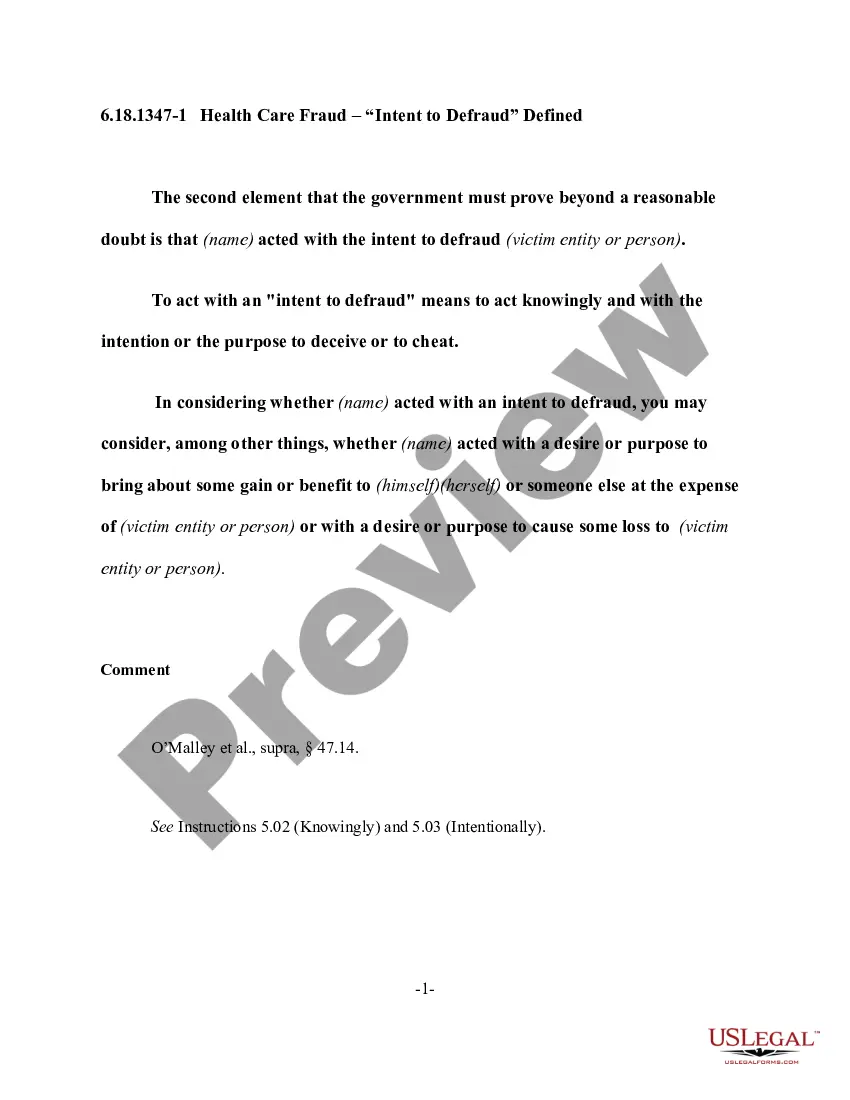
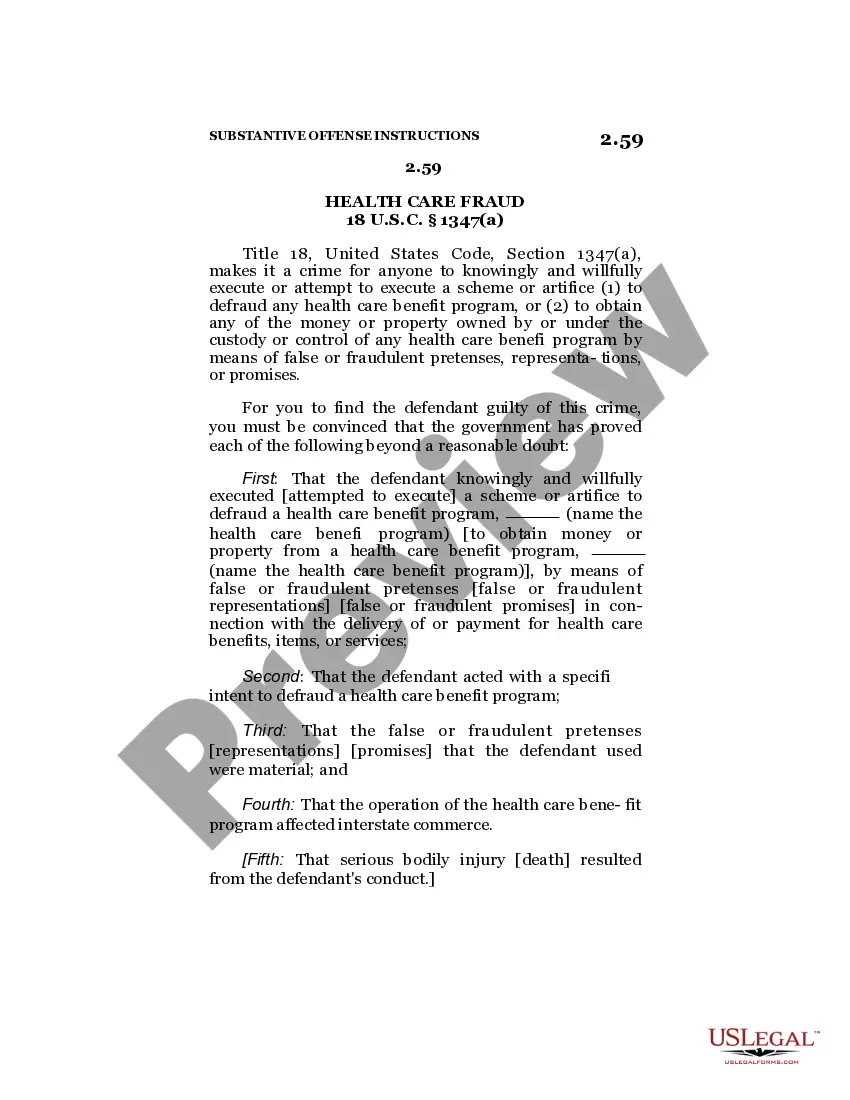
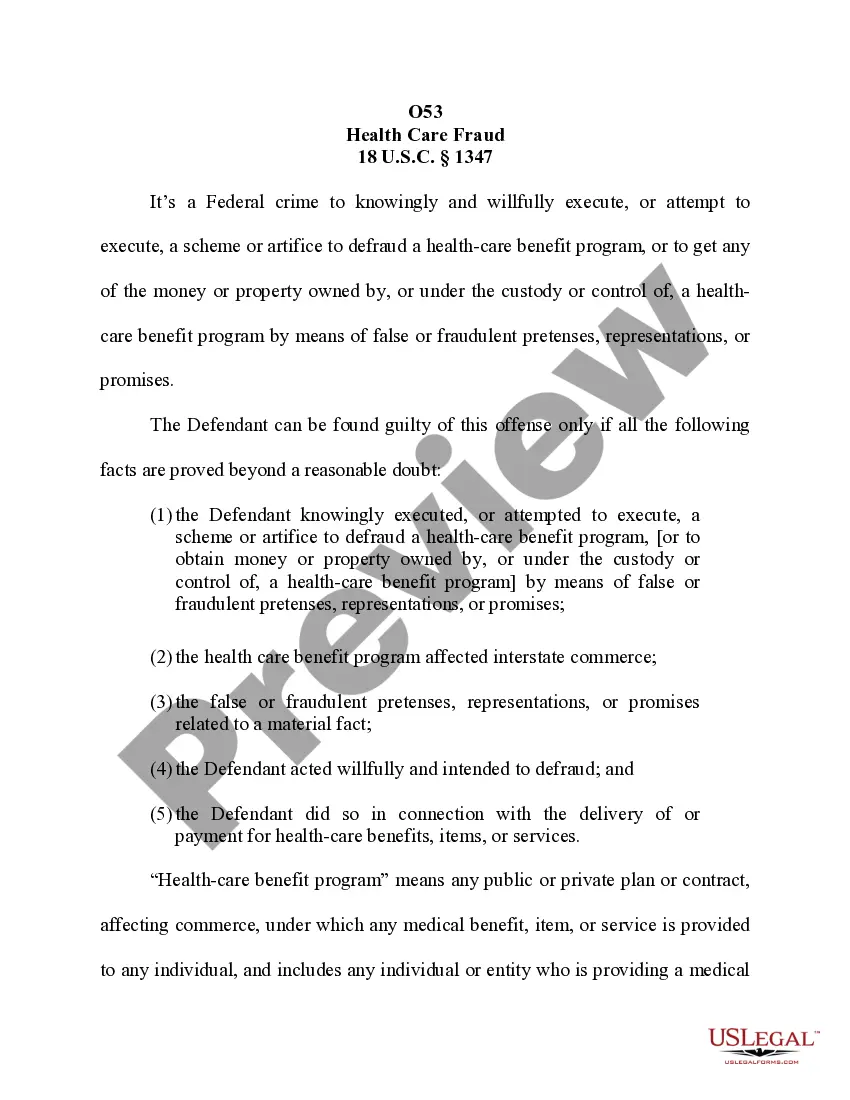
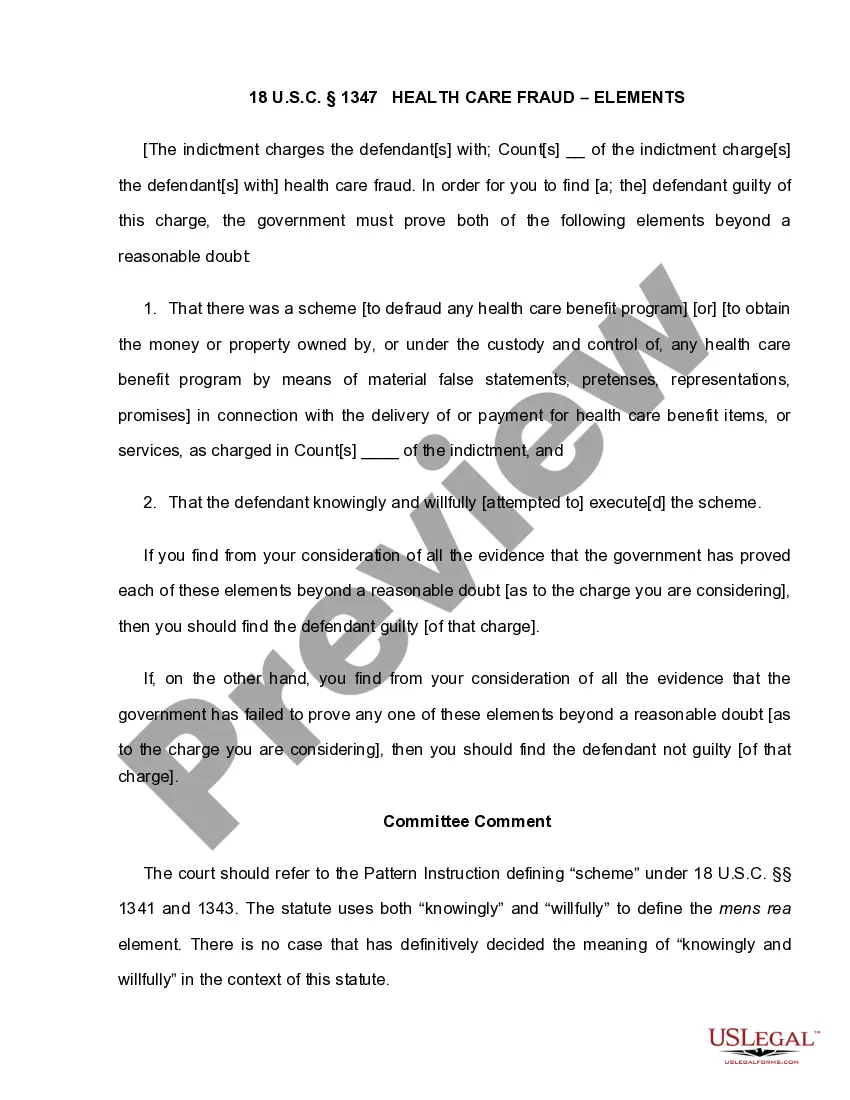
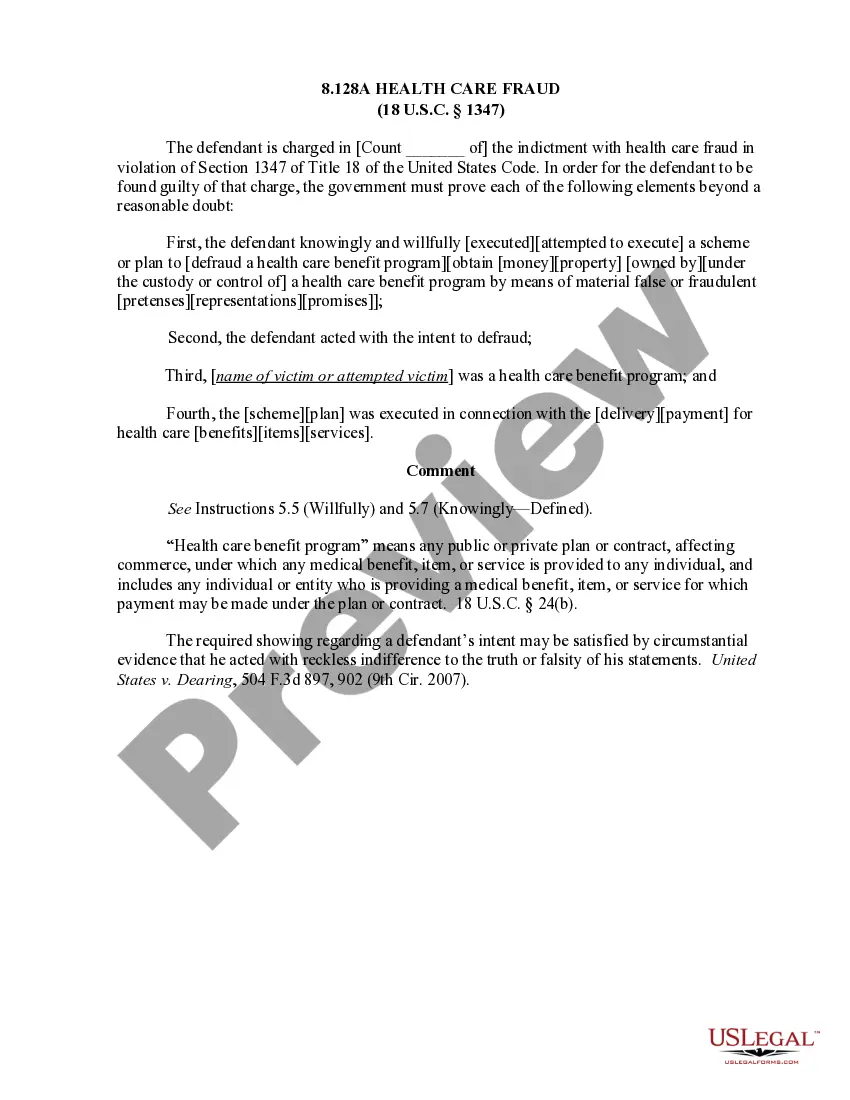
Health Care Fraud — Elements of the Offense (18 U.S.C. Sec. 1347) (revised 2015) is a federal law that prohibits individuals and organizations from knowingly and willfully executing, or attempting to execute, a scheme or artifice to defraud any health care benefit program or to obtain, by means of false or fraudulent pretenses, representations, or promises, any of the money or property owned by, or under the control of, any health care benefit program. This offense covers a variety of fraudulent activities, including billing for services or items that are not medically necessary, submitting claims for services that were not actually provided, submitting false or fraudulent cost reports, and submitting claims for services provided by unlicensed providers. There are two types of Health Care Fraud — Elements of the Offense (18 U.S.C. Sec. 1347) (revised 2015): (1) health care fraud for a federal health care benefit program; and (2) health care fraud not involving a federal health care benefit program. The first type of fraud covers activities related to federal health care programs, such as Medicare, Medicaid, TRI CARE, the Federal Employees Health Benefits Program (FEB), and the Veterans Health Administration (VA). The second type of fraud covers activities related to private health care benefit programs, such as private health insurance plans or employer-sponsored health care plans.
Health Care Fraud - Elements of the Offense (18 U.S.C. Sec. 1347) (revised 2015)
Description
How to fill out Health Care Fraud - Elements Of The Offense (18 U.S.C. Sec. 1347) (revised 2015)?
How much time and resources do you normally spend on composing official paperwork? There’s a greater option to get such forms than hiring legal experts or wasting hours browsing the web for a suitable blank. US Legal Forms is the premier online library that provides professionally drafted and verified state-specific legal documents for any purpose, such as the Health Care Fraud - Elements of the Offense (18 U.S.C. Sec. 1347) (revised 2015).
To obtain and prepare a suitable Health Care Fraud - Elements of the Offense (18 U.S.C. Sec. 1347) (revised 2015) blank, adhere to these simple instructions:
- Look through the form content to make sure it meets your state regulations. To do so, check the form description or utilize the Preview option.
- In case your legal template doesn’t meet your requirements, locate a different one using the search bar at the top of the page.
- If you already have an account with us, log in and download the Health Care Fraud - Elements of the Offense (18 U.S.C. Sec. 1347) (revised 2015). Otherwise, proceed to the next steps.
- Click Buy now once you find the right document. Select the subscription plan that suits you best to access our library’s full opportunities.
- Register for an account and pay for your subscription. You can make a transaction with your credit card or through PayPal - our service is totally safe for that.
- Download your Health Care Fraud - Elements of the Offense (18 U.S.C. Sec. 1347) (revised 2015) on your device and fill it out on a printed-out hard copy or electronically.
Another advantage of our library is that you can access previously downloaded documents that you securely keep in your profile in the My Forms tab. Get them anytime and re-complete your paperwork as frequently as you need.
Save time and effort preparing formal paperwork with US Legal Forms, one of the most reliable web solutions. Sign up for us today!
Form popularity
FAQ
In California, healthcare fraud is considered a ?wobbler? crime, which means it can be charged as a misdemeanor or a felony. Typically, the prosecutor decides based on the amount of money involved.
Examples of Health Insurance Fraud Falsifying a patient's diagnosis to justify the need for tests, surgeries, or other procedures that are not medically necessary. Misrepresenting procedures performed to obtain payment for non-covered services, such as cosmetic surgery.
Members can commit health care fraud by providing false information when applying for programs or services, forging or selling prescription drugs, using transportation benefits for non-medical related purposes, and loaning or using another's insurance card.
The five most important Federal fraud and abuse laws that apply to physicians are the False Claims Act (FCA), the Anti-Kickback Statute (AKS), the Physician Self-Referral Law (Stark law), the Exclusion Authorities, and the Civil Monetary Penalties Law (CMPL).
Other forms of fraud and abuse in health care. Billing for services not rendered medically necessary. Double-billing for services rendered. Billing for covered service when the service provided was not covered.
Whoever, having devised or intending to devise any scheme or artifice to defraud, or for obtaining money or property by means of false or fraudulent pretenses, representations, or promises, or to sell, dispose of, loan, exchange, alter, give away, distribute, supply, or furnish or procure for unlawful use any
As a result, 18 U.S.C. § 1347 prohibits health care fraud broadly, prohibiting anyone from knowingly or willfully attempting ?to execute, a scheme or artifice? to defraud any health care benefit program or obtain money in connection with delivery or payment of health care benefits, items, or services.
Examples: A physician knowingly submits claims to Medicare for medical services not provided or for a higher level of medical services than actually provided.