Prior Statement of Defendant - Single Defendant on Trial
Understanding this form
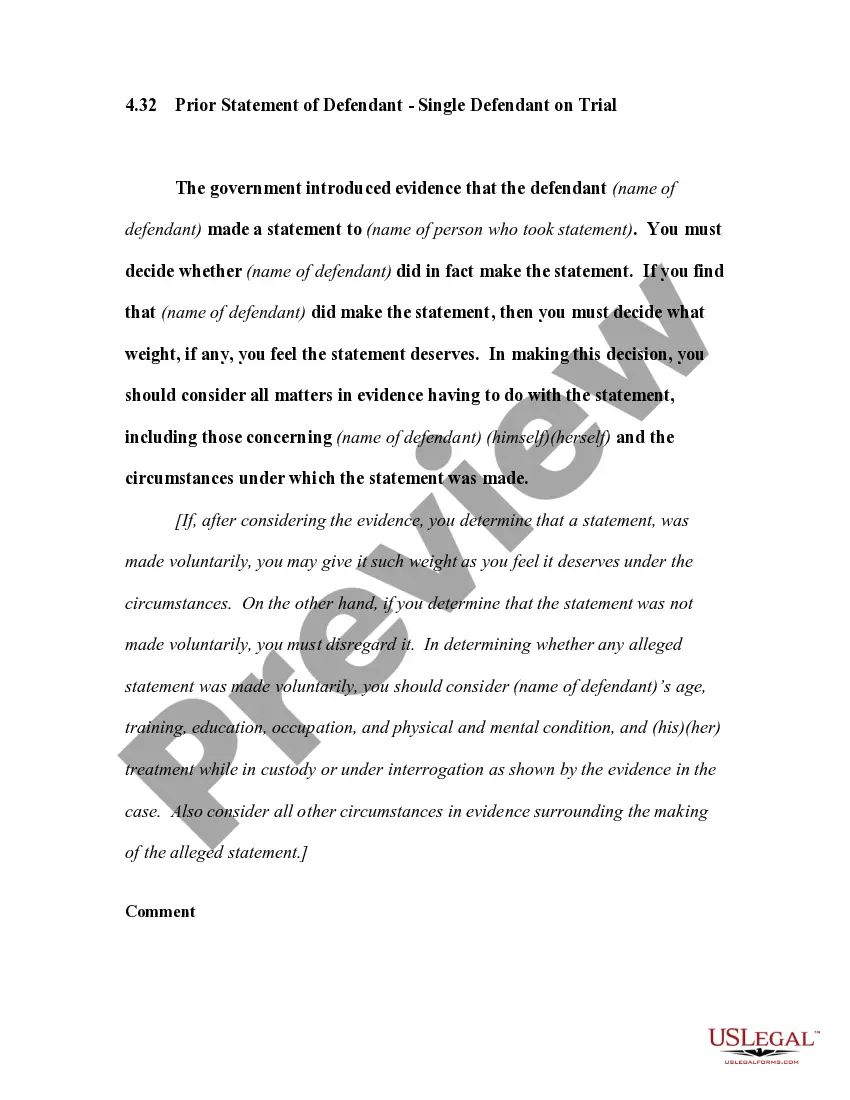
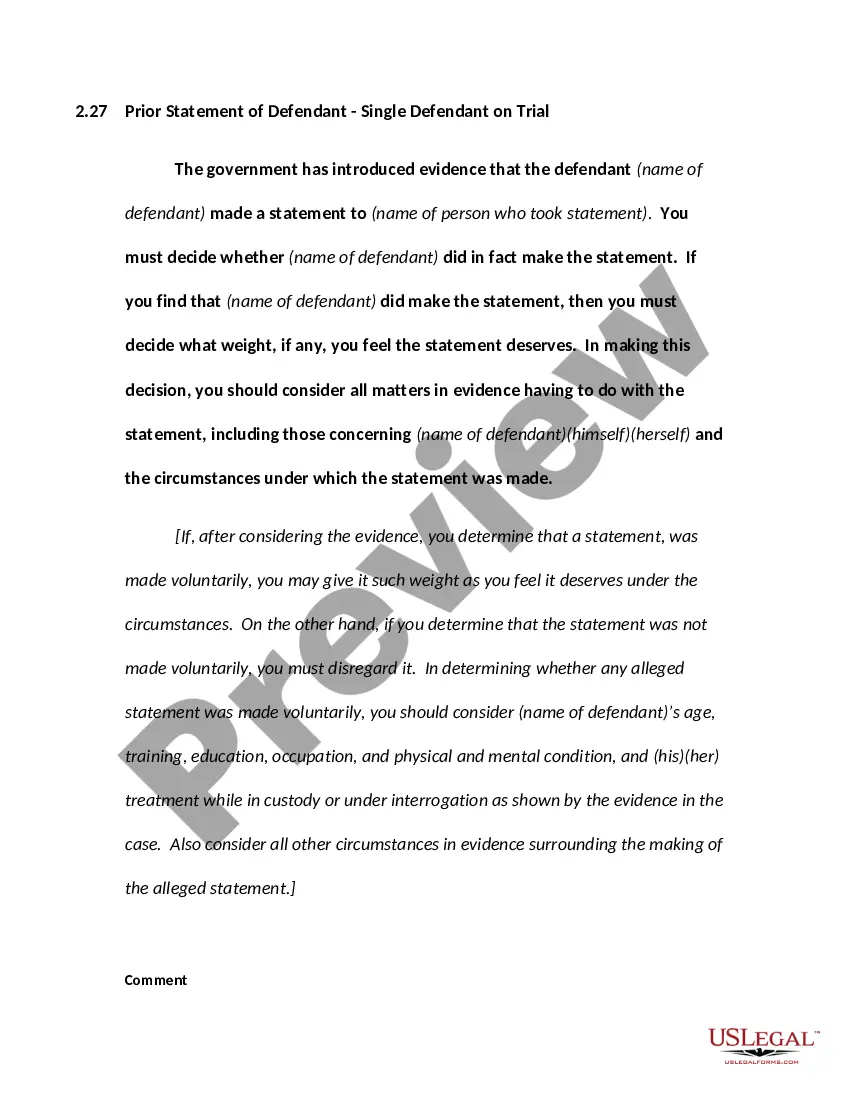
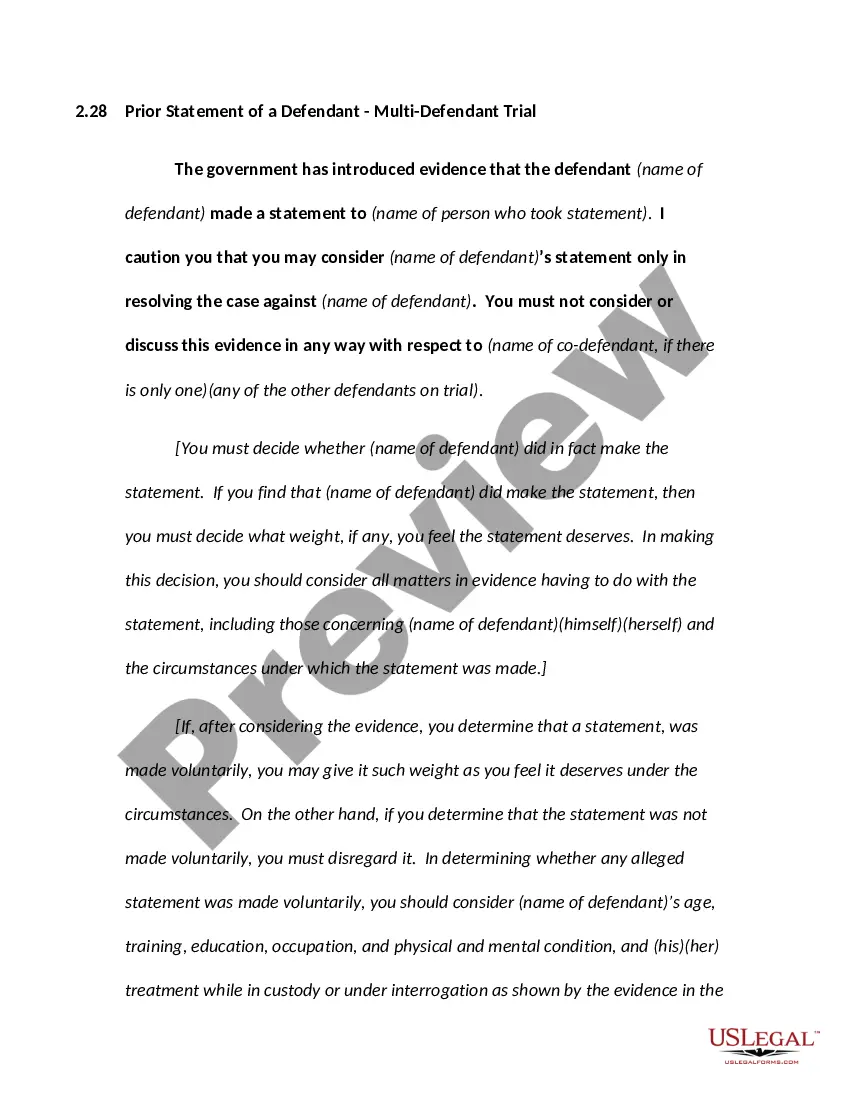
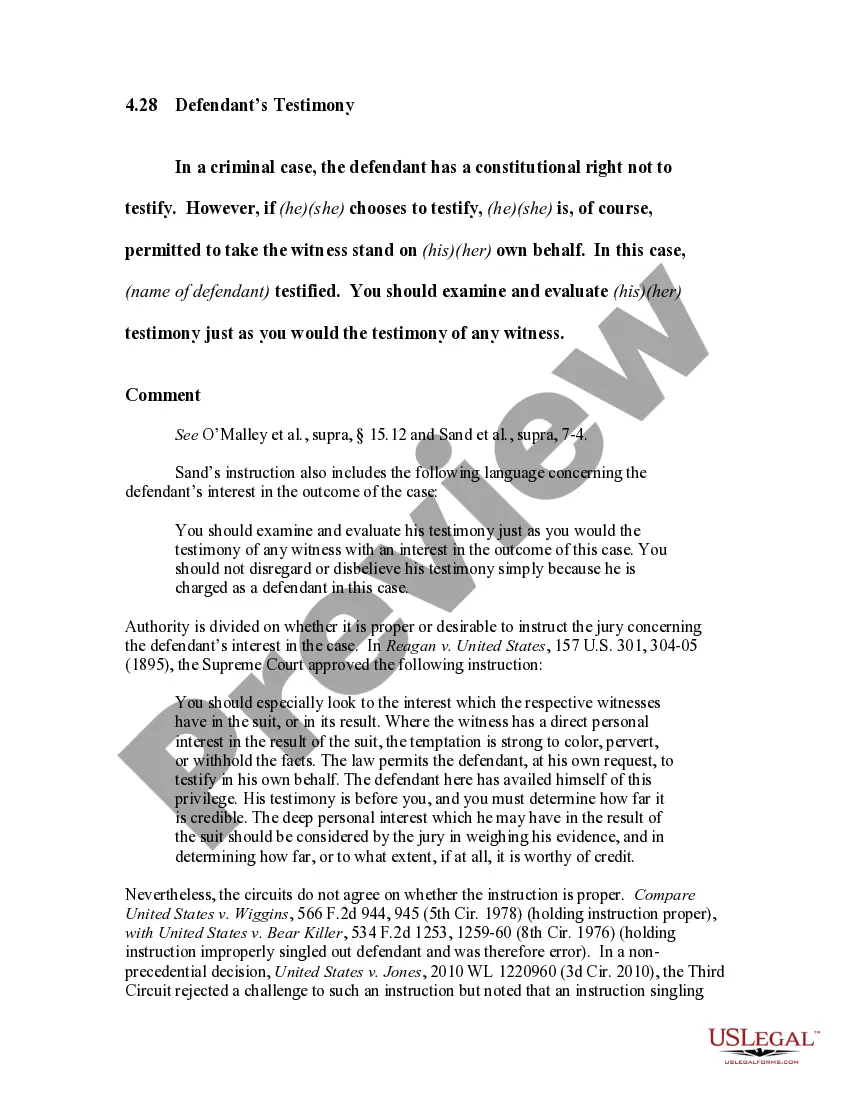
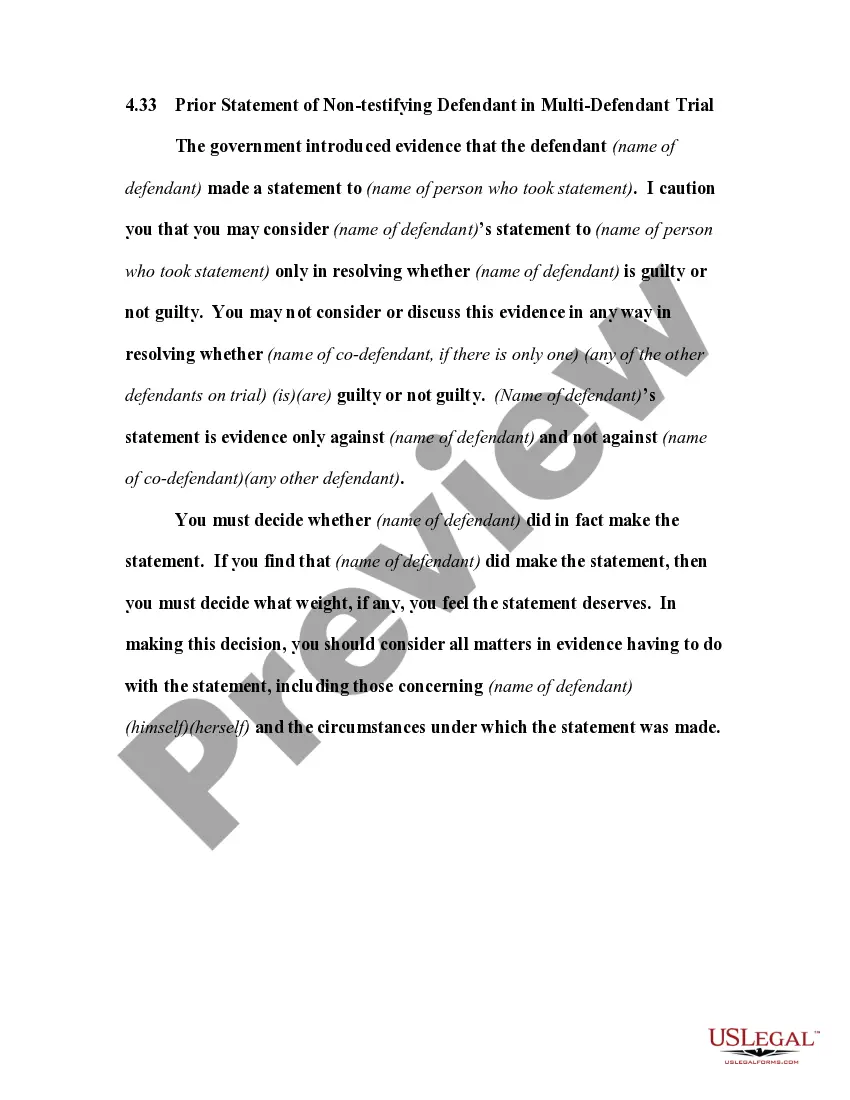
The Prior Statement of Defendant - Single Defendant on Trial is a legal document used in court proceedings. It is designed to provide jury instructions regarding a defendant's prior statements made during a trial. The purpose of this form is to help jurors assess the credibility and weight of the defendant's statement, specifically whether it was made voluntarily and under lawful circumstances. This form is crucial when dealing with confessions or statements that may impact the trial's outcome and should not be confused with other types of witness statements or affidavits.
Key parts of this document
- Identification of the defendant and the individual who took the statement.
- Instructions for jurors on determining the authenticity and weight of the statement.
- Criteria to assess whether the statement was made voluntarily.
- Considerations for the defendant's age, education, and mental state during the statement's making.
- Guidelines on the jury's discretion in evaluating the statement's probative weight.
When this form is needed
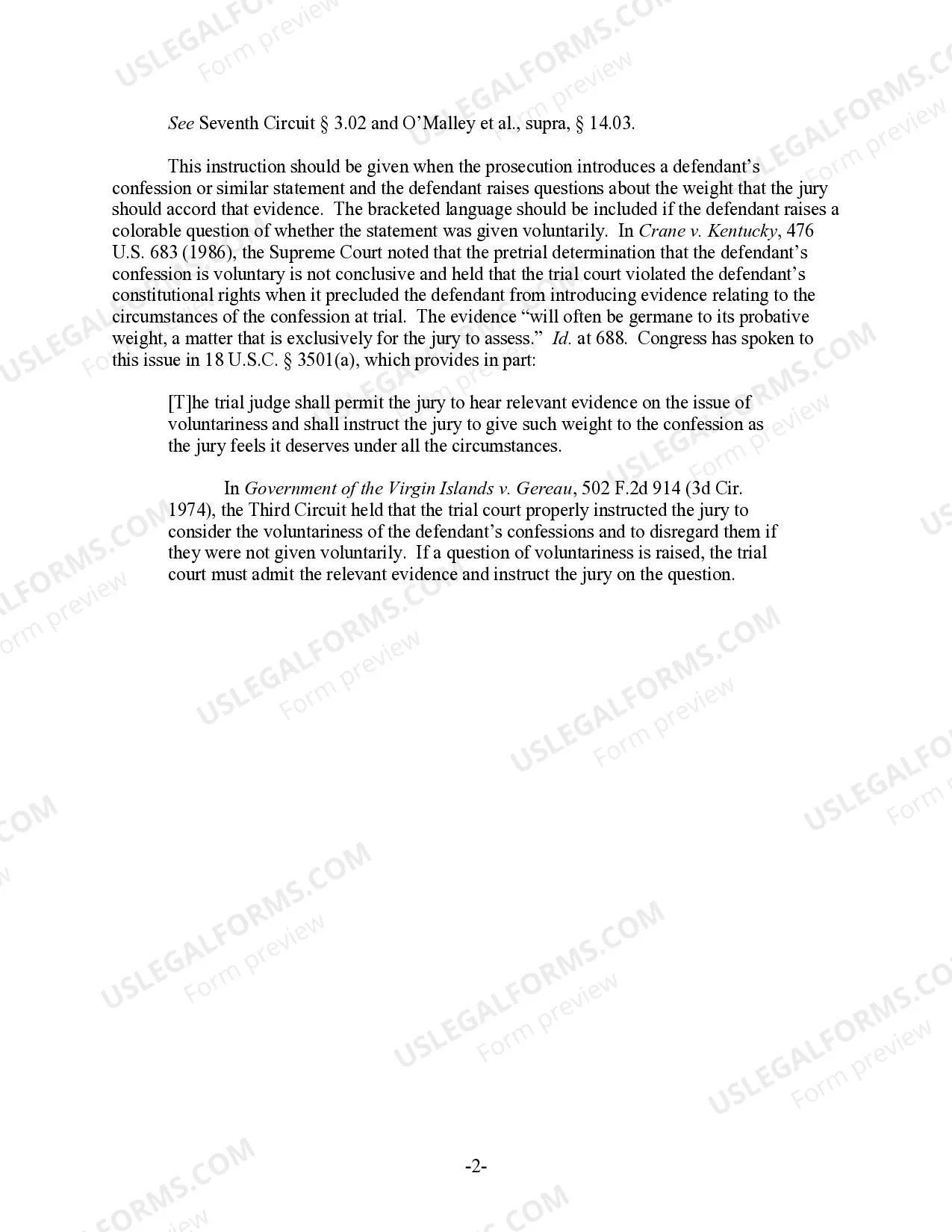
This form should be utilized during a trial when the prosecution has introduced a prior statement made by the defendant. It is applicable in situations where the defense challenges the voluntary nature of the statement or seeks to clarify the context in which it was made. Additionally, use this form if there are questions about giving weight to the defendant's statement due to circumstances surrounding its creation.
Who can use this document
- Legal professionals involved in criminal trials.
- Prosecutors presenting evidence of a defendant's statement.
- Defense attorneys contesting the validity of such statements.
- Jurors who need clear guidance on assessing the evidence presented.
How to complete this form
- Identify the parties involved, including the defendant and the individual who took the statement.
- Clearly outline the circumstances under which the prior statement was made.
- Include information on the mental and physical state of the defendant at the time of the statement.
- Specify any evidence regarding the voluntary nature of the statement.
- Provide clear instructions for the jury on how to evaluate the statement's credibility.
Does this form need to be notarized?
This form does not typically require notarization to be legally valid. However, some jurisdictions or document types may still require it. US Legal Forms provides secure online notarization powered by Notarize, available 24/7 for added convenience.
Get your form ready online
Our built-in tools help you complete, sign, share, and store your documents in one place.
Make edits, fill in missing information, and update formatting in US Legal Forms—just like you would in MS Word.
Download a copy, print it, send it by email, or mail it via USPS—whatever works best for your next step.
Sign and collect signatures with our SignNow integration. Send to multiple recipients, set reminders, and more. Go Premium to unlock E-Sign.
If this form requires notarization, complete it online through a secure video call—no need to meet a notary in person or wait for an appointment.
We protect your documents and personal data by following strict security and privacy standards.

Make edits, fill in missing information, and update formatting in US Legal Forms—just like you would in MS Word.

Download a copy, print it, send it by email, or mail it via USPS—whatever works best for your next step.

Sign and collect signatures with our SignNow integration. Send to multiple recipients, set reminders, and more. Go Premium to unlock E-Sign.

If this form requires notarization, complete it online through a secure video call—no need to meet a notary in person or wait for an appointment.

We protect your documents and personal data by following strict security and privacy standards.
Common mistakes
- Failing to clearly define who took the statement or the context of its making.
- Omitting instructions on how jurors should weigh the voluntariness of the statement.
- Neglecting to consider the defendantâs background and mental health in relation to the statement.
- Not addressing potential challenges to the statementâs admissibility based on the circumstances of its creation.
Advantages of online completion
- Convenience of downloading and editing the form at any time without the need for physical paperwork.
- Access to templates drafted by licensed attorneys ensures the forms meet legal standards.
- Quickness in obtaining necessary legal documentation, speeding up trial preparations.
- Easily customizable to fit specific case requirements.
Legal use & context
- This form is vital for ensuring the jury understands how to evaluate prior statements.
- It serves as a legal safeguard for the rights of defendants by clarifying the evaluation of confessions.
- Adhering to the guidelines prevents potential legal challenges based on the admissibility of statements.
Looking for another form?
Form popularity
FAQ
613(b) in that extrinsic evidence of a prior inconsistent statement is not admissible unless the statement is shown or disclosed to the witness during the witness's examination. Paragraph (b) is intended to give the witness and the party a fair opportunity to explain or deny the allegation.
Coleman, 72 M.J. 184 (a prior consistent statement is not hearsay if it is offered to rebut an express or implied charge against the declarant of recent fabrication or improper influence or motive; the rule requires that a prior statement, admitted as substantive evidence, precede any motive to fabricate or improper
A statement of a witness made prior to his or her testimony and consistent with that testimony is admissible when offered to rebut an express or implied claim of recent fabrication and when the statement was made prior to the circumstances supporting that claim.
The general rule1 is that a witness may not state, nor may evidence be given to prove, that he has previously made a statement consistent with his evidence2. This rule does not apply to witness statements served for use at the trial since they stand as the witness's evidence in chief3.
A statement of a witness made prior to his or her testimony and consistent with that testimony is admissible when offered to rebut an express or implied claim of recent fabrication and when the statement was made prior to the circumstances supporting that claim.
Impeachment by prior inconsistent statement is used when a witness remembers a fact, but previously made a different statement about that fact.
Rule 801 defines what is and what is not hearsay for the purpose of admitting a prior statement as substantive evidence. A prior statement of a witness at a trial or hearing which is inconsistent with his testimony is, of course, always admissible for the purpose of impeaching the witness' credibility.
Appellant was accusing Jonathan of lying when Jonathan testified that he told Knoch it was his stepdad who shot his mother, not his dad. This alleged fabrication was necessarily recent because it happened during the trial. Third, Jonathan's statement to Pitts was consistent with his testimony at trial.