Specific Investigation Techniques Not Required (revised 2016)
What is this form?
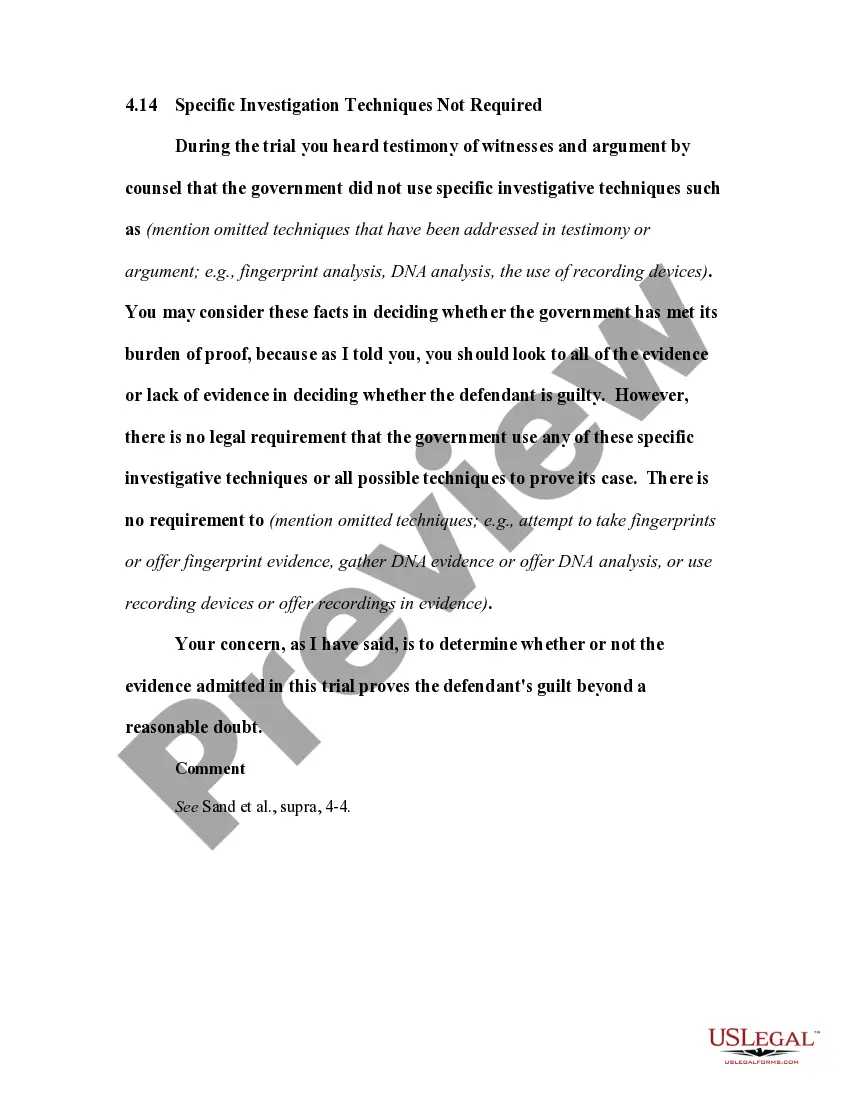
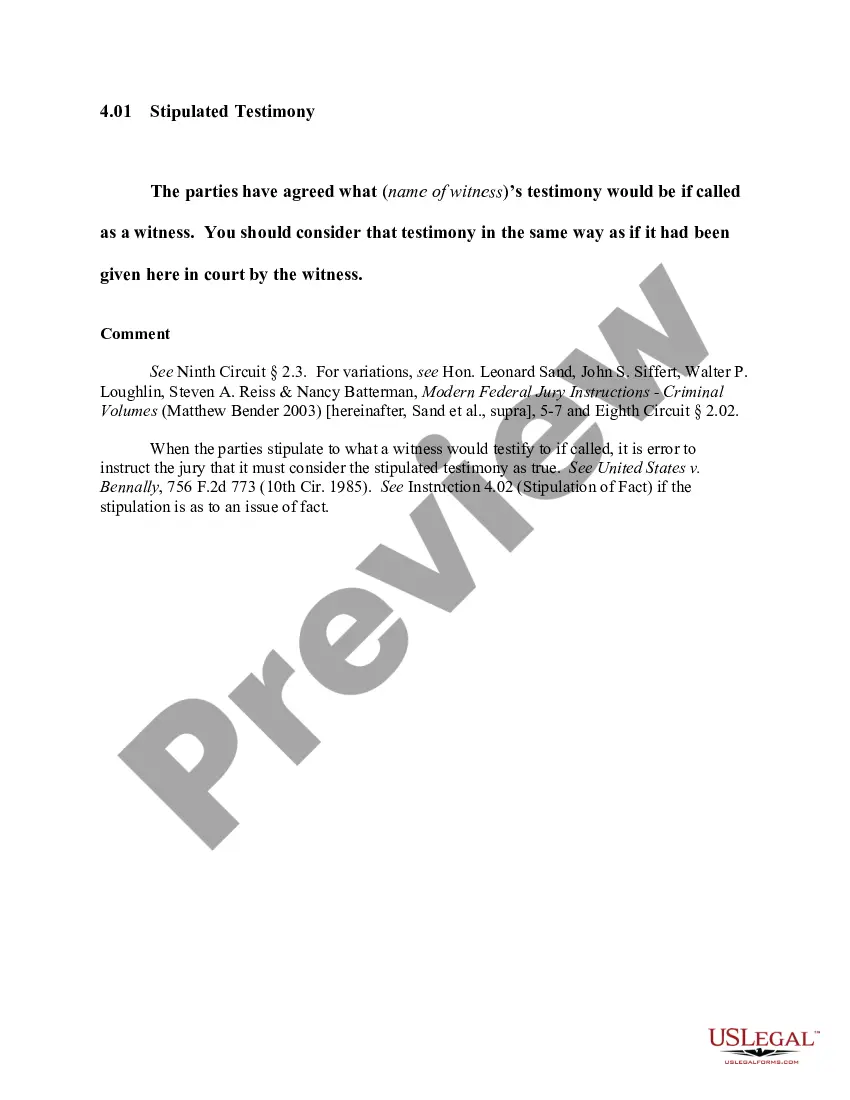
The specific investigation techniques not required form (revised 2016) is a legal instruction used in criminal trials. It clarifies that the government is not mandated to utilize specific investigative methods to establish a defendant's guilt. Instead, jurors must consider all evidence presented and determine whether it meets the burden of proof without relying on preconceived notions about standard investigative procedures.
Key parts of this document
- Clarification of the government's burden of proof.
- Explanation that specific investigative techniques are not legally required.
- Guidance for jurors to assess all evidence or lack thereof.
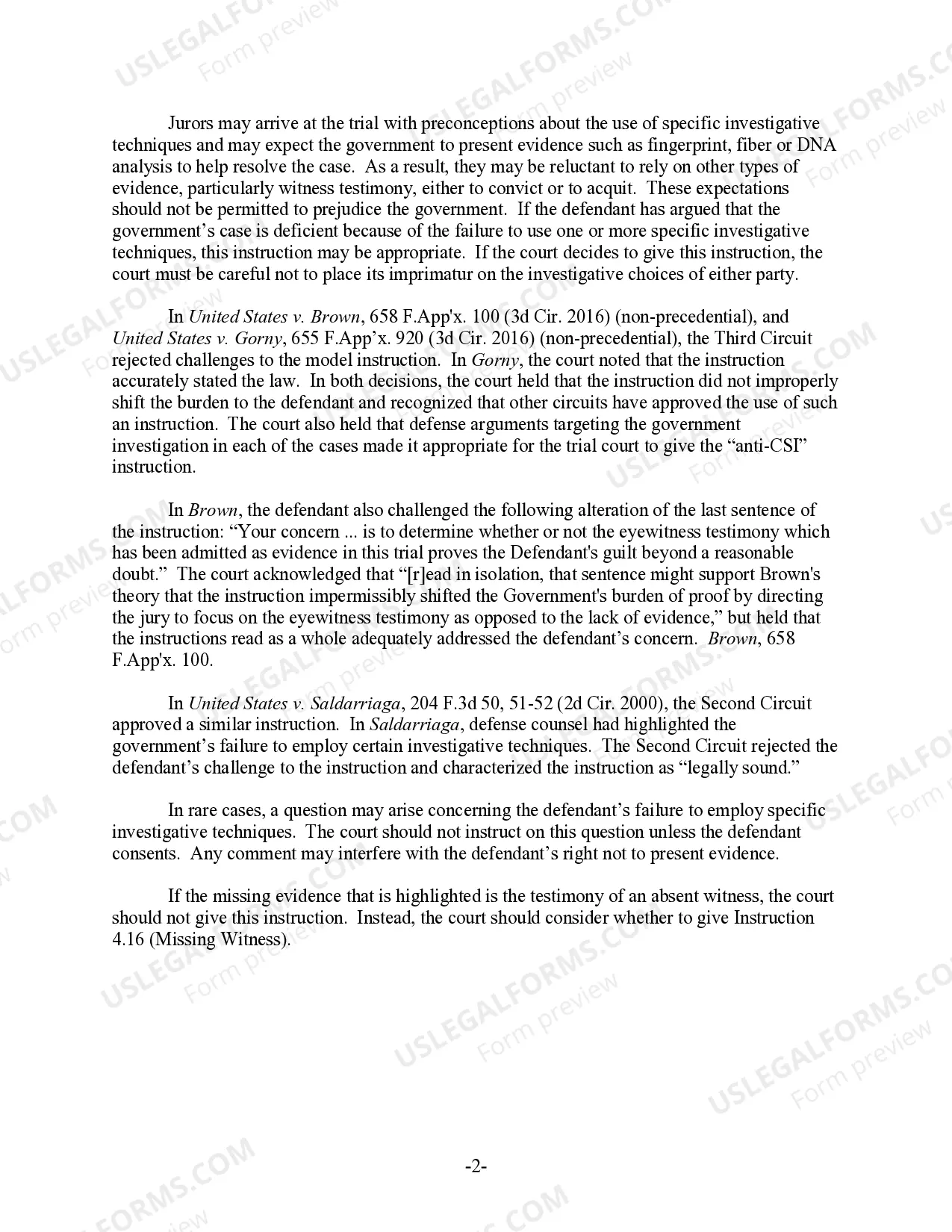
- Addressing potential prejudices jurors may have about evidence types.
- Context on when this instruction may be applicable in trials.
When to use this document
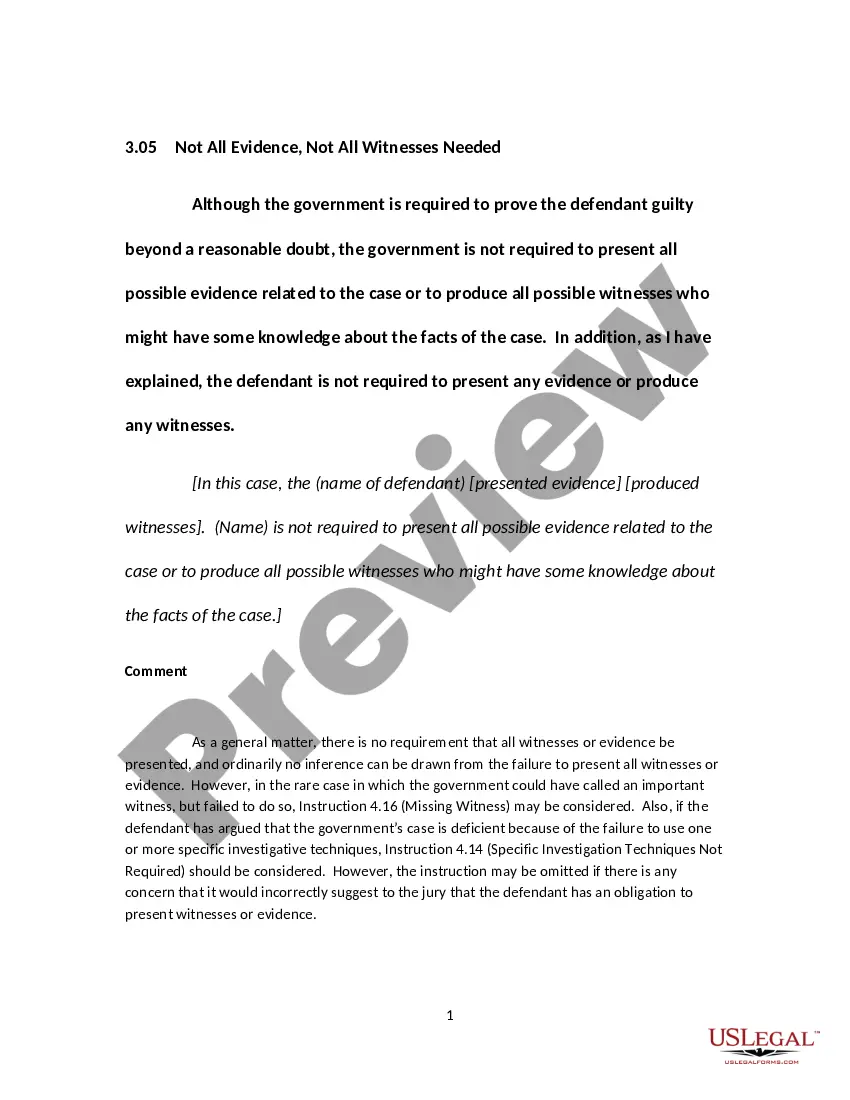
This form is used during criminal trials when the defense contends that the government has failed to use certain investigative techniques, such as fingerprinting or DNA analysis. It serves to inform jurors that the absence of these techniques does not diminish the government's ability to prove guilt beyond a reasonable doubt.
Who this form is for
- Judges presiding over criminal trials.
- Jurors who require guidance on evaluating evidence.
- Attorneys involved in criminal defense cases.
- Prosecutors addressing arguments from the defense regarding investigative techniques.
Instructions for completing this form
- Determine if a defendant has raised concerns about the lack of specific investigative techniques.
- Consider the evidence presented at trial, including witness testimonies.
- Instruct jurors on the legal standard of proof required to find a defendant guilty.
- Ensure jurors understand that the absence of particular investigative methods does not indicate weakness in the prosecution's case.
- Provide clarity on how to evaluate the overall evidence rather than focusing solely on investigative techniques.
Notarization requirements for this form
This form does not typically require notarization to be legally valid. However, some jurisdictions or document types may still require it. US Legal Forms provides secure online notarization powered by Notarize, available 24/7 for added convenience.
Get your form ready online
Our built-in tools help you complete, sign, share, and store your documents in one place.
Make edits, fill in missing information, and update formatting in US Legal Forms—just like you would in MS Word.
Download a copy, print it, send it by email, or mail it via USPS—whatever works best for your next step.
Sign and collect signatures with our SignNow integration. Send to multiple recipients, set reminders, and more. Go Premium to unlock E-Sign.
If this form requires notarization, complete it online through a secure video call—no need to meet a notary in person or wait for an appointment.
We protect your documents and personal data by following strict security and privacy standards.

Make edits, fill in missing information, and update formatting in US Legal Forms—just like you would in MS Word.

Download a copy, print it, send it by email, or mail it via USPS—whatever works best for your next step.

Sign and collect signatures with our SignNow integration. Send to multiple recipients, set reminders, and more. Go Premium to unlock E-Sign.

If this form requires notarization, complete it online through a secure video call—no need to meet a notary in person or wait for an appointment.

We protect your documents and personal data by following strict security and privacy standards.
Common mistakes to avoid
- Assuming specific investigative techniques are always necessary for a conviction.
- Focusing too heavily on absent evidence rather than the evidence actually presented.
- Neglecting to instruct jurors that their decision should be based on the overall case, not just selective evidence.
Benefits of completing this form online
- Convenience of accessing legal instructions anywhere.
- Editable format allows customization for specific cases.
- Reliability of attorney-drafted content ensures legal soundness.
Legal use & context
- This form is grounded in federal and state criminal law principles.
- It allows judges to provide clear instructions to jurors about evaluating the evidence.
- Ensures that jurors do not develop biases based on typical investigative procedures.
Looking for another form?

Form popularity
FAQ
Scientists use different methods of investigation in different circumstances. These methods include (in no particular order) fair testing, identifying and classifying, modelling, pattern seeking, and researching.
Here are the five steps. Define a Question to Investigate. As scientists conduct their research, they make observations and collect data.Make Predictions. Based on their research and observations, scientists will often come up with a hypothesis.Gather Data.Analyze the Data.Draw Conclusions.
It consists of gathering, securing, and examination of evidence aiming to establish facts substantiating or refuting allegations, and may consist of several stages (including initial consideration, preliminary assessment, and investigation).
Investigation protocols are a set of standard statements that publicly explain the process and expectations that guide the process. Once they're put in place, they exert tremendous power in making sure that the outcome of your investigation will be valid, transparent and legally defensible.
The Seven S'S of Crime-Scene Investigation Securing the Scene. Separating the Witnesses. Scanning the Scene. Seeing the Scene. Sketching the Scene. Searching for Evidence. Securing and Collecting Evidence.
The investigation of an offence consists of: Proceeding to the spot. Ascertainment of facts and circumstances of the case. Discovery and arrest of the suspect. Collection of evidence which may include:Formation of opinion as to whether there is a case for trial, and taking necessary steps ingly.
Six steps for successful incident investigation STEP 1 ? IMMEDIATE ACTION.STEP 2 ? PLAN THE INVESTIGATION.STEP 3 ? DATA COLLECTION.STEP 4 ? DATA ANALYSIS.STEP 5 ? CORRECTIVE ACTIONS.STEP 6 ? REPORTING.