Summaries - Underlying Evidence Not Admitted (F.R.E. 1006) (title revised 2013)
What this document covers
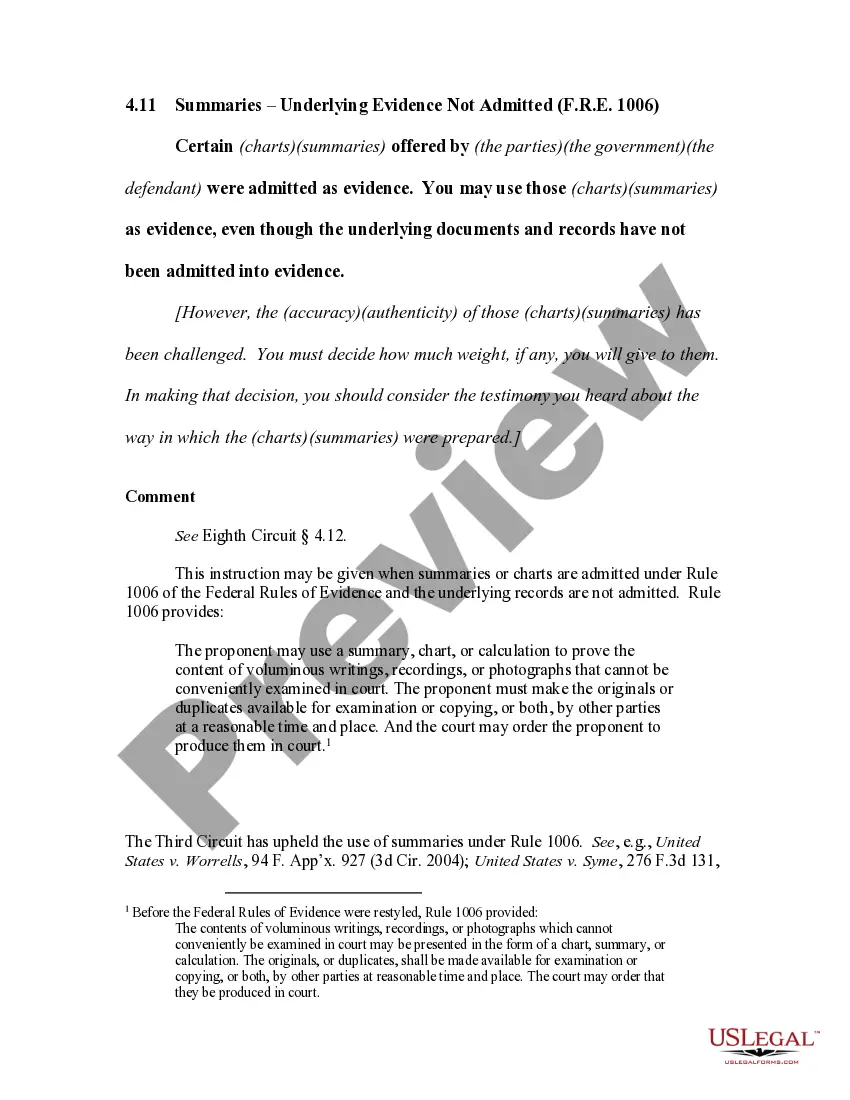
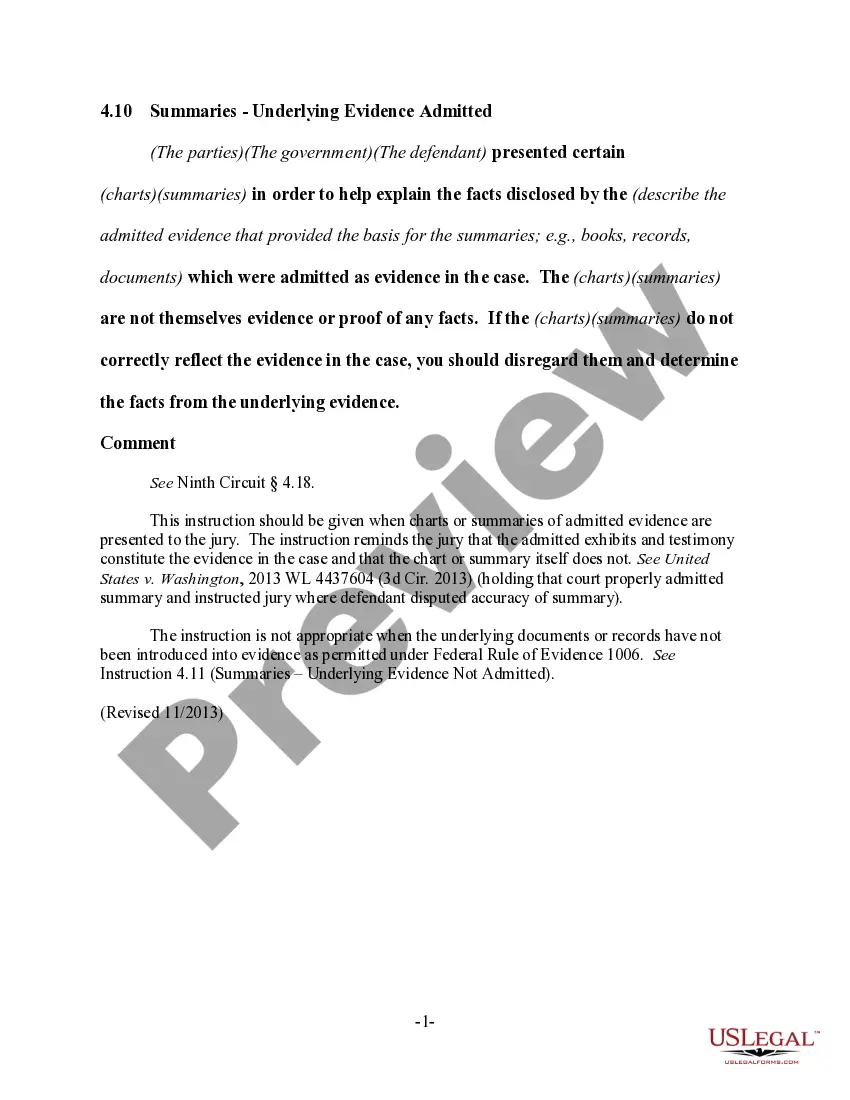
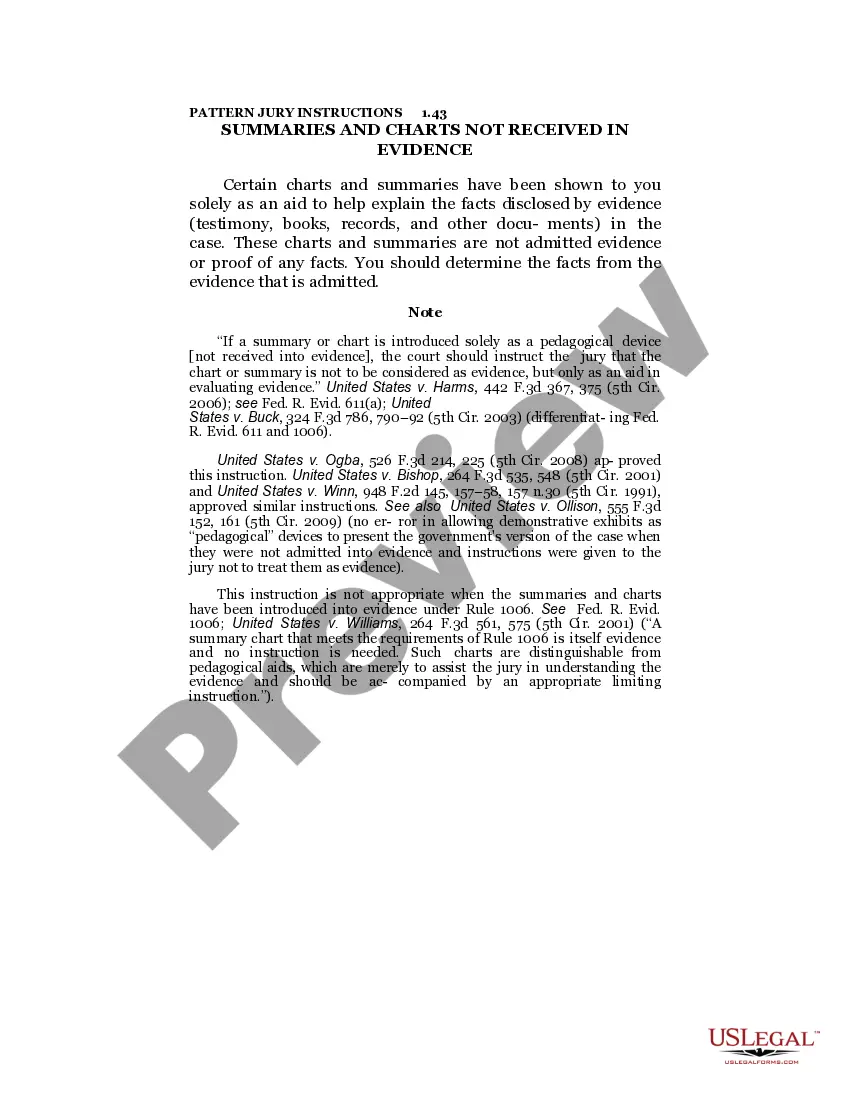
The Summaries - Underlying Evidence Not Admitted form, based on Federal Rule of Evidence 1006, allows parties in a legal case to present summaries or charts as evidence, even if the original documents have not been admitted. This form is critical for cases involving large volumes of records that are impractical to review in court, ensuring that relevant information can still be presented effectively, while the accuracy of these summaries may be subject to challenge.
What’s included in this form
- Introduction of summaries or charts as evidence.
- Consideration of the accuracy and authenticity of the provided summaries.
- Requirements for the proponent to provide underlying records for examination.
- Legal precedents supporting the use of summaries under Rule 1006.
- Guidance on jury instructions regarding the evaluation of the summaries.

Common use cases
This form is used in legal proceedings when a party wants to introduce a summary or chart derived from documents that are too voluminous to present in their entirety. It is particularly relevant when the original documents have not been admitted into evidence, ensuring that the jury can still consider crucial information that may affect the outcome of the case.
Who should use this form
- Lawyers representing clients in civil or criminal cases.
- Litigants needing to summarize voluminous records for court presentation.
- Parties involved in trials where evidence must be presented efficiently.
- Individuals seeking to challenge the credibility of summaries introduced by opposing parties.
How to complete this form
- Identify the parties involved in the case.
- Prepare a summary or chart based on admissible evidence.
- Ensure the underlying documents are accessible for cross-examination.
- Document any challenges to the accuracy or authenticity of the summary.
- Follow any specific legal references or instructions relevant to your jurisdiction.
Does this document require notarization?
This form usually doesn’t need to be notarized. However, local laws or specific transactions may require it. Our online notarization service, powered by Notarize, lets you complete it remotely through a secure video session, available 24/7.
Get your form ready online
Our built-in tools help you complete, sign, share, and store your documents in one place.
Make edits, fill in missing information, and update formatting in US Legal Forms—just like you would in MS Word.
Download a copy, print it, send it by email, or mail it via USPS—whatever works best for your next step.
Sign and collect signatures with our SignNow integration. Send to multiple recipients, set reminders, and more. Go Premium to unlock E-Sign.
If this form requires notarization, complete it online through a secure video call—no need to meet a notary in person or wait for an appointment.
We protect your documents and personal data by following strict security and privacy standards.

Make edits, fill in missing information, and update formatting in US Legal Forms—just like you would in MS Word.

Download a copy, print it, send it by email, or mail it via USPS—whatever works best for your next step.

Sign and collect signatures with our SignNow integration. Send to multiple recipients, set reminders, and more. Go Premium to unlock E-Sign.

If this form requires notarization, complete it online through a secure video call—no need to meet a notary in person or wait for an appointment.

We protect your documents and personal data by following strict security and privacy standards.
Typical mistakes to avoid
- Failing to provide underlying documents for examination, which is a prerequisite for the use of summaries.
- Not adequately addressing challenges to the accuracy or authenticity of the chart or summary.
- Overlooking local court rules that may modify the application of F.R.E. 1006.
- Using summaries based on inadmissible evidence, which can lead to dismissal.
Benefits of using this form online
- Convenient access to legal forms that can be downloaded and printed from home.
- Editability allows users to customize the form as needed for their specific case.
- Reliability in utilizing attorney-drafted content aligned with current laws.
- Immediate availability of forms, streamlining the legal process and reducing delays.
Legal use & context
- Summaries must be based on admissible evidence.
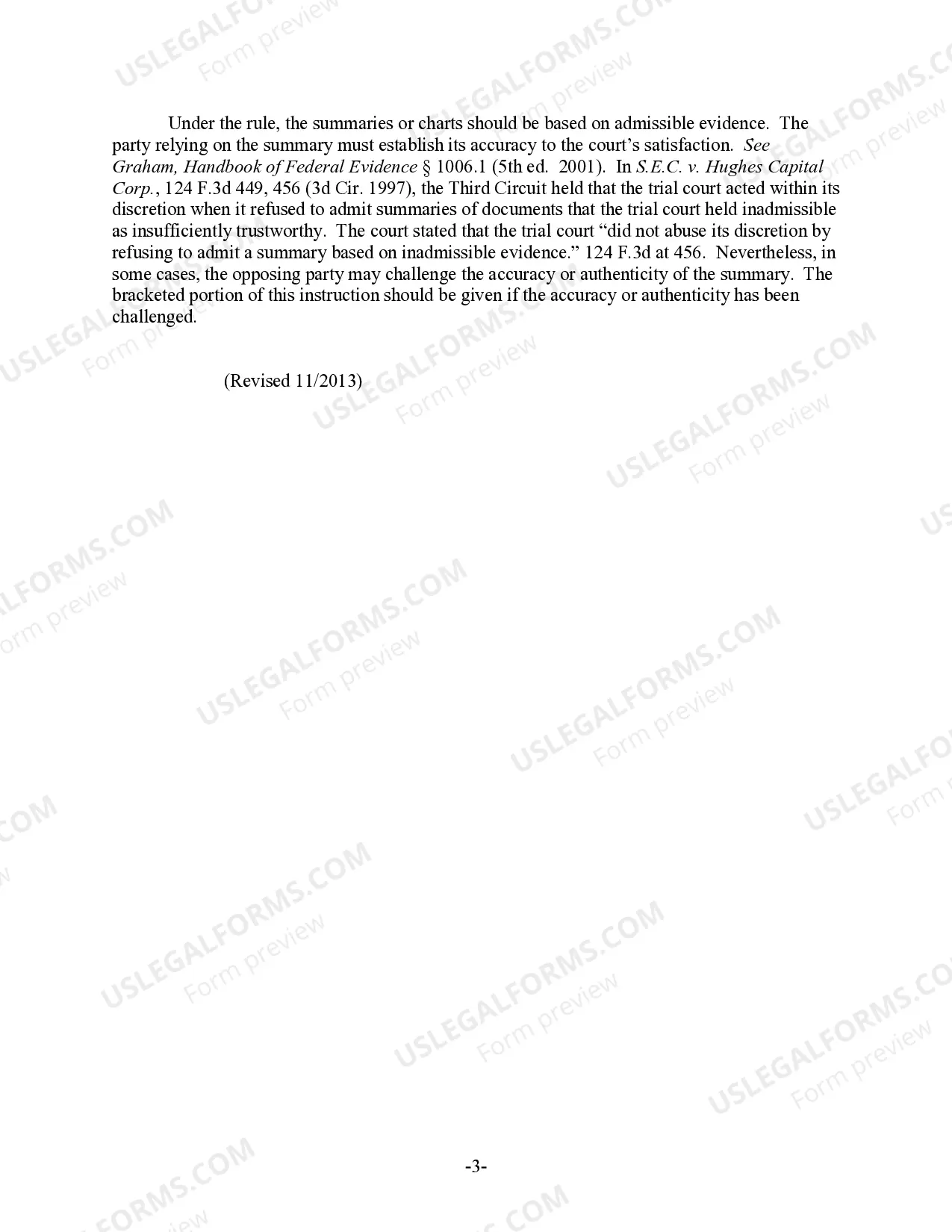
- The proponent must establish the accuracy of summaries to the court's satisfaction.
- Judicial discretion is involved in the admission of summaries based on underlying evidence challenges.
- F.R.E. 1006 supports the use of summaries to aid in presenting complex information clearly.
Summary of main points
- The form allows for the use of summaries when direct evidence is not admitted.
- Understand the importance of establishing the accuracy of the summaries presented.
- Consult both federal and relevant state rules regarding the use of this form.
- Be aware of potential challenges from opposing parties regarding evidence reliability.
Looking for another form?

Form popularity
FAQ
There are five key steps that can help you to write a summary: Read the text. Break it down into sections. Identify the key points in each section. Write the summary. Check the summary against the article.
As the Federal Rules of Evidence puts it, evidence is relevant if: ?it has any tendency to make a fact more or less probable than it would be without the evidence; and. the fact is of consequence in determining the action" (FRE 4.01).
The act of summarizing is much like stating the plot of a play. For instance, if you were asked to summarize the story of Shakespeare's 'Hamlet,' you might say: It's the story of a young prince of Denmark who discovers that his uncle and his mother have killed his father, the former king.
The proponent may use a summary, chart, or calculation to prove the content of voluminous writings, recordings, or photographs that cannot be conveniently examined in court.
An evidence summary is a short summary of the best available evidence on a defined question. It aims to help policymakers and practitioners use the best available evidence in their decision making about interventions.
While an abstract is a short, descriptive paragraph overviewing your entire paper from introduction to the findings or future studies, a summary includes your entire paper and its visuals, just in a shorter length and more concise than it's original document.
Rule 1006. The proponent must make the originals or duplicates available for examination or copying, or both, by other parties at a reasonable time and place. And the court may order the proponent to produce them in court.
As the Federal Rules of Evidence puts it, evidence is relevant if: ?it has any tendency to make a fact more or less probable than it would be without the evidence; and. the fact is of consequence in determining the action" (FRE 4.01).