Job Offer Letter for Judge
Overview of this form
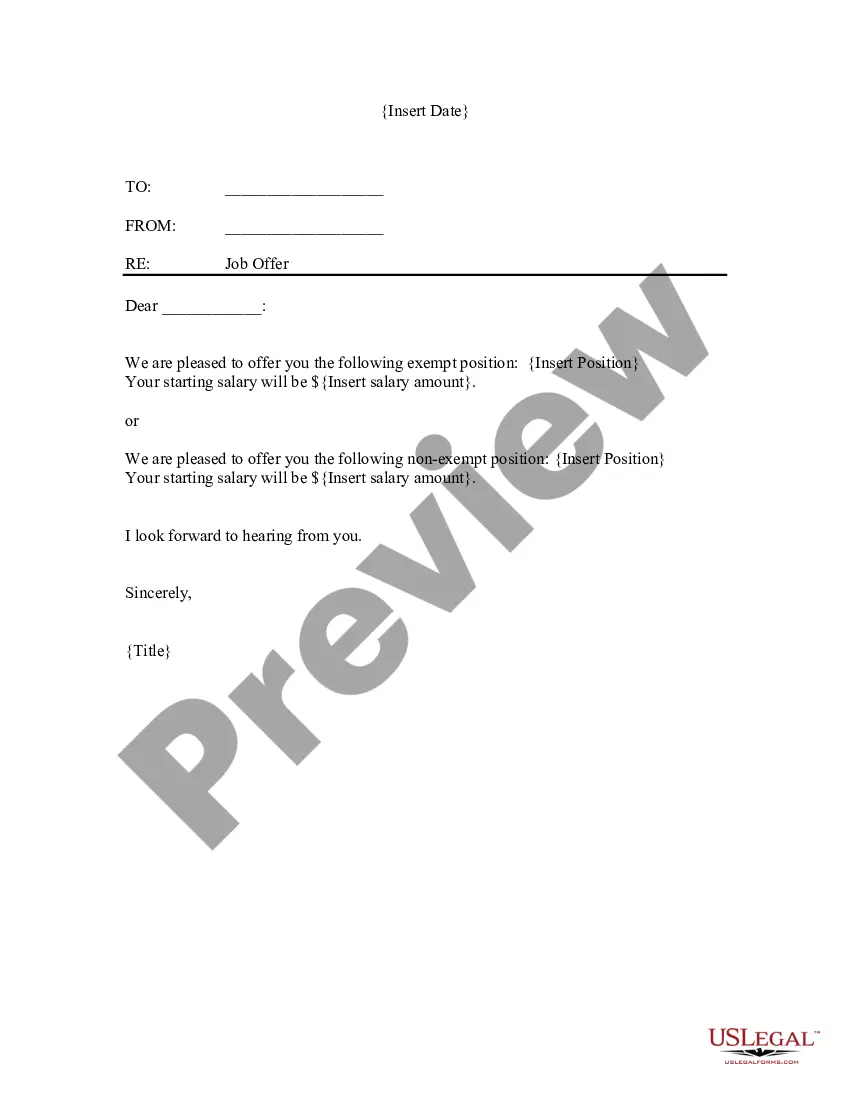
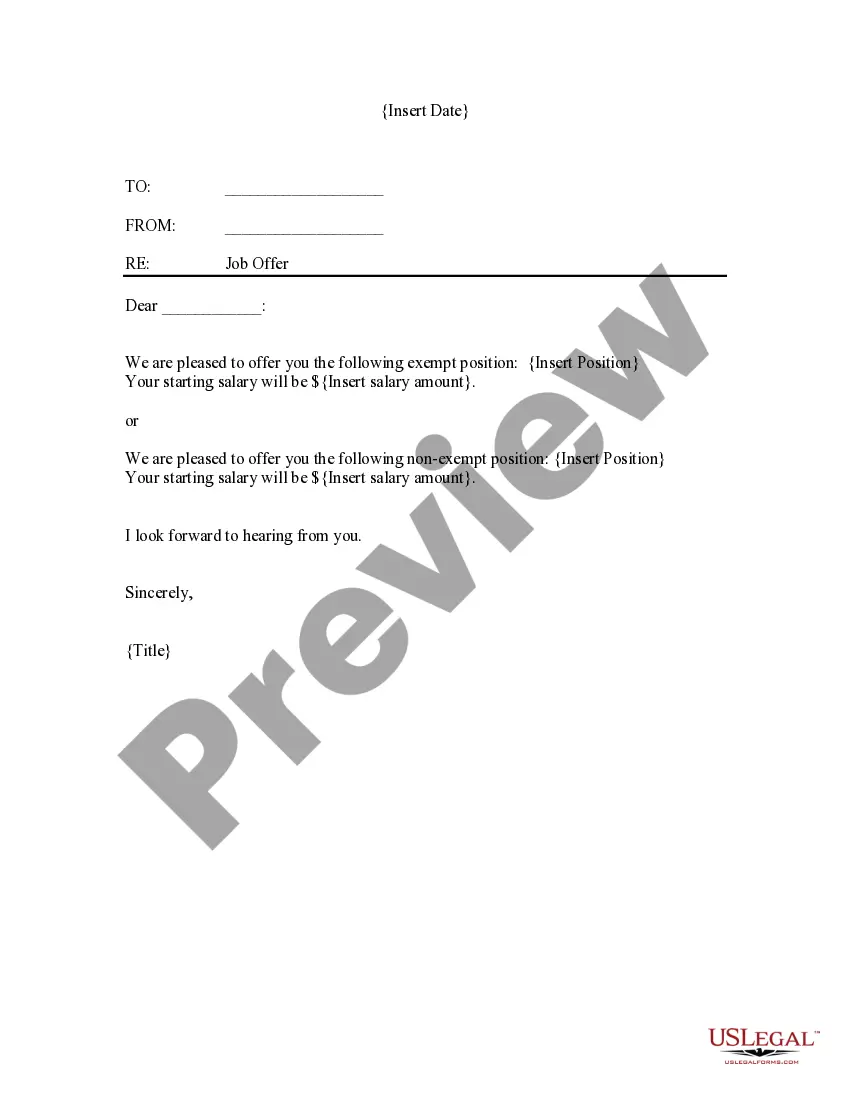
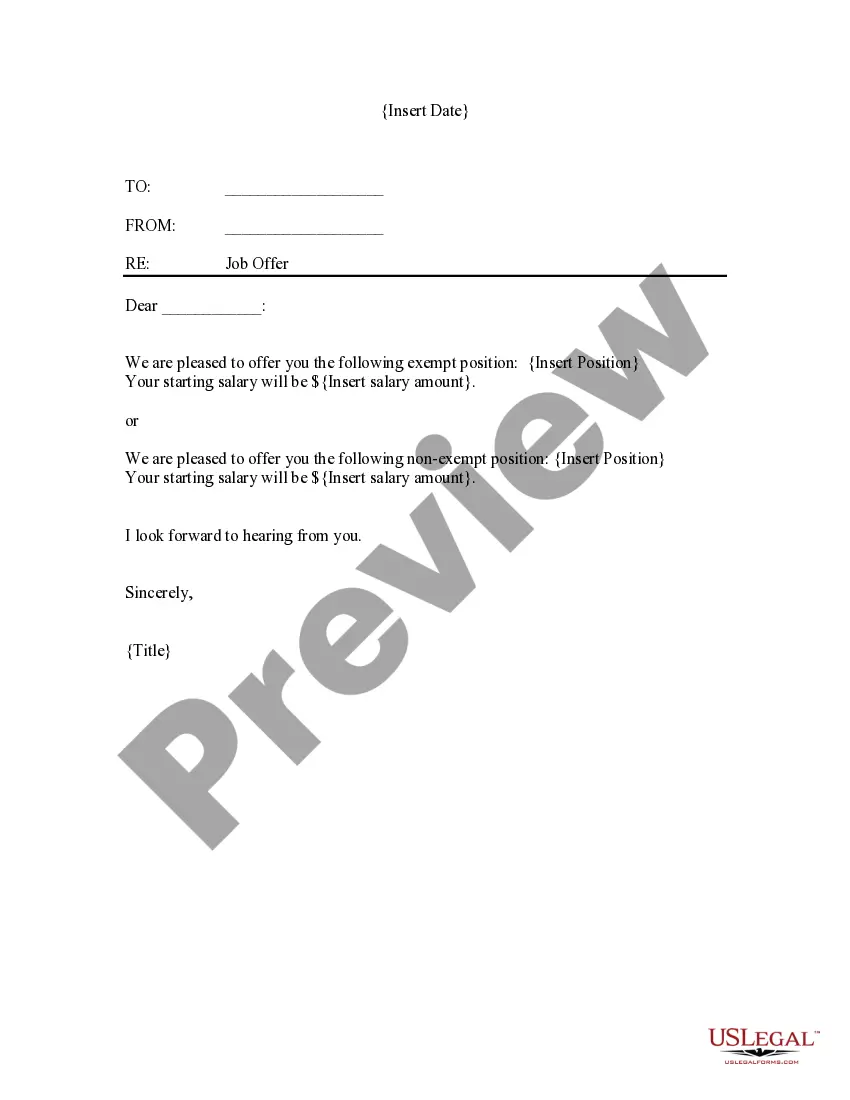
The Job Offer Letter for Judge is a formal document that communicates an employment offer to an individual for a judicial position. This letter specifies whether the role is exempt or non-exempt and includes key employment details, setting it apart from general job offer letters by its focus on judicial positions within the legal system.
Form components explained
- Recipient's name and contact information
- Sender's name and title
- Job title and classification (exempt or non-exempt)
- Starting salary
- Closing statement expressing anticipation of acceptance

When to use this document
You would use the Job Offer Letter for Judge when you have finalized a candidate for a judicial position and need to formally convey the job offer. This is essential when hiring judges for courts at various levels, ensuring candidates receive all pertinent job details in a professional format.
Who can use this document
This form is intended for:
- Judicial hiring committees
- Law firms or legal organizations offering judicial roles
- Human resources personnel dealing with legal positions
How to prepare this document
- Identify the recipient's name and contact details.
- Insert the senderâs name and title.
- Specify the position title and whether it is exempt or non-exempt.
- Enter the starting salary for the position.
- Sign and date the letter before sending it to the candidate.
Does this form need to be notarized?
This form does not typically require notarization unless specified by local law.
Get your form ready online
Our built-in tools help you complete, sign, share, and store your documents in one place.
Make edits, fill in missing information, and update formatting in US Legal Forms—just like you would in MS Word.
Download a copy, print it, send it by email, or mail it via USPS—whatever works best for your next step.
Sign and collect signatures with our SignNow integration. Send to multiple recipients, set reminders, and more. Go Premium to unlock E-Sign.
If this form requires notarization, complete it online through a secure video call—no need to meet a notary in person or wait for an appointment.
We protect your documents and personal data by following strict security and privacy standards.

Make edits, fill in missing information, and update formatting in US Legal Forms—just like you would in MS Word.

Download a copy, print it, send it by email, or mail it via USPS—whatever works best for your next step.

Sign and collect signatures with our SignNow integration. Send to multiple recipients, set reminders, and more. Go Premium to unlock E-Sign.

If this form requires notarization, complete it online through a secure video call—no need to meet a notary in person or wait for an appointment.

We protect your documents and personal data by following strict security and privacy standards.
Common mistakes to avoid
- Forgetting to specify if the position is exempt or non-exempt.
- Omitting the starting salary or providing an incorrect amount.
- Not including official titles or relevant details about the judicial role.
Why use this form online
- Easy access to downloadable templates designed by legal experts.
- Time-efficient; quickly create personalized job offers.
- Editable format allows for customization to suit specific needs.
Legal use & context
- Job offer letters are legally binding once accepted by the candidate.
- Ensure compliance with state-specific employment laws when issuing offers.
- Providing clear terms helps in preventing misunderstandings and disputes.
Quick recap
- The Job Offer Letter for Judge is critical for formally presenting employment offers to candidates in judicial roles.
- Completing the form accurately is vital for leaving a positive impression and ensuring clear communication.
- Using this online form streamlines the process of creating job offers and enhances convenience.
Looking for another form?

Form popularity
FAQ
You can't write to the judge. You can hire your own attorney to make your case to the court.
You can address most judges at the start of a letter as "Dear Judge" (or "Dear Justice" if they serve in a U.S. state or federal Supreme Court, or in certain courts of other countries). When addressing the envelope, it is best to use the judge's full title, along with the full name of the court in which he/she serves.
Open with a salutation.Write "Dear Judge (last name)," to start your letter. Note that you use "the Honorable" when referring to the judge, but use "Judge" when addressing him or her in person. The title still applies even if the judge has retired.
Use "Re:" (an abbreviation for "regarding" or "with reference to"), followed by a brief identifying phrase. Begin with a salutation. Write "Dear Judge (last name)," to start the message of your letter. Note that you should use "the Honorable" when referring to the judge, but use "Judge" addressing him or her directly.
However, when a person is awaiting trial, writing a letter to the judge will not help. At best, the letter will go unread by the judge, and will be of no help. In a worst-case scenario, the letter will end up being used by the prosecution as evidence against that person.
Thanks and appreciation for the opportunity. Written acceptance of the job offer. The terms and conditions of employment (salary, benefits, job title, etc.) Starting date of employment.
Character letters should include your name, mailing address, phone number and email address so that the court can verify your information. They should be addressed either to the Honorable FIRST NAME LAST NAME or Judge FIRST NAME LAST NAME.
You put "p.p." in front of the name of the person for whom you are writing the letter -- p.p. stands for "per pro" (for and on behalf of).