Request for an Individuals Health Information
What is this form?
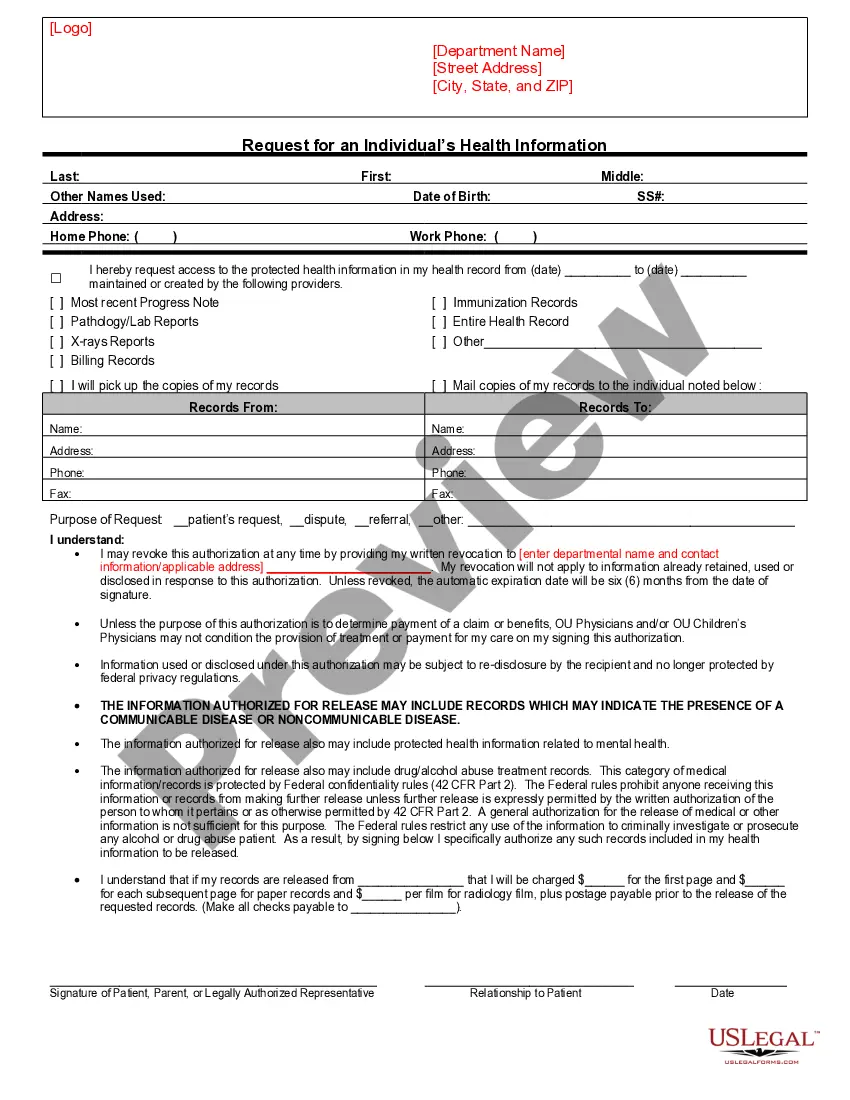
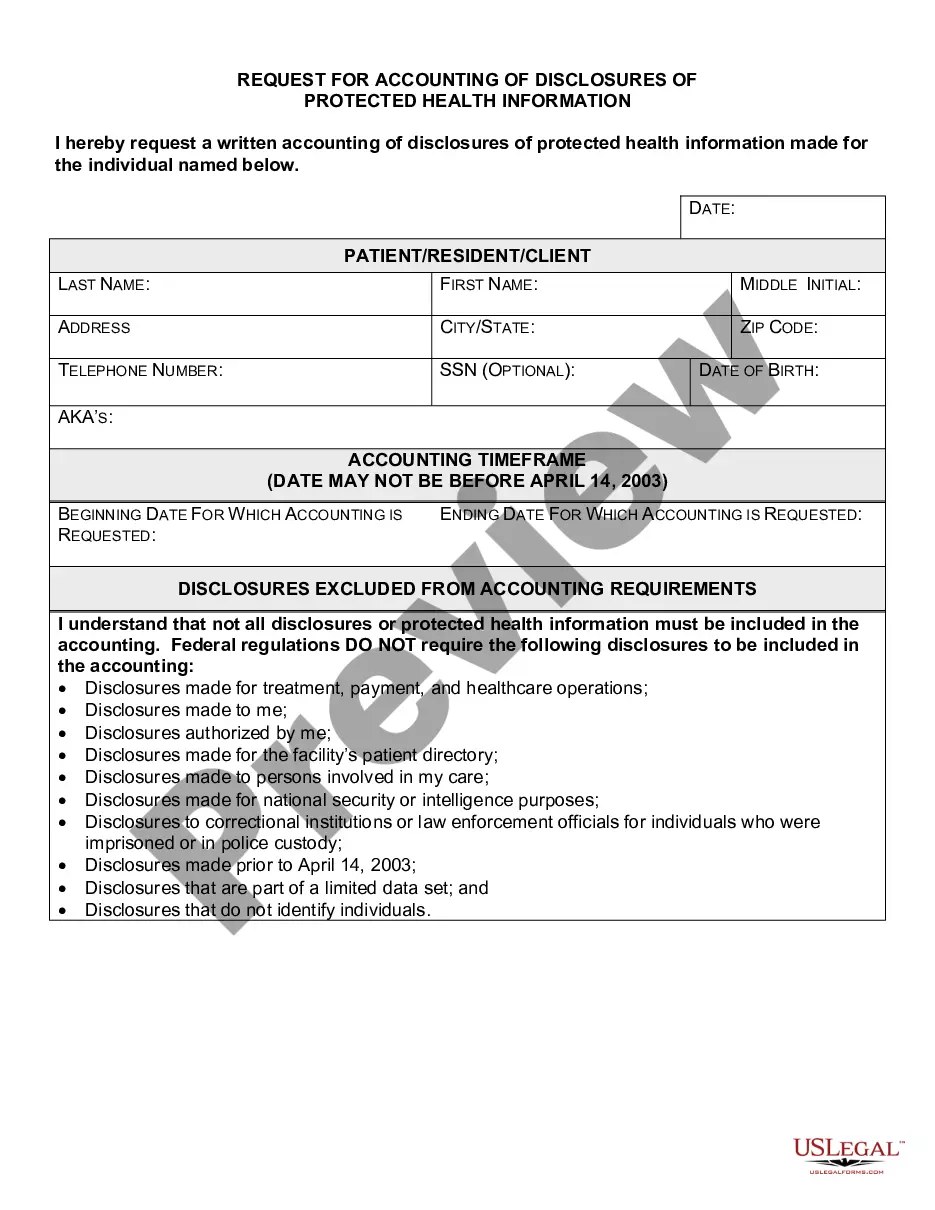
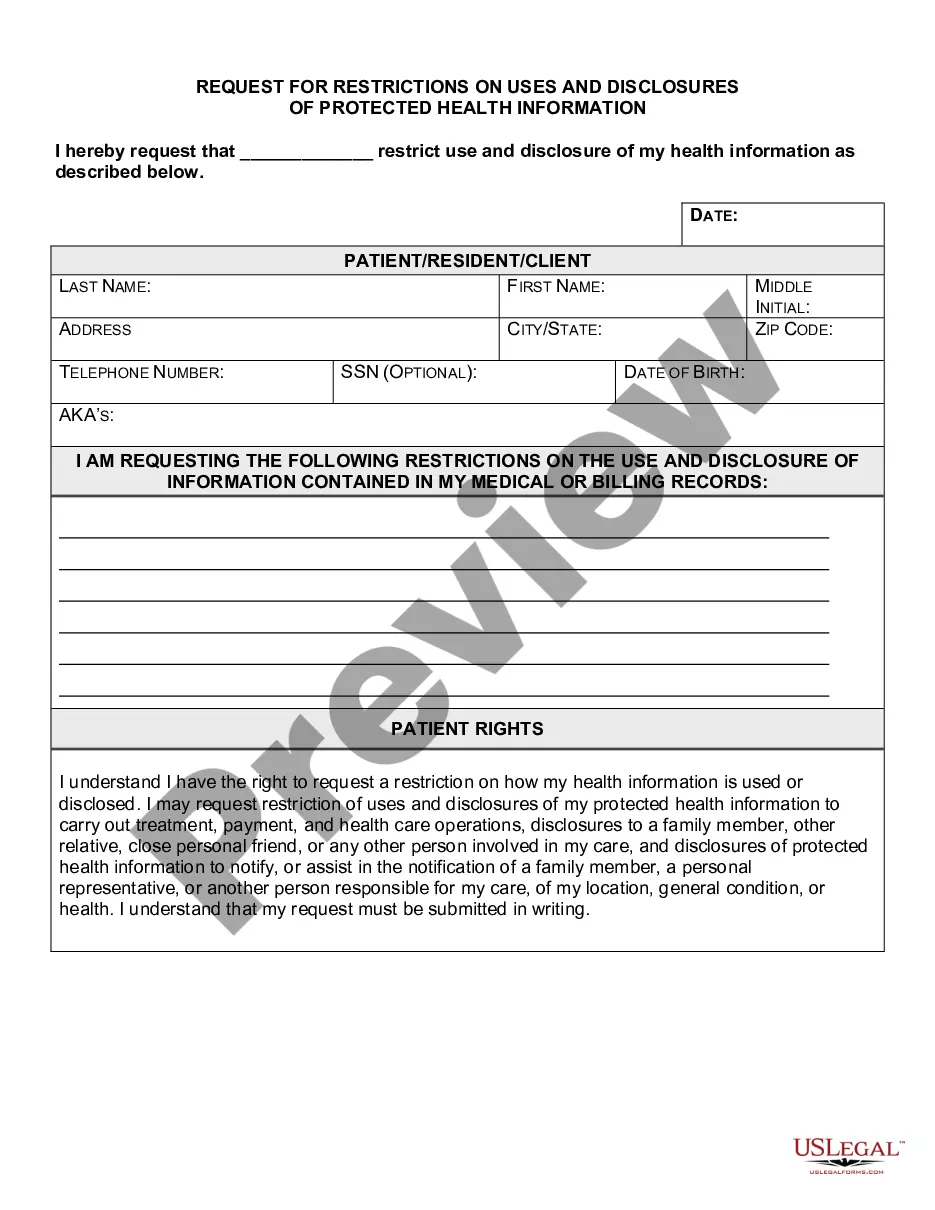
The Request for an Individual's Health Information is a legal document that allows an individual to request access to their protected health information. This form stands out because it acknowledges the rights of the individual regarding their health information access, particularly in cases where sensitive data, such as mental health or drug/alcohol abuse treatment records, is involved. It is essential for individuals who wish to understand and control their medical records while ensuring that their sensitive information is handled according to federal privacy regulations.
What’s included in this form
- Personal identification information of the requestor.
- Details of the specific health information being requested.
- Acknowledgment of the rights regarding the access and use of the health information.
- Authority to release information related to mental health and substance abuse treatment.
- Signature and date, signifying consent to release the requested information.
When to use this form
This form should be used when an individual wants to obtain their protected health information for personal review, medical consultations, or when switching healthcare providers. It is particularly important for individuals requiring access to sensitive information that is typically more restricted by federal privacy laws. Examples include requesting records from a therapist or obtaining past medication records from a doctor.
Who needs this form
- Individuals seeking to access their medical records.
- Patients transitioning between healthcare providers.
- People who want to review mental health and substance abuse treatment records.
- Any person who wishes to ensure their health information is shared appropriately and with consent.
Completing this form step by step
- Enter your personal identification details, including name and contact information.
- Clearly specify the type of health information you are requesting.
- Acknowledge your rights regarding the information access as outlined in the form.
- Sign and date the form to provide your consent for the release of your health information.
- Submit the completed form to the relevant healthcare provider or organization.
Is notarization required?
Notarization is not commonly needed for this form. However, certain documents or local rules may make it necessary. Our notarization service, powered by Notarize, allows you to finalize it securely online anytime, day or night.
Get your form ready online
Our built-in tools help you complete, sign, share, and store your documents in one place.
Make edits, fill in missing information, and update formatting in US Legal Forms—just like you would in MS Word.
Download a copy, print it, send it by email, or mail it via USPS—whatever works best for your next step.
Sign and collect signatures with our SignNow integration. Send to multiple recipients, set reminders, and more. Go Premium to unlock E-Sign.
If this form requires notarization, complete it online through a secure video call—no need to meet a notary in person or wait for an appointment.
We protect your documents and personal data by following strict security and privacy standards.

Make edits, fill in missing information, and update formatting in US Legal Forms—just like you would in MS Word.

Download a copy, print it, send it by email, or mail it via USPS—whatever works best for your next step.

Sign and collect signatures with our SignNow integration. Send to multiple recipients, set reminders, and more. Go Premium to unlock E-Sign.

If this form requires notarization, complete it online through a secure video call—no need to meet a notary in person or wait for an appointment.

We protect your documents and personal data by following strict security and privacy standards.
Common mistakes
- Failing to specify the exact health information needed.
- Not signing or dating the form, making it invalid.
- Overlooking state-specific regulations that affect the request process.
- Neglecting to clarify whether consent includes sensitive information regarding mental health or substance abuse records.
Why complete this form online
- Convenient access to templates available for instant download.
- Editable forms allow users to personalize their requests quickly and easily.
- Reliable forms drafted by licensed attorneys ensure compliance with legal standards.
Summary of main points
- The form is essential for individuals wanting access to their health information.
- It includes specific clauses regarding mental health and substance abuse records.
- Proper completion and submission are crucial for validity and compliance with privacy laws.
Glossary of terms
- Protected Health Information: Any health information that can be linked to a specific individual.
- Authorization: A formal permission required for the release of health information.
- Substance Abuse Records: Confidential health information related to an individual's history of drug or alcohol use.
Looking for another form?
Form popularity
FAQ
To enable you to authorize someone else to access your records, TriCore provides the form, Patient Authorization to Disclose Protected Health Information. This Guide provides you with a copy of the form (the last page of the Guide), and step-by-step instructions for completing and submitting it to TriCore.
You have a legal right to copies of your own medical records. A loved one or caregiver may have the right to get copies of your medical records, too, but you may have to provide written permission. Your health care providers have a right to see and share your records with anyone else to whom you've granted permission.
Yes. The Privacy Rule allows covered health care providers to share protected health information for treatment purposes without patient authorization, as long as they use reasonable safeguards when doing so. These treatment communications may occur orally or in writing, by phone, fax, e-mail, or otherwise.
Under the federal law known as HIPAA, it's illegal for health care providers to share patients' treatment information without their permission.
Visit: www.myhealthrecord.gov.au. Call the My Health Record Helpdesk on 1800 723 471.
You can formally request specific information from the Ministry of Health. In limited circumstances, access to information will require a formal access application. A copy of an application form that you may use to request information held by the Ministry of Health is available.
Patient names. Addresses In particular, anything more specific than state, including street address, city, county, precinct, and in most cases zip code, and their equivalent geocodes. Dates Including birth, discharge, admittance, and death dates. Telephone and fax numbers. Email addresses.
Dear Recipient's name, I am writing you to request copies of my medical records. I was treated in your office on xx/xx/xxxx. Please include all of my charts, test results, and consultation notes including referrals regarding my medical care.
Only you or your personal representative has the right to access your records. A health care provider or health plan may send copies of your records to another provider or health plan only as needed for treatment or payment or with your permission.