USLegal Pamphlet on Pardons or Clemency
What this document covers
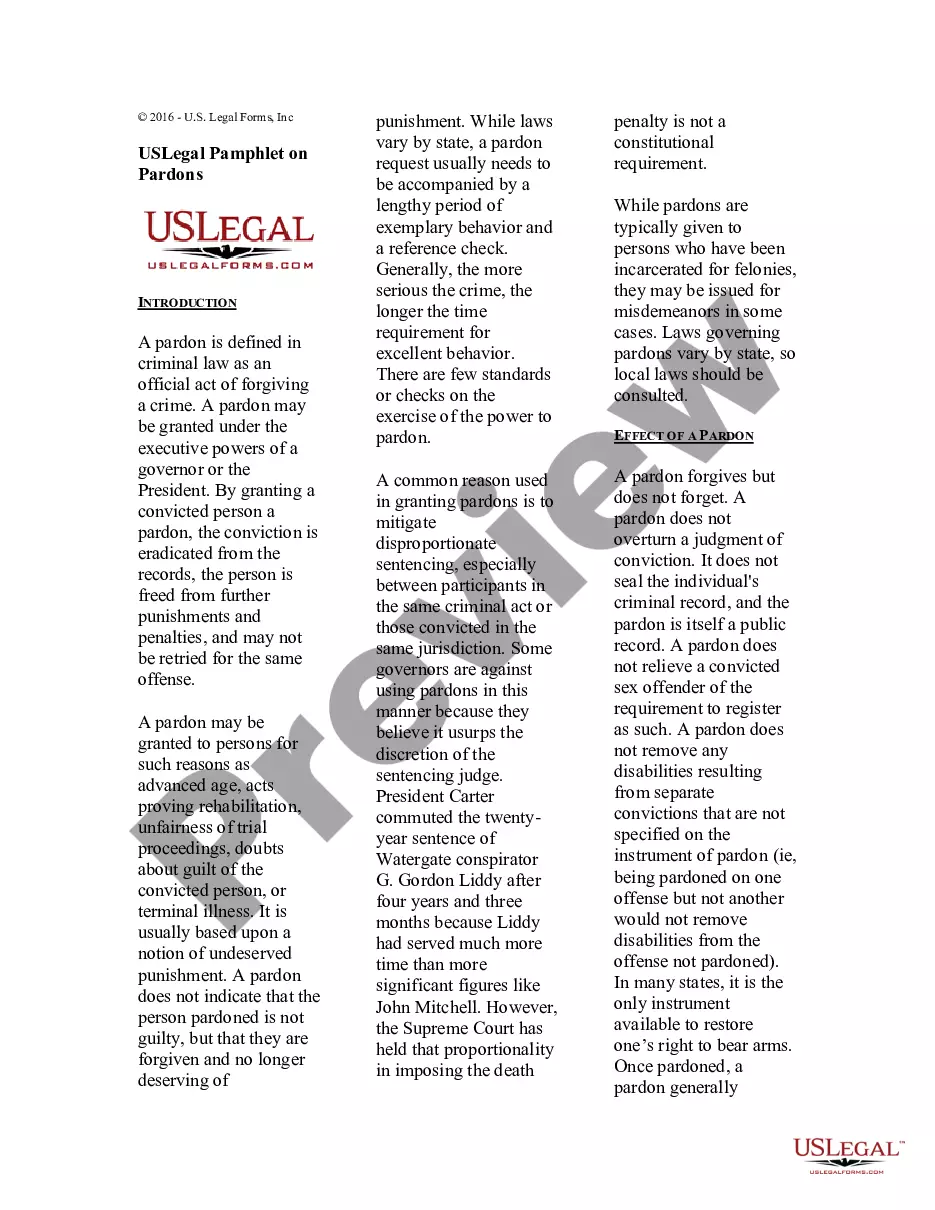
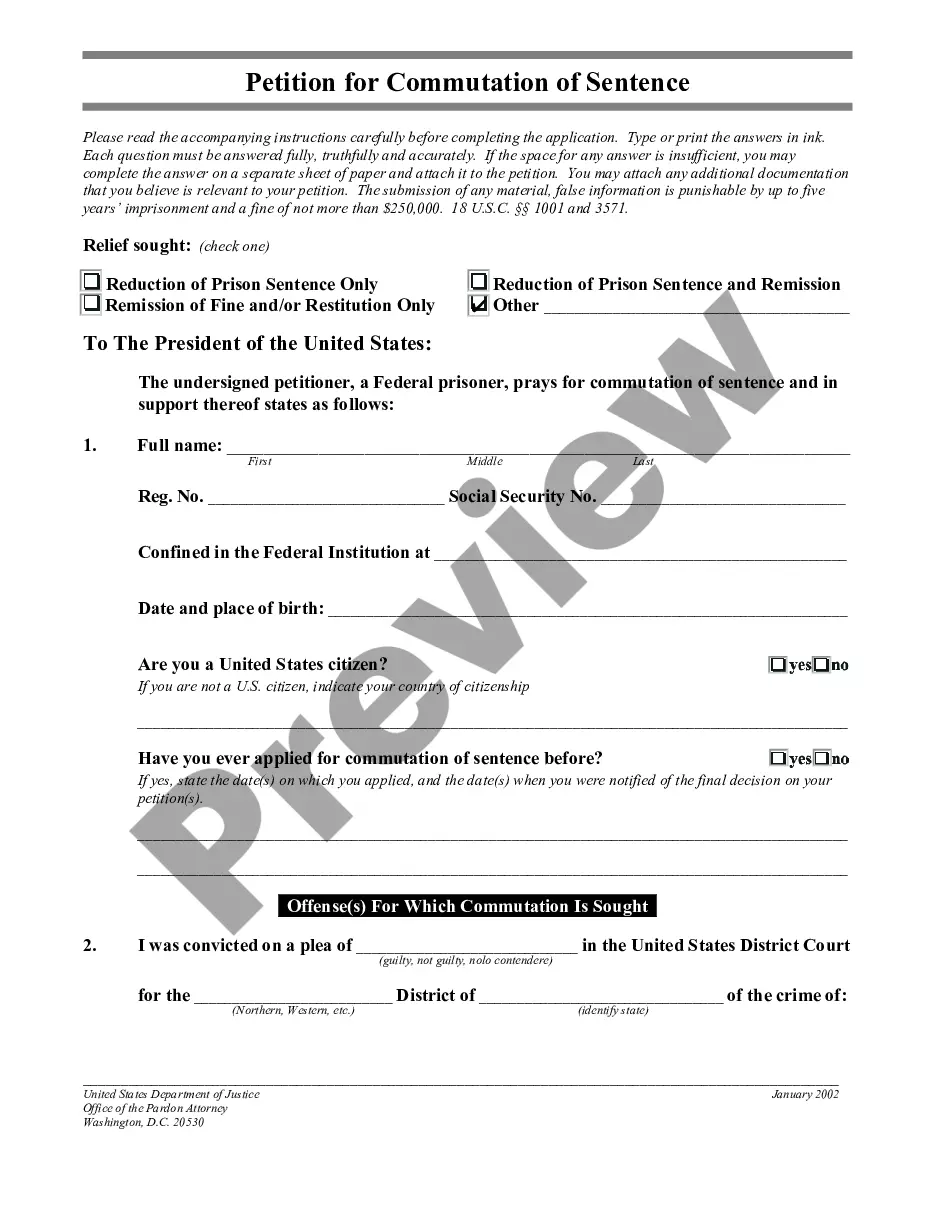
The USLegal Pamphlet on Pardons or Clemency provides a comprehensive overview of the concept of a pardon in criminal law. This pamphlet distinguishes pardons from other legal remedies by explaining their purpose, the types of pardons available, and the specific effects they have on a convicted person's record. Unlike expungement, a pardon acknowledges the conviction but provides forgiveness, allowing individuals to move forward without serving further punitive measures.
Key components of this form
- Definition of a pardon and its implications
- Details on different types of pardons
- Information on the effects of a pardon on criminal records
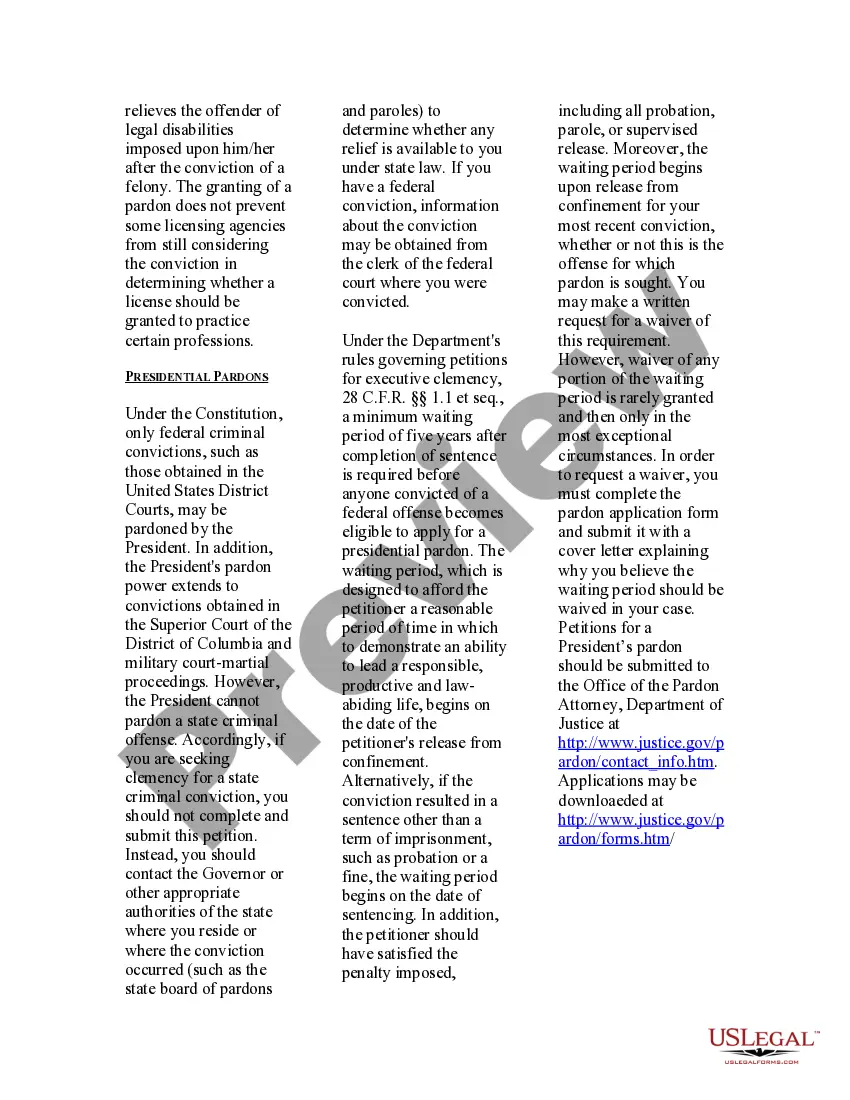
- Overview of the presidential pardon process for federal crimes
- Eligibility criteria and waiting periods for applying for a pardon
Situations where this form applies
This pamphlet is useful in situations where individuals are seeking to understand the process of obtaining a pardon or clemency. You may want to refer to this pamphlet if you or someone you know has a criminal conviction and is considering applying for a pardon due to reasons like demonstrated rehabilitation, age, or inconsistent trial fairness. It is also relevant for those seeking to explore their rights after a conviction.
Who should use this form
- Individuals convicted of federal crimes seeking a presidential pardon
- People interested in understanding the implications of a pardon
- Families and advocates of those with criminal records
- Legal professionals guiding clients through the pardon process
How to prepare this document
- Review the eligibility criteria for a pardon based on your conviction type.
- Gather necessary documentation proving rehabilitation and good behavior.
- Complete the pardon application form as directed by the appropriate authorities.
- Submit your application to the designated office, such as the Office of the Pardon Attorney for federal cases.
- Prepare for possible follow-up or additional information requests during the review process.
Notarization guidance
This form does not typically require notarization unless specified by local law. However, some additional documentation you provide may need to be notarized, depending on the jurisdiction or specific requirements outlined during the application process.
Get your form ready online
Our built-in tools help you complete, sign, share, and store your documents in one place.
Make edits, fill in missing information, and update formatting in US Legal Forms—just like you would in MS Word.
Download a copy, print it, send it by email, or mail it via USPS—whatever works best for your next step.
Sign and collect signatures with our SignNow integration. Send to multiple recipients, set reminders, and more. Go Premium to unlock E-Sign.
If this form requires notarization, complete it online through a secure video call—no need to meet a notary in person or wait for an appointment.
We protect your documents and personal data by following strict security and privacy standards.

Make edits, fill in missing information, and update formatting in US Legal Forms—just like you would in MS Word.

Download a copy, print it, send it by email, or mail it via USPS—whatever works best for your next step.

Sign and collect signatures with our SignNow integration. Send to multiple recipients, set reminders, and more. Go Premium to unlock E-Sign.

If this form requires notarization, complete it online through a secure video call—no need to meet a notary in person or wait for an appointment.

We protect your documents and personal data by following strict security and privacy standards.
Avoid these common issues
- Failing to meet the eligibility waiting period before applying
- Not documenting sufficient evidence of rehabilitation
- Ignoring the requirement for a cover letter when requesting a waiver of the waiting period
- Applying for a presidential pardon when the conviction is state-related
Benefits of using this form online
- Convenience of accessing information and forms at any time
- Editability allows you to customize your application before submission
- Access to forms drafted by licensed attorneys ensures accuracy
- Immediate downloads provide quick assistance in your pardon application process
Legal use & context
- Pardons are legal acts that forgive a conviction but do not erase it from record.
- Eligibility and rules vary widely between federal and state jurisdictions.
- Understanding the limits of a pardon is crucial, as certain rights may not be restored.
Main things to remember
- A pardon forgives but does not erase a criminal conviction.
- Federal pardons differ from state pardons in terms of eligibility and process.
- Demonstrated rehabilitation and a waiting period are usually required.
Looking for another form?
Form popularity
FAQ
Submit a completed Pardon Application (2 pages) to the Governor's Office. Submit a completed Notice of Intent to Apply for Clemency (1 page) to the district attorney(s) in the county or counties of the conviction(s) for the offense(s) for which you are requesting a pardon.
A waiver of any portion of the waiting period is rarely granted and then only in the most exceptional circumstances. In order to request a waiver, you must complete the pardon application form and submit it with a letter explaining why you believe the waiting period should be waived in your case.
State clearly and succinctly that you are writing to support the person's application for a pardon. You also should indicate that you have knowledge and understanding of the criminal conviction for which the person is seeking a pardon.
Clemency under the criminal justice system is the act by an executive member of the government of extending mercy to a convicted individual. In the United States, clemency is granted by a governor for state crimes and by the presidential pardon power to people convicted of violating federal law.
If you want to request a presidential pardon you must submit your application to the Office of the Pardon Attorney. Whenever the Office of the Pardon Attorney receives a presidential pardon application, the Office reviews, investigates, and prepares a recommendation about the application.
A federal pardon can be issued prior to the start of a legal case or inquiry, prior to any indictments being issued, for unspecified offenses, and prior to or after a conviction for a federal crime.
Pardon letter to the governor. In such a letter, you need to state the date of conviction, describe the nature of the crime and the conviction itself, again, state the reason why you think you should be pardoned.
As with any letter, you want to make sure that you address the letter properly, with a date, then the address of the president or governor, and then a subject line with something like Letter of your name in Support of His Petition for Commutation of Sentence/Pardon. Greeting. Again, as with any letter, Dear Mr.
Clemency is a general term for reducing the penalties for a particular crime without actually clearing your criminal record.A pardon is meant to indicate forgiveness of a particular crime, either because a person was wrongfully convicted or the punishment was not appropriate for the crime committed.