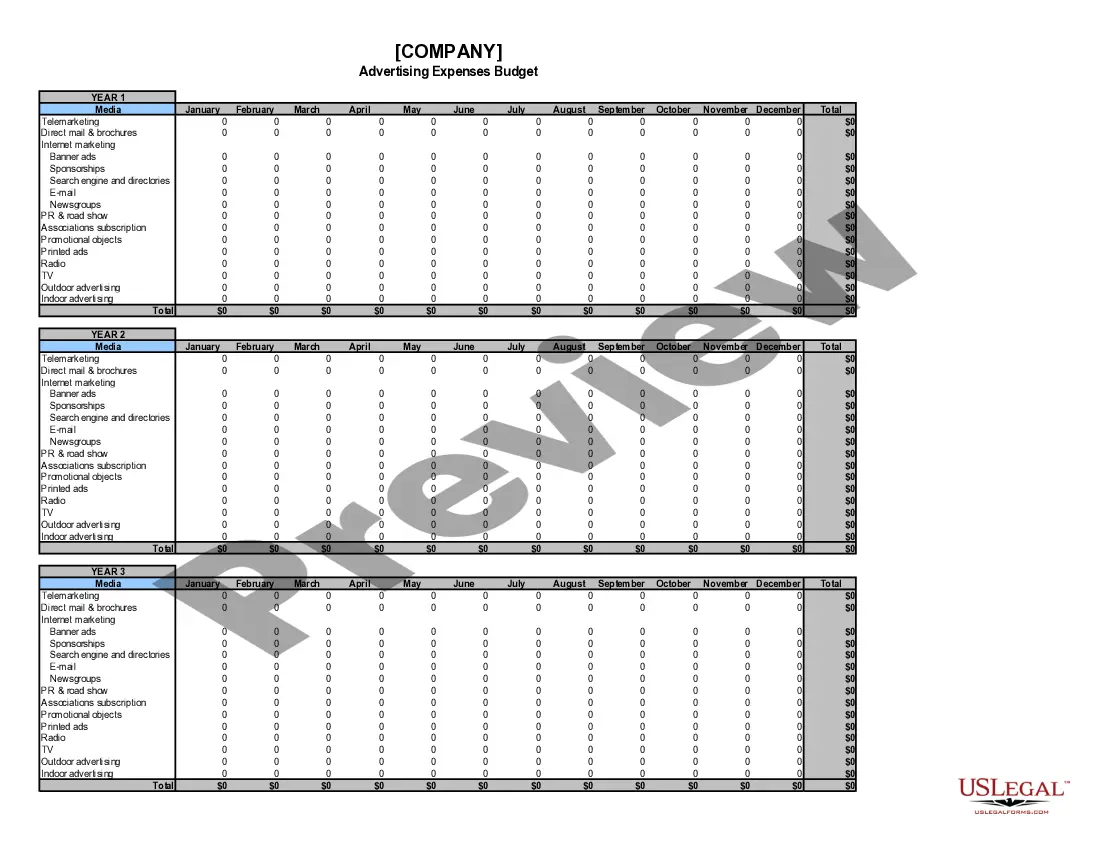
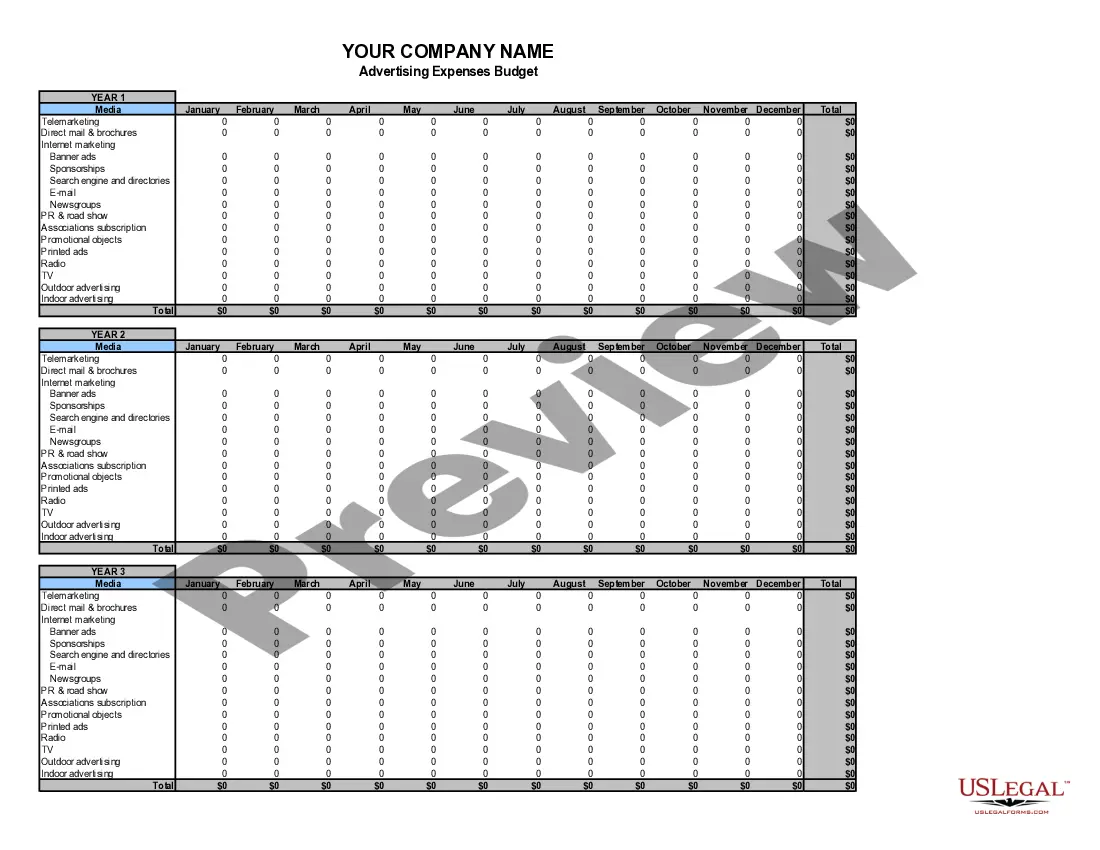
Advertising Expenses Budget
Is notarization required?
In most cases, this form does not require notarization. However, some jurisdictions or signing circumstances might. US Legal Forms offers online notarization powered by Notarize, accessible 24/7 for a quick, remote process.
Get your form ready online
Our built-in tools help you complete, sign, share, and store your documents in one place.
Make edits, fill in missing information, and update formatting in US Legal Forms—just like you would in MS Word.
Download a copy, print it, send it by email, or mail it via USPS—whatever works best for your next step.
Sign and collect signatures with our SignNow integration. Send to multiple recipients, set reminders, and more. Go Premium to unlock E-Sign.
If this form requires notarization, complete it online through a secure video call—no need to meet a notary in person or wait for an appointment.
We protect your documents and personal data by following strict security and privacy standards.

Make edits, fill in missing information, and update formatting in US Legal Forms—just like you would in MS Word.

Download a copy, print it, send it by email, or mail it via USPS—whatever works best for your next step.

Sign and collect signatures with our SignNow integration. Send to multiple recipients, set reminders, and more. Go Premium to unlock E-Sign.

If this form requires notarization, complete it online through a secure video call—no need to meet a notary in person or wait for an appointment.

We protect your documents and personal data by following strict security and privacy standards.
Looking for another form?

Form popularity
FAQ
The advertising budget of a company is based on the following factors: Type of advertising campaign that it intends to run. Selection of target audience. Type of advertising media. Company's objective of advertising.
Your advertising budget should encompass all costs associated with advertising, from start to finish. For example, production of your ad creatives includes copy, design, video production, and printing.
How to Create a Marketing Budget Set Marketing Goals & Objectives. Your goals and objectives should be SMART.Conduct Market Research.Develop Your Marketing Campaign.Choose Marketing Channels.Estimate Marketing Costs.Develop a Marketing Budget.Schedule Your Marketing Campaigns.Track Marketing Costs In Real Time.
An advertising budget is an estimate of a company's promotional expenditures over a certain time period. More importantly, it is the money a company is willing to set aside to accomplish its marketing objectives.
Start by researching your industry. In the simplest terms, your marketing budget should be a percentage of your revenue. A common rule of thumb is that B2B companies should spend between 2 and 5% of their revenue on marketing. For B2C companies, the proportion is often higher?between 5 and 10%.
Kazim says every business should follow these five steps to plan their marketing budget. Define your business strategy and marketing plan.Determine your current marketing spend.Measure the effectiveness of your spending.Optimize your efforts.Follow up and give guidance.
The U.S. Small Business Administration recommends spending 7 to 8 percent of your gross revenue on marketing source. There is also a general rule of thumb that you should aim at spending between 2-5% of your sales revenue on marketing.