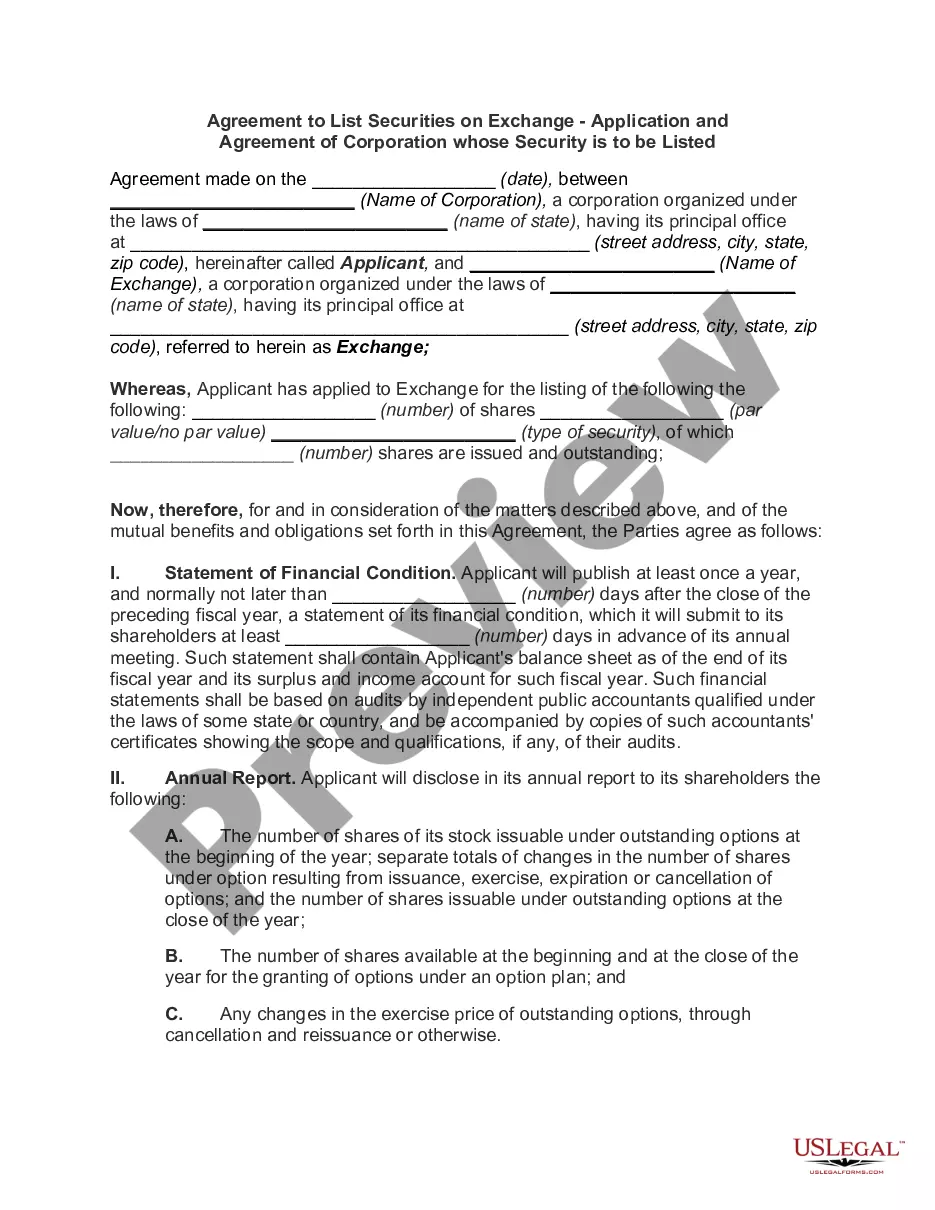
Agreement to List Securities on Exchange - Application and Agreement of Corporation whose Security is to be Listed
What is this form?
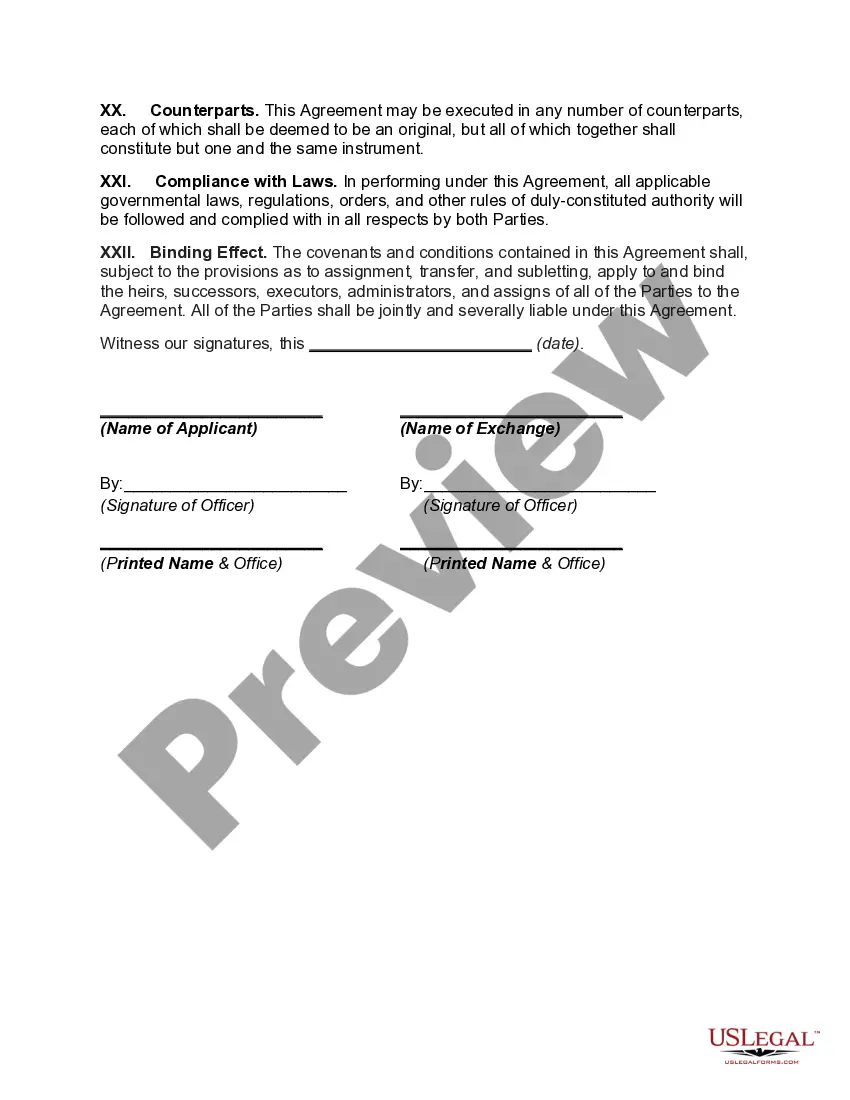
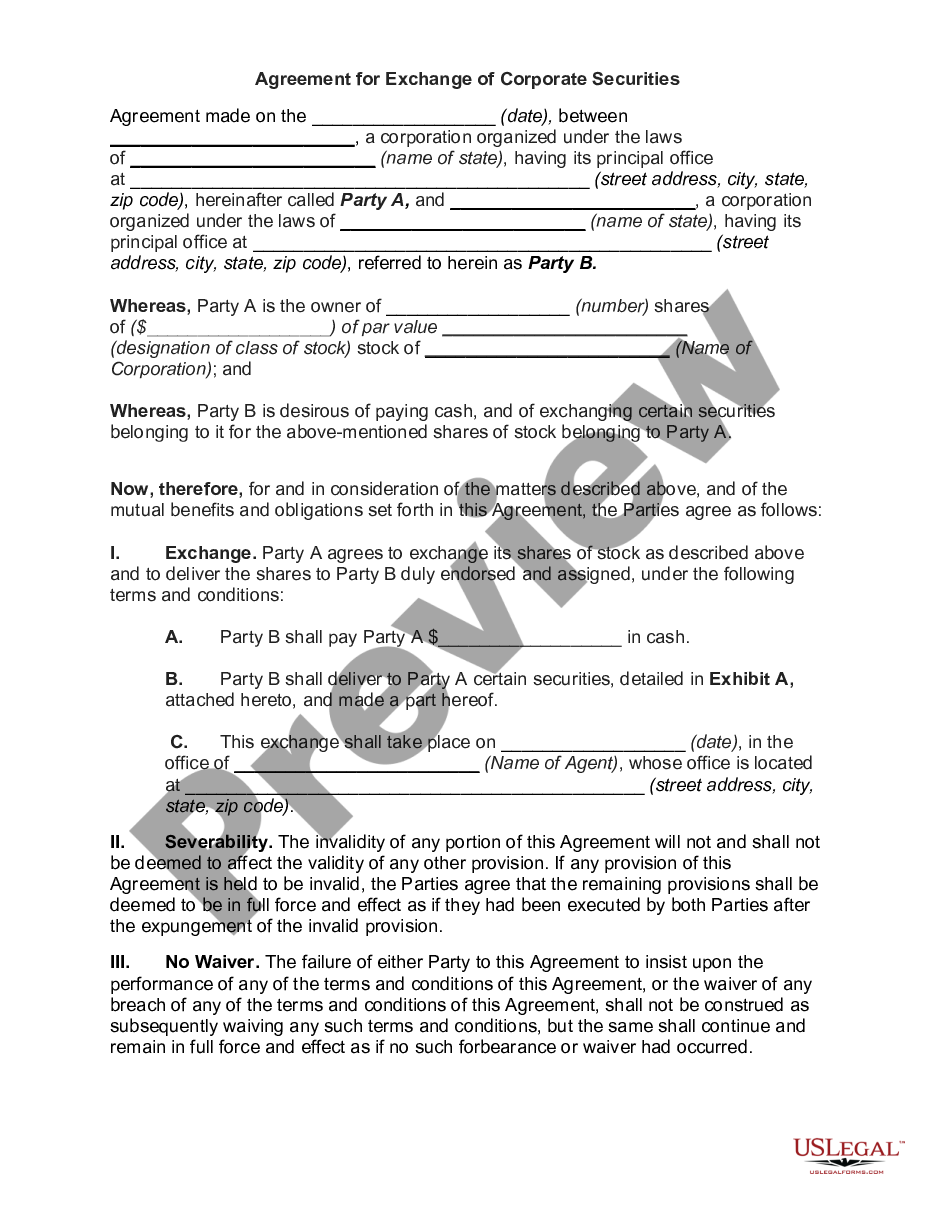
The Agreement to List Securities on Exchange is a legally binding document used by corporations to apply for the listing of their securities on a stock exchange. This form outlines the responsibilities and obligations of both the corporation (referred to as the Applicant) and the exchange. It differs from similar forms as it specifically addresses the terms for listing securities, ensuring compliance with exchange regulations while allowing for efficient trading on electronic platforms.
What’s included in this form
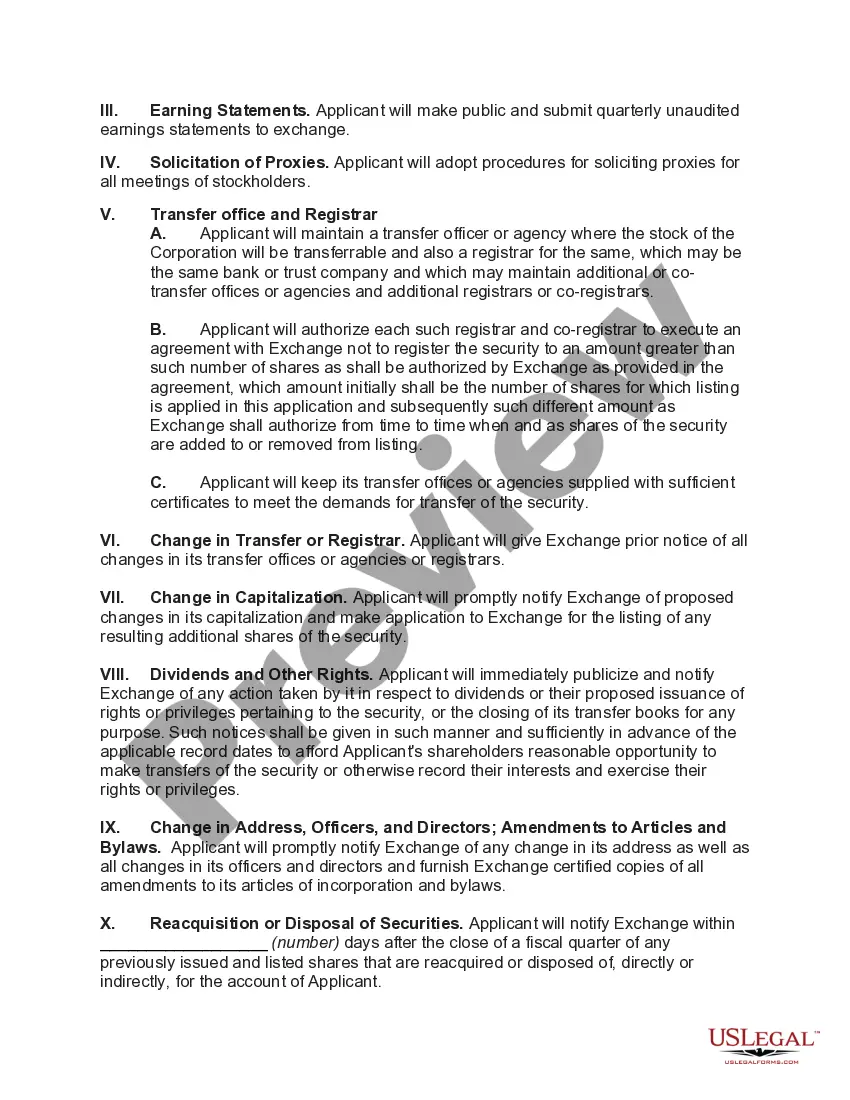
- Statement of Financial Condition: Details the annual financial disclosure requirements for the corporation.
- Annual Report Obligations: Specifies the information that must be included in the corporation's annual report to shareholders.
- Quarterly Earnings Statements: Mandates the public disclosure of unaudited quarterly earnings.
- Transfer Office and Registrar: Outlines the requirements for maintaining a transfer office and registrar for the securities.
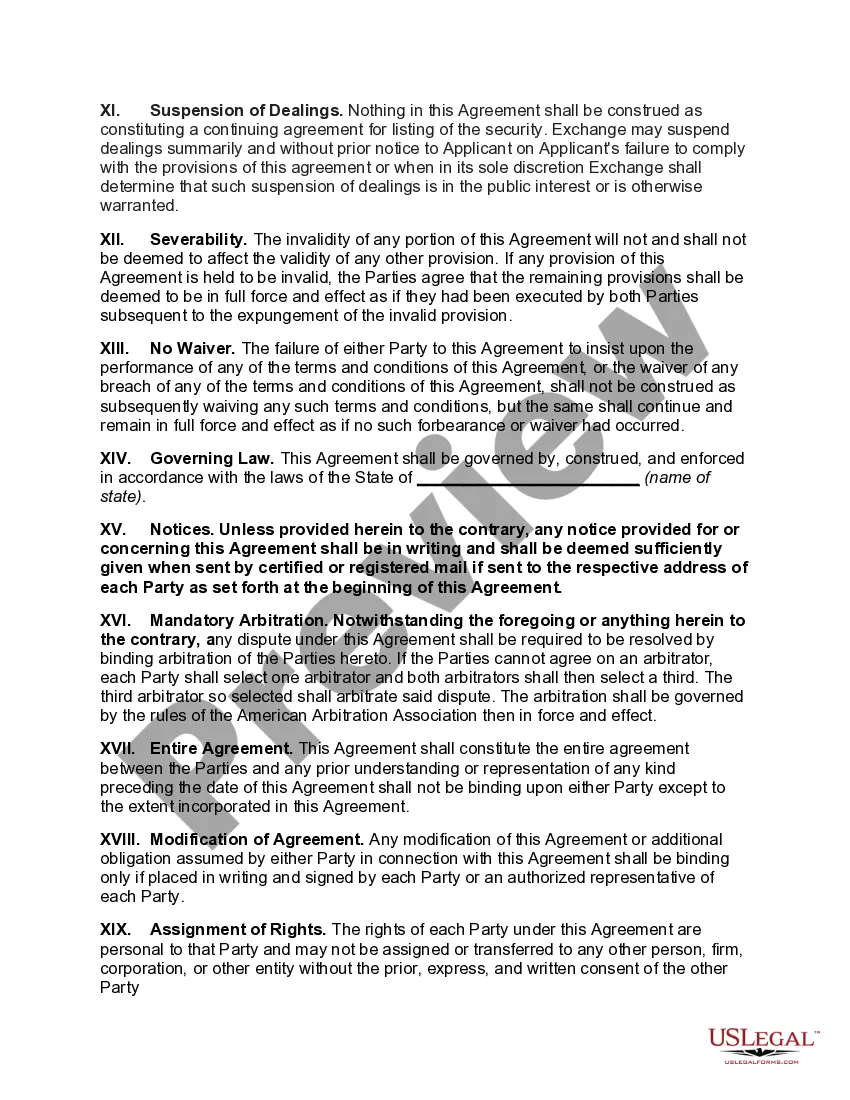
- Change Notifications: Defines the notification requirements for changes in capitalization, address, and corporate governance.
When this form is needed
This form should be used when a corporation seeks to list its securities on a stock exchange. Companies need this agreement to comply with the regulations of the exchange, ensuring that their securities can be traded publicly. It is particularly relevant during the initial public offering (IPO) process or when existing companies decide to switch or add exchanges for trading their stock.
Who can use this document
This form is intended for:
- Corporations seeking to list their securities on a stock exchange.
- Corporate compliance officers or legal representatives responsible for maintaining compliance with exchange standards.
- Investors and stakeholders looking to understand the obligations of the corporation regarding transparency and reporting.
Steps to complete this form
- Identify the parties: Fill in the names and addresses of the corporation and the exchange.
- Specify the security details: Enter the number of shares and their par value or type of security being listed.
- Complete financial disclosure requirements: Indicate deadlines for publishing financial statements and annual reports.
- Provide information on transfer offices: Document the details of the transfer office and registrar responsible for security transactions.
- Include signature information: Have authorized officers of both parties sign the agreement to finalize it.
Notarization guidance
This form does not typically require notarization unless specified by local law. However, it is advisable to consult state regulations or a legal expert if any signatures need to be notarized for compliance.
Get your form ready online
Our built-in tools help you complete, sign, share, and store your documents in one place.
Make edits, fill in missing information, and update formatting in US Legal Forms—just like you would in MS Word.
Download a copy, print it, send it by email, or mail it via USPS—whatever works best for your next step.
Sign and collect signatures with our SignNow integration. Send to multiple recipients, set reminders, and more. Go Premium to unlock E-Sign.
If this form requires notarization, complete it online through a secure video call—no need to meet a notary in person or wait for an appointment.
We protect your documents and personal data by following strict security and privacy standards.

Make edits, fill in missing information, and update formatting in US Legal Forms—just like you would in MS Word.

Download a copy, print it, send it by email, or mail it via USPS—whatever works best for your next step.

Sign and collect signatures with our SignNow integration. Send to multiple recipients, set reminders, and more. Go Premium to unlock E-Sign.

If this form requires notarization, complete it online through a secure video call—no need to meet a notary in person or wait for an appointment.

We protect your documents and personal data by following strict security and privacy standards.
Avoid these common issues
- Failing to complete all required fields, leading to an incomplete application.
- Not specifying the correct type or number of securities being listed.
- Ignoring the deadlines for financial disclosures and reports.
- Not consulting legal counsel to ensure compliance with exchange regulations.
Benefits of completing this form online
- Easy access: Download and complete the form from the convenience of your home or office.
- Editability: Easily modify the form to reflect specific company details and requirements.
- Reliability: Receive a professionally drafted template created by licensed attorneys ensuring compliance with legal standards.
Looking for another form?
Form popularity
FAQ
Mandatory Disclosures The Securities Act effectuates disclosure through a mandatory registration process in any sale of any securities. In reality, due to a number of exemptions (for trading on the secondary market and small offerings), the Act is mainly applied to primary market offerings by issuers.
The Securities Exchange Act requires disclosure of important information by anyone seeking to acquire more than 5 percent of a company's securities by direct purchase or tender offer. Such an offer often is extended in an effort to gain control of the company. If a party makes a tender offer, the Williams Act governs.
Generally, if an investment of money is made in a business with the expectation of a profit to come through the efforts of someone other than the investor, it is considered a security.
In general, all securities offered in the United States must be registered with the SEC or must qualify for an exemption from the registration requirements.
The U.S. Securities and Exchange Commission, or SEC, regulates the offer and sale of all securities, including those offered and sold by private companies.
Unless they qualify for an exemption, securities offered or sold to a United States Person must be registered by filing a registration statement with the SEC.
Clearly though the offer and sale of stock, bonds, debentures, ownership interests in limited liability companies and most notes with a maturity date over nine months are considered ?securities? (Section 3(a)(3) of the Securities Act).
The Securities Act of 1933 has two basic objectives: To require that investors receive financial and other significant information concerning securities being offered for public sale; and. To prohibit deceit, misrepresentations, and other fraud in the sale of securities.