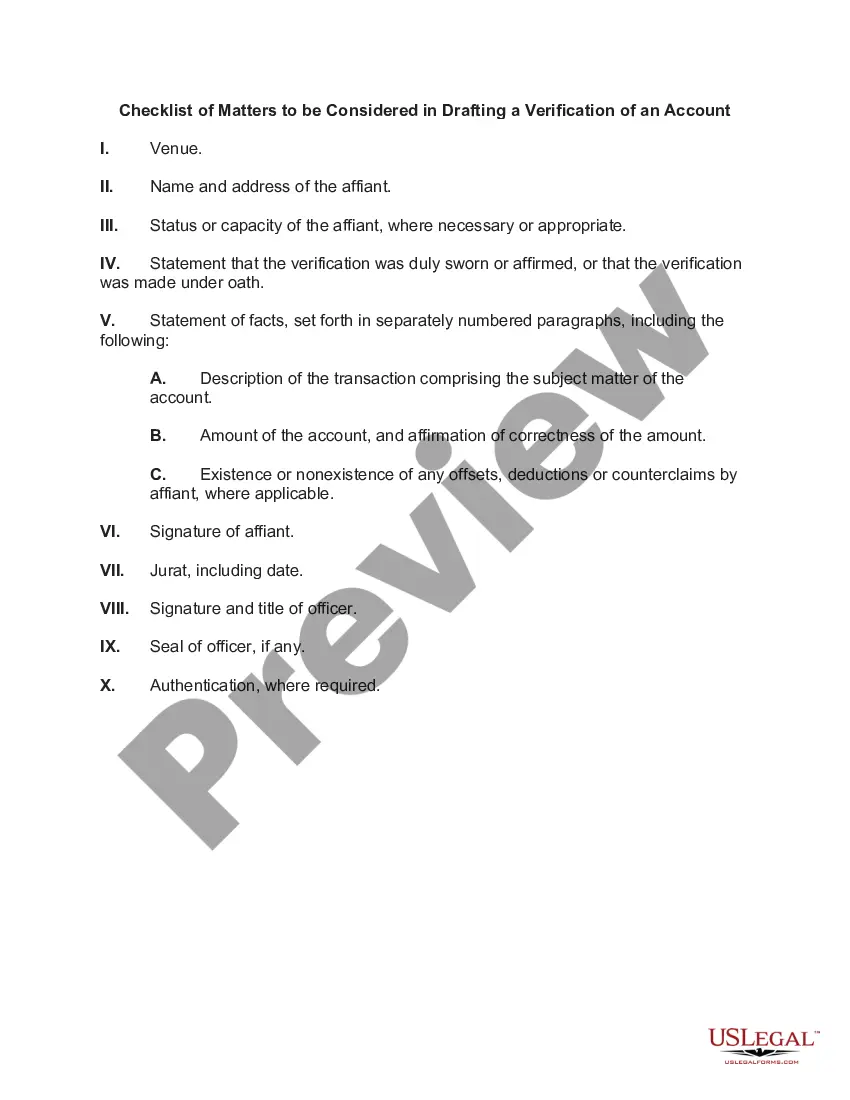
Checklist of Matters to be Considered in Drafting a Verification of an Account
What this document covers
The Checklist of Matters to be Considered in Drafting a Verification of an Account is a valuable document used to ensure that account verification meets all legal requirements. This form outlines essential information about the account owner, the account status, and the facts surrounding the account. This differs from other forms by focusing specifically on verification processes and is crucial for establishing ownership and legitimacy of the account in question.
Key parts of this document
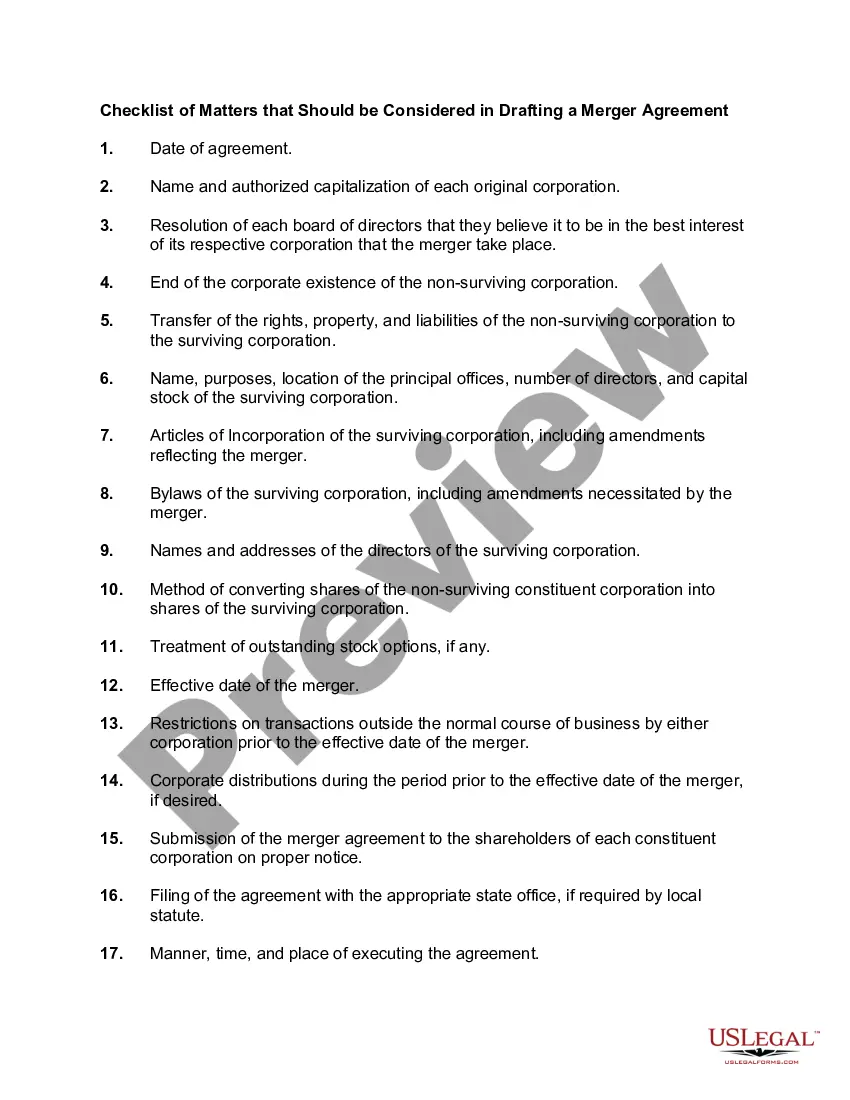
- Venue of the verification.
- Name and address of the affiant.
- Status or capacity of the affiant, if necessary.
- Statement affirming the verification was duly sworn or affirmed.
- Statement of facts including transaction description and account amount.
- Existence or nonexistence of any offsets, deductions, or counterclaims.
- Signature of the affiant.
- Jurat, including date.
- Signature and title of the officer.
- Seal of the officer, if applicable.
- Authentication, where required.
Situations where this form applies
This form is essential when you need to verify ownership of an account, especially in situations involving disputes, legal claims, or when required by financial institutions. It can be utilized by businesses or individuals to confirm the legitimacy of an account prior to entering into agreements or transactions that require such verification.
Who this form is for
- Individuals who are opening or managing a personal account.
- Business owners verifying customer or client accounts.
- Legal professionals assisting clients with financial disputes.
- Financial institutions requiring verification for compliance purposes.
Completing this form step by step
- Identify the appropriate venue for the verification.
- Provide the name and address of the affiant.
- Include the affiantâs status or capacity, if necessary.
- Include a statement affirming the verification was duly sworn, followed by the facts in numbered paragraphs.
- Ensure the affiant signs and dates the form and that an officer also signs and seals it, if required.
Notarization requirements for this form
This form does not typically require notarization unless specified by local law. However, it is essential to check jurisdiction-specific regulations to confirm if notarization is needed for legal validity.
Get your form ready online
Our built-in tools help you complete, sign, share, and store your documents in one place.
Make edits, fill in missing information, and update formatting in US Legal Forms—just like you would in MS Word.
Download a copy, print it, send it by email, or mail it via USPS—whatever works best for your next step.
Sign and collect signatures with our SignNow integration. Send to multiple recipients, set reminders, and more. Go Premium to unlock E-Sign.
If this form requires notarization, complete it online through a secure video call—no need to meet a notary in person or wait for an appointment.
We protect your documents and personal data by following strict security and privacy standards.

Make edits, fill in missing information, and update formatting in US Legal Forms—just like you would in MS Word.

Download a copy, print it, send it by email, or mail it via USPS—whatever works best for your next step.

Sign and collect signatures with our SignNow integration. Send to multiple recipients, set reminders, and more. Go Premium to unlock E-Sign.

If this form requires notarization, complete it online through a secure video call—no need to meet a notary in person or wait for an appointment.

We protect your documents and personal data by following strict security and privacy standards.
Typical mistakes to avoid
- Failing to include the full name and accurate address of the affiant.
- Not providing sufficient details about the transaction or account.
- Omitting the signature of the affiant or the verifying officer.
- Neglecting to date the jurat or include necessary seals.
Benefits of using this form online
- Convenience of downloading the form anytime, allowing you to save time.
- Editability lets you complete the form at your own pace and ensure accuracy.
- Reliability from using templates drafted by licensed attorneys, ensuring legal compliance.
Looking for another form?
Form popularity
FAQ
Carrying out activities in which it is important that no step is forgotten and / or tasks must be done in an established order. Carrying out inspections where it must be recorded what the inspected points were. Verify or examine articles.
A checklist is a standardized list of required steps developed usually for repetitive tasks. It provides several benefits. It helps people stay more organized, assuring them they will not skip any important step in the process. A checklist motivates us to take action and complete tasks.
When You Can Use a Checklist You can use a checklist in the following situations: Tasks that you need to complete in a specific order. Business Process Management. Activities that are of a series of steps, each of which is equally important.
A checklist is straightforward to use, and when used correctly, it can be a handy tool. Basically, it's a to-do list that allows you to manage your various tasks quickly and efficiently. Using a list, you can keep all the tasks and items you need to complete in one easy to access place.
Give a name to your checklist. The name of the checklist represents the purpose and use of creating it. Date / Date range. Add tasks in your checklist. Continue repeating for every task.
The Verification Process confirms that Design Synthesis has resulted in a physical architecture that satisfies the system requirements. Throughout a system's life cycle, design solutions at all levels of the physical architecture are verified to meet specifications.
Necessary trace to a user need Concise minimal Feasible attainable Testable measurable Technology Independent avoid HOW to statements unless they are real constraints on the design of the system Unambiguous Clear Complete function fully defined
Requirement Verification: the process of ensuring the requirement meets the rules and characteristics defined for writing a good requirement. The focus is on the wording and structure of the requirement.
A time-tested means of making sure nothing is forgotten in any process is a checklist (see the figure). A verification checklist will help manage all of the details that must be attended to in an SoC of any significance.