Agreement between Homeowners' Association and Individual Lot Owners for Association to Replace and Maintain Boundary Fence
Understanding this form
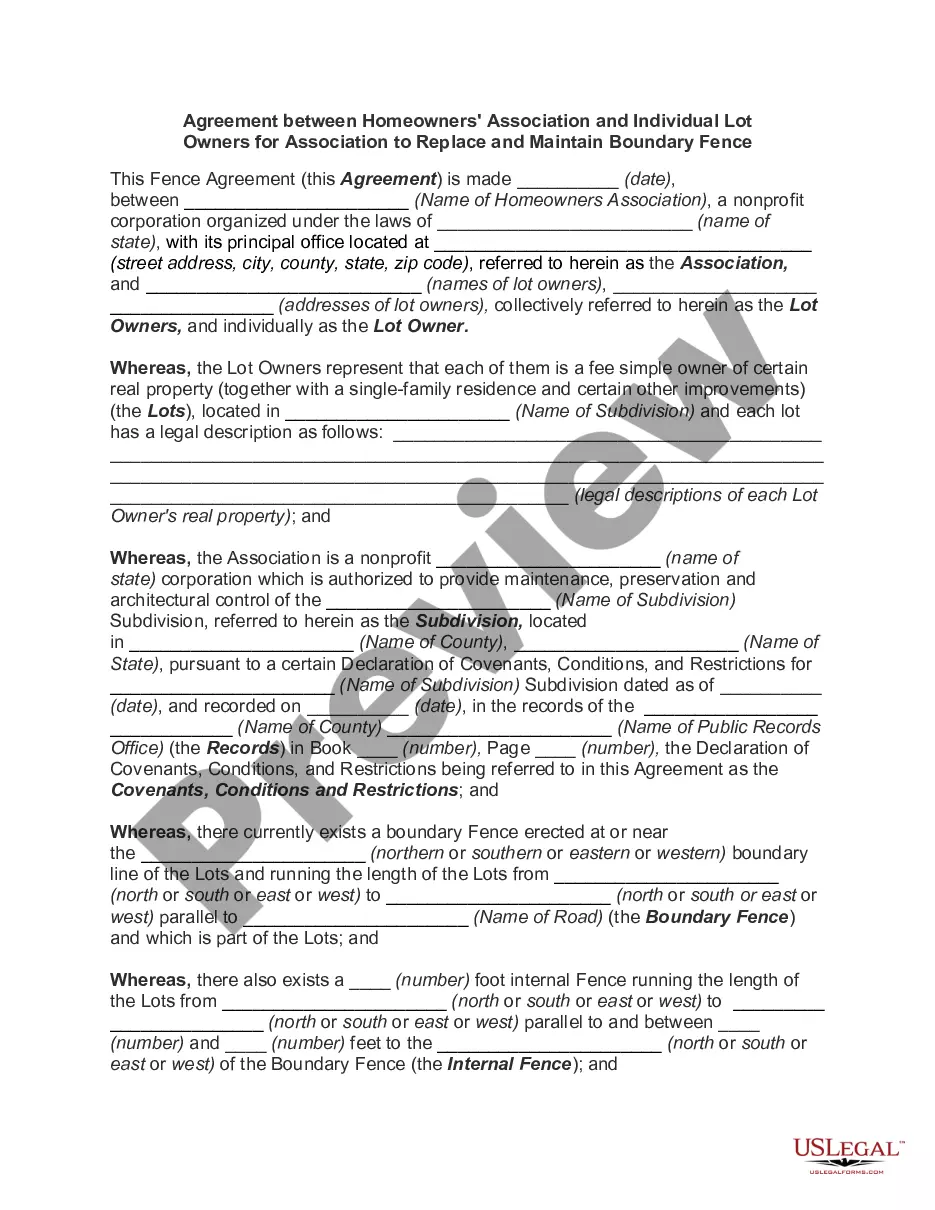
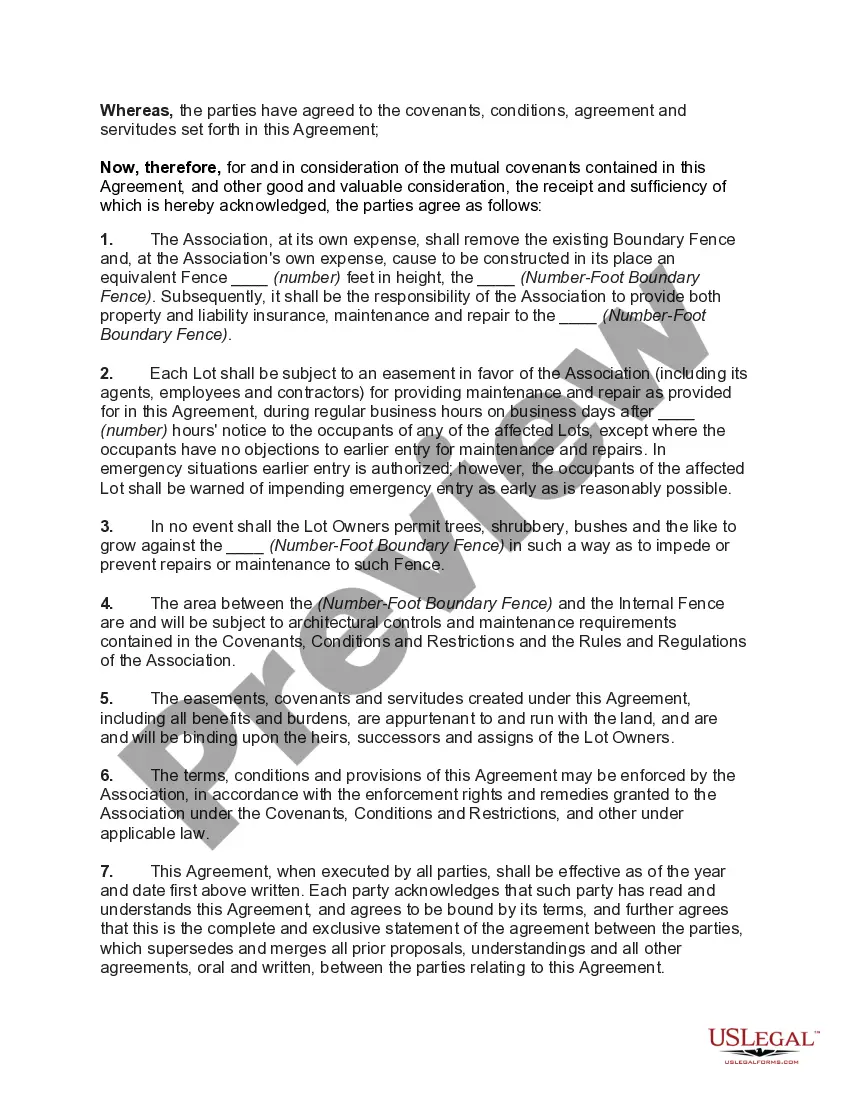
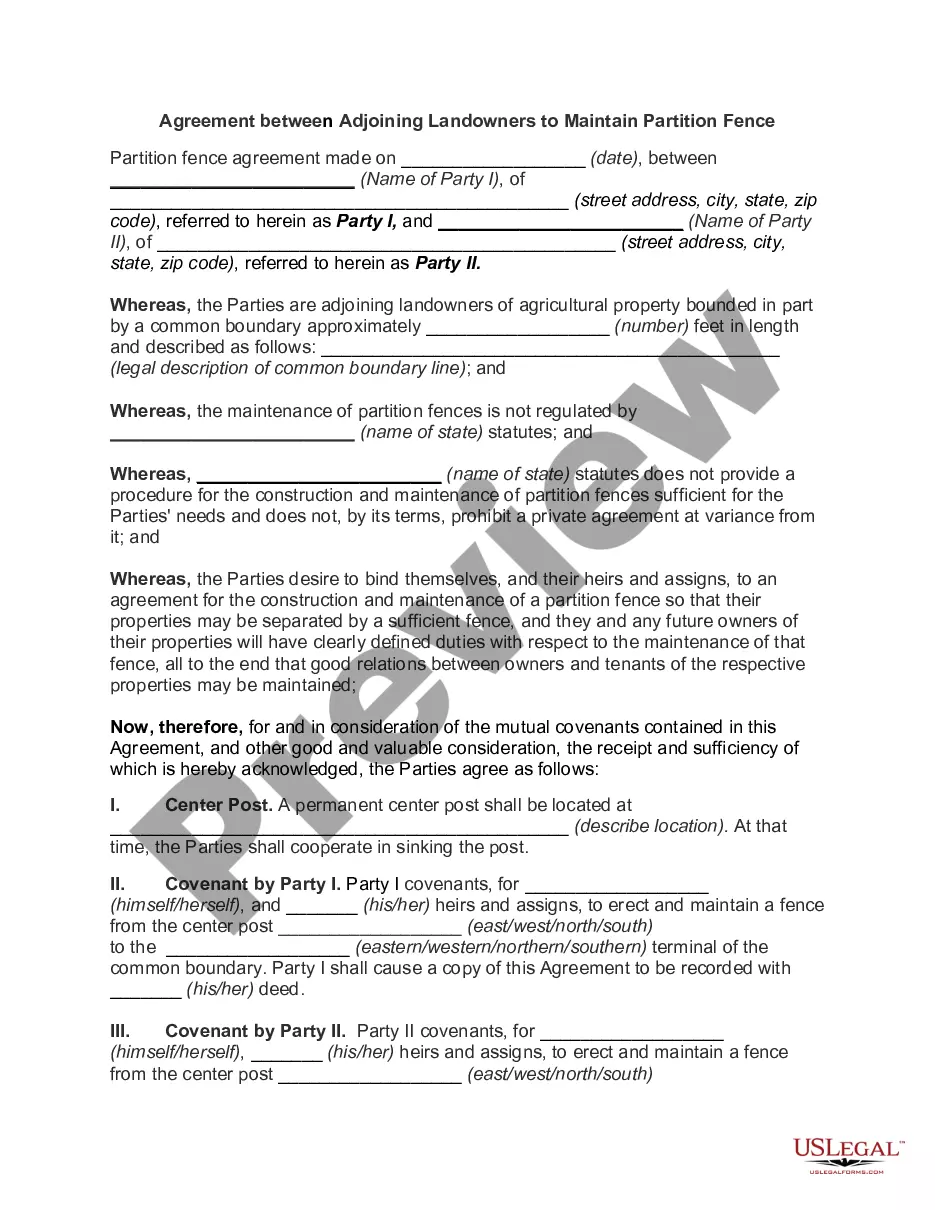
This form is an Agreement between Homeowners' Association and Individual Lot Owners for Association to Replace and Maintain Boundary Fence. It outlines the responsibilities and rights of both the homeowners' association and lot owners regarding the replacement, maintenance, and insurance of boundary fences on the property within a subdivision. This agreement is essential for ensuring that both parties understand their obligations concerning the fences that define property boundaries, promoting clarity and harmony within the community.
Key parts of this document
- Date and parties involved in the agreement.
- Legal descriptions of the properties involved.
- Details about the existing boundary and internal fences.
- Obligations of the association to replace and maintain the boundary fence.
- Easement rights for maintenance and repairs.
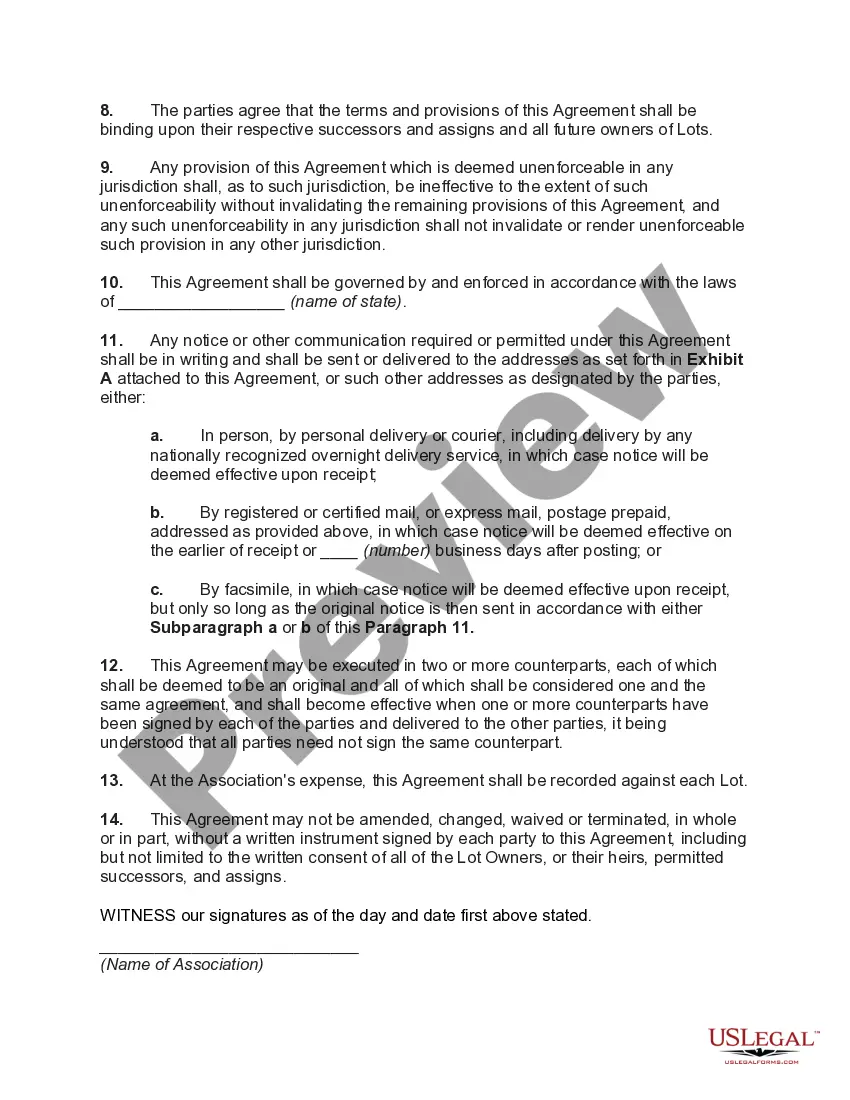
- Enforcement and governing laws applicable to the agreement.
When to use this form
This form is necessary when a homeowners' association decides to replace or upgrade an existing boundary fence that separates individual lots within a subdivision. It is particularly pertinent when there is a mutual agreement among lot owners and the association regarding maintenance responsibilities. Additionally, it should be used when there are existing covenants, conditions, and restrictions that govern property use within the subdivision.
Who can use this document
- Homeowners' associations looking to formalize their authority to manage boundary fences.
- Individual lot owners who wish to ensure their rights and responsibilities regarding boundary fences are clearly defined.
- Property managers overseeing maintenance in residential subdivisions.
How to prepare this document
- Identify and enter the date of the agreement.
- Fill in the names and addresses of the homeowners' association and individual lot owners.
- Specify the legal descriptions of each lot involved in the agreement.
- Detail the specifications of the existing and proposed fences, including height and location.
- Include the signatures of all involved parties to finalize the agreement.
Notarization requirements for this form
This form does not typically require notarization unless specified by local law. However, having it notarized can provide additional verification of the parties' identities and intent.
Get your form ready online
Our built-in tools help you complete, sign, share, and store your documents in one place.
Make edits, fill in missing information, and update formatting in US Legal Forms—just like you would in MS Word.
Download a copy, print it, send it by email, or mail it via USPS—whatever works best for your next step.
Sign and collect signatures with our SignNow integration. Send to multiple recipients, set reminders, and more. Go Premium to unlock E-Sign.
If this form requires notarization, complete it online through a secure video call—no need to meet a notary in person or wait for an appointment.
We protect your documents and personal data by following strict security and privacy standards.

Make edits, fill in missing information, and update formatting in US Legal Forms—just like you would in MS Word.

Download a copy, print it, send it by email, or mail it via USPS—whatever works best for your next step.

Sign and collect signatures with our SignNow integration. Send to multiple recipients, set reminders, and more. Go Premium to unlock E-Sign.

If this form requires notarization, complete it online through a secure video call—no need to meet a notary in person or wait for an appointment.

We protect your documents and personal data by following strict security and privacy standards.
Typical mistakes to avoid
- Failing to accurately describe the legal boundaries of the properties.
- Neglecting to specify maintenance responsibilities clearly.
- Omitting necessary signatures from all lot owners and association representatives.
Benefits of using this form online
- The form is easily accessible, allowing quick downloads for immediate use.
- Customization options are available to modify the agreement per specific conditions.
- Ensures compliance with legal standards through professionally drafted content.
Legal use & context
- This agreement is enforceable between the homeowners' association and the individual lot owners.
- Compliance with local property laws and subdivision covenants is necessary for the agreement's validity.
- It is essential for maintaining transparent communication regarding property responsibilities among all parties.
Looking for another form?
Form popularity
FAQ
If your neighbour owns the fence and it is on their property, then they can take away the wall. If your not happy with this decision then you are more than welcome to erect your fence on your boundary.
If the fence is your neighbour's responsibility2026 You should be aware that they are not legally obliged to put up a garden fence on their boundary at all. As long as there is a visible demarcation along the boundary, your neighbour could string a length of wire between some posts and call it a day.
If your neighbour owns the fence and it is on their property, then they can take away the wall.If the property is rented or council-owned enquire with them if your neighbour has removed or removing the fence and not replacing it!
Good fence etiquette means defining your property lines By law you can't install a fence on property that doesn't belong to you.
A general rule (not sure if your neighbors abide to it) is to build the fence 1-2 feet inside your property line.Your neighbors could have even blocked you from getting a fence because of easement right between yards, all things to look up before this endeavor.
Who owns the dividing fence? In most states, if you and your neighbour are both owner-occupiers, you share equal responsibility for the dividing fence on your land. Generally, that means you pay an equal share of the cost of a 'sufficient' fence. The definition of 'sufficient' differs from state-to-state.
Your neighbour doesn't have to change a wall or fence just because you want them to, for example making it higher for privacy. You can't make changes to your side without their permission, such as painting it. If the wall or fence seems dangerous, point this out because your neighbour might not be aware.
Your jurisdiction may have laws about how far back a fence needs to be set on your property, which is typically 2, 4, 6 or 8 inches from the property line. Other areas will allow you to go right up to the property line.
Assuming responsibility can be as simple as putting up a fence over the boundary and maintaining it. If both you and your neighbour have been maintaining the fence, it's now a party fence, and you are both responsible for it.